OpenAI’s move to introduce advertising inside ChatGPT marks a decisive shift in the commercial roadmap for conversational AI — a shift that turns assistants from neutral research tools into potential ad surfaces where brands can buy visibility at the exact moments users express purchase intent. This is not a hypothetical: OpenAI announced plans to begin testing ads for logged-in adults in the United States and to expand testing in the coming weeks, while also launching a lower-cost ChatGPT Go tier priced at $8 USD/month.
On January 16, 2026 OpenAI publicly outlined “Our approach to advertising and expanding access to ChatGPT,” confirming planned tests of ads in the free and Go tiers in the U.S., while committing to keep paid tiers (Pro, Business, Enterprise) ad‑free and to preserve answer independence and conversation privacy. The company framed ads as a way to subsidize access and keep the assistant broadly available.
For Windows enthusiasts, IT decision‑makers, and product teams, this moment is a test of whether the industry can build a sustainable commercial g the trust that made conversational assistants valuable in the first place. The next few months of pilots and independent audits will determine whether chat‑based advertising matures into a beneficial complement to subscriptions and enterprise revenue, or whether it becomes a cautionary tale about monetizing intimate, assistant‑like experiences.
Conclusion
The race to commercialize conversational AI through advertising has accelerated from engineering experiments to public policy and product tests. OpenAI’s announcement is the clearest signal yet that the era of ad‑free chat assistants is ending — at least for free tiers — but the path forward is narrow. The industry must prove that ads can be useful, transparent, and privacy‑preserving, or risk fragmenting user trust and damaging the very engagement advertisers hope to monetize. The coming pilots, audits, and market responses will reveal whether conversational advertising can deliver helpful discovery at scale without sacrificing the credibility that makes AI chat valuable.
Source: Management Today With ChatGPT about to open to advertising the race to commercialise AI chatbots is on in earnest
 Background
From ad‑light to ad‑enabled: the timeline so far
ChatGPT launched as an ad‑light consumer product in late 2022, monetized primarily through paid tiers and API usage. Over 2024–2025, multiple signals — including reverse‑engineered Android APK strings referencing “ads feature,” “bazaar content,” and “search ads carousel” — suggested OpenAI had been building an advertising subsystem within the ChatGPT client. Early leaks and developer sleuthing made the engineering work visible long before OpenAI published its formal policy statement.On January 16, 2026 OpenAI publicly outlined “Our approach to advertising and expanding access to ChatGPT,” confirming planned tests of ads in the free and Go tiers in the U.S., while committing to keep paid tiers (Pro, Business, Enterprise) ad‑free and to preserve answer independence and conversation privacy. The company framed ads as a way to subsidize access and keep the assistant broadly available.
Why this matters now
Running large, multimodal language models at consumer scale is expensive. Platforms are seeking diversified revenue streams to subsidize free access, maintain investment in model development, and build monetization that scales with user attention. Advertising — combined with commerce integrations — is the most familiar lever for converting massive free usage into predictable income. But putting ads into a conversational surface raises novel UX, privacy, publisher, and regulatory issues not present in classic search advertising. These trade‑offs are the regulatory and reputational battlegrounds ahead.Overview of OpenAI’s announced approach
Core commitments OpenAI published
OpenAI’s public framework emphasizes five principles: mission alignment; answer independence; conversation privacy; choice and control for users (including the ability to turn off personalization); and prioritizing long‑term value over optimizing for time spent. Practically, OpenAI says ads will be clearly labeled, separated from organic answers, and excluded from sensitive categories such as health, mental health, and politics. Ads will initially be tested for logged‑in adults in the U.S., and the company claims it will not sell conversation data to advertisers.First‑wave product hypothesis
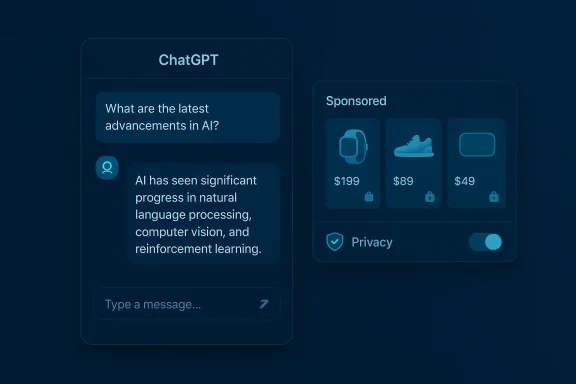
Based on the APK artifacts, OpenAI’s early ad placements are expected to be commerce‑ and retrieval‑focused: product cards (“bazaar”), search‑style sponsored carousels, and labeled sponsored follow‑ups appended to shopping or local‑services answers. This mirrors approaches already tested by Google, Microsoft, and smaller players such as Perplexity. The goal is to place ads where intent is high, making them more likely to convert while avoiding injection into casual or personal conversations. Observers also expect a period of controlled pilots before wider rollouts.Who wins — and who loses — if chat becomes an ad surface
Winners
- Advertisers and brands gain access to hyper‑contextual, conversation‑level intent. A user asking “best blender for smoothies under $150” provides a far richer signal than a keyword search, making in‑chat placements highly attractive for conversion‑focused marketers. Platforms offering in‑chat shopping and checkout can shorten conversion funnels and capture more value.
- Small businesses and emerging brands may benefit if platforms design ad formats that lower discoverability barriers and offer lower‑cost auction options than established ad ecosystems. OpenAI explicitly says ads could be transformative for smaller merchants.
- Ad tech and measurement vendors that can prove attribution from in‑chat prompts to downstream purchases will be in demand, since advertisers will want reliable evidence of conversion lift.
Losers and at‑risk groups
- Publishers and independent creators could suffer further traffic loss. If assistants synthesize answers without linking out, referral volumes to source sites decline — accelerating a “zero‑click” economy and undermining publisher economics. Some platforms (e.g., Perplexity) have responded with publisher revenue‑share programs, but that is not yet industry‑standard.
- Privacy‑conscious users may balk at personalization, especially if memory features are used for ad targeting. Even with opt‑outs promised, perception and trust matter; any misstep could drive churn.
- Regulators and consumer protection advocates will scrutinize targeting based on private conversation data and age gating, and may press for stronger transparency, auditability, and limits on personalization.
UX and trust: the hardest design problems
Labeling, separation, and clarity
Conversational UIs have far fewer natural “slots” for promotional content compared with list‑based search result pages. As a result, clear and persistent labeling is an absolute prerequisite. Ads must be visually distinct — for example, boxed product cards with “Sponsored” badges and separate CTAs — and the system must avoid weaving paid content into the narrative answer itself. OpenAI has promised such separation, but implementation details and tests will determine whether users feel manipulated or assisted.Frequency and contextual relevance
Even clearly labeled ads can degrade experience if they appear too often or in low‑relevance contexts. Platforms should implement:- strict frequency caps per session;
- high relevance thresholds before showing paid placements;
- conservative defaults for sensitive or personal prompts.
The personalization trade‑off
Personalization increases ad value but erodes privacy expectations. Chat assistants can accumulate richer, long‑lived profiles (memories) than cookies ever did. Any use of those memories for targeting must be explicit, opt‑in, auditable, and revocable. If memories are used by default for ad targeting, the reputational damage could be severe. OpenAI’s promise to let users turn off personalization and clear ad data is necessary but must be enforceable and transparent.Technical and data governance questions that need answers
- What telemetry will advertisers receive? Will they get only anonymized aggregate signals, or will message‑level metadata be shared in any form?
- Will conversation memory or long‑term profiles be used for targeting by default, or only after explicit, granular consent?
- How will ads be excluded from sensitive topics, and who audits those exclusion rules?
- What controls ensure paying subscribers and enterprise customers are genuinely access and integrations?
- How will platforms measure and certify that ads do not influence the model’s answers (answer independence)?
Competitive landscape and market implications
Microsoft and Google are already in the fight
Microsoft has been repositioning Copilot and Bing as commercialized assistants with commerce placements and contextual promotions; Google has likewise experimented with AI Overviews and ad placements in search. OpenAI’s ad play effectctively makes ChatGPT a core battleground for conversational commerce, forcing advertisers and agencies to decide where to allocate budgets across assistants, search, and social channels. Industry reaction includes public skepticism from rival leaders: Google’s AI executives have signalled caution, arguing that ads inside assistants could erode trust.New monetization models for publishers and content owners
As assistants suppress referral traffic, publishers must negotiate new models: API licensing, revenue‑share programs, or embedding paywalled content that demands direct access. Some platforms (notably Perplexity) are experimenting with revenue‑share programs that return a portion of ad revenue to cited publishers; whether this becomes widespread will influence the sustainability of newsrooms and niche vertical sites.Practical guidance for IT leaders, product managers and advertisers
For IT and enterprise buyers
- Treat consumer assistants and enterprise assistants as different risk categories; require written contractual guarantees that enterprise and employee instances will not show consumer ads.
- Update data‑processing agreements and SLAs to explicitly prohibit conversation data from being used for ad targeting unless explicitly consented to.
- Run conservative pilots for assistant integrations and require tamper‑evident audit logging and separation of ad telemetry from enterprise data flows.
For product and UX teams at platforms
- Prioritize unambiguous labeling, frequency caps, and context gating.
- Provide easy, visible controls for personalization and the ability to clear ad data.
- Publish audit results and allow third‑party attestation for privacy claims.
For advertisers and agencies
- Design in‑chat creative that genuinely helps the user — quick product compariso or friction‑reducing checkout flows — rather than generic promotional copy.
- Demand measurement and fraud protections that attribute conversions reliably from chat‑initiated journeys.
- Be mindful of brand safety: avoid categories and moments where a or exploitative.
Risks, unknowns and unverifiable claims
- Claims about OpenAI’s multi‑year compute commitments “exceeding $1 trillion” are widely circulated as industry estimates and should be treated with caution; they are not publicly audited figures. Public statements about infrastructure cost pressures are credible, but aggregate dollar figures vary by analysis and are not fully verifiable in public filings.
- APK leaks provide high‑confidence signals of engineering direction, but they do not prove final product behavior, ad targeting mechanics, auction rules, or rollout timelines. Early code strings are best read as product intent, not as the final UX.
- OpenAI’s promise not to sell conversation data to advertisers and to keep paid tiers ad‑free are policy commitments; the enforceability of those promises depends on implemented technical and legal controls and on independent audits. Until those controls are visible and auditable, these remain company assurances rather than verifiable guarantees.
Scenario modelling: three plausible outcomes
- Conservative pilot and measured rollout (best case)
- Ads confined to clear commerce/search flows, robust labeling and opt‑outs implemented, publishers receive some revenue share or attribution, and user trust remains stable. This outcome preserves subscription economics while adding ad revenue to subsidize free tiers.
- Aggressive monetization with weak controls (worst case)
- Ads infiltrate general conversation, personalization uses memory without clear consent, publishers see major traffic declines, regulatory scrutiny intensifies, and user churn grows among privacy‑sensitive cohorts. Rebuilding trust would be slow and costly.
- Hybrid ecosystem emerges (likely intermediate)
- Different assistants adopt divergent approaches: some prioritize privacy and ad‑free premium tiers, others pursue commerce‑first ad plays. Advertisers allocate budgets across multiple assistants, publishers diversify revenue and pursue direct partnerships. This fragmentation increases complexity but creates market opportunities for specialized, privacy‑first providers.
What to watch next — concrete signals and dates
- Monitor OpenAI’s planned tests in the U.S. and subsequent documentation for exactly how ads are labeled, where they appear, and what telemetry advertisers receive. The company said testing would begin “in the coming weeks” from the January 16, 2026 announcement; the timing and scale of those tests will indicate product intent versus experiment.
- Look for third‑party audits or independent attestations about data use and memory‑based personalization; these will be critical to validate privacy promises.
- Track publisher and platform partnership announcements (revenue‑share programs, API licensing). If platforms begin signing publishers to revenue deals, that signals the economics are being shared more broadly.
- Watch regulatory interest from privacy and consumer protection authorities, particularly around targeted advertising using conversational data and age‑gating enforcement. Public inquiries or guidance will materially shape rollout strategies.
Final analysis: opportunity with caveats
The commercialisation of AI chatbots through advertising is both inevitable and fraught. The economics that make ads attractive are real: conversational AI captures rich intent signals and can convert discovery into purchase far more efficiently than traditional display inventory. OpenAI’s stated approach — testing ads in commerce contexts, promising separation of ads and answers, offering paid ad‑free tiers, and giving users control over personalization — outlines a workable framework on paper. However, execution is everything. The user experience depends on clear labeling, conservative placement, meaningful consent, and legal enforceability of privacy promises. Publishers face a real existential risk unless platforms offer credible revenue alternatives or fair attribution. Advertisers must resist the temptation to prioritize short‑term conversion over long‑term trust. Regulators will not be passive if targeting crosses privacy red lines or if ad placements target vulnerable groups.For Windows enthusiasts, IT decision‑makers, and product teams, this moment is a test of whether the industry can build a sustainable commercial g the trust that made conversational assistants valuable in the first place. The next few months of pilots and independent audits will determine whether chat‑based advertising matures into a beneficial complement to subscriptions and enterprise revenue, or whether it becomes a cautionary tale about monetizing intimate, assistant‑like experiences.
Conclusion
The race to commercialize conversational AI through advertising has accelerated from engineering experiments to public policy and product tests. OpenAI’s announcement is the clearest signal yet that the era of ad‑free chat assistants is ending — at least for free tiers — but the path forward is narrow. The industry must prove that ads can be useful, transparent, and privacy‑preserving, or risk fragmenting user trust and damaging the very engagement advertisers hope to monetize. The coming pilots, audits, and market responses will reveal whether conversational advertising can deliver helpful discovery at scale without sacrificing the credibility that makes AI chat valuable.
Source: Management Today With ChatGPT about to open to advertising the race to commercialise AI chatbots is on in earnest