

OpenAI’s new "agent mode" marks a decisive step toward making ChatGPT not just a conversational assistant but an active, autonomous collaborator that can research, plan, and execute multi-step tasks on behalf of users — a capability now rolling out in stages to paid subscribers and integrated into OpenAI’s new Atlas browser for preview on premium tiers.
The shift from reactive chatbots to agentic AI — systems that can take actions, call external tools, and carry out workflows autonomously — has been accelerating through 2024 and 2025. OpenAI’s public announcements describe a unified agentic system that combines prior building blocks (Operator-style web interaction, Deep Research synthesis, and ChatGPT’s conversational reasoning) into a single experience that uses a virtual computer to navigate websites, run code, and assemble deliverables like slides and spreadsheets. This move follows a broader industry trend: major cloud and AI vendors are adding agent-like features to platforms, and analysts warn that the enterprise adoption curve will be steep but uneven. Research firms place large, diverging bets on the market opportunity — from niche billion-dollar estimates to forecasts of hundreds of billions over the next decade — underscoring both the economic potential and the forecasting uncertainty that surrounds agentic systems.
Source: Blockchain News OpenAI Launches Agent Mode in ChatGPT: AI Research and Planning Now Available for Plus, Pro, and Business Users | AI News Detail
 Background
The shift from reactive chatbots to agentic AI — systems that can take actions, call external tools, and carry out workflows autonomously — has been accelerating through 2024 and 2025. OpenAI’s public announcements describe a unified agentic system that combines prior building blocks (Operator-style web interaction, Deep Research synthesis, and ChatGPT’s conversational reasoning) into a single experience that uses a virtual computer to navigate websites, run code, and assemble deliverables like slides and spreadsheets. This move follows a broader industry trend: major cloud and AI vendors are adding agent-like features to platforms, and analysts warn that the enterprise adoption curve will be steep but uneven. Research firms place large, diverging bets on the market opportunity — from niche billion-dollar estimates to forecasts of hundreds of billions over the next decade — underscoring both the economic potential and the forecasting uncertainty that surrounds agentic systems. What exactly is "agent mode"?
The user-facing definition
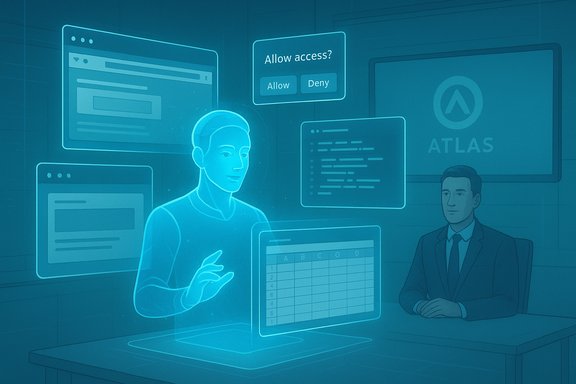
Agent mode is the label OpenAI uses for ChatGPT’s ability to perform multi-step tasks with a degree of autonomy. In practice, that means a user can ask ChatGPT to "research X, summarize findings, create a slide deck, and draft an outreach email," and the system will take multiple actions — browsing sites, extracting facts, running computations in a sandboxed virtual machine, and producing editable outputs — while requesting permission before any action that has direct consequences (e.g., placing orders, booking tickets). OpenAI positions this as an "agent that works for you, with you."The architectural baseline (verified)
OpenAI’s published technical description confirms several consistent elements that underpin agent mode:- A virtual computer / sandboxed environment where the agent can open web pages, run code, and manipulate files in a controlled manner.
- A model layer that integrates reasoning chains with tool-calling APIs (search, browser navigation, code execution, document editors).
- A safety stack that includes permission prompts, action confirmations, and the option for users to interrupt or take back control at any time.
Timeline and availability — clarifying the rollout
- OpenAI introduced the core product known as ChatGPT agent in mid‑July 2025, describing the underlying agentic model and its capabilities. Access initially targeted paid tiers and developer previews.
- In October 2025 OpenAI unveiled ChatGPT Atlas, an AI-powered browser that embeds ChatGPT directly into the browsing experience; Atlas includes a contextual sidebar, browser memory features, and Agent Mode as a heavy-lift capability currently available in preview to premium subscribers (Plus, Pro, Business/Team tiers). Early press coverage dates Atlas’ launch and the agent-mode preview to October 21–22, 2025.
- Availability differs by plan and geography. OpenAI’s product notes and independent reports make clear that agent features are rolling out progressively to Pro, Plus, Team/Business subscribers and that enterprise/education availability may follow. Reported limitations and regional rollouts mean some users will see delays or restrictions based on regulatory considerations.
How agent mode works — a technical look
Core components
- Model + planner: a large language model (OpenAI refers to models like GPT‑4o and specialized
agentmodels) makes high‑level decisions about what steps to take, when to call tools, and how to decompose tasks into subtasks. - Tooling layer: APIs for web browsing (Operator-style), document editors (generate slides, spreadsheets), code execution (sandboxed terminal), and external connectors (calendar, Slack, CRM) let the agent interface with real systems.
- Execution sandbox: actions that need execution run in a controlled virtualized environment that restricts what the agent can access and prevents unauthorized persistence or system-level changes.
- Permission & control loops: the agent asks for permission before "actions of consequence," logs actions, allows user interruption, and exposes an audit trail for enterprise governance.
Verified capabilities and limits
OpenAI’s documentation and press testing confirm the agent can:- Navigate and summarize web content, extracting structured facts.
- Create editable deliverables (slide decks, spreadsheets) from gathered data.
- Run code for data analysis inside the sandbox, then present results.
Business implications — where agent mode helps, and where it doesn’t
Concrete productivity gains (verified claims and caution)
Vendors and analysts forecast significant productivity improvements from agentic AI. Multiple analyst summaries suggest that agentic capabilities will be integrated into a large share of enterprise apps within a few years, and early adopters report measurable efficiencies in targeted workflows. For example, Gartner projects a rapid integration of agents across enterprise applications and highlights both opportunity and risk in fast adoption. That said, specific percentages placed in conversational summaries vary by source and often reflect marketing or context‑specific pilots. Some vendors have presented optimistic productivity figures (for example, vendor or sector-specific studies claiming up to ~40% improvements in discrete tasks), but these are not universal guarantees and depend heavily on use case, data quality, governance, and integration. The claim that "organizations adopting AI agents could see productivity gains of up to 40 percent by 2027" is plausible in targeted workloads but should be treated as a possible outcome rather than an industry‑wide baseline — it is not a single, universally validated industry standard. Independent verification shows a mix of promising pilot results and cautionary notes about projects stalling or being canceled.Monetization and product strategy
- Subscription expansion: OpenAI’s decision to gate advanced agent features to Plus, Pro, and Business users is designed to monetize higher tiers while limiting early exposure. Enterprises will likely pay for custom integrations, higher usage tiers, and governance tooling.
- Ecosystem opportunities: Agents that integrate with CRMs, ERPs, and collaboration tools can be embedded by ISVs to add action automation to existing workflows — a fertile avenue for partnerships.
- SMB impact: Small and medium businesses could access high-end automation capabilities previously only affordable via consultants, potentially disrupting legacy professional services. However, measurable ROI requires sensible scoping and human oversight.
Implementation realities (short list)
- Integration complexity (APIs, data mapping, SSO)
- Governance and compliance overhead (logging, explainability, audit trails)
- Operational costs (API usage, compute, storage, observability)
- Human-in-the-loop design for high-risk decisions
Market sizing and forecasts — what the data says (and where it diverges)
Forecasts for the "AI agent" or "agentic AI" market vary significantly by firm and scope:- Precedence Research and several syndicated industry reports forecast multi‑billion dollar markets growing quickly into the 2030s, with some estimates projecting AI agent markets in the tens to hundreds of billions by the early 2030s. These reports highlight steep CAGRs reflecting rapid demand but also depend on broad definitions of "agents."
- Other market trackers (Valuates, MarkNtel, Market.us) present different timelines and end figures — for example, certain PR‑distributed forecasts project market sizes of roughly $15B by 2031 or many times that by 2034 — reflecting differing base years, market definitions, and inclusion/exclusion of adjacent software categories.
- Analyst firms such as Gartner and IDC are less likely to publish simple headline market numbers publicly but instead emphasize adoption rates and strategic impact; Gartner’s public commentaries forecast that a high proportion of enterprise applications will embed agent features within a few years and warn that many early projects will fail without proper governance.
Risks, safety, and regulatory landscape
Safety and governance (what OpenAI says)
OpenAI highlights layered safety mechanisms for agent mode: permission prompts, execution sandboxes, action logging, and limits around sensitive site interactions. The company also acknowledges limitations and ongoing development needs in its product materials. These are explicit product design decisions meant to reduce misuse, data leakage, and unsafe actions.Regulatory obligations (verified)
The EU’s Artificial Intelligence Act — now adopted as Regulation (EU) 2024/1689 — establishes a risk‑based compliance regime for AI systems, with transparency obligations for generative systems and stricter rules for high‑risk applications. Agentic systems that operate in regulated domains (healthcare, finance, critical infrastructure) may trigger higher compliance requirements, and providers or deployers should be prepared for conformity assessments and reporting obligations under EU rules. Many organizations building or deploying agents must therefore bake compliance into design and deployment.Operational and security risks
- Data privacy: Agents that access calendars, emails, or CRM data increase the attack surface for PII leakage or insider exposure. Enterprises must enforce least‑privilege and robust encryption.
- Hallucination & correctness: Agents that synthesize research and then act on it can propagate errors; mitigation requires reliable retrieval sources, RAG (retrieval‑augmented generation) designs, and human review on critical outputs.
- Agent sprawl: Gartner warns of "agent sprawl" and project cancellations due to unmanaged complexity, rising costs, and unclear business value — organizations must adopt governance and observability frameworks before scaling.
Ethical considerations
- Transparency about when actions are automated is essential for user trust.
- Bias detection and mitigation remain mandatory for any agent that influences decisions affecting people.
- Audit trails and explainability tools should be integrated from day one to support compliance and incident response.
Competitive landscape
OpenAI’s agent push sits alongside parallel efforts from major vendors:- Google/DeepMind: experimenting with agent architectures and integrations into search and Workspace.
- Microsoft: embedding agentic features into Copilot and Microsoft 365, with enterprise connectors to Azure and GitHub.
- Anthropic, Meta, and emerging startups: building alternative agent frameworks and developer toolchains.
Practical guidance — how businesses should approach agent mode now
- Pilot with clear KPIs: start with small, measurable tasks (meeting prep, competitor scans, draft generation).
- Build governance before scale: identity controls, permissioning, logging, and periodic audits.
- Use RAG and trusted sources for fact‑heavy tasks; require human sign‑off for consequential actions.
- Monitor cost and observability: API usage and sandbox compute are real recurring costs.
- Invest in explainability: capture the decision chain and tool calls so humans can reconstruct what the agent did.
Integration examples — realistic short wins
- Sales operations: automate lead enrichment by having an agent compile public company data, summarize product fit, and populate CRM fields (with a human gating step).
- Marketing research: use agents to scan customer reviews, competitor pages, and industry news to produce a 1‑page brief and initial slide deck.
- Legal & compliance: agents can pre‑screen contracts to flag high‑risk clauses but not finalize approvals without lawyer review.
What remains uncertain (and where to watch)
- Long‑term reliability: agentic systems show promise, but many enterprise pilots stall; Gartner publicly predicts a meaningful failure/cancellation rate for early projects, underscoring the need for careful ROI tracking and governance.
- Pricing evolution: OpenAI’s initial gating to premium tiers is a commercial lever; how pricing evolves as agent usage scales will materially shape adoption scenarios.
- Standardization & interoperability: the market lacks mature standards for agent observability, tool calls, and audit formats; expect standards bodies and commercial observability vendors to converge here in the next 12–24 months.
Future outlook — a balanced forecast
Agentic AI will become a core productivity layer for knowledge work, but not overnight. The near‑term (12–36 months) will be dominated by carefully scoping pilot projects that demonstrate measurable ROI in targeted workflows. Over the medium term (3–5 years), expect:- Broad embedding of task‑specific agents inside enterprise apps.
- Emergence of standard observability and governance platforms for agent fleets.
- Growing regulatory scrutiny and regionally differentiated rollouts (notably in the EU).
Conclusion
OpenAI’s agent mode is a material evolution for ChatGPT: it transforms the service from an advanced co‑pilot into an execution engine capable of autonomous, multi‑step task completion within a controlled environment. The feature’s staged rollout to Plus, Pro, and Business tiers and its integration into the Atlas browser demonstrate a pragmatic commercialization strategy that balances capability, monetization, and early safety controls. For businesses, the opportunity is real: agentic tools can compress research-to-action cycles, lower costs for repeatable knowledge work, and extend small teams’ reach. But the path to sustainable value is narrow: success requires disciplined pilot design, robust governance, and an observability-first approach to avoid the well‑documented pitfalls of early agentic programs. Analyst forecasts and market estimates underscore the high stakes and large rewards — but also the substantial variation in outcomes depending on how organizations manage technical, regulatory, and operational risk. Cautionary note: some numerical market forecasts and productivity percentages cited across vendor and media reporting vary widely and reflect differing methodologies. Where an exact number matters for procurement or board decisions, organizations should request underlying methodology from the analyst or vendor and validate assumptions against their own workload metrics. OpenAI’s agent mode is not a panacea, but it is a clear inflection point: the next 12–24 months will reveal whether agentic systems mature into reliable productivity multipliers or become another generation of ambitious but under‑governed pilots. The prudent course for IT leaders is to experiment fast, govern tightly, and measure relentlessly.Source: Blockchain News OpenAI Launches Agent Mode in ChatGPT: AI Research and Planning Now Available for Plus, Pro, and Business Users | AI News Detail
