

OpenAI’s latest moves — from model refinements and agent primitives to hardware partnerships and a fresh vision for how people interact with software — are poised to reshape what an app is and how designers think about user interfaces, accessibility, and platform strategy.
OpenAI’s product roadmap in late 2025 and early 2026 shows a coordinated push across model capabilities, developer primitives, and product surfaces that turns conversational AI from a “feature” into a platform-level interaction model. That evolution includes the GPT‑5.1 family (with Instant and Thinking variants), new developer tools that let models propose and enact changes, expanded personalization and memory features in ChatGPT, and early experiments with shared/group chat experiences and hardware concepts. These developments are not isolated product refinements — they are the scaffolding for a different class of human–computer interaction where agents (AI systems that can plan, act, and automate) mediate many classic UI tasks. Multiple reporting threads and product summaries confirm the staged rollout of GPT‑5.1 in November 2025, the introduction of agent primitives, and broader productization efforts.
Designers and product leaders must now resolve a series of trade-offs:
For designers, engineers, and IT leaders, the immediate imperative is pragmatic: pilot agentic features with strict safety gates, preserve baseline accessibility and semantics, make memory and personalization transparent, and design capability signals so users understand what their device and app can — and cannot — do. Those actions will determine whether the agent revolution augments usability for everyone, or accelerates new forms of fragmentation and exclusion. The next few product cycles will show whether this approach becomes a robust platform model or a costly experiment in poor UX disguised as innovation.
Source: Fast Company https://www.fastcompany.com/91459774/openai-might-change-app-design-forever/
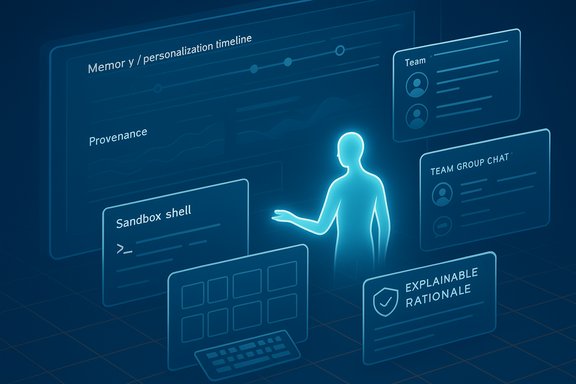 Background
OpenAI’s product roadmap in late 2025 and early 2026 shows a coordinated push across model capabilities, developer primitives, and product surfaces that turns conversational AI from a “feature” into a platform-level interaction model. That evolution includes the GPT‑5.1 family (with Instant and Thinking variants), new developer tools that let models propose and enact changes, expanded personalization and memory features in ChatGPT, and early experiments with shared/group chat experiences and hardware concepts. These developments are not isolated product refinements — they are the scaffolding for a different class of human–computer interaction where agents (AI systems that can plan, act, and automate) mediate many classic UI tasks. Multiple reporting threads and product summaries confirm the staged rollout of GPT‑5.1 in November 2025, the introduction of agent primitives, and broader productization efforts.Why Fast Company’s “OpenAI might change app design forever” is credible — and important
Fast Company’s framing captures a broader industry trend: apps are no longer just screens users manipulate directly. Instead, they become capabilities that agents call upon or orchestrate within larger workflows. That shift is supported by two concrete technical patterns in OpenAI’s announcements and adjacent platform changes:- Agent primitives and tooling — new APIs and tools (for example, structured patching and controlled shell interactions) let models produce effectful actions, not just text outputs. These primitives change integration patterns between AI and apps from “suggest and copy” into “propose and apply,” enabling more seamless automation across file systems, repositories, and application surfaces.
- Adaptive runtime behaviour — GPT‑5.1’s Instant vs Thinking split and the reasoning_effort controls let hosts trade latency for deliberation. That makes it feasible to embed AI into real‑time UI flows without forcing a single latency/quality compromise across every interaction.
What’s changing in practice: key product and design shifts
From UI-first to agent-first interaction
Traditional app design focuses on visible affordances — buttons, menus, dialogs — that a human reads and manipulates. An agent-first world reorders this:- Users express intents (explicitly or by delegating) and the agent chooses the apps, APIs, and internal steps to fulfil them.
- The visible UI’s role becomes one of signaling, auditing, and intervening rather than being the primary action surface.
- Designers will reallocate effort: fewer pixels to craft menus, more attention to intent specification, feedback channels, undo/visibility, and provenance.
Agents change the cost model of design
Design touches shift from fixed assets (icons, layout grids) to dynamic affordances (how an agent represents choices, explains rationale, and recovers from errors). For example:- A “Save” button’s semantics widen: did the agent save locally, push to cloud, or create a draft with collaborator comments?
- Visual design must encode trust signals — provenance, confidence, and the ability to revert automated actions.
Personalization and memory as interface design levers
OpenAI has been shipping memory and personalization features that let models retain user context and preferences. That capability changes onboarding, discoverability, and long-term UX:- Apps can be designed to lean on memory: fewer repeated preferences, more anticipatory features.
- Designers must expose and control memory boundaries in the UI, offering clear opt-outs and localized consent screens for different data scopes.
Technical context: what OpenAI (and partners) delivered and why it matters
GPT‑5.1: Instant vs Thinking, and the reasoning_effort control
GPT‑5.1 is positioned as a refinement rather than a purely bigger model family. Its defining product features are:- Instant: tuned for low latency, friendly tone, and high-throughput conversational flows.
- Thinking: allocates more internal compute for difficult, multi-step reasoning.
- reasoning_effort parameter: lets integrators request deterministic, low-latency behaviour (for real-time UI flows) or allocate more thinking time for complex workflows.
Developer primitives that enable automation
Two notable primitives change integration semantics:- apply_patch: returns structured diffs that host systems can apply to repositories or documents, enabling more reliable programmatic edits than free-text suggestions. This reduces brittle copy-paste workflows and supports iterative automation pipelines.
- shell tool: allows the model to propose shell commands that an orchestrator can run in sandboxes and feed back into the model’s reasoning loop, enabling secure plan→execute→validate cycles.
Long-context and group experiences
OpenAI’s productization path includes sustained context windows, group chat pilots, and shared instructions, which enable multi‑hour workflows and team collaboration with an always‑aware assistant. Embedding an assistant into group interaction models reframes apps as collaborative canvases rather than single-user tools.Accessibility: potential gains and serious risks
Potential benefits
- Hyper-personalized accessibility: Agents can translate, summarize, or reformat content on-demand — turning dense interfaces into usable layouts for specific needs (simplified text, screen-reader friendly summaries, or alternative navigational flows).
- Context-aware assistance: An agent that knows user preferences could proactively surface larger fonts, contrast adjustments, or keyboard shortcuts before the user asks.
Danger: shortcutting standards and marginalizing non-standard needs
However, the risk is real: if product teams assume an agent will “fix” accessibility for everyone, they may reduce investment in tested accessibility affordances (semantic HTML, ARIA, keyboard navigation). For users who rely on specific assistive flows, relying on a generalized agent can be brittle and exclusionary unless agents are validated for diverse edge cases. The design community must treat agentic accessibility as an addition to — not a replacement for — baseline accessible UI.Platform strategy and politics: who wins, who loses
Platform gating and distribution channels
Meta’s changes to WhatsApp’s Business API (restricting general-purpose assistants from being the primary functionality) and Microsoft’s shifting Copilot integrations reveal deeper platform politics: distribution channels matter. When an assistant is the product, platform policies can determine reach, cost, and survival of third‑party services. Providers that rely on hosted messaging channels may be forced to migrate to native apps or the web. The WhatsApp enforcement timeline and its impact on vendors underscore how platform rules can rapidly reshape distribution strategies.Hardware partnerships and capability fragmentation
Microsoft’s Copilot+ device class and guidance that some AI features require NPUs capable of 40+ TOPS create a two‑tier hardware landscape. Advanced local inference and low-latency features will be gated to modern, NPU-equipped devices, while older hardware will rely on cloud fallback. That split creates UX fragmentation and raises questions about equity and upgrade costs for enterprises. Designers must plan graceful degradation and clear signaling of capability differences across devices.The hardware wildcard: specialized devices and design reorientation
Speculation about OpenAI working with high-profile industrial designers and experimenting with dedicated hardware prototypes introduces a possible accelerant: if a new class of ambient AI devices succeeds, it could redefine interaction patterns away from mobile-first UIs toward more opportunistic, always-available assistant surfaces. That is a plausible but uncertain scenario; public reporting notes prototypes and designer involvement but does not yet confirm shipping timelines or guarantees. Treat such claims as speculative until vendor roadmaps and shipping timelines are published.Developer and IT implications
Governance, auditing, and human-in-the-loop controls
When models can propose patches or execute shell commands, organizations must adopt stricter governance:- Require role-based approvals for any effectful agent action.
- Enable immutable audit trails for automation and model calls.
- Sandbox shell execution and automate safety tests for apply_patch outputs.
Data residency and compliance considerations
Preview or experimental model routes may route data outside tenant geography. Enterprises must validate data flows and ensure compliance with residency and regulatory requirements before exposing sensitive workflows to experimental endpoints. Microsoft and OpenAI both flag these as concerns when enabling early access.Operational playbook for trialing agentic features
- Start in sandbox tenants with controlled pilot users.
- Instrument every model call with logging, cost tracking, and correctness metrics.
- Use automated test runners to validate any code or repo patches produced by models.
- Require explicit human signoff before applying effectful changes to production systems.
Design recommendations: how to adapt app design to an agent-first world
1. Reframe the interface around intents, not only widgets
Design product flows that accept partial or vague intents and provide progressive disclosure: show what the agent will do, the scope, and options to refine.2. Emphasize transparency and control
- Clearly mark agent-originated actions with provenance badges.
- Offer single-click undo and multi-step review for complex or destructive changes.
3. Operationalize accessibility and test agents against real-world assistive scenarios
Do not remove ARIA labels, keyboard flows, or semantic markup. Instead, augment them with agentic fallback options and validate with assistive technology users.4. Design capability signals and graceful degradation
When a feature requires an NPU or cloud capability, the UI should show capability levels, offer degraded alternatives, and provide clear upgrade paths for enterprise admins.5. Treat personalization as a permissioned, explorable setting
Memory and personalization are powerful but must be discoverable and revocable. Offer per-feature opt-ins, audit logs, and contextual explanations for what is stored and how it is used.Risks and failure modes to call out
- Hallucinations and overtrust: Even refined models still hallucinate on complex multi-step tasks. When agents act on behalf of users, the cost of hallucinations escalates from misinformation to operational errors. Vendor materials and independent guidance stress human-in-the-loop validation for mission-critical outputs.
- Accessibility regression: Assuming agents substitute for baseline accessible design risks leaving people behind. Accessibility must remain a first-class design constraint, not a deferred responsibility.
- Platform lock-in and distribution fragility: Changes in platform policies (e.g., messaging API restrictions) can remove critical distribution channels overnight. Design strategies that depend on single platforms are brittle.
- Fragmentation by capability: Gating features to NPU-capable hardware accelerates innovation but fragments user experience and increases support overhead. Designers and IT teams must balance novelty against the cost of inequality.
- Opaque governance around experimental models: Experimental availability often comes with different data routing and residency behaviour. Organizations must not assume preview deployments meet production governance requirements.
Practical checklist for product teams and IT leaders
- Inventory devices by capability (NPUs, RAM, OS versions) and segment pilots by hardware tier.
- Establish an “agent safety gate” requiring explicit human approvals for any automation that modifies systems, files, or user accounts.
- Add visible provenance UI elements for agent actions and a straightforward undo flow.
- Use dedicated sandbox environments for testing apply_patch and shell integrations; require unit tests and continuous verification for any code outputs.
- Define clear memory/privacy policies, surface them to end users, and provide per‑feature opt-outs.
- Prepare a comms plan that explains capability differences across devices and update support documentation to reflect agent behaviours.
Cross-checks, verifiable facts, and flagged uncertainties
Verified or corroborated items in public product reporting and platform notices include:- The staged rollout of GPT‑5.1 in November 2025 with Instant and Thinking variants and the addition of developer primitives such as apply_patch and shell.
- The WhatsApp Business Solution policy update that restricts AI providers from using the Business API when the assistant is the primary functionality, with enforcement dates and migration guidance impacting several vendors.
- Microsoft’s Copilot+ guidance and internal documentation that many Copilot features require NPUs with a floor around 40+ TOPS, creating device capability gates.
- Concrete shipping dates or guaranteed market timing for hypothetical OpenAI‑designed hardware, or the exact features and market reception of any Jony Ive collaboration. Reports indicate prototypes and active work, but shipping timelines and final specifications are not public and should be considered speculative until official vendor announcements confirm them.
The long view: user experience, business, and design
OpenAI’s influence on app design is a function of both capability and productization. The technical changes — adaptive reasoning, action primitives, group experiences, and memory — make it feasible to build agent-mediated workflows that previously were impractical. But feasibility is only part of the story.Designers and product leaders must now resolve a series of trade-offs:
- Automation vs. control: How much autonomy will agents have, and how will users regain control?
- Uniformity vs. personalization: Will platforms push standard agent behaviours or let applications craft bespoke personas and policies?
- Performance vs. correctness: When should an app choose instant, lower-latency responses versus deeper, slower reasoning?
Conclusion
The claim that “OpenAI might change app design forever” is not hyperbole so much as a forecast: current model and product innovations lower the technical barriers for agents to become first-class interaction channels. That shift reframes design problems — from pixel-perfect menus to intent specification, provenance, and reversible automation — and elevates governance, auditing, and inclusive practices to the center of product decisions.For designers, engineers, and IT leaders, the immediate imperative is pragmatic: pilot agentic features with strict safety gates, preserve baseline accessibility and semantics, make memory and personalization transparent, and design capability signals so users understand what their device and app can — and cannot — do. Those actions will determine whether the agent revolution augments usability for everyone, or accelerates new forms of fragmentation and exclusion. The next few product cycles will show whether this approach becomes a robust platform model or a costly experiment in poor UX disguised as innovation.
Source: Fast Company https://www.fastcompany.com/91459774/openai-might-change-app-design-forever/
