

Shopify and Google’s new Universal Commerce Protocol (UCP) marks a decisive move to make AI agents first-class participants in commerce, wiring conversational assistants into product discovery, checkout and post‑purchase flows without the bespoke integrations that have long burdened merchants and platforms. Co-developed with retailers such as Target, Walmart, Wayfair and Etsy and backed by more than 20 payment and marketplace partners, UCP is explicitly designed to collapse the N × N integration problem into a single, negotiated language for agents and merchants — a foundational change that promises frictionless buying in Gemini, Google Search’s AI Mode, Microsoft Copilot and other agentic surfaces while raising urgent questions about data quality, merchant control and who ultimately benefits from this shift.
The Universal Commerce Protocol surfaced publicly during the National Retail Federation conference and was detailed in tandem by Shopify and Google in January. Its stated purpose is simple and sweeping: define a common schema, discovery mechanism and transport bindings so that AI agents can discover merchants’ capabilities, negotiate the specifics of a transaction, and execute purchases securely without per‑platform engineering work.
This is not a point solution. UCP is an open standard with a layered architecture that separates discovery, negotiation and execution — an approach intentionally modeled after robust, composable internet protocols. It aims to support multiple transports (REST, Agent2Agent, Model Context Protocol) and payment arrangements, and to preserve the merchant as the system of truth and Merchant of Record even when purchases originate from third‑party agents.
The protocol arrives at a moment of accelerating agentic commerce adoption: leadership at Shopify reported steep increases in AI‑originated traffic and orders in 2025, and both Shopify and Google are already piloting native UCP‑based checkouts inside major AI surfaces. The result is a clear industry push to make conversational shopping not only possible, but practical, scalable and — crucially — merchant‑friendly.
Key promises:
This modularity is central to adoption: merchants don’t have to rip out their checkouts or change fulfillment logic overnight. Instead, they expose capability profiles and let agents do the heavy lifting of negotiation.
These early integrations demonstrate UCP’s real‑world use cases:
That shift alters discovery economics:
Core security features include:
But the competitive landscape is complicated:
For AI platform owners, native UCP support makes their assistants more useful and sticky: the assistant that can both recommend and buy accrues more user engagement and data. The open‑source posture, meanwhile, helps defuse antitrust anxieties and encourages ecosystem contributions that could accelerate adoption.
For merchants, the immediate imperative is pragmatic: treat UCP as both an opportunity and a productization challenge. Invest in catalog hygiene, publish honest capability profiles, and pilot agentic flows fairly conservatively. For platform vendors and payment providers, the race is to offer the most seamless, secure and developer‑friendly integrations to capture the first wave of agentic activity.
The protocol’s open design and prominent backers increase the likelihood that agentic commerce will scale quickly — but its long‑term shape will be determined by adoption, the development of robust tooling, and how merchants, platforms and regulators respond when the agents in our pockets become responsible for both discovery and the bill.
Source: WebProNews UCP: Shopify and Google’s Bid to Wire AI Agents for Frictionless Commerce
 Background
The Universal Commerce Protocol surfaced publicly during the National Retail Federation conference and was detailed in tandem by Shopify and Google in January. Its stated purpose is simple and sweeping: define a common schema, discovery mechanism and transport bindings so that AI agents can discover merchants’ capabilities, negotiate the specifics of a transaction, and execute purchases securely without per‑platform engineering work.This is not a point solution. UCP is an open standard with a layered architecture that separates discovery, negotiation and execution — an approach intentionally modeled after robust, composable internet protocols. It aims to support multiple transports (REST, Agent2Agent, Model Context Protocol) and payment arrangements, and to preserve the merchant as the system of truth and Merchant of Record even when purchases originate from third‑party agents.
The protocol arrives at a moment of accelerating agentic commerce adoption: leadership at Shopify reported steep increases in AI‑originated traffic and orders in 2025, and both Shopify and Google are already piloting native UCP‑based checkouts inside major AI surfaces. The result is a clear industry push to make conversational shopping not only possible, but practical, scalable and — crucially — merchant‑friendly.
Overview: What UCP is and what it promises
A single dialect for agentic commerce
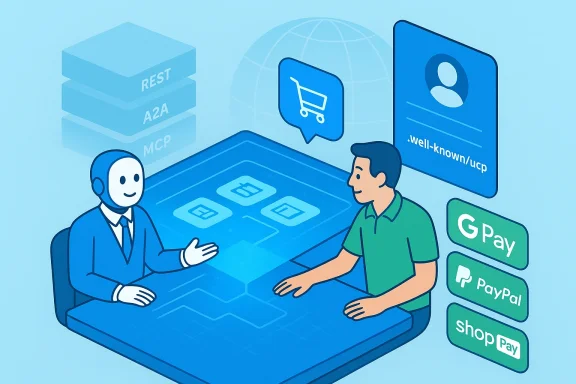
UCP is a capability‑driven, manifest‑based protocol. Merchants publish a machine‑readable profile (commonly placed at a well‑known endpoint such as /.well-known/ucp) that enumerates the capabilities they support — checkout, fulfillment, subscriptions, discounts, loyalty, and so on — plus the payment handlers and extensions available for negotiation. Agents likewise publish a profile describing their supported primitives and constraints. When a shopper asks an AI assistant to buy something, the agent negotiates with the merchant profile to determine what can happen automatically and what requires escalation to the merchant UI.Key promises:
- Unified integration: one integration point can serve many agentic channels.
- Shared language: a standard schema for discovery, negotiation and execution.
- Extensibility: capabilities and extensions allow domain‑specific features to be added without breaking backward compatibility.
- Security‑first payments: separation of payment instruments and payment handlers, with tokenized flows and explicit consent baked into the design.
Designed for existing infrastructure and choice
Crucially, UCP is built to work with the stacks merchants already run. Rather than forcing a single payments provider, UCP lets merchants advertise which payment handlers they accept while allowing agents to follow a handler’s specification at runtime. The protocol supports REST APIs, Agent2Agent (A2A) patterns, and binds to Model Context Protocol (MCP) to allow LLMs and agents to use the merchant’s capabilities as tools.This modularity is central to adoption: merchants don’t have to rip out their checkouts or change fulfillment logic overnight. Instead, they expose capability profiles and let agents do the heavy lifting of negotiation.
Technical backbone: how UCP wires agents to merchants
Discovery and negotiation: /.well‑known/ucp and capability intersection
At the core of UCP is a discovery primitive. Merchants publish a JSON profile at a well‑known URL that declares:- Supported capabilities (checkout, catalog search, order management, identity linking).
- Payment handlers (Google Pay, PayPal, Shop Pay, regional PSPs).
- Fulfillment rules and constraints (shipping windows, fragile item handling, local pickup).
- Extensions and domain schemas (loyalty points, subscription plans, custom engraving fields).
Layered capabilities and graceful handoffs
UCP defines core capabilities (e.g., Checkout, Catalog, Orders) and allows extensions to add domain‑specific fields. Because capabilities are versioned independently, new features can arrive without forcing a monolithic protocol upgrade. When an agent encounters a capability it cannot fully satisfy (for example, a bespoke engraving that requires a human input), UCP supports graceful handoffs — the agent escalates to the merchant’s UI with the session context intact, preserving the conversational state.Transport and payment architectures
The protocol is transport‑agnostic: it supports REST bindings, A2A messaging, and MCP bindings that let large language models call capabilities as tools. Payment architecture separates the consumer’s payment instruments from payment handlers (the processors). The result: agents can select a handler that matches both the merchant’s acceptance list and the buyer’s preferences, and tokenized flows and cryptographic proof of consent are used to reduce friction while preserving security and merchant control.Where UCP is already showing up: Google, Gemini, Copilot, ChatGPT
Large AI surfaces are starting UCP pilots immediately. Google’s implementations allow embedded checkouts inside AI Mode in Search and within the Gemini app, enabling users to complete purchases using payment and shipping data stored in Google Wallet and Google Pay. Microsoft is leveraging its Copilot integration for similar embedded checkout experiences, and OpenAI’s ChatGPT ecosystem likewise supports agentic flows via merchant catalogs and agent extensions.These early integrations demonstrate UCP’s real‑world use cases:
- Agents building carts mid‑conversation and escalating for confirmation only when necessary.
- Merchants retaining Merchant of Record status and order records.
- Tokenized payments and per‑transaction consent to safeguard consumers.
Merchant implications: visibility, merchandising and the death of "one size fits all" SEO
Merit over marketing dollars — what changes for discovery
One of the most consequential claims around UCP is that it enables merit‑based discovery for agentic shoppers. Instead of relying on paid placements or traditional search ranking signals, conversational agents will shortlist items based on contextual fit: user preferences, past purchase history, size constraints, ethical filters, subscription eligibility, and more.That shift alters discovery economics:
- Contextual fit matters more than ad spend for agentic queries.
- Structured product data and accurate capability profiles become essential signals for agents.
- Niche brands with tightly structured catalogs may appear more often for relevant conversational queries, diluting incumbents’ dominance in some categories.
Merchant responsibilities — feed hygiene and capability curation
With agentic discovery, traditional merchandising roles morph into feed engineering duties. Merchants must:- Keep structured catalogs current and expressive (attributes, variants, real‑time inventory).
- Maintain accurate UCP profiles that reflect capabilities, discounts, subscriptions, and fulfillment rules.
- Curate negotiation behavior (which payment handlers to offer, how discounts stack, whether subscriptions are available during agentic flows).
Payments, privacy and security: tradeoffs and precautions
Tokenized payments and verifiable consent
UCP’s payment model keeps payments secure by design. It decouples the instrument (what the consumer uses to pay) from the handler (the processor that executes the transaction). That allows multiple payment handlers to coexist while preserving cryptographic proof of consent for agent‑initiated charges. Agent Payments Protocol (AP2) and other tokenized flows are integrated to reduce risk.Core security features include:
- Explicit per‑transaction consent prompts presented by agents.
- Tokenized payment handlers to minimize credential exposure.
- Granular permissioning so agents can be limited to specific spend caps or types of transactions.
Privacy and data control
Agents will access profile‑level data — shipping addresses, loyalty credentials, membership statuses — to make agentic commerce work. That concentration of sensitive data raises important privacy needs:- Clear consent and revocation UX for users granting agents purchase privileges.
- Audit trails proving which agent performed what action and when.
- Governance for how identity linking and loyalty credentials are shared between merchants and agents.
Competitive dynamics: Shopify and Google vs. closed gardens
UCP is explicitly positioned as an open standard meant to break down integration barriers and prevent single vendors from locking commerce flows. Shopify executives argue this opens agentic commerce to all brands — even those not hosted on Shopify — via catalog syndication and proxy layers.But the competitive landscape is complicated:
- Amazon’s absence from UCP and similar industry pushes is notable; it retains a massive ad and retail ecosystem that could resist a merit‑based discovery model.
- Platform wars remain plausible: different agent providers or cloud vendors may favor their own protocols or extensions, fragmenting the agentic layer.
- Payment providers and card networks will be decisive stakeholders given the tokenized flows and handler negotiation.
Risks, unanswered questions and implementation friction
Adopting UCP is not risk‑free. Key challenges include:- Data quality and catalog readiness: Agents can only recommend what they understand. Merchants with incomplete or inconsistent catalogs risk being invisible to agentic shoppers.
- Operational complexity at scale: Negotiating capabilities in real time for millions of transactions — including taxes, region‑specific rules, and fulfillment permutations — will stress systems and require robust monitoring.
- Regulatory and compliance hurdles: Cross‑border disputes, digital consumer protection laws and evolving AI regulation could complicate agentic commerce rollouts.
- Agent maturity and safety: Agents need reliable guardrails to avoid erroneous purchases, especially for complex or high‑value items. Human escalation patterns must be safe and obvious.
- Ecosystem fragmentation: If major players diverge on protocol extensions or vendor bindings, the promise of “universal” commerce standards weakens.
- Fraud vectors: Agentic flows introduce new fraud surface areas (e.g., compromised agents, rogue agent profiles, replay attacks) which demand additional verification layers.
Practical steps merchants should take now
To get ahead of the agentic commerce transition, merchants need a both/and approach: shore up technical readiness while building organizational capabilities.- Strengthen structured product data
- Audit catalog attributes, specs and variant mappings.
- Add conversationally friendly descriptors (materials, occasion, fit).
- Publish and test a UCP profile
- Start with a minimal capability set (checkout, fulfillment, orders) and iterate.
- Use validators and test agents to exercise negotiation paths.
- Harden payments and consent UX
- Define payment handlers you will accept and how agent consent is recorded.
- Implement per‑session spend caps and clear revocation flows for agents.
- Prepare handoff experiences
- Map out where agentic interactions must escalate to the merchant UI and ensure session continuity via deep links or embedded checkout.
- Train merchandising and ops teams
- Build responsibilities for catalog hygiene, profile updates, and UCP governance into existing product/merchandising roles.
- Run limited pilots
- Begin with low‑risk SKUs and incremental user segments to validate routing, fulfillment and fraud controls.
How platform vendors and payments partners benefit — and why they’re investing
Platform vendors and payment processors have clear monetary incentives to make UCP succeed. Embedded checkouts in large agentic surfaces shorten purchase funnels and increase conversion. Payments providers stand to grow tokenized volume and gain deeper integration with merchants’ checkout experiences. For Shopify specifically, becoming the connective tissue for agentic channels — while retaining the Merchant of Record role — aligns directly with its payments and infrastructure businesses.For AI platform owners, native UCP support makes their assistants more useful and sticky: the assistant that can both recommend and buy accrues more user engagement and data. The open‑source posture, meanwhile, helps defuse antitrust anxieties and encourages ecosystem contributions that could accelerate adoption.
The long view: what success looks like and what to watch for
If UCP delivers on its promises, the next five years could bring:- A new, durable channel for discovery where conversational relevance and contextual fit compete with, or even eclipse, traditional search ranking signals.
- A richer set of commerce primitives for agents — subscriptions, bundles, delivery preferences and complex fulfillment rules handled seamlessly in chat.
- A services market for UCP readiness: validators, profile management, proxies, fraud services and agent analytics.
- Walled‑garden countermeasures from dominant marketplaces that elect not to participate.
- Fragmentation over incompatible extensions that reintroduce bespoke integrations.
- Consumer trust issues tied to mistaken purchases, unclear consent, or poor escalation experiences.
Conclusion
The Universal Commerce Protocol is a bold, technically grounded attempt to reassemble the shopping stack for an agentic future. By codifying discovery, negotiation and execution into a capability‑driven standard and by enabling flexible payment and transport bindings, UCP targets the exact friction points that have made conversational commerce aspirational rather than practical.For merchants, the immediate imperative is pragmatic: treat UCP as both an opportunity and a productization challenge. Invest in catalog hygiene, publish honest capability profiles, and pilot agentic flows fairly conservatively. For platform vendors and payment providers, the race is to offer the most seamless, secure and developer‑friendly integrations to capture the first wave of agentic activity.
The protocol’s open design and prominent backers increase the likelihood that agentic commerce will scale quickly — but its long‑term shape will be determined by adoption, the development of robust tooling, and how merchants, platforms and regulators respond when the agents in our pockets become responsible for both discovery and the bill.
Source: WebProNews UCP: Shopify and Google’s Bid to Wire AI Agents for Frictionless Commerce
