

OpenAI’s tenth year reads less like a company anniversary and more like a technology milestone: a research lab that launched in December 2015 has become a global infrastructure provider and a central actor in a geostrategic race over compute, models and the rules that will govern them. What began as an experiment to “benefit all of humanity” is now embedded in everyday productivity software, search, creative workflows and national infrastructure plans — and it is reshaping how governments, enterprises and consumers think about trust, regulation and economic value.
OpenAI was founded in December 2015 as a nonprofit research organisation and publicly framed its mission around building safe and broadly beneficial artificial general intelligence. The organization’s early charter and blog posts made its safety-focused origins clear, even as it gathered world-class talent and backers. Those foundations matter today because the company’s shift from pure research to large-scale consumer products and infrastructure has forced fresh debates over governance, capitalism and national strategy. ChatGPT — the conversational product that catalysed mass adoption — launched as a public preview in November 2022 and quickly turned a research demonstration into a mainstream utility. The product’s reach has been extraordinary: within months it changed how millions of people write, code, search and learn. But beyond that milestone, OpenAI’s trajectory over the last three years shows a company reinventing itself repeatedly — from model developer to platform provider, and now toward agentic systems and dedicated compute provisioning.
The next ten years will be defined by three questions: who controls the stacks that run agentic AI, who governs the behaviour of systems that can act on behalf of people and organisations, and how societies distribute both the benefits and the risks. For policymakers and IT leaders in the MENA region — and in resource‑rich states such as Qatar — the immediate opportunity is clear: investments in compute and cloud capacity can yield sovereignty and economic value, but only if paired with skills, rule‑making and interoperability commitments that ensure those resources empower local innovation rather than simply host foreign workloads.
OpenAI’s decade is a story of velocity, ambition and the hard engineering and economic truths that now define modern AI. From chat windows to agentic browsers and multi‑billion‑dollar compute ventures, the platform era of AI has arrived — and with it a new set of strategic choices for businesses, regulators and nations.
Source: Gulf Times OpenAI turns 10 years: A decade that reshaped artificial intelligence, from chatbots to global infrastructure
 Background
OpenAI was founded in December 2015 as a nonprofit research organisation and publicly framed its mission around building safe and broadly beneficial artificial general intelligence. The organization’s early charter and blog posts made its safety-focused origins clear, even as it gathered world-class talent and backers. Those foundations matter today because the company’s shift from pure research to large-scale consumer products and infrastructure has forced fresh debates over governance, capitalism and national strategy. ChatGPT — the conversational product that catalysed mass adoption — launched as a public preview in November 2022 and quickly turned a research demonstration into a mainstream utility. The product’s reach has been extraordinary: within months it changed how millions of people write, code, search and learn. But beyond that milestone, OpenAI’s trajectory over the last three years shows a company reinventing itself repeatedly — from model developer to platform provider, and now toward agentic systems and dedicated compute provisioning. The four-layer framework for understanding today’s AI stack
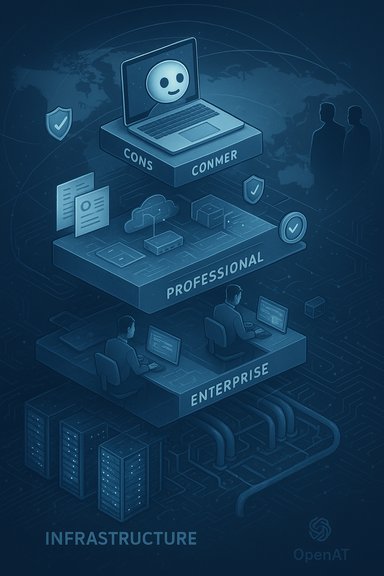
To make sense of the last decade, it helps to view the AI ecosystem in four stacked layers — a simple taxonomy that clarifies where value accrues, where risk concentrates, and where policy levers actually matter.1. Consumer layer: AI as everyday assistant
- Tools for writing, translation, learning and conversation are now mainstream.
- ChatGPT and Google’s Gemini introduced conversational AI to hundreds of millions of people and turned “AI chat” into a default consumer interaction pattern. Public court filings and multiple industry reports suggest ChatGPT’s global reach measured in the hundreds of millions of monthly active users by early‑to‑mid 2025, though exact numbers vary by source and measurement method. These figures come from disclosed documents and analytics firms rather than a single official tally, so they should be treated as directional rather than precise.
2. Professional layer: specialised knowledge work
- Distinct products (Claude, Perplexity, research-focused platforms) position themselves on long-context, source-grounded outputs and citation-first research workflows.
- These services emphasize verifiability, regulatory compliance and integration with research and legal workflows.
3. Enterprise layer: embedded automation
- Businesses now embed assistants into workflows (Microsoft Copilot, GitHub Copilot, enterprise ChatGPT editions), making AI a productivity substrate in Office suites, developer tools and cloud systems.
- Enterprises demand SLAs, private model variants and non‑training guarantees; that commercial need drives feature design and pricing.
4. Infrastructure layer: compute, data centres, and national systems
- High‑performance compute, efficient interconnects, and large-scale data centres are the physical backbone behind everything above.
- OpenAI’s strategy in 2024–2025 — including multi‑cloud deals, hardware partnerships and large infrastructure programs often described under initiatives like “Stargate” — reflects the reality that future model scale will be constrained not by algorithms alone but by access to accelerators, power and networking. Industry reporting and internal planning documents make clear that compute is now a strategic asset.
Ten years in: what changed, and what stayed the same
OpenAI’s changes can be grouped into three linked transitions: scale, productisation, and vertical integration.Scale: mass consumer adoption after 2022
ChatGPT flipped LLMs from specialist infrastructure into consumer software. The rate of adoption dwarfed earlier AI waves: the product crossed usage milestones far faster than earlier mainstream apps did. Media and court documents reported ChatGPT’s user base swelling into the hundreds of millions by 2025, a scale that reoriented competitors and regulators alike. These numbers come from a mixture of company disclosures, court filings and third‑party web analytics — consistent in direction, not always identical in magnitude.Productisation: from research demos to paid tiers and platform features
OpenAI has steadily professionalised its consumer offering: tiered subscriptions, enterprise products, and product leaders hired from consumer tech signal a change in priorities. Paid tiers now regulate access to the company’s most capable model families and to advanced features (e.g., agentic tooling), reflecting the real economics of running global, low‑latency AI systems. Independent reporting and company release notes document these shifts toward monetised, product-led features.Vertical integration: models + compute + tooling
The appetite for compute pushed OpenAI to diversify its infrastructure strategy. The company has restructured relationships with long-time partners, signed capacity deals with multiple providers, and signalled intentions to commission custom hardware and possibly "sell compute" as an integrated offering. That pivot reflects an industry reality: control over hardware and data-centre design materially affects cost per token, feature velocity and competitive positioning. Industry threads and internal analyses in the trade press show this strategy as a major inflection point.The geopolitics of compute and the emerging “AI cloud”
The last two years made clear that AI is not only software; it's infrastructure with strategic implications.- Countries and sovereign funds are investing in national compute capacity. Recent deals — including major Gulf-region commitments — demonstrate that governments are not passive consumers anymore; they are building capabilities and asking for trusted, sovereign infrastructure. Qatar’s new initiatives and joint ventures to build integrated compute hubs exemplify this trend. Reuters and official statements reported a major $20 billion strategic infrastructure partnership in December 2025 aimed at building regional AI compute capacity in Qatar. That deal is a concrete example of national efforts to anchor AI infrastructure domestically.
- Cloud economics are shifting. The conventional hyperscaler model (general‑purpose VMs) is increasingly suboptimal for ultra‑large model workloads. “AI cloud” offerings that combine accelerator-first hardware, model-aware orchestration and bundled model‑plus‑compute pricing are emerging as a distinct product category — and OpenAI’s statements and partner deals suggest it wants to be a primary actor in that space. Industry analysis and reporting reinforce that selling or tightly packaging compute changes the competitive map between OpenAI and the major cloud providers.
The next phase: from chatbots to autonomous agents
Perhaps the most important technical and product shift is the move toward agents — systems that do work, not just generate content.- Agent capabilities: Modern agents combine browsing, tool-calling, sandboxed execution and long-form planning. OpenAI’s Agent Mode (now integrated into the ChatGPT experience and embedded in the Atlas browser) exemplifies this leap: agents can research, assemble documents, interact with web UIs and propose or execute multi‑step workflows while asking for confirmation before consequential actions. OpenAI documentation and launch materials describe agent behaviour, permission prompts and constraints built into the system. Early rollouts to paid tiers confirm the company’s direction toward “AI that does work” rather than just responds to prompts.
- Product implications: Agents shift the product goalposts. Where chatbots optimise for helpful, human‑like conversation, agents must also be reliable executors with predictable, auditable behaviour. That requires orchestration layers, strong authentication and explicit permissions — changes that alter UX, engineering and compliance burdens.
- Industry momentum: Other cloud vendors and platform teams (Amazon, Google, Microsoft and specialist startups) are pursuing agentic systems, making the next wave as much about orchestration and safety as it is about pure model capability. Commentary from independent reviewers and trade outlets highlights both the promise and the fragility of agent behaviour in real world tasks.
Regional impact: MENA and Qatar’s growing role
The Middle East and North Africa (MENA) is now one of the fastest-growing AI adoption corridors.- Local drivers: High smartphone penetration, young populations and explicit government strategies to diversify away from hydrocarbons have catalysed rapid uptake. Multiple regional initiatives and private investments have targeted both usage and infrastructure. While user‑level estimates vary widely across sources, regional growth rates are consistently above global averages for AI adoption. Some news outlets and regional reporting estimate that MENA accounted for tens of millions of AI users by 2025, though the exact monthly‑active user figures are estimates rather than independently audited metrics. These estimates should be cited with caution.
- Qatar’s strategy: Qatar is notable for heavy public and sovereign‑fund investment in compute and data centres, and its QIA‑backed firm Qai has announced multibillion‑dollar initiatives to develop AI infrastructure and local capabilities. The December 2025 Brookfield–Qai joint venture ($20 billion) is the clearest recent example of Qatar positioning itself as a regional AI hub with integrated compute projects. That work signals a move beyond consumption toward enabling AI at scale across the Gulf.
- What to watch: whether national compute initiatives translate into local capabilities (engineering talent, research labs, startup ecosystems) or primarily serve as data centres for foreign workloads will determine long‑term economic impact. Sovereign funds and infrastructure investors are betting on cluster effects; governments must now deliver talent pipelines and regulatory clarity to realise those bets.
What OpenAI’s tenth year reveals about power, competition and risk
The last decade shows how concentrated the AI stack has become, and why concentration matters.- Platform concentration: A handful of platforms now dominate mass consumer AI usage. That concentration creates economic efficiencies but also single points of failure that matter for safety, privacy and competition. Corporate disclosures and competitive filings (including public court documents) show how usage and scale metrics have been used as strategic arguments in antitrust contexts. Reported user numbers for major platforms — ChatGPT, Gemini, Meta AI — have been cited in legal proceedings and industry reporting to demonstrate both scale and rivalry. Those figures are useful but should be treated as part of a broader competitive narrative rather than flawless census data.
- Data and privacy: As agents gain the ability to interact with accounts and APIs, the data access surface increases dramatically. Agent design choices — logged actions, permission prompts, safe defaults — will determine whether those agents enhance productivity or open new vectors for abuse.
- Economic and labour implications: Automation of knowledge work will be incremental but real. Agentic task execution could compress many first‑draft and research tasks into machine time, shifting the value towards curation, validation and oversight. That change will create winners and losers across job roles and industries.
- Regulatory pressure: With a few platforms acting as de facto infrastructure providers, regulators in multiple jurisdictions are now considering interventions: data residency rules, vendor certification, transparency requirements for model provenance and new frameworks for accountability when AI systems take real‑world actions. The shape of these rules will strongly influence how freely companies can deploy agentic systems and whether national clouds become purchaseable commodities. Industry analysis and public filings indicate regulators are already scrutinising the market structure and safety claims.
Strengths, weaknesses and hard trade‑offs
What OpenAI (and leading platforms) have done well
- Rapid productisation: moving research breakthroughs into usable products that scaled to mainstream audiences.
- Focus on UX: conversational interfaces lowered the barrier to entry for complex capabilities.
- Investment in safety tooling: while imperfect, OpenAI and peers have invested in moderation tools, red-team frameworks and external review mechanisms.
Where risks cluster
- Measurement uncertainty: user metrics reported in the public domain often come from internal filings, press leaks or third‑party web analytics; those figures are useful but not always independently audited. Treat headline MAU/Dau figures as estimates that drive market narratives rather than crystal‑clear truth.
- Concentration and vendor lock‑in: the tendency to centralise model access, model updates and compute under a few suppliers creates systemic vulnerability.
- Agent safety and UX fragility: agentic systems introduce new classes of errors — action mismatches, automation surprises and permission drift — that are harder to detect than text hallucinations.
- Energy and supply constraints: scaling models and agents requires massive accelerator fleets and energy; the race for silicon and power may produce awkward tradeoffs between speed, efficiency and sustainability.
Practical takeaways for IT leaders, policymakers and regional planners
- Reframe AI strategy around capabilities, not vendors. Prioritise outcomes (automation, research efficiency, customer experience) and design multi‑vendor resiliency into procurement.
- Treat agent rollouts as product projects. Pilot Agent Mode with human‑in‑the‑loop gates, audit trails and rollback capability before broad deployment.
- Build data governance that anticipates cross‑border compute. Data residency and model‑training waiver clauses will be central in contracts with global providers.
- For regional planners: pair infrastructure investment with talent development. Data centres and compute are necessary but not sufficient for sustained AI industry growth — the human and regulatory ecosystems matter equally.
What can’t (yet) be verified, and where to be cautious
- Exact user counts: headline numbers such as “600 million monthly active users for ChatGPT” have been cited in various court documents and industry reports; multiple outlets reported those figures in 2025, but they originate from internal disclosures and external traffic estimates rather than an independently audited public dataset. Treat these numbers as credible industry estimates that illustrate scale but not as immutable facts.
- Regional per‑capita adoption numbers: granular claims about single countries (for example, a specific range of monthly AI users in Qatar or exact national per‑capita adoption percentages) are often derived from proprietary surveys, single‑outlet reporting, or country‑level extrapolations. Where precise national usage rates are cited in local press, those figures should be validated against multiple independent telemetry sources before being used for policy decisions. Qatar’s substantial infrastructure investments are independently documented, but headline user penetration rates are estimates and should be treated as such.
Conclusion
OpenAI’s tenth birthday is less a celebration of a single product and more a marker of how rapidly a field can pivot from lab notebooks to global infrastructure. In ten years the company helped turn language models into a mainstream interface, catalysed hundreds of millions of users into new workflows and provoked a worldwide re‑evaluation of how compute, data and governance intersect.The next ten years will be defined by three questions: who controls the stacks that run agentic AI, who governs the behaviour of systems that can act on behalf of people and organisations, and how societies distribute both the benefits and the risks. For policymakers and IT leaders in the MENA region — and in resource‑rich states such as Qatar — the immediate opportunity is clear: investments in compute and cloud capacity can yield sovereignty and economic value, but only if paired with skills, rule‑making and interoperability commitments that ensure those resources empower local innovation rather than simply host foreign workloads.
OpenAI’s decade is a story of velocity, ambition and the hard engineering and economic truths that now define modern AI. From chat windows to agentic browsers and multi‑billion‑dollar compute ventures, the platform era of AI has arrived — and with it a new set of strategic choices for businesses, regulators and nations.
Source: Gulf Times OpenAI turns 10 years: A decade that reshaped artificial intelligence, from chatbots to global infrastructure
