

OpenAI’s freshly announced, multi‑year infrastructure pact with Amazon — a headline-grabbing commitment worth roughly $38 billion — is more than a single vendor win: it completes OpenAI’s strategic shift from one dominant cloud partner to a diversified, multi‑hyperscaler compute architecture, and it redraws the map for AI infrastructure, chip procurement, and cloud competition.
These moves are not accidental. The AI workloads that power large language models (LLMs) and agentic systems require enormous, specialized compute — and vendors that can supply high-density GPU racks, coherent memory architectures, and low-latency networking are suddenly strategic partners rather than commodity vendors. That reality is forcing AI companies to hedge vendor risk, secure chip access, and lock capacity in multiple geographic regions.
That said, the headlines overstate neither the speed nor the certainty of execution. Physical limits — chip supply, thermal design, power availability, and data‑center construction timelines — are real constraints. Financially, headline dollar values should be modeled conservatively, since revenue recognition, deferred deployment, and capital intensity will shape earnings over multiple years. For technologists, the immediate takeaway is to plan for portability and long lead times. For investors, the takeaway is to price in both the growth upside from AI infrastructure demand and the capital, supply‑chain, and geopolitical risks that come with building the AI factories of tomorrow.
Source: AOL.com OpenAI CEO Sam Altman Just Delivered Fantastic News to Amazon Investors
 Background
How we got here
OpenAI’s commercial success with ChatGPT triggered a tidal wave of compute demand that outgrew the early model of a single-cloud relationship. The company’s origins on Microsoft Azure — reinforced by multibillion dollar investments and deep product integrations — gave OpenAI the scale it needed to launch, but it also created a single‑provider dependency that became operationally and commercially risky as the company grew. Over the past 12–18 months OpenAI has methodically broadened its compute relationships, adding Google Cloud, Oracle Cloud Infrastructure, CoreWeave (a GPU cloud specialist), and now AWS to its supplier roster.These moves are not accidental. The AI workloads that power large language models (LLMs) and agentic systems require enormous, specialized compute — and vendors that can supply high-density GPU racks, coherent memory architectures, and low-latency networking are suddenly strategic partners rather than commodity vendors. That reality is forcing AI companies to hedge vendor risk, secure chip access, and lock capacity in multiple geographic regions.
The announcement in plain language
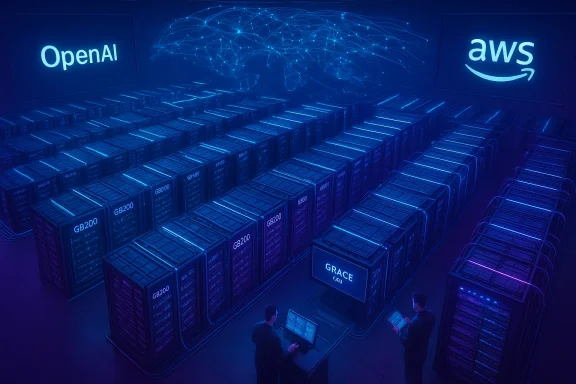
On November 3, OpenAI and Amazon disclosed a seven‑year supply agreement under which OpenAI will buy approximately $38 billion in cloud services from AWS. OpenAI said it will begin using AWS compute immediately and target full deployment of the contracted capacity by the end of 2026, with options to expand into 2027 and beyond. The deal explicitly covers access to rack‑scale GPU systems powered by Nvidia’s latest Blackwell family accelerators, including GB200 and GB300 class platforms.Overview: What the $38B AWS commitment actually buys OpenAI
Scale: hundreds of thousands of high‑end accelerators
Public filings and press reports tied to the announcement repeatedly emphasize access to “hundreds of thousands” of Nvidia accelerators through AWS’s data centers. That language reflects the scale needed to train, fine‑tune, and serve next‑generation models that will run multi‑step agentic reasoning and real‑time multimodal inference — workloads that are orders of magnitude denser than typical cloud VMs. While firms rarely disclose precise rack or chip counts in these public announcements, independent reporting and vendor product pages confirm that AWS, Nvidia, and their ODM partners are shipping GB200/GB300 NVL rack configurations at hyperscale to meet these demands.Hardware: GB200, GB300 and rack‑scale Blackwell platforms
The GPUs cited in the deal — named in industry coverage as GB200 and GB300 — belong to Nvidia’s Blackwell family and represent a rack‑scale approach that pairs many Blackwell GPUs with Arm‑based Grace CPUs to produce unified, very‑large coherent memory systems (NVL72-style configurations). Nvidia’s own product descriptions and industry supply‑chain reporting show GB300 is positioned as a higher‑performance successor to GB200 with more CUDA cores, increased HBM capacity, and heavier cooling/power requirements — features that make GB300 attractive for extremely large inference and reasoning clusters. These are the kinds of building blocks OpenAI needs to compress training timelines and enable low‑latency inference at scale.Software and product integration: Amazon Bedrock and open‑weight models
AWS has already integrated OpenAI’s open‑weight model offerings into Amazon Bedrock, simplifying enterprise access to selected OpenAI models through Bedrock’s unified API and console. AWS blog posts and documentation confirm that Bedrock supports OpenAI open‑weight models such as gpt‑oss‑20b and gpt‑oss‑120b, and AWS announced streamlined access to these models in mid‑2025. That prior Bedrock integration served as a practical testbed that likely informed the deeper $38B infrastructure commitment.Strategic implications for the cloud ecosystem
For OpenAI: resiliency, bargaining power, and a runway for growth
- Resiliency: Multi‑hyperscaler capacity reduces systemic risk tied to a single provider outage, pricing shift, or contractual friction. OpenAI’s diversified supplier mix — Microsoft, Google Cloud, Oracle, CoreWeave, and now AWS — smooths capacity availability.
- Bargaining power: By moving compute procurement from an exclusive Azure dependency toward a competitive sourcing model, OpenAI gains pricing leverage and operational choice when negotiating capacity, specialized hardware types, and regional deployments.
- Capital and expansion runway: The AWS commitment is a signal to investors and chip suppliers that OpenAI intends to scale aggressively. It also complements OpenAI’s broader infrastructure projects — such as joint builds with Oracle and SoftBank under large data‑center initiatives — intended to secure capacity for the next generation of models.
For AWS/Amazon: revenue, differentiation, and product narrative
- Revenue and margin upside: A multibillion‑dollar, multi‑year purchase commitment from OpenAI is revenue that AWS can plan around, sell capacity against, and leverage to justify further expansion in GPU‑dense regions. Public markets reacted positively to the news, reflecting investor recognition that AI-related infrastructure contracts can materially accelerate top‑line growth.
- Product differentiation: AWS already touts Bedrock and a broad model catalog; deepening ties to OpenAI (the company behind ChatGPT) creates a narrative AWS can sell into enterprise customers who want managed, high‑performance access to industry‑leading LLMs alongside AWS’s ecosystem. Bedrock’s simplified access to OpenAI weights is an example of this positioning.
- Competitive marketing: AWS can now claim parity across the three major hyperscalers — customers of OpenAI can be hosted on AWS, Google Cloud, or Azure — and position AWS specifically for ultra‑large, latency‑sensitive inference workloads thanks to its global data center footprint.
For Microsoft, Google Cloud, Oracle and others: shifting alliances and intensified competition
- Microsoft: Once the dominant cloud partner for OpenAI, Microsoft remains a strategic investor and collaborator, but its exclusive leverage has diminished. The restructuring OpenAI undertook (which loosened constraints that previously required Microsoft approval for other cloud contracts) paved the way for this multi‑cloud pivot. Microsoft still retains deep integration across productivity stacks and will remain a major supplier for many OpenAI workloads, but the political and contractual dynamics have clearly changed.
- Google Cloud: Google’s win to host parts of ChatGPT earlier in 2025 was notable because it showed that even direct competitors will supply compute when capacity and performance needs demand it. Google has unique advantages in TPU hardware and a strong AI‑centric on‑prem and cloud stack, and the OpenAI‑Google relationship introduced further competitive friction in hyperscaler land.
- Oracle and the Stargate project: Oracle’s role — including large physical data‑center buildouts tied to OpenAI and other partners — signals a parallel strategy to vertically integrate AI capacity closer to customer premises. Oracle’s infrastructure plays a strategic second fiddle to the hyperscale trio but brings database, enterprise software, and facilities expertise that matter for specific workloads and regulatory/geographic constraints. Recent reporting indicates some construction and capacity scheduling challenges, highlighting the logistical complexity of rapidly scaling AI data centers.
Technical realities and supply‑chain constraints
Why GB200/GB300 matter (and why they’re hard to get)
Nvidia’s Blackwell family (GB200 and GB300 design points) is purpose‑built for the density, memory coherency, and interconnect bandwidth modern LLMs require. The GB300 NVL72 rack configurations pair dozens of Blackwell Ultra GPUs with Grace CPUs, high‑bandwidth memory, and 800 Gb/s interconnects — a hardware architecture that reduces the time‑to‑train for enormous models and enables complex agentic inference that stitches many compute steps together. Nvidia, its channel partners, and cloud operators are racing to supply these systems, but they face manufacturing, packaging, and thermal engineering constraints that limit immediate, unconstrained scale‑up.Power, cooling, and data‑center buildout challenges
Delivering thousands of GB300 racks is not just a chip problem; it’s a facilities problem. Each NVL72-style rack consumes megawatts of power and requires dense liquid‑cooling systems, upgraded electrical substations, and significant network backhaul to fulfill low‑latency demands. That complexity is one reason why OpenAI and partners have announced large physical buildouts (for example, the Stargate collaborations), and why some vendors have warned of timeline slippage or material shortages in large deployments. Those logistical constraints are a practical limit on how fast any AI company — OpenAI included — can scale capacity even when funds are available.Software stack and interoperability
Large‑scale, multi‑cloud AI requires orchestration layers that can schedule jobs across different GPU architectures, manage data locality, and preserve model consistency. OpenAI’s move to support multiple clouds will force tooling improvements in distributed training, model sharding, and orchestration to make developer and operations lifecycles portable. Services like Amazon Bedrock, Azure Machine Learning, and Google Vertex/TPU orchestration are converging on similar requirements: a unified API, model governance, access controls, and cost observability. AWS’s decision to host OpenAI weights in Bedrock signals a pragmatic convergence where clouds offer both hardware and software glue.Financial and investor perspective
Why investors cheered (and why the headline needs context)
Market reaction to the announcement reflected two themes: the size of the contract itself, and the broader evidence that AI infrastructure is driving hyperscaler revenues. A multi‑billion‑dollar commitment from the company that popularized ChatGPT is an earnings catalyst for AWS and a signal that enterprise spending on AI will continue to accelerate. But investors should be cautious about reading the $38 billion figure as immediate, linear revenue: the commitment spans years and will be consumed across a mix of services and regions. Short‑term earnings impact will be meaningful but uneven, and a large part of the cash flows will underwrite capital‑intensive buildouts that have long payback cycles.Valuation takeaways
- AWS and Amazon: The deal strengthens AWS’s revenue outlook in AI services and capacity sales, justifying a premium multiple in growth scenarios — but it doesn’t eliminate macro or retail risks facing Amazon’s e‑commerce business. Investors should separate AWS profitability gains from longer‑tail e‑commerce dynamics when modeling Amazon.
- OpenAI: The agreement reduces a major operational dependency and sends a positive growth signal, but OpenAI remains capital‑intensive. Model development and inference carry high recurring costs; unless OpenAI can find reliable monetization levers and margin expansion (e.g., enterprise partnerships, premium products), heavy compute commitments will pressure cash needs and fundraising strategies.
Practical investor questions
- How will AWS recognize revenue over the seven‑year contract, and what portion will be infrastructure vs. managed services?
- Does the agreement include volume discounts, reserved capacity pricing, or embedded capital commitments (e.g., AWS‑owned racks built on OpenAI’s behalf)?
- What are the knock‑on effects for multi‑cloud customers who buy managed OpenAI‑backed services on different clouds?
Risks and unanswered questions
Technological concentration and supply limits
Even with multi‑cloud sourcing, the industry’s reliance on a small set of GPU architectures (principally from Nvidia) creates a single‑point risk that chip shortages, export restrictions, or design defects could meaningfully slow AI rollout. GB300 is a leap forward in performance, but it’s also more complex to produce and deploy, and the global supply chain for advanced packaging and HBM memory is constrained. That bottleneck can translate into project delays and fierce competition for limited rack shipments.Competitive escalation and rising costs
Hyperscalers will respond to OpenAI’s multi‑cloud strategy with their own incentives, capacity pledges, and product bundling. That dynamic can accelerate capital spending across the sector and increase margin pressure as providers underwrite long‑term capacity for marquee AI customers. The result could be higher gross capital expenditure across the industry, possibly compressing short‑term free cash flow even as cloud revenue grows.Regulatory and geopolitical exposure
Large infrastructure deals implicate export controls (especially for advanced AI accelerators), data‑locality rules, and national security reviews. The countries where OpenAI deploys capacity — and the customers those deployments will serve — will shape compliance burdens and could create regional restrictions on model access or hardware shipments. Those geopolitical variables add an overlay of uncertainty to the operational timelines in the deal.Verifiability gaps to flag
Some language in early press reports — for example, exact counts like “hundreds of thousands of clusters” — is loosely reported and should be treated cautiously. Companies commonly use rounded, promotional language when describing future capacity plans; precise hardware counts, rack deployments, and internal pricing terms are rarely published in detail. Readers should treat headline dollar figures and chip‑count claims as directional unless confirmed in formal filings or vendor supply agreements.How this changes the cloud market map (a practical summary)
Short term (next 12 months)
- OpenAI will begin shifting parts of training and inference workloads to AWS while continuing use of Microsoft, Google, Oracle, and specialized GPU clouds.
- Enterprises that want managed access to OpenAI models will see more options: Bedrock on AWS, native Azure integrations, and Google Cloud offerings — giving CIOs greater bargaining power and deployment flexibility.
Medium term (1–3 years)
- Hyperscalers will push to win share in AI factory workloads by expanding GB300/GB200 capacity, optimizing thermals, and offering new pricing models (e.g., committed capacity discounts, dedicated racks).
- The hardware and facilities buildout race will accelerate, but so will supply‑chain bottlenecks and localized infrastructure investments (datacenters, power capacity, and networking).
Long term (3+ years)
- If AI workloads remain structurally larger — as major model designers expect — the cloud market may bifurcate into general‑purpose cloud offerings and specialized AI‑factory services, with new entrants and consortia building vertically integrated offerings (hardware + software + facilities). Existing hyperscalers will adapt by offering closer‑to‑metal services, co‑designing hardware and software with customers, and expanding financing models for capital‑intensive customers.
Practical guidance for technologists and enterprise buyers
- Plan for multi‑cloud portability now. Architect training and inference pipelines so they can run on different GPU families and networking topologies; assume model weights and data will move between clouds.
- Budget for long lead times. High‑end accelerators, liquid cooling retrofits, and power upgrades require planning on the order of quarters to years. Treat capacity as a strategic procurement problem, not an IT refresh.
- Negotiate flexibility in contracts. When signing large, long‑term infrastructure agreements, insist on scalability clauses, predictable price escalators, and hardware migration paths.
- Monitor regulatory exposure. If your workloads touch regulated data or cross borders, include legal and compliance teams early in infrastructure planning.
Conclusion
OpenAI’s $38 billion AWS commitment marks a pivotal moment in the industrialization of AI: it closes the loop on a multi‑hyperscaler strategy that gives OpenAI flexible access to the world’s biggest GPU clouds while creating a new revenue axis for AWS. The deal is both a practical answer to immediate capacity needs and a strategic signal that the next phase of AI will be dominated by scale, specialized hardware, and cross‑cloud orchestration.That said, the headlines overstate neither the speed nor the certainty of execution. Physical limits — chip supply, thermal design, power availability, and data‑center construction timelines — are real constraints. Financially, headline dollar values should be modeled conservatively, since revenue recognition, deferred deployment, and capital intensity will shape earnings over multiple years. For technologists, the immediate takeaway is to plan for portability and long lead times. For investors, the takeaway is to price in both the growth upside from AI infrastructure demand and the capital, supply‑chain, and geopolitical risks that come with building the AI factories of tomorrow.
Source: AOL.com OpenAI CEO Sam Altman Just Delivered Fantastic News to Amazon Investors
