

Amazon’s twin AI moves this week — a headline-grabbing pledge to build supercomputing and classified cloud capacity for U.S. government customers alongside the longer-running multiyear compute relationship between OpenAI and AWS — have reset the narrative around Amazon’s capital intensity, competitive posture in cloud AI, and near-term investor sentiment. The market’s reaction was quick but nuanced: shares ticked up as traders rewarded clearer monetization pathways for AWS, even as organized labor staged targeted Black Friday strikes in Germany that underscore ongoing operational and reputational risks. This feature parses the facts, verifies the major claims against multiple independent sources, and offers a practical, forward-looking assessment for investors, IT leaders, and Windows-focused enterprise teams watching how hyperscaler capex reshapes products and procurement.
Amazon’s announcements this month actually cover two distinct but related strategic bets: a direct investment intended to serve U.S. federal customers, and an expanded role in hosting frontier AI workloads for major model builders.
That said, the story is not risk‑free. Execution on dense GPU fleets, continued dependence on a narrow set of hardware vendors, labor dynamics in logistics, and the timing of government procurements are real, measurable contingencies that will determine whether this is a re‑rating-worthy strategic pivot or an expensive experiment with stretched payback. Investors should prize demonstrable utilization and monetization metrics over headline billions; IT leaders should use this moment to press for portability and rigorous cost telemetry; and Windows‑centric teams should expect richer AI integrations to arrive tied tightly to cloud SLAs, compliance regimes, and new operational tooling.
In short: the AI infrastructure race has widened the gap between narrative and execution. Amazon has bought itself a much clearer seat at the table — and now the market will watch whether that seat translates into durable revenue, efficient utilization, and repeatable product wins.
Source: NewsCase Amazon's AI Gambit Sparks Investor Enthusiasm | NewsCase
 Background / Overview
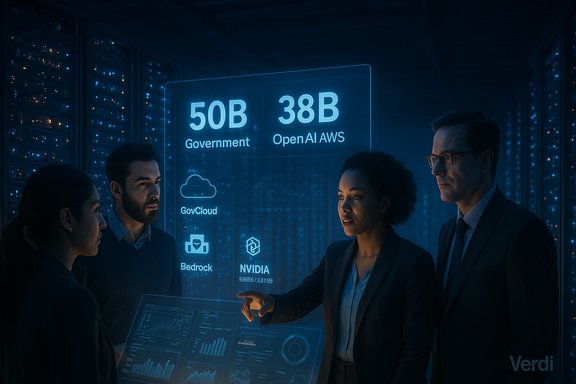
Amazon’s announcements this month actually cover two distinct but related strategic bets: a direct investment intended to serve U.S. federal customers, and an expanded role in hosting frontier AI workloads for major model builders.- Amazon told the market it will invest up to $50 billion to expand AI and high-performance computing capacity aimed specifically at U.S. government customers, including classified workloads across Top Secret, Secret and GovCloud environments. This is an infrastructure and datacenter buildout, not a single cash transfer to any third party.
- Separately, OpenAI and AWS publicly announced a multi‑year, roughly $38 billion consumption commitment for cloud compute and services that gives OpenAI access to hundreds of thousands of NVIDIA GPUs and specialized EC2 UltraServer infrastructure over several years. The commitment is structured as contracted cloud consumption across an initial multi‑year term, not an upfront cash payment.
Why the $50B government pledge matters (and what it actually is)
What Amazon announced — the concrete contours
The publicly disclosed $50 billion figure is an Amazon plan to expand AWS capacity tailored for federal customers. Reporting indicates the program will:- Add roughly 1.3 gigawatts of high‑performance computing capacity across AWS classified and GovCloud regions.
- Include purpose‑built data centers, high‑performance interconnect, and stacks that combine AWS platform services (e.g., SageMaker, Bedrock, Nova) and third‑party accelerators (notably NVIDIA hardware and Anthropic/partner integrations) to meet sovereign and mission‑critical requirements.
- Require multi‑year construction and capital spending phases beginning in 2026.
Strategic logic: capture sovereign AI demand
There are three clear strategic drivers behind a large, government‑focused AI push:- Government customers demand “sovereign” infrastructure with specific security, compliance, and residency guarantees. That raises the price point and margin potential relative to commodity cloud usage.
- Federal procurements are multi‑year, locked‑in revenue streams that can justify heavy up‑front capex in exchange for predictable future consumption.
- Building classified and GovCloud capacity strengthens AWS’s credibility against competitors (notably Microsoft Azure), who also court public‑sector AI workloads.
Key verification and caveats
- Multiple independent outlets (including Reuters and the Wall Street Journal) reported the $50B commitment and the 1.3GW capacity figure, which supports credibility on the headline metrics. However, the company’s public statements do not convert “up to $50B” into an audited, line‑item, cash‑transfer schedule. Treat that number as a top‑end planning commitment rather than an irrevocable cash outflow on day one.
- Government projects face additional timing, contracting, and export‑control hurdles, and the pace at which new classified regions come online will determine when revenue actually appears. These are non-trivial execution risks that investors must monitor in filings and program updates.
The OpenAI–AWS $38B deal: reinforcement of compute economics
What the $38B deal is, and why it matters
OpenAI’s multi‑year agreement with AWS — widely reported as a seven‑year, ~$38 billion consumption commitment — gives OpenAI immediate and ramping access to EC2 UltraServers with hundreds of thousands of NVIDIA GB200/GB300 accelerators and the ability to scale CPU capacity to tens of millions of cores for preprocessing and auxiliary workloads. The OpenAI announcement and corroborating reporting make the structure and intent clear: this is a consumption commitment, not a single lump‑sum cash payment. Two independent sources (OpenAI/AWS public statements and multiple news outlets) confirm the essential facts about the commitment and the hardware families involved; that cross‑validation reduces the chance the core story is inaccurate.Strategic consequences
- For AWS: a marquee customer consuming vast GPU hours improves long‑term revenue visibility and justifies continued specialization and productization (UltraServer racks, tuned networking, secure enclaves).
- For OpenAI: multi‑cloud sourcing reduces single‑vendor concentration risk and gives negotiating leverage with cloud providers and hardware suppliers.
- For NVIDIA: these arrangements further entrench Blackwell‑generation GPUs (GB200/GB300) as the performance backbone of frontier model training and inference.
Execution and economic risks
- Delivering hundreds of thousands of top‑tier GPUs on schedule requires enormous work: datacenter power and cooling upgrades, supply‑chain coordination for racks and chassis, networking to reduce cross‑GPU latency, and tight operational SLAs. These are not trivial; independent analysis repeatedly flags provisioning and energy constraints as principal execution risks.
- The $38B figure should be read as consumption potential — the real revenue Amazon will recognize depends on actual utilization, pricing tiers, and how much of that purchased capacity OpenAI actually consumes year over year.
Market response: what investors actually rewarded
Immediate stock moves and volume
Market reaction was favorable in the short term. On trading sessions following the announcements, Amazon shares rose — intraday numbers and session closes varied, but public market trackers recorded gains in the low single‑digit percentages as investor attention refocused on AWS monetization. Indexed trading data and market terminals show Amazon closing near the low‑to‑mid $230s on late‑November sessions as the Cyber Five period began. The market’s response reflects a simple investor calculus: clarer revenue paths for AI‑heavy capex (government contracts, committed consumption) reduce the perception that spending is purely experimental and give analysts a firmer basis for long‑range revenue modeling.Why optics matter — and where they deceive
- Headlines that read “Amazon spent $50B on AI” can distort the economic picture. The $50B government plan is capital investment over time and is targeted. The $38B with OpenAI is contracted consumption, not upfront cash. Together they tighten narrative coherence (AWS is where next‑generation AI compute runs), but the accounting and cash‑flow reality is gradual, not immediate.
- Investors sane about multiples will want to see utilization and monetization metrics: are these racks running at high utilization? Is Bedrock / managed AI revenue rising? Are custom silicon projects (Trainium/Inferentia) beginning to yield margin benefits? These are the real data points that convert a narrative rally into sustained valuation expansion.
Labor unrest and operational realities: Black Friday strikes in Germany
The facts on strikes
On Black Friday, roughly 3,000 Amazon warehouse employees in Germany joined coordinated walkouts organized by Verdi across multiple facilities — including Bad Hersfeld, Dortmund and Koblenz — as part of a campaign seeking collective bargaining agreements and higher pay. Reuters and other international outlets reported the events and Amazon’s statement that customer orders would not be materially affected due to scale and seasonal staffing. This kind of action is cyclical — Verdi has staged Amazon protests around peak days before — but it remains a recurring operational and reputational risk, particularly across Europe where collective bargaining norms and political scrutiny are strong.Operational and investor implications
- Short term: Amazon’s logistics scale, seasonal hires, and routing flexibility usually blunt the operational impact of targeted walkouts. Preliminary sales data from the U.S. Cyber Five period suggests strong consumer demand that helped stabilize revenue trajectories even as European strikes played out.
- Medium term: coordinated labor action can increase wage pressure, raise structural cost for European operations, and invite regulatory and political scrutiny — all of which can reduce operating leverage if not offset by productivity gains or higher prices.
- Strategic disconnect: capital‑heavy AI investments sit alongside a business model that still depends heavily on human logistics. That tension — automation vs. labor relations — is a structural conflict Amazon must manage publicly and operationally.
Cross‑checked verification: what we can say with confidence (and what remains speculative)
Confirmed by at least two independent sources:- Amazon announced an up to $50 billion capacity and datacenter investment aimed at U.S. government customers and classified clouds. Multiple major outlets reported the headline and core metrics.
- OpenAI signed a multiyear, roughly $38 billion consumption commitment with AWS to access EC2 UltraServer GPU capacity; the structure and hardware families (NVIDIA Blackwell GB200/GB300) were described in both company statements and independent reporting.
- Roughly 3,000 Amazon logistics workers in Germany participated in Black Friday strikes coordinated by Verdi at multiple sites. Reuters and other news organizations reported the event and Amazon’s comment on limited operational impact.
- U.S. holiday online spending (the Cyber Five) posted record or near‑record figures across several tracking services (Adobe Analytics, Salesforce/NRF estimates), supporting the view that holiday demand offset some regional disruptions.
- Any single headline that aggregates multiple large figures (for example, adding together all long‑range infrastructure pledges into a trillion‑dollar total) should be treated as directional projection rather than audited cash. Numerous reports use planning horizons and optionality in public estimates; those totals depend heavily on future consumption, renewals, and expansion decisions. Treat aggregated long‑range totals as strategic signaling until contract details and revenue recognition rules appear in filings.
Critical analysis — strengths, weaknesses, and the balanced investor checklist
Strengths and strategic opportunities
- Sovereign cloud demand is durable and attractive. Governments value security and predictable supply — AWS positioning for classified and GovCloud workloads can create high‑value, long‑duration revenue.
- Multi‑year consumption agreements reduce revenue volatility. For AWS, long‑dated commitments from large AI customers provide utilization visibility and make capex easier to justify.
- Productization potential. If AWS can productize AI primitives (hosted models, inference endpoints, managed fine‑tuning) and convert capacity into developer and enterprise products, it shortens the path from capex to recurring revenue.
Material risks and fragility points
- Execution risk on a massive technical scale. Deploying ultra‑dense GPU clusters at global scale involves supply chains, power contracts, cooling innovations, and regional permitting — any slippage hurts both timing and margin.
- Concentration on NVIDIA hardware. Industry dependence on NVIDIA Blackwell accelerators creates supply and bargaining risks; if GPU availability is constrained, timelines and costs shift.
- Labor and geopolitical costs. Recurrent European labor actions and potential export controls or data‑residency regulations can raise both operating expenses and project friction.
- Valuation vs. cash conversion. Capital intensity creates near‑term pressure on free cash flow and depreciation — investors must see improving utilization and incremental gross margins, not just top‑line commitments.
A practical investor checklist (what to watch next)
- Quarterly commentary on AWS utilization and AI‑specific revenue: Are Bedrock/managed AI and ultra‑dense cluster bookings visible in segment disclosures?
- Capex guidance and free‑cash‑flow trends: Is Amazon’s capex cadence aligning with utilization or ballooning without revenue lift?
- GPU supply and supplier cadence: Are GB200/GB300 deliveries on schedule? Are discounts or latency credits being offered to close gaps?
- Contract structure: Look for details in filings — committed consumption vs. actual usage, pricing tiers, and termination clauses matter.
- Labor developments and regional cost pressures: Are strikes intensifying, or are collective bargaining agreements being negotiated?
What this means for enterprise IT and Windows‑focused readers
- Plan for multi‑cloud resiliency. Large model hosting is trending toward multi‑cloud sourcing. Build portability at the API, container, and model‑packaging layers to avoid single‑vendor lock‑in.
- Model cost awareness becomes essential. Track cost per inference, reserved capacity discounts, and data‑movement charges. AI workloads can generate outsized cloud bills without careful instrumentation.
- Security and compliance gains attention. If federal-grade classified and sovereign clouds expand, expect higher demand for secure enclave architectures, key management practices, and audited control planes that enterprise IT teams must mirror.
- Windows integration and UX improvements. As hyperscalers productize models into managed endpoints, expect plugin‑style integrations into desktop and server software — improving productivity but also raising questions about endpoint telemetry, privacy and update cycles.
Tactical takeaways — what stakeholders should do now
- For investors: Differentiate between narrative and deliverable cash flows. Use demand signals (Bedrock customers, RPO, sales pipeline) and capex conversion ratios to judge whether capex creates durable returns.
- For CIOs/IT architects: Design for portability. Favor containerized runtimes, model packaging standards, and staged multi‑cloud tests for mission‑critical AI.
- For procurement and finance teams: Model TCO precisely. Include GPU hours, storage, cross‑region transfer, monitoring, and model‑ops staffing — AI workloads change every cost line.
- For Windows admins and enterprise teams: Start small with managed endpoints, instrument latency and costs, and insist on contractual SLAs for availability and data residency when adopting hosted AI features.
Conclusion
Amazon’s recent moves — a government‑focused $50 billion buildout and the broader emergence of AWS as a principal home for frontier model compute via multiyear commitments — change the conversation from “capex as a liability” to “capex as a strategic lever.” Markets rewarded clarity: committed consumption and sovereign demand reduce some of the uncertainty that pressured multiple‑quarter corrections.That said, the story is not risk‑free. Execution on dense GPU fleets, continued dependence on a narrow set of hardware vendors, labor dynamics in logistics, and the timing of government procurements are real, measurable contingencies that will determine whether this is a re‑rating-worthy strategic pivot or an expensive experiment with stretched payback. Investors should prize demonstrable utilization and monetization metrics over headline billions; IT leaders should use this moment to press for portability and rigorous cost telemetry; and Windows‑centric teams should expect richer AI integrations to arrive tied tightly to cloud SLAs, compliance regimes, and new operational tooling.
In short: the AI infrastructure race has widened the gap between narrative and execution. Amazon has bought itself a much clearer seat at the table — and now the market will watch whether that seat translates into durable revenue, efficient utilization, and repeatable product wins.
Source: NewsCase Amazon's AI Gambit Sparks Investor Enthusiasm | NewsCase
