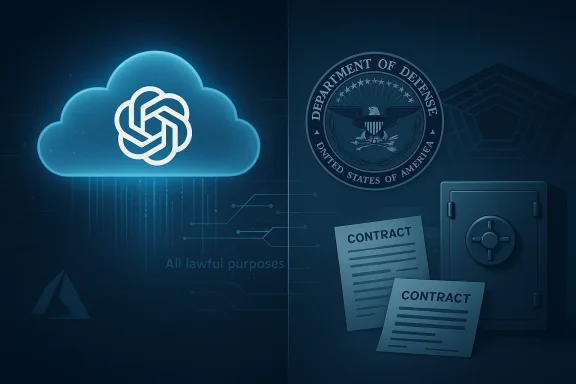
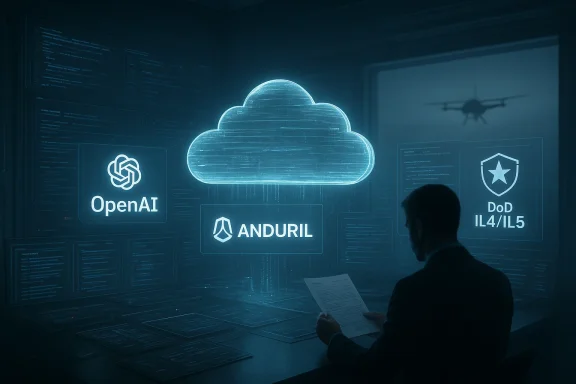
OpenAI quietly reversing its public ban on military use of its models has become one of the clearest fault lines in modern AI policy — a move that preceded, intersected with, and now complicates the Pentagon’s increasing use of Microsoft’s Azure OpenAI services, internal employee unrest, and a high-profile partnership between OpenAI and defense contractor Anduril that together expose the messy overlap of corporate ethics, national security imperatives, and rapidly maturing AI capabilities.
The narrative begins with a simple commitment: early on, OpenAI publicly stated limits on how its models would be used, including restrictions around military applications. That posture — part safety commitment, part public-relations stance — quietly shifted when OpenAI removed explicit prohibitions on military use from its public usage policy, a change first reported by mainstream outlets in early 2024. The policy change was not widely signposted and generated immediate questions about whether the company had rerouted its ethical compass to accommodate potential defense customers.
At the same time, Microsoft’s Azure OpenAI service — which integrates OpenAI models into an enterprise-grade cloud platform — evolved into a de facto bridge between commercial models and defense use cases. Microsoft pursued certifications and authorizations intended for sensitive government workloads, including Impact ions, positioning Azure OpenAI as a technically viable path for classified and operational military workloads. Those technical steps meant that even if OpenAI itself tried to restrict certain uses, the models could still reach defense users through vendor partnerships and cloud-hosted interfaces.
This convergence — policy shifts at OpenAI, Azure’s hardening for government, and active Pentagon experimentation — culminated in two lightning-rod developments: a partnership announced between OpenAI and defense systems company Anduril, and a later agreement allowing the U.S. Department of Defense to use OpenAI’s models under negotiated terms. Both moves prompted heated debate inside OpenAI and across the wider tech ecosystem.
Key factual claims verified across independent reporting:
This is not an abstract debate. It’s a practical engineering, policy, and ethical problem with real-world consequences for who controls powerful tools, how decisions are made in the fog of conflict, and whether corporate promises about safety survive the pressures of national security. The only durable path forward requires better instrumentation of model behavior, stronger contractual and audit mechanisms, and public institutions that can adjudicate trade-offs transparently — because leaving these questions to optics, opportunism, or quiet policy edits will only make the next crisis worse.
Source: Digg OpenAI employees claim the US DOD tested Microsoft's Azure version of OpenAI's models before OpenAI lifted its blanket ban on military use in January 2024 | politics
 Background
The narrative begins with a simple commitment: early on, OpenAI publicly stated limits on how its models would be used, including restrictions around military applications. That posture — part safety commitment, part public-relations stance — quietly shifted when OpenAI removed explicit prohibitions on military use from its public usage policy, a change first reported by mainstream outlets in early 2024. The policy change was not widely signposted and generated immediate questions about whether the company had rerouted its ethical compass to accommodate potential defense customers.At the same time, Microsoft’s Azure OpenAI service — which integrates OpenAI models into an enterprise-grade cloud platform — evolved into a de facto bridge between commercial models and defense use cases. Microsoft pursued certifications and authorizations intended for sensitive government workloads, including Impact ions, positioning Azure OpenAI as a technically viable path for classified and operational military workloads. Those technical steps meant that even if OpenAI itself tried to restrict certain uses, the models could still reach defense users through vendor partnerships and cloud-hosted interfaces.
This convergence — policy shifts at OpenAI, Azure’s hardening for government, and active Pentagon experimentation — culminated in two lightning-rod developments: a partnership announced between OpenAI and defense systems company Anduril, and a later agreement allowing the U.S. Department of Defense to use OpenAI’s models under negotiated terms. Both moves prompted heated debate inside OpenAI and across the wider tech ecosystem.
Timeline of the key events
Early policy and the quiet removal of the ban
- Early public statements from OpenAI framed the organization as cautious about military applications; the company articulated safety principles around surveillance and lethal autonomous systems.
- In January 2024, reporting documented that OpenAI had removed a clear prohibition on military use from its usage policy — a change described by some as “quiet” because it lacked a large public announcement. That removal catalyzed concern among ethicists, policy wonks, and many company employees.
Microsoft, Azure OpenAI, and the Pentagon
- Micrtegrate OpenAI models into Azure and sought the controls and accreditations needed for government and DoD customers, including IL‑level authorization to run sensitive or classified workloads.
- Journalistic and industry reporting later established that the Pentagon had been experimenting with Azure-hosted versions of OpenAI technology — a reality that both preceded and outlived OpenAI’s policy changes. Those experiments illustrated that vendor-layer integrations can create practical channels for military use, regardless of a model developer’s nominal restrictions.
The Anduril partnership and internal dissent
- In late 2024, OpenAI announced a partnership with Anduril — a defense company focused on autonomous systems, sensors, and tactical hardware. The announcement signaled a deepening commercial relationship between an AI-first research organization and a company that explicitly markets to militaries and allies.
- The move provoked immediate internal reaction: employees raised ethical objections, requested clarifications, and in some cases publicly questioned whether their work would be used in ways that violated previously expressed safety goals. OpenAI executives, including CEO Sam Altman, then began holding internal briefings to explain the rationale and the guardrails promised in the partnership.
The Pentagon, Anthropic, and the market scramble
- When rival Anthropic faced a Pentagon supply‑chain designation tied to its refusal to remove certain safety redlines, the DoD and defense contractors rapidly scrambled to maintain AI capabilities on other vendor stacks. OpenAI moved to position itself as a supplier able to meet the Department’s operational needs at scale, while Microsoft’s Azure platform offered the engineering controls DoD required for classified work. These dynamics accelerated negotiations and public scrutiny.
Recent admissions and amendments
- Facing public and internal criticism, OpenAI’s leadership acknowledged that some steps “looked sloppy” and that communication with employees could have been handled better. Sam Altman reportedly told employees that the company cannot control every operational decision the Pentagon makes once models are deployed — a claim that fuelled further debate about what “control” means when a private model is adopted by a sovereign actor. OpenAI did subsequently amend certain contractual language and describe “technical safeguards” that would be layered into defense deployments, though critics remain skeptical about enforceability and the long-term implications. ([theguardian.com](Sam Altman admits OpenAI can’t control Pentagon’s use of AI-
What actually changed at OpenAI — the policy mechanics
OpenAI’s public-facing policy language evolved in two complementary ways: (1) the explicit ban on military use was removed from some usage documents, and (2) the company described case-by-case agreements and technical controls for government and defense work. The practical effect is not binary; it depends on contractual commitments, platform controls, and government demands.Key factual claims verified across independent reporting:
- The explicit, public prohibition against military use was removed from OpenAI’s published terms in early 2024, as reported by multiple outlets.
- The Pentagon had already tested Azure-hosted OpenAI models (or Microsoft-hosted variants) in defense workflows before OpenAI’s policy shift, signaling that the cloud layer provided a ready conduit for adoption.
- OpenAI entered a partnership with Anduril and later reached an agreement permitting DoD use in classified networks under negotiated safety commitments; OpenAI’s executives acknowledged internal criticism and amended contract language in response.
Why this matters: technical, ethical, and operational implications
The intersection of commercial AI models and military operations is consequential for at least three distinct communities: engineers and product teams at AI firms; defense planners and procurement officers; and society at large (lawmakers, human-rights advocates, and the public).Technical risks and operational realities
- Model access vs. model control: Even if a model developer embeds safety filters, the deployment architecture determines whether those filters remain effective in battlefield or classified contexts. Vendor-layer integrations (e.g., Azure’s IL authorizations and tenant separation) permit the DoD to route sensitive workloads through hardened infrastructure, but assurance that model redlines survive operationalization is a complex engineering and contractual challenge.
- Auditability and provenance: Defense systems must be auditable. When a decision pipeline includes a proprietary, constantly-updated LLM, proving which model version produced a recommendation — and why — becomes difficult unless strict telemetry, logging, and immutable evidence packages are required and enforced.
- Latency and availability trade-offs: Defense users often demand on-premises or air-gapped capabilities. Cloud-hosted models reduce friction and accelerate adoption, but they can introduce resilience and sovereignty risks if connectivity or third-party dependencies fail during crises.
Ethical considerations
- Mass surveillance and autonomy: Two of the clearest ethical redlines in public debate have been domestic mass surveillance and fully autonomous lethal weaponry. Companies like Anthropic had tried to enshrine such redlines; the Pentagon’s insistence on “all lawful uses” placed pressure on vendors that created an acute political and legal standoff. The DoD’s ability to demand unfettered access through procurement levers raises foundational questions about whether commercial safety design choices can be overridden by national-security demands.
- Employee agency and organizational legitimacy: Worker protests and internal dissent at AI firms are not symbolic. Employees who build alignment systems, test failure modes, or write guardrails often understand system limits best. Ignoring their input risks not only morale and talent attrition but also the loss of internal safety checks that can materially reduce downstream harm. Reports indicate OpenAI employees raised such concerns after the Anduril and DoD steps, prompting internal town halls and clarifications.
Geopolitical and legal ramifications
- Precedent for procurement leverage: The Pentagon’s actions toward some vendors have signaled that procurement designations can be used to pressure companies. That sets a precedent: should national-security procurement be used to shape corporate feature sets and policies? Legal challenges and congressional oversight are likely to follow.
- Alliances and export controls: As U.S. vendors formalize relationships with defense customers, allied countries will demand clarity about export controls, data residency, and multinational operational norms. Fragmentation among vendors could create strategic vulnerabilities or interoperability problems for coalition operations.
Close reading of the Anduril connection and the Pentagon agreement
The Anduril partnership and the later DoD agreement with OpenAI are not identical events, but they intertwine in morally and operationally important ways.- The Anduril deal placed OpenAI squarely in the orbit of a systems integrato and autonomous systems designed for kinetic and non-kinetic missions. OpenAI publicly framed the engagement as building defensive capabilities and promised policy vetting; employees, however, argued that the line between defense and offense, or surveillance and protection, is often blurred in practice.
- The subsequent agreement allowing DoD use of OpenAI models in classified networks followed the Pentagon’s disciplinary action against Anthropic and the broader scramble to ensure continuum of AI capability. Although OpenAI published language emphasizing prohibitions on domestic mass surveillance and the centrality of human responsibility for use of force, critics pointed out that contractual terms and practical enforcement mechanisms matter more than aspirational promises. Sam Altman’s own admission that the rollout “looked sloppy” and that operational decisions rest with governments only deepened uncertainty.
- Importantly, Microsoft’s Azure platform has technical authorizations (IL levels) that permit secure hosting of classified workloads. The DoD’s use of Azure-hosted OpenAI models demonstrates a multi-party ecosystem where one actor’s policy changes can be materially deconflicted (or defeated) by platform-level capabilities. That structural reality means vendor ethics and cloud procurement practices must be aligned, or the safety intent will be brittle.
Strengths of the current approach (and why some argue it’s pragmatic)
- Rapid capability delivery: Defense organizations face real operational challenges where faster analysis, better data fusion, and generative assistance can save lives or shorten decision cycles. Vendors argue that prohibiting access to state-of-the-art models simply hands advantage to adversaries or slows critical modernization.
- Technical safeguards available: Platform providers now offer fine-grained isolation, cryptographic key control, and IL-level compliance that make running sensitive workloads more tractable than a raw public cloud deployment.
- Contractual levers: The DoD can — and does — place legal obligations on vendors to provide audit logs, red-team results, and semantic provenance. These instruments can create enforceable frameworks beyond public policy language.
Weaknesses, risks, and open questions
- Enforcement gap: Public postings about redlines mean little without verifiable, audit-ready mechanisms and independent oversight that can confirm models refuse prohibited tasks in operational settings.
- Transparency vs. secrecy paradox: Defense uses are often classified; secrecy needed for missions limits public debate and independent safety assessments. The result is less oversight precisely where the consequences may be greatest.
- Talent and trust erosion: When employees believe their employer has crossed ethical lines, the resulting loss of trust can impair recruitment, retention, and the internal culture of safety that reduces long-term risk.
- Precedent setting for procurement power: If procurement actions can compel companies to drop safety commitments, companies have incentives to bifurcate products — creating “defense-usable” forks without guardrails — which would accelerate weaponization.
Recommendations — what responsible stewards should do now
- For policymakers:
- Require auditable safety attestations in any procurement that involves models: immutable logs, model-version anchoring, and third-party evaluation of refusal behavior.
- Establish a permanent interagency mechanism to review and mediate disagreements between vendors and defense customers rather than relying solely on ad-hoc designations.
- For vendors and cloud providers:
- Implement technical policy enforcement points that survive operational handoffs — for example, model-side request filtering, runtime attestations, and encrypted policy anchors that cannot be trivially bypassed by cloud routing.
- Offer a transparent compliance package to government partners that includes red-team results, access controls, and external audits.
- For enterprise and defense architects:
- Maintain model provenance: log which model versions answered which queries, with cryptographic proofs where feasible.
- Adopt multi-model redundancy: avoid single-vendor lock-in for critical operational functions.
- For civil society and researchers:
- Push for independent evaluation regimes that can assess how models behave under adversarial prompts and in edge-case operational scenarios.
- Insist on protective clauses for civil liberties where government-use agreements touch on surveillance or domestic operations.
What to watch next
- Litigation and congressional oversight: Legal challenges by firms that are designated or sanctioned, plus congressional hearings, will shape whether procurement levers are seen as legitimate policy tools or overreach.
- Technical open standards for “defense-safe” AI: The community should expect calls for standardizing how safety guarantees are encoded, verified, and enforced in deployed models.
- Market shifts: If the DoD and primes demand model features that require special concessions, new vendor ecosystems could emerge — either more defense-specialized providers or split product linirms.
- Employee activism and whistleblowing: Against a backdrop of classified deployments, internal dissent can surface via leaks or public campaigns, generating reputational risk for vendors and political pressure on procurement decisions.
Conclusion
The trajectory from a publicly stated ban on military use to a negotiated, contractual allowance for Department of Defense deployments shows how technological possibility, platform engineering, and national-security urgency can rapidly overwhelm good-intentioned policy language. OpenAI’s policy changes, Microsoft’s productionization of OpenAI models inside Azure, the Anduril partnership, and the Pentagon’s procurement decisions together form a cautionary tale: ethical guardrails are necessary but not sufficient; they must be paired with verifiable technical enforcement, transparent governance, and a legal ecosystem that balances operational need with civil liberties and safety.This is not an abstract debate. It’s a practical engineering, policy, and ethical problem with real-world consequences for who controls powerful tools, how decisions are made in the fog of conflict, and whether corporate promises about safety survive the pressures of national security. The only durable path forward requires better instrumentation of model behavior, stronger contractual and audit mechanisms, and public institutions that can adjudicate trade-offs transparently — because leaving these questions to optics, opportunism, or quiet policy edits will only make the next crisis worse.
Source: Digg OpenAI employees claim the US DOD tested Microsoft's Azure version of OpenAI's models before OpenAI lifted its blanket ban on military use in January 2024 | politics