

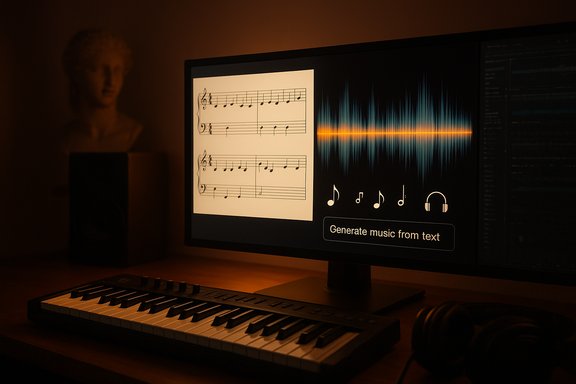
OpenAI is quietly building a generative music tool that can create full musical accompaniments from short text descriptions or audio snippets — a move that would mark the company's deliberate re-entry into AI music after earlier experiments and put it squarely in competition with Google, Suno and a growing roster of music‑AI startups.
OpenAI first experimented with music generation years ago with research projects such as MuseNet and Jukebox, which explored symbolic (MIDI) and raw‑audio approaches to automated composition and singing. Those projects demonstrated the potential of model‑driven composition while also exposing the hard limits of early systems — slow sampling, noisy vocals, and structural incoherence beyond short clips. Jukebox’s engineering notes, for example, reported that rendering high‑quality output could take hours per minute of audio in 2020, and the team treated the work as experimental rather than product-ready. The new reporting indicates OpenAI’s current effort aims to move beyond research demos toward a practical tool for creators: one that can add background scores to videos, produce guitar or instrumental backing for vocal tracks, and generally generate music from text and audio prompts at higher fidelity and control than earlier experiments allowed. The initial coverage traces back to an industry report that several outlets reproduced, and multiple independent newsrooms have summarized the same core claims.
OpenAI’s reported step back into music — combining text and audio conditioning with domain annotations from conservatory‑level musicians — would be an important signal that high‑quality music generation is moving from lab demos toward integrated creative tooling. The capability promises huge productivity gains for creators and a new class of generative services inside chatbots and video apps, but it also brings thorny questions about training data, licensing, and provenance that the industry has not yet resolved. Until OpenAI publishes product details or formal statements, the story should be treated as credible reporting with open, verifiable gaps that buyers and creators must manage carefully.
Source: finway.com.ua Generate Music from Text and Audio with OpenAI's Tool
 Background
OpenAI first experimented with music generation years ago with research projects such as MuseNet and Jukebox, which explored symbolic (MIDI) and raw‑audio approaches to automated composition and singing. Those projects demonstrated the potential of model‑driven composition while also exposing the hard limits of early systems — slow sampling, noisy vocals, and structural incoherence beyond short clips. Jukebox’s engineering notes, for example, reported that rendering high‑quality output could take hours per minute of audio in 2020, and the team treated the work as experimental rather than product-ready. The new reporting indicates OpenAI’s current effort aims to move beyond research demos toward a practical tool for creators: one that can add background scores to videos, produce guitar or instrumental backing for vocal tracks, and generally generate music from text and audio prompts at higher fidelity and control than earlier experiments allowed. The initial coverage traces back to an industry report that several outlets reproduced, and multiple independent newsrooms have summarized the same core claims. What we know so far
Core claims reported
- OpenAI is developing a generative music tool that accepts text descriptions and audio clips as input and returns finished or partially finished musical accompaniments for media projects and songs.
- The company is reportedly working with students at the Juilliard School to annotate sheet music and score features as part of the training and data‑labeling pipeline. That collaboration is presented as a way to capture compositional structure and music theory knowledge that purely scraped audio datasets miss.
- It is unclear whether OpenAI will ship this capability as a standalone product or fold it into existing surfaces such as ChatGPT or the short‑video generator Sora; no release date has been announced. Reported timelines remain speculative.
Who else is in the race
- Suno pioneered commercially visible text‑to‑song systems and is now integrated into Microsoft’s Copilot as a plugin, demonstrating how third‑party models are already being embedded into mainstream productivity tools.
- Google has continued active work in this space with models first demonstrated publicly as MusicLM and later productized via Vertex AI (Lyria), signaling strong multi‑modal ambitions from a company that already operates at scale for video and audio services.
- Nvidia and other research groups continue to prototype high‑fidelity audio synthesis tools (for example, Fugatto), increasing the competition and pace of innovation across audio generation stacks.
Why the Juilliard collaboration matters
OpenAI’s reported work with Juilliard students is significant because it signals a shift in data strategy: rather than relying exclusively on large, noisy crawled datasets, the company appears to be investing in annotated, theory‑aware training material.- Music theory and structure are not easily captured by raw audio alone. Labeled scores, harmonic analysis, and human annotations of form (verse/chorus, cadences, motif development) help models learn composition at a higher abstraction level. Partnering with trained musicians can supply that structured signal.
- The move also has reputational and product implications. Juilliard’s participation — even at the student/annotation level — provides a veneer of legitimacy and domain expertise that could help models produce more meaningful, musically coherent outputs suitable for film, games, and professional post‑production, not just novelty clips.
Technical approach — plausible architectures and tradeoffs
Although OpenAI has not published technical details for this reported tool, the broader research and product landscape suggests several plausible design choices and engineering tradeoffs.Likely building blocks
- Symbolic conditioning (MIDI / scores): Models that generate symbolic representations of music (notes, velocities, instruments) are compact and controllable, and they integrate well with DAWs and scoring tools. Conditioning a symbolic generator on user text or a short audio motif is an effective way to produce harmonically coherent accompaniments. Past systems such as MuseNet explored this direction.
- Raw‑audio models (latent diffusion, VQ‑VAE + transformers): Generating full audio (instruments plus vocals) requires solutions that control high‑dimensional waveforms. OpenAI’s Jukebox used VQ‑VAE + autoregressive priors; more recent research and commercial players favor latent diffusion and hybrid encoder–decoder stacks for quality and speed. If OpenAI wants real‑time‑ish performance and usability inside ChatGPT or Sora, a latent diffusion + alignment architecture with musical priors is a likely path.
- Audio conditioning: Accepting an audio clip as a prompt (to add guitar backing, for example) requires robust alignment between the prompt’s tempo, key, and phrasing and the generated accompaniment. Soft alignment attention and explicit beat/key extraction followed by conditioning are common methods in the literature. Recent papers show this is tractable with careful engineering and labeled datasets.
Performance and runtime tradeoffs
- Early raw‑audio systems were slow: Jukebox took many hours to render a minute of high‑resolution audio in 2020. Since then, inference stacks and specialized silicon have improved dramatically, but the tradeoffs between fidelity, latency, and cost remain real. If OpenAI aims to embed music generation into consumer products or social apps, the company must prioritize fast sampling, compact representations, and potentially model distillation.
- Commercial viability will depend heavily on how the model is served: cloud inference with GPU farms reduces local latency but increases operating costs; on‑device, low‑latency pipelines would require highly optimized, quantized models and hardware support.
Market dynamics and competition
The arrival of an OpenAI music tool would reshape a crowded, legally fraught market.- Microsoft’s partnership with Suno shows how major cloud vendors can integrate specialist music models directly into productivity assistants; Suno’s plugin for Copilot makes music creation frictionless for non‑musicians and sets a commercial precedent.
- Google has productized music models (Lyria 2, Lyria RealTime) inside Vertex AI and consumer verticals such as YouTube Shorts, making it a direct competitor for developers and enterprise customers seeking text‑to‑music APIs. Google has also emphasized SynthID style watermarks to signal provenance and mitigate misuse.
- Startups like Suno, Udio and others continue to innovate at speed; their agility fuels experimentation but also exposes them to legal risk. The RIAA lawsuits filed in 2024 against Suno and Udio underscore unresolved rights questions for music training data and model outputs. Those cases seek injunctions and damages and have already influenced public debate and corporate caution in the sector.
Rights, provenance, and the legal minefield
AI music generation currently sits at the intersection of creativity, technology, and copyright law — a place of active litigation and policy uncertainty.- The RIAA’s litigation against Suno and Udio makes clear that record labels and rights holders will litigate vigorously where they perceive large‑scale unlicensed use of recordings in training datasets. The complaints allege replication and direct copying in many generated outputs, and the suits seek statutory damages that can be substantial per work.
- Tech companies are responding in different ways: some embed provenance metadata or visible watermarks, others pursue licensing deals, and some adopt a “defensive” posture until legal standards crystallize. Google has coupled model releases with SynthID watermarking and detection tools as a safety and attribution mechanism.
- OpenAI’s public messaging in other product rollouts has acknowledged rights concerns and suggested that rights holders should “share in revenues” in some future model, but concrete frameworks for music — split sheets, mechanical and master rights, songwriter versus performer shares — are complicated and absent from public detail for this reported project. Any commercial music tool will need a clear rights strategy before it can be broadly deployed for paid or monetized content.
Use cases — practical and fringe
If delivered as described, the tool would fit into multiple creator workflows:- Video creators could auto‑generate background scores that match scene mood, length, and timing, saving hours of manual composition or stock licensing research.
- Musicians and producers could rapidly prototype arrangements, getting a guitar or bass backing generated to accompany a vocal stem.
- Game and media production pipelines could use the tool for adaptive and personalized scores, where music changes dynamically to gameplay or user choice.
- Advertising and short‑form content creators gain a fast path to bespoke jingles and themes without commissioning a composer.
- Voice and style mimicry can produce tracks that are difficult to distinguish from specific artists, amplifying impersonation risk.
- Low‑cost, high‑volume music generation could flood streaming services with machine‑made content, complicating discovery and compensation.
- Bad actors could use generated tracks to evade content filters or to game metadata‑driven monetization systems.
What this means for Windows users and creators
Windows users are already embedded in ecosystems where audio tools and cloud services intersect (DAWs like FL Studio, Pro Tools, Reaper, and collaborative cloud apps). A high‑quality, low‑latency OpenAI music generation tool would likely appear as:- A plugin or API that integrates with DAWs and NLEs, enabling composers to iterate inside familiar timelines.
- An addition to ChatGPT or Sora where creators can request score beds or backing tracks in natural language and then export stems for mixing.
- Audit vendor licensing terms and data‑processing locations before adopting music‑AI services for commercial projects.
- Define provenance and rights workflows so generated music can be tracked and properly licensed for monetization.
- Prepare content filtering and identity controls where voice likeness or artist styles might be sensitive.
Strengths, limitations, and risks — critical analysis
Strengths
- Domain expertise: Partnering with trained musicians (if the Juilliard reports are accurate) can materially improve model understanding of musical form, leading to higher‑quality outputs that are useful in production—not just novelty.
- Multimodal conditioning: Supporting both text and audio prompts would give the system practical flexibility for creators who want to describe mood or provide a raw vocal/guitar stem and receive a polished backing track.
- Ecosystem leverage: If released inside ChatGPT or Sora, OpenAI could immediately deliver scale and user experience integration (prompt history, editing, and remix flows) that small startups lack.
Limitations and technical risks
- Quality vs. speed: High‑fidelity music generation remains compute‑intensive. The real challenge is delivering production‑grade audio at interactive speeds without bankrupting the hosting bill or offloading too much cost to end users. Past research demonstrated very long render times for raw audio models; although inference efficiency has improved industry‑wide, the physics of audio synthesis still favors hybrid symbolic/latent solutions.
- Model hallucinations and musical coherence: Generative models can produce musically plausible but logically incoherent segments (weak recurrences, phrase drift). Professional scoring often relies on long‑range structure (motif development, thematic returns) that remains difficult for many models.
Legal and ethical risks
- Copyright exposure: The RIAA lawsuits against Suno and Udio show that training on copyrighted music without licensing can trigger expensive litigation and regulatory scrutiny. Any vendor that releases a trained music model without a clear licensing model faces legal and reputational risk.
- Attribution and provenance: Without reliable provenance (watermarks, metadata, or tamper‑evident records), generated music may be misused or misattributed, undermining trust in creative pipelines. Google’s SynthID approach and visible watermarks on some generative media products illustrate one path to mitigate this risk.
Practical guidance for creators and IT decision‑makers
- If you are a creator evaluating this space:
- Experiment with tools to assess musical coherence and mixability — can the generated stems be imported cleanly into your DAW and mixed with live instruments?
- Treat generated outputs as starting points, not final masters; human editing and mixing remain essential for professional results.
- If you are a platform or enterprise buyer:
- Request explicit documentation about training data provenance and licensing rights.
- Insist on metadata embedding or watermarking for all generated outputs so you can trace origin and demonstrate due diligence.
- Consider contractual protections for downstream use (indemnity, IP warranties, audit rights).
Outlook — where this could lead
OpenAI entering the music generation market is consequential for three reasons:- It raises product expectations. OpenAI’s scale and UX fluency could set new standards for how generate music from text experiences should perform in production, pushing competitors to improve fidelity, controls, and safety features.
- It forces a reckoning on rights. Large vendors with deep pockets can both license catalogs and endure litigation; smaller vendors may be squeezed or pushed into licensing deals. The industry will likely see more formal licensing arrangements and possibly legislation or court rulings that define acceptable training and output use.
- It amplifies the need for provenance. As audio synthesis improves, verification and provenance tools (watermarks, SynthID‑style markers, platform‑level policies) will become basic hygiene for responsible deployment.
OpenAI’s reported step back into music — combining text and audio conditioning with domain annotations from conservatory‑level musicians — would be an important signal that high‑quality music generation is moving from lab demos toward integrated creative tooling. The capability promises huge productivity gains for creators and a new class of generative services inside chatbots and video apps, but it also brings thorny questions about training data, licensing, and provenance that the industry has not yet resolved. Until OpenAI publishes product details or formal statements, the story should be treated as credible reporting with open, verifiable gaps that buyers and creators must manage carefully.
Source: finway.com.ua Generate Music from Text and Audio with OpenAI's Tool
