

OpenAI’s pivot toward stronger commercialization is no longer theoretical: the company has installed a seasoned consumer‑product executive as CEO of Applications, and ChatGPT’s tiered, paid plans are already reshaping who gets premium access to the company’s most capable models.
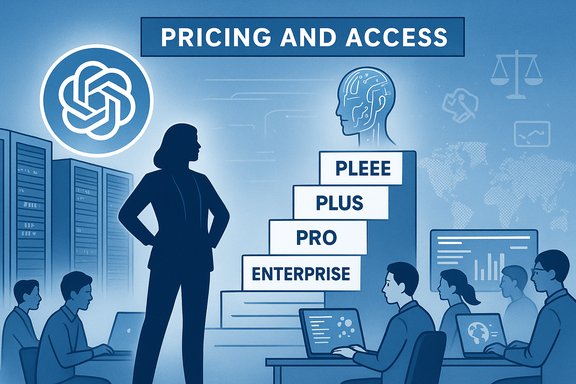
OpenAI announced the appointment of Fidji Simo — formerly CEO of Instacart and a senior product leader at Meta — as its new CEO of Applications, a role created to scale product, go‑to‑market operations, and revenue‑driving channels while letting Sam Altman concentrate on research, compute and safety. The hire is explicit proof that OpenAI is moving from research lab mode toward a product organization that must justify its costs with sustainable business models. At the same time, OpenAI’s consumer product is structured as a multi‑tier service: a free tier alongside paid plans — ChatGPT Plus (widely reported at ~$20/month) and ChatGPT Pro (a higher tier around $200/month) — with enterprise and business packages above them. These tiers unlock different models, higher usage limits, lower latency and priority access to experimental features. OpenAI’s own pricing documentation and multiple independent reports confirm this structure.
Source: CEO Today Will Paying for ChatGPT Limit Accessibility?
 Background
OpenAI announced the appointment of Fidji Simo — formerly CEO of Instacart and a senior product leader at Meta — as its new CEO of Applications, a role created to scale product, go‑to‑market operations, and revenue‑driving channels while letting Sam Altman concentrate on research, compute and safety. The hire is explicit proof that OpenAI is moving from research lab mode toward a product organization that must justify its costs with sustainable business models. At the same time, OpenAI’s consumer product is structured as a multi‑tier service: a free tier alongside paid plans — ChatGPT Plus (widely reported at ~$20/month) and ChatGPT Pro (a higher tier around $200/month) — with enterprise and business packages above them. These tiers unlock different models, higher usage limits, lower latency and priority access to experimental features. OpenAI’s own pricing documentation and multiple independent reports confirm this structure. Why OpenAI is charging — the economics behind the decision
AI at ChatGPT’s scale is expensive. Training, fine‑tuning, inference for large‑context models, and global CDN and datacenter operations require persistent capital and predictable revenue. Paid subscriptions deliver recurring income that funds:- sustained model development and iterative research,
- capacity for low‑latency, high‑concurrency usage,
- product features that require orchestration (agents, browsing, multimodal processing),
- and enterprise controls and compliance tooling that corporate buyers demand.
How monetization fuels product improvements
Paid plans free companies to offer differentiated, higher‑value features without taxing the free pool. In practice, that means:- priority compute for paying users (faster responses, reserved capacity),
- earlier access to model advances and novel tools (agentic automation, multimodal features),
- business‑grade guarantees (non‑training clauses, SSO, audit logs) that cost extra engineering effort.
Accessibility at risk: what paying changes, and what it does not
Charging for premium ChatGPT tiers changes the dynamics of who receives the best AI assistance. That statement breaks down into several concrete effects.1) Performance and feature gap
Paid tiers are designed to offer materially better performance: higher throughput, larger context windows, experimental agent features, and priority routing during congestion. Those advantages have practical consequences — faster and more capable tools for code, research, and business automation translate directly into time and resource savings. For professionals and enterprises, the ROI can be immediate.2) Financial gating of advanced capabilities
When advanced functionality (for example, Operator/agent modes capable of performing web actions) is restricted to higher tiers, the ability to build complex integrations, autonomous workflows, or to rely on large‑context reasoning in everyday tasks requires payment. That changes how institutions, students, and independent creators plan tooling budgets. It also makes product roadmaps for many startups contingent on paid access to the most capable assistants.3) Global and regional affordability gaps
Vendors increasingly experiment with regional pricing and “local” tiers to broaden access (for example, localized, lower‑cost options in price‑sensitive markets). Those moves help but also add complexity: tiers, quotas, and payments differ by market, and local promotional windows may temporarily expand access without addressing long‑term affordability. Regional plays can partly mitigate exclusion but do not eliminate stratification.4) Free tier remains useful — but limited
OpenAI and competitors still maintain free tiers with meaningful capability for casual use: drafting, ideation, simple Q&A, and limited multimodal inputs. However, the real productivity delta — automation, native integrations, low‑latency code execution, and extended context analytics — lives behind paywalls. For many power users, the free option is enough for experimentation but not for production.Who gains — and who’s likely to fall behind
Winners
- Businesses and enterprise buyers: get productivity gains, governance, and integration with internal data. For regulated industries, contractual non‑training and data residency options often require enterprise contracts.
- Power users, researchers, and technical professionals: access to large context, agentic tooling, and higher throughput translates directly into fewer manual steps and faster outputs.
- Vendors building B2B tools: a reliable revenue base makes it simpler to justify heavy engineering investments and customer support.
Losers (or at risk)
- Casual and low‑income users: sustained use beyond experimentation becomes expensive, and a reliance on free tiers may not be sufficient for intensive study, job preparation, or small‑business scale automation.
- Students and educators in underfunded institutions: while targeted programs (grants, promotional access) can help, systemic dependence on paid tiers concentrates advantage among those with purchasing power.
- Regions with payment friction: markets lacking convenient payment rails or with high currency conversion tax can face higher effective prices and adoption gaps.
The competitive landscape: will alternatives fill the gap?
The consumer AI market is not a single monopoly; several providers have introduced their own freemium and paid plans, often clustering around a similar $15–$25/month consumer tier and higher professional tiers at $200/month or more. That pricing convergence reflects the underlying cost structure of high‑capability models and the premium value of enterprise controls. Competition creates options — some lower‑cost challengers and open‑source projects remain attractive for basic workflows — but they frequently trade capability, safety, or integration polish for price. Two practical market outcomes are plausible:- A bifurcated market: commodity, low‑cost assistants for everyday tasks and paid, high‑capability assistants for professional workflows.
- A best‑of‑breed stack: organizations combine free or low‑cost assistants for ideation with paid engines for production tasks.
Policy, education, and equity implications
Monetizing cutting‑edge AI raises questions that go beyond product strategy.Education
If advanced tutoring, research synthesis, and code debugging fall behind a paywall, learners at underfunded schools or in low‑income families may lose access to tools that accelerate learning. Short‑term subsidies and student promotions help, but they don’t replace systemic affordability mechanisms. Public institutions, libraries, and NGOs will likely need to play a larger role as intermediaries or negotiate subsidized institutional access.Public sector and civic services
Government use of AI for public services must balance cost with public benefit. If public agencies are priced out of the most capable models, citizen services that could benefit from automation or analysis might lag. Conversely, public procurement can secure enterprise terms (non‑training clauses, auditability) that are not available to small buyers. Policymakers should consider procurement frameworks that preserve public access to essential AI capabilities.Antitrust and competition policy
If dominant model providers gate the most advanced capabilities behind price ceilings, competition regulators may be asked to evaluate the effects of bundling model access with platform services. Diverse supplier ecosystems and interoperability standards reduce concentration risk; policymakers can encourage open benchmarks, portability, and non‑discriminatory access to foundational layers where feasible.Technical realities that justify charging
From an engineering standpoint, advanced agentic features and very large context windows materially increase compute and storage costs.- Agentic automation requires browser automation, scraping, and safe exploration loops with rollback and verification systems.
- Persistent memory and long‑context reasoning require orchestration of large attention‑state storage and retrieval systems.
- Reducing latency for paying customers often means standing up reserved GPU instances or priority queues in multi‑tenant clusters.
Practical recommendations — what OpenAI and other vendors should do
OpenAI and similar companies can pursue a balanced commercialization path that retains a public benefit orientation without jeopardizing business sustainability. Concrete measures include:- Preserve a usable free tier with clear minimums: keep the baseline useful for learning, low‑volume study, and basic productivity.
- Expand and publicize subsidized or discounted access for students, educators, researchers and nonprofits with streamlined verification.
- Offer institutional licensing for libraries, schools and civic bodies at cost‑reflective, non‑exploitative rates.
- Maintain transparent, regionally adjusted pricing and support local payment rails to reduce friction in lower‑income markets.
- Publish clear quotas and capability differences between tiers so users can make informed tradeoffs.
- Invest in developer tools and sandboxed APIs that enable third‑party innovation around lower‑cost models.
What policymakers and institutions should consider
- Education budgets and digital inclusion programs should explicitly account for AI access as critical infrastructure, similar to broadband or library services.
- Public procurement frameworks should be updated to require non‑training clauses and auditability where taxpayer data is involved.
- Competition policy should monitor whether bundling model access to platform products reduces market entry for specialized or lower‑cost alternatives.
Risks and caveats
Several claims about exclusivity and future stratification are projections, not certainties. Critical unknowns include:- How aggressively vendors will gate capabilities over time versus opening them as costs fall.
- The pace at which cheaper architectures, model distillation, or open‑source innovations will offer competitive, lower‑cost alternatives.
- The role of public policy interventions, subsidies, or institutional purchasing in offsetting market dynamics.
How Windows users and IT admins can respond now
- Map workloads to tiers: separate experimental, occasional, and production uses so you can assign paid seats only where they deliver measurable ROI.
- Use free tiers for ideation and prototyping; reserve Pro/Enterprise seats for production tasks that require reliability, auditability and high throughput.
- Evaluate alternatives and build a heterogeneous stack: combine free assistants with paid engines for heavy lifting where needed.
- Negotiate enterprise terms early if you will process regulated or sensitive data — contractual non‑training and data residency assurances matter.
Conclusion
OpenAI’s hiring of Fidji Simo as CEO of Applications and its tiered commercialization strategy crystallize a tension at the heart of contemporary AI: the need to finance an extraordinarily expensive technical stack while honoring the principle that transformative tools should not be limited to those who can pay the most. Paid plans are a practical necessity if the industry is to sustain the compute, engineering and safeguards that underpin safe, performant systems. Yet commercialization will shape who benefits first. Without deliberate policies, regional pricing, institutional licensing, and public programs aimed at inclusion, the most advanced conversational AI — the very systems that can accelerate learning, automate drudgery, and enlarge economic opportunity — risks becoming a stratified resource. The immediate challenge for OpenAI, policymakers, educators and industry peers is to design pricing, procurement and access strategies that preserve innovation incentives while preventing an avoidable divide between paid insiders and the broader public. Ultimately, paying for ChatGPT need not be a hard limit on accessibility — but absent careful product design and public policy, it creates a risk that the AI revolution will reward those who can afford the best tools first. The next two years will determine whether that risk becomes reality or whether a more inclusive equilibrium can be engineered.Source: CEO Today Will Paying for ChatGPT Limit Accessibility?
