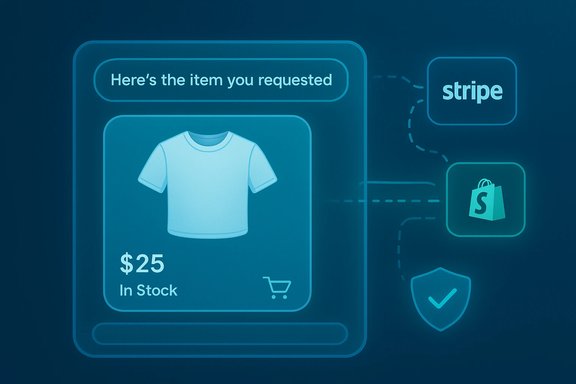
OpenAI’s new Instant Checkout is moving from experiment to scale: after launching with U.S. Etsy sellers, the feature will soon enable in-chat purchases from more than one million Shopify merchants, a step that crystallizes a shift from “links to actions” in e-commerce and creates a new transactional surface inside conversational AI.
The Instant Checkout capability lets ChatGPT users confirm and pay for single-item purchases without leaving the chat interface. The feature is built around tokenized, delegated payment primitives and an open Agentic Commerce Protocol developed with Stripe, which together allow the assistant to orchestrate checkout while the payment processor and merchant complete settlement and keep the merchant as the merchant of record. OpenAI rolled out the initial pilot for Etsy sellers and has publicly stated that over one million Shopify merchants will be “coming soon,” naming household brands among the group likely to appear early. The company says consumers are not charged to use in-chat checkout, while merchants will pay a small fee on successful transactions. Shopify’s parallel work on “Agentic Storefronts,” the Shopify Catalog, and the Universal Commerce Protocol (UCP) provides the canonical, machind that agents like ChatGPT, Microsoft Copilot and Google Gemini will use to discover products and initiate delegated checkouts. These platform- and protocol-level developments are converging into an agentic commerce stack that moves discovery, clarification and payment into single conversational flows.
That promise comes with complexity: richer protocol plumbing, new fraud vectors, potential concentration of gatekeeper power, and thorny governance questions around opt-in defaults and fee transparency. Merchants who treat this as an operational and engineering project—focusing on feed hygiene, tokenized checkout testing, and clear contractual terms—will be best positioned to capture upside while managing downside. The next 6–12 months of rollout and independent audits will determine whether agentic commerce becomes a mainstream channel or a powerful but narrowly used experiment. For merchants, payments partners and platform operators, the right approach is cautious experimentation combined with hard work on catalog quality, fraud controls and clear customer-facing policies.
Source: FourWeekMBA https://fourweekmba.com/openais-ins...out-expands-1m-shopify-merchants-coming-soon]
 Background
The Instant Checkout capability lets ChatGPT users confirm and pay for single-item purchases without leaving the chat interface. The feature is built around tokenized, delegated payment primitives and an open Agentic Commerce Protocol developed with Stripe, which together allow the assistant to orchestrate checkout while the payment processor and merchant complete settlement and keep the merchant as the merchant of record. OpenAI rolled out the initial pilot for Etsy sellers and has publicly stated that over one million Shopify merchants will be “coming soon,” naming household brands among the group likely to appear early. The company says consumers are not charged to use in-chat checkout, while merchants will pay a small fee on successful transactions. Shopify’s parallel work on “Agentic Storefronts,” the Shopify Catalog, and the Universal Commerce Protocol (UCP) provides the canonical, machind that agents like ChatGPT, Microsoft Copilot and Google Gemini will use to discover products and initiate delegated checkouts. These platform- and protocol-level developments are converging into an agentic commerce stack that moves discovery, clarification and payment into single conversational flows.What Instant Checkout actually does — technical anatomy
The three-layer stack: discovery, orchestration, delegated checkout
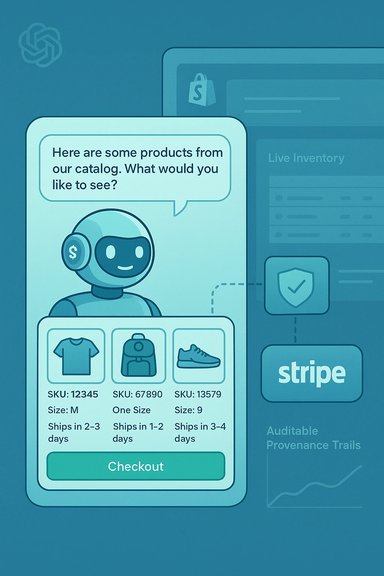
Instant Checkout is not a single API call; it’s an orchestration pattern builed layers:- Machine-readable product data — canonical catalog records (SKUs, GTINs, live inventory, shipping windows, return policies, images and brand voice) that let an assistant ground recommendations in authoritative merchant data rather than scraped or inferrersational orchestration** — the runtime that interprets shopper intent, asks clarifying questions (size, color, delivery constraints), surfaces a short list of buyable items and produces an auditable provenance trail tying the conversation to a catalog record.
- Delegated, tokenized checkout — short-lived payment sessions or scoped tokens generated by a payments partner (Stripe, PayPal, Shop Pay and others) that allow the assistant to trigger a checkout while the PSP performs settlement, fraud checks and dispute handling. The assistant never sees raw card data.
Single-item today, multi-item tomorrow
At launch, Instant Checkout supports single-item purchases; OpenAI has signaled multi-item cart support is in the roadmap. This initial constraint simplifies token semantics and liability boundaries while the ecosystem scales enrollment and fraud controls.Why the Shopify expansion matters
Shopify powers millions of independent merchants. Making those merchant catalogs discoverable — and enabling tokenized checkout from inside ChatGPT — dramatically expands the available inventory for in-chat commerce and creates a meaningful new distribution channel for merchants who opt in or are made agent-ready via platform defaults. OpenAI’s “1M+ Shopify merchants coming soon” claim is material: it converts Instant limited to a boutique marketplace into a channel with broad reach and heterogeneous inventory. Shopify’s productization of the required primitives — Agentic Storefronts, Catalog normalization, Checkout Kit and automated enrollment mechanisms — reduces integration overhead for merchants, making agentic commerce accessible without bespoke engineering for each assistant or channel. That engineering work is the reason Shopify can talk about reaching millions of stores quickly.Economic leverage: transaction fees and Shop Pay
When in-chat checkouts route to payment rails Shopify helps control (Shop Pay) or when third-party processors pay Shopify for integration benefits, the platform captures merchant-services revenue and richer signal data. OpenAI’s model — a merchant-paid “small fee” on purchases within ChatGPT — adds another monetization axis for assistants. Both sides win revenue upside when friction is reduced, but merchants trade margin and dependencent mechanics for that distribution.Merchant-facing practical checklist
Merchants should treat agentic channels like any ibution shift: they require engineering, process discipline and new fraud and fulfillment guardrails. Immediate actions merchants should take include:- Audit produ
- Ensure SKUs, GTINs, sizes, variants, images, shipping options and return rules are accurate and updated in real time. Agents rely on canonical records; bad metadata equals bad discovekout handshakes
- Test delegated payment tokens, success/failure flows and merchant reconciliation paths in staging to confirm orders created through an agent aphant admin and fulfillment systems.
- Harden inventory and fulfillment
- Add rapid cancellation and back-in-stock logic. If chat referrals spike, mis-synced inventory causes oversells and returns.
- Tighten fraud detection
- Extend exce and behavioral rules to cover agent-originated sessions; monitor chargebacks and disputes separately for agentic channels.
- Surface policies and brand voice
- Publish clear return, shipping and warranty policies for agents to ingest; brand-consistent responses lower dispute risk.
- Review commercial terms and opt-out options
- Understand fee schedules, default enrollment windows (automatic opt-ins/opt-outs) and attribution rules. Document fallback plans to withdraw from channels or to restrict product eligibility.
Risks and downside scenarios
ionless in-chat purchases comes with real operational, financial and regulatory trade-offs.Concentration and gatekeeper power
Agentic commerce concentrates discovery inside a few assistant surfaces (ChatGPT, Copilot, Gemini), potentially reducing merchants’ bargaining power. Default enrollment mechanics (e.g., opt-out windows for broad platform rollouts) speed scale but also amplify governance concerns: merchant economics can change if platforms alter ranking algorithms, fees, or featured placements.Attribution, economics, and hidden fees
When discovery and checkout both occur inside an assistant, attribution becomes ambiguous. Platforms could monetize placement, preference slots, or “preferred merchant” treatments inside chat, reshaping CAC and lifetime value math for merchants. The immediate “small fee” on merchant transactions is only the starting point; broader monetization can include advertising-like placements within conversationalcFraud, chargebacks and underwriting
Delegated tokens keep raw card data out of the assistant, but they transfer settlement, fraud mitigation and liability to PSPs and merchants. Higher conversion rates can carry different fraud patterayment processors may change thresholds, reserves or pricing for merchant cohorts that rely heavily on agentic channels. Merchants should expect changes in underwriting rules and fraud monitoring requirements.SEO and discoverability disruption
If conversational assistants become the dominant discovery surface for certain purchase intents, traditional SEO and paid-search traffic may decline. Merchants that rely on organic search should diversify: mainvest in feed-optimization, and test AI-first promotional strategies to retain visibility.Privacy and cross-border compliance
Exposing product feeds and potentially order-enriched metadata to third-party AI vendors raises data governance questions, especially for merchants operating in jurisdictions with strict privacy rules. Merchants must confirm what order data is shared, how long it’s retained, and whether customers’ personal or preference data are forwarded to agent platforms. These are matters of compliance and contractual clarity.Consumer experience: convenience vs. trust
From a consumer perspective, instant, conversational checkout is compelling: it reduces friction at the moment of intent and lets people complete purchases in fewer steps. Early reporting indicates that in-rove conversion velocity because the assistant captures intent, clarifies constraints, then triggers a tokenized checkout. However, trust depends on predictability. If agents surface incorrect availability, wrong sizes, or obscure return rules, a transaction completed in a frictionless way can still damage merchant reputation and lead to higher returns and disputes. Clear provenance, visible merchant identity, and accessible post-purchase support are essential for preserving consumer trust.The broader competitive and standards laout is part of a larger industry race to define the technical and commercial primitives for agentic commerce.
- OpenAI + Stripe published the Agentic Commerce Protocol and open-sourced aspects to accelerate onboarding of merchants and developers. That protocol lays out the token semantics and message flows used in Instant Checkout.
- Shopify hronts and the Shopify Catalog to normalize product metadata and checkout tokens at scale. Those primitives are designed to feed multiple agents and preserve merchant control.
- Google has proposed or endorsed the Universal Commerce Protocol (UCP) for broader interoperability across agents like Gemini, and announced pilot partnerships with large retailers to embed inline checkout inside Gemini and Google’s AI Mode.
- Microsoft is integrating similar ideas into Copilot Checkout PayPal and Stripe as payment partners and an opt-out enrollment model for Shopify merchants in certain rollouts.
Regulatory and policy considerations
Agentic commerce raises issues that regulators will watch closely:- Consumer protection and dispute resolution e trails are vital for resolving disputes that originate from conversational agents. Protocols must record the agent’s decision path and the canonical SKU used for the order.
- Payments and PCI compliance — delegated tokens reduce the neeandle card data but leave fraud handling and settlement to PSPs and merchants, who must maintain robust PCI and dispute workflows.
- Competition and platform governance — automatic enrollment mechanics and prioritization inside AI responses could attract attention from competition authorities if platforms use default settings to advantage their own payment rails or preferred merchants.
- Privacy and data transfers — cross-border order data and user preference signals must comply with local data-protection regimes; merchants should insist on contractual clarity about what data is shared with AI vendors and for how long.
Strategic recommendations for merchants and platform operators
For merchants:- Treat agentic channels as part of your distribution mix, not a replacement for owned channels.
- Prioritize catalog hygiene and invest in automation for attribute extraction and deduplication.
- Negotiate clear commercial terms and monitor channel economics closely, including fee changes and attribution models.
- Test agentic checkout with a limited SKU set and scale as fulfillment and fraud controls prove reliable.
- Publish clear, auditable provenance standards and dispute APIs so merchants can reconcile agent-originated orders.
- Provide sandbox tools and monitoring dashboards tailored to agentic flows to help merchants detect and respond to anomalies quickly.
- Offer transparent commercial models and opt-in/opt-out controls that respect merchant autonomy and reduce gohese steps reduce operational risk and help turn agentic distribution into a sustainable channel rather than a one-off growth spike.
What to watch next
- Multi-item cart rollout — the move from singfull carts is the technical inflection point that will determine whether agentic commerce replaces or complements existing checkout funnels. OpenAI and partners have announced plans but not a precise public timeline.
- Merchant enrollment mechanics — whether merchants are auto-enrolled, opt-in, or have staged opt-outs wiliment and regulatory interest. Watch Shopify and partner announcements closely for default settings.
- Fraud and underwriting signals — payments partners and acquirers will publish or change underwriting rules as they learn agent-originated fraud patterns. Merchants should track chargeback rates by channel.
- Interoperability standards — the interplay between OpenAI’s Agentic Commerce Protocol, Google’s Universal Commerce Protocol, and platform-specific variants will determine how portable merchant integrations are across agents.
- Regulatory scrutiny — expect inquiries into default enrollment, fee transparency and potential anti-competitive behavior as agentic commerce grows.
Conclusion
OpenAI’s Instant Checkout expansion to more than one million Shopify merchants is not merely a product announcement; it is an inflection in how online commerce can be architected. By collapsing discovery, clarification and payment into conversational flows, Instant Checkout and the broader agentic commerce stack promise higher conversion velocity and a new distribution surface that benefits customers, platforms and prepared merchants.That promise comes with complexity: richer protocol plumbing, new fraud vectors, potential concentration of gatekeeper power, and thorny governance questions around opt-in defaults and fee transparency. Merchants who treat this as an operational and engineering project—focusing on feed hygiene, tokenized checkout testing, and clear contractual terms—will be best positioned to capture upside while managing downside. The next 6–12 months of rollout and independent audits will determine whether agentic commerce becomes a mainstream channel or a powerful but narrowly used experiment. For merchants, payments partners and platform operators, the right approach is cautious experimentation combined with hard work on catalog quality, fraud controls and clear customer-facing policies.
Source: FourWeekMBA https://fourweekmba.com/openais-ins...out-expands-1m-shopify-merchants-coming-soon]