

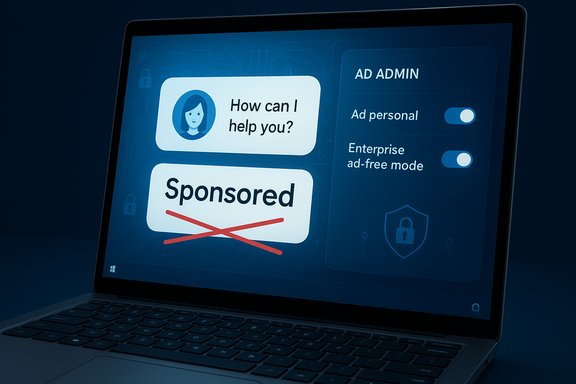
OpenAI’s decision to pause in-chat promotional suggestions inside ChatGPT is a blunt reaffirmation that monetizing conversational AI is harder than building it — and that user trust can evaporate faster than a rollout plan can be written.
Background
In early December, users noticed a puzzling suggestion in ChatGPT: a “Shop at Target” prompt surfaced during an otherwise technical conversation about Windows’ BitLocker, prompting public complaints and internal scrutiny. OpenAI’s Chief Research Officer acknowledged the misstep and said the company had “turned off this kind of suggestion while we improve the model’s precision.”The pause is not an isolated tweak. It sits against a backdrop of engineering signals, beta APK strings, and public debate about how to balance accessibility and reliability while funding ever-more-expensive AI infrastructure. Reverse-engineered Android beta builds had previously exposed resource strings like “ads feature,” “bazaar content,” and “search ads carousel,” which prompted coverage and concern about an ad surface being built into ChatGPT. That evidence is development-level — not proof of a global rollout — but it made a product risk obvious: ads inside a conversational assistant blur the line between editorial responses and paid placements.
What happened — the immediate trigger
- A user reported that ChatGPT surfaced a retail suggestion (Target) in reply to a conversation about Windows BitLocker.
- Mark Chen, OpenAI’s Chief Research Officer, acknowledged the problem publicly, admitting the company “fell short” and confirming the specific kind of in-chat suggestion was disabled while model precision improvements are made.
- OpenAI’s head of ChatGPT sought to clarify that not all screenshot examples were live ad tests, but the perception of ad-like content had already triggered negative reactions that threatened trust.
Overview: Why this matters now
OpenAI, like every major AI vendor, faces a simple economic tension: running large, multimodal models at scale is extremely expensive. Subscription revenue grows, but so does the compute and engineering bill. Ads are a natural lever to subsidize free access and extend reach, particularly when the product becomes a discovery surface where users express purchase intent. Yet, inserting advertising into an assistant that often provides self-contained answers creates unique technical, ethical, and legal problems unmatched by traditional search ads.Two technical realities magnify the risk:
- Conversational outputs are generative and can mix factual summaries with external recommendations, which makes obvious labeling essential.
- Retrieval-enabled features and agentic commerce flows can surface merchant cards, product metadata, and even in-chat checkout buttons — amplifying the consequences of poor catalog freshness or mistaken recommendations.
Technical evidence and limits of what we know
APK reverse engineering produced intuitively worrying strings — “ads feature,” “bazaar content,” and “search ad” — in a ChatGPT Android beta. These strings indicate a client-side UI and module naming that map to an advertising or commerce layer, but they do not, by themselves, demonstrate live ad targeting, auction mechanics, or data-sharing practices. Treat the APK finds as high-confidence evidence of engineering intent, not a finished user experience.Key unknowns that remain unverified and should be treated as such:
- Whether memories or long-term conversation history would be used for ad targeting.
- The precise telemetry or identifiers advertisers would receive (if any).
- The auction, ranking, or revenue-share model that would govern placements.
- Whether paid placements would be visually and functionally separable from organic assistant output at scale.
Business drivers: Why ads were inevitable, and why pausing is pragmatic
OpenAI’s economics make exploration of ad models rational. Subsidizing free access via ads can:- Keep a basic tier accessible to non-paying users,
- Provide advertisers access to high-intent conversational moments,
- Fund continued model improvements and safety work.
The core risks: Trust, privacy, and the open web
- Trust erosion
- Conversational assistants derive value from perceived neutrality. If users suspect recommendations are monetized or biased toward paying partners, confidence collapses quickly. Ads that are not unmistakably labeled risk turning helpful replies into suspect commerce fixtures.
- Privacy and targeting hazards
- Ads typically rely on signals: session intent, account data, location, or historical preferences. Using ChatGPT’s memory features for targeting without explicit, granular consent would be risky both legally and reputationally. OpenAI must avoid hidden personalization that leverages private chat history for monetization.
- Publisher and publisher-economy impact
- A monetized assistant that reduces clicks back to source sites accelerates a “zero-click” dynamic, threatening publishers’ referral revenue and the broader health of the open web. The industry has already flagged this as a systemic risk in ad-enabled AI products.
- Stale data and poor commerce UX
- Retrieval-dependent shopping features can surface out-of-stock SKUs, wrong models, or outdated prices. Integrations that proceed without robust inventory freshness or error handling risk users making purchases they will regret.
- Regulatory and antitrust attention
- A conversational assistant that becomes a default discovery surface invites regulatory scrutiny over auction mechanics, targeting signals, and competition effects — especially if favored partners receive privileged placement.
For Windows users and IT administrators: Practical implications
Windows users and admins should not assume the consumer ChatGPT experience will remain static. Prepare now with clear, concrete steps:- Audit integrations: identify where ChatGPT or embedded assistants are used in workflows, scripts, or automation. If the consumer app is surfaced in employee tools, flag potential ad exposure as an operational risk.
- Review privacy and memory settings: ensure personal and corporate memory features are configured according to policy and educate end users about potential personalization opt-outs.
- Use managed controls: enterprises should expect — and request — admin toggles that can disable ad experimentation for managed accounts or block retrieval-enabled commerce flows. Push vendors for contractual guarantees that enterprise deployments remain ad-free unless explicitly agreed.
- Monitor app updates via MDM: beta strings and feature flags often appear first in mobile clients; use mobile device management (MDM) to control which builds reach employees and to vet new permissions or network endpoints.
- Validate outputs in compliance workflows: if ChatGPT assists in compliance or governance tasks, add verification steps or human-in-the-loop checks before acting on recommendations that could be influenced by commerce placements.
How OpenAI can repair and redesign responsibly
If monetization is inevitable, the product and policy choices will determine whether the move helps or harms the platform. Good design principles include:- Clear labeling: all sponsored content must be prominently and unambiguously labeled as sponsored, visually distinct from model-generated summaries.
- Scoped placements: limit ads to clear commerce and high-intent queries (shopping, local services) and avoid embedding sponsored content into purely informational or technical answers.
- Granular opt-outs: give users explicit, persistent toggles to opt out of ads or ad personalization — not buried settings or opaque consent pop-ups.
- Premium guarantees: ensure paid tiers are reliably ad-free with enforceable SLAs; subscribers must receive a materially different experience.
- Enterprise separation: keep enterprise and API products ad-free by default, with contract-level assurances preventing ad leakage into business workflows.
- Independent audits: commission third-party audits of ad placement fairness, data flows, and labeling practices to rebuild and preserve trust.
Scenario planning: three practical paths OpenAI could follow
- Conservative (lowest risk)
- Ads are limited to labeled commerce cards during retrieval-enabled flows.
- No use of memories for targeting; premium tiers forever ad-free.
- Strong transparency and admin controls for enterprise customers.
- Hybrid (likely)
- Ads appear in shopping/search contexts with session-based personalization.
- Memories are opt-in for ad personalization; paid tiers remove ads.
- Gradual rollout with visible A/B testing and opt-out toggles.
- Aggressive (highest risk)
- Ads are embedded broadly across conversational outputs with deep personalization using memory signals.
- Minimal labeling and aggressive monetization optimizations.
- Significant regulatory risk, user backlash, and potential publisher pushback.
Recommendations for advertisers and publishers
- Advertisers: test cautiously. Conversational ad inventory can deliver high intent, but measurement models differ; insist on transparency for attribution, placement mechanics, and creative controls.
- Publishers: prepare for reduced referral traffic by diversifying revenue (subscriptions, direct-sold placements) and engaging platforms about fair compensation if answers routinely replace clicks.
- Ad tech vendors: focus on privacy-first attribution (hashed, aggregated signals, short-lived tokens) and avoid dependence on long-term user memories without explicit consent.
What to watch next — clear signals that matter
- Server-side experiments visible in screenshots or A/B test reports (e.g., “Sponsored” badges appearing for some users).
- Official policy pages or updated privacy terms describing what conversational signals are used for targeting.
- Admin controls for managed accounts and explicit enterprise guarantees that consumer ad experiments will not leak into enterprise products.
- Advertiser onboarding materials or dashboards — a sign the ad stack is transitioning from prototype to revenue-ready.
- Independent audits or industry agreements around labeling and compensation to publishers.
Conclusion
OpenAI’s temporary shutdown of ad-like suggestions inside ChatGPT is a terse but important lesson: monetizing a conversational assistant is not simply a UI change — it’s a trust experiment with privacy, legal, and ecosystem consequences. The company’s immediate pivot to improve model precision and offer better user controls is the right tactical response. Longer-term success will rest on the discipline to label clearly, respect privacy, preserve premium guarantees, and keep enterprise contexts insulated from consumer experiments.For Windows users and IT professionals, the moment is one of proactive governance: audit integrations, demand admin controls, and treat conversational monetization as a product change that requires policy updates, user education, and technical safeguards. If executed with transparency and design restraint, ads could subsidize broader access without destroying trust. If executed rushed or opaquely, a single misplaced suggestion — like the Target prompt in a BitLocker thread — can quickly become the headline that undoes years of credibility.
Source: PCWorld OpenAI turns off ads on ChatGPT as AI falls short
