

OpenAI’s reported plan to fold ChatGPT, Codex, and a forthcoming browser into a single app is more than a product cleanup exercise. It signals a broader shift from isolated AI features toward a unified agent platform that can chat, code, browse, and act on a user’s behalf. If the company executes well, the result could be the clearest consumer-facing expression yet of “AI as an operating layer” rather than just a chatbot.
The idea also fits the direction OpenAI has already been taking in 2025 and 2026. Codex has moved from a standalone coding agent into ChatGPT-adjacent workflows, while Operator-style browser automation has already been integrated into ChatGPT as an agent mode. That makes the reported superapp less like a surprise and more like the logical next step in OpenAI’s consolidation strategy.
OpenAI’s product line has expanded quickly, and that expansion has created both opportunity and friction. ChatGPT began as a general-purpose conversational assistant, but over time it absorbed more specialized capabilities, including agentic browsing, coding assistance, and workflow automation. The company’s own product announcements show a steady push toward deeper task completion rather than simple question answering.
Codex is a useful example of that evolution. OpenAI described Codex as a cloud-based software engineering agent, and later updates noted that it could be accessed through ChatGPT and across multiple surfaces such as the web, the CLI, and IDE extensions. That matters because it shows OpenAI has already been reducing the gap between “the chat app” and “the coding app,” even before any rumored full merger.
Browser-based automation followed a similar path. Operator launched as a research preview of an agent that could use its own browser to type, click, and scroll, and OpenAI later said those capabilities were integrated into ChatGPT as ChatGPT agent. In practical terms, that means the company already has a pattern for turning niche standalone systems into features inside the main app.
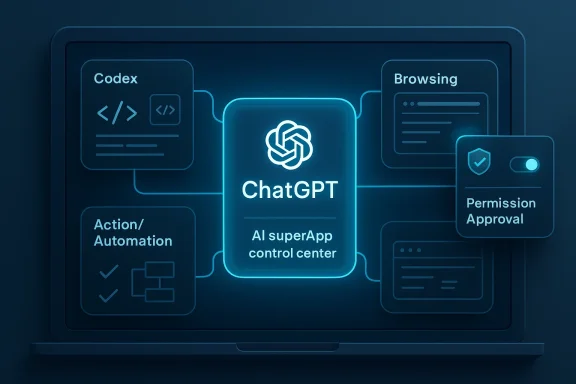
The reported superapp concept therefore looks like a product architecture decision, not just a branding move. OpenAI appears to be converging on a single interface where the user can ask, browse, code, delegate, and possibly trigger actions in one place. That is a powerful proposition, but it also raises hard questions about clarity, governance, and how much autonomy is too much for a mainstream app.
There is also a competitive pressure component. Rival platforms are racing toward integrated assistants that can span conversations, documents, code, and browser actions. If OpenAI can make its own ecosystem feel seamless, it strengthens retention and reduces the chance that users drift toward specialized rivals.
That architecture is attractive because it mirrors how people actually work. Many tasks begin as conversation, move into research, then require code changes or actions on external systems. A well-designed unified app could reduce the handoffs that currently interrupt that flow.
If OpenAI gets this right, users may stop thinking in terms of separate products at all. Instead, they may ask one system to “research, build, and do,” trusting it to choose the right tools in sequence.
That breadth matters because software development is already a multi-surface activity. Developers live in terminals, editors, browsers, repositories, and chat tools. A unified OpenAI experience could reduce the cognitive load of switching between those environments, especially if the system can remember the state of a task across contexts.
If Codex becomes a native module inside a larger app, that could make AI coding feel less like a sidecar and more like a standard part of the development stack. In turn, that may raise expectations for every other coding assistant in the market.
This matters because browser access turns AI from an interpreter into an actor. A model that can read a page is helpful; a model that can navigate a page, fill forms, and complete multi-step tasks is far more consequential. That is the leap from information retrieval to digital labor.
But browser action also introduces failure modes that are easy to underestimate. Websites change constantly, interfaces are brittle, and workflows often require edge-case judgment. Agentic browsing works best when tasks are bounded, permissions are clear, and the user can intervene easily.
Enterprise users, however, will judge the product differently. They will care less about convenience and more about permissions, auditability, data boundaries, and admin controls. A merged app can be helpful, but only if it exposes clear governance around what the AI can access and what actions it can take.
OpenAI’s existing product positioning already hints at this dual-track strategy. Codex is offered across multiple ChatGPT plans and surfaces, while agent-style features are increasingly embedded directly into ChatGPT. That suggests OpenAI wants one core architecture but multiple levels of access and governance.
That would pressure competitors in two directions. First, it would force them to match the convenience of a single interface. Second, it would force them to defend the value of specialization, which is a harder argument if users can get “good enough” performance across several tasks from one app.
That could be especially important in coding and agent automation, where switching costs rise quickly once users have stored workflows, preferences, and trust in one platform. If OpenAI can make ChatGPT the default place where work begins and ends, it gains a structural advantage.
The interface must therefore do two contradictory things at once. It has to feel unified, but it also has to preserve enough separation that users understand what mode they are in. That is especially important when the system can act autonomously or trigger side effects.
It also gives OpenAI room to introduce guardrails. A browser task might require confirmation before sending a form, while a code task might need explicit repository permissions. Those boundaries are not just safety features; they are UX features because they build trust.
This is not a hypothetical concern. OpenAI has already framed its agentic tools with explicit limits and updates, which reflects the reality that these systems need human oversight. The company’s public positioning around Operator and Codex suggests a deliberate balance between capability and caution.
The trust problem also extends to everyday users who may not fully understand what the AI is doing. If the interface hides too much, users may feel disoriented. If it reveals too much, the product may feel overwhelming. The best outcome is a layered design that surfaces complexity only when needed.
If that happens, the surrounding ecosystem will change. Developers will build with the assumption that ChatGPT is a launchpad. Users may expect browser tasks, coding tasks, and content tasks to all live under the same sign-in. And third-party tools may need to decide whether to integrate with the platform or compete against it.
A single app also simplifies branding. Instead of explaining multiple product names, plan tiers, and access points, OpenAI can present one assistant with expandable capabilities. That may sound cosmetic, but in consumer technology clarity is conversion.
The market will also be watching for evidence of scope. Is this merely a front-end simplification, or is OpenAI building a deeper orchestration layer that lets the app plan, browse, code, and execute across services? Those are different ambitions, and they imply very different engineering and safety burdens. If the company chooses the larger path, it will need serious guardrails and a very clear permission model.
Source: YugaTech OpenAI to merge ChatGPT, Codex, browser into one app
The idea also fits the direction OpenAI has already been taking in 2025 and 2026. Codex has moved from a standalone coding agent into ChatGPT-adjacent workflows, while Operator-style browser automation has already been integrated into ChatGPT as an agent mode. That makes the reported superapp less like a surprise and more like the logical next step in OpenAI’s consolidation strategy.
 Background
OpenAI’s product line has expanded quickly, and that expansion has created both opportunity and friction. ChatGPT began as a general-purpose conversational assistant, but over time it absorbed more specialized capabilities, including agentic browsing, coding assistance, and workflow automation. The company’s own product announcements show a steady push toward deeper task completion rather than simple question answering.Codex is a useful example of that evolution. OpenAI described Codex as a cloud-based software engineering agent, and later updates noted that it could be accessed through ChatGPT and across multiple surfaces such as the web, the CLI, and IDE extensions. That matters because it shows OpenAI has already been reducing the gap between “the chat app” and “the coding app,” even before any rumored full merger.
Browser-based automation followed a similar path. Operator launched as a research preview of an agent that could use its own browser to type, click, and scroll, and OpenAI later said those capabilities were integrated into ChatGPT as ChatGPT agent. In practical terms, that means the company already has a pattern for turning niche standalone systems into features inside the main app.
The reported superapp concept therefore looks like a product architecture decision, not just a branding move. OpenAI appears to be converging on a single interface where the user can ask, browse, code, delegate, and possibly trigger actions in one place. That is a powerful proposition, but it also raises hard questions about clarity, governance, and how much autonomy is too much for a mainstream app.
Why consolidation matters now
The AI market is maturing fast, and fragmented interfaces are starting to look expensive. Users do not want to remember which app handles coding, which one handles web tasks, and which one manages long-running agents. OpenAI’s challenge is to make its portfolio feel like one coherent system rather than a stack of unrelated experiments.There is also a competitive pressure component. Rival platforms are racing toward integrated assistants that can span conversations, documents, code, and browser actions. If OpenAI can make its own ecosystem feel seamless, it strengthens retention and reduces the chance that users drift toward specialized rivals.
- Less app switching for everyday users.
- Fewer mental models to learn for new users.
- More cross-sell potential across plans and features.
- A stronger default surface for agentic workflows.
- Better brand clarity in a crowded AI market.
What the “superapp” really implies
A true AI superapp would do more than place several tools under one icon. It would connect them through shared context, shared memory, and shared task execution. In OpenAI’s case, that means ChatGPT could become the front door, Codex the specialized reasoning layer for software work, and browser automation the execution layer for web-facing actions.That architecture is attractive because it mirrors how people actually work. Many tasks begin as conversation, move into research, then require code changes or actions on external systems. A well-designed unified app could reduce the handoffs that currently interrupt that flow.
From chatbot to control center
The biggest shift is conceptual. ChatGPT would no longer be seen mainly as a place to ask questions, but as a control center for digital work. That is a meaningful change in user perception, and perceptions often matter as much as technical capability in consumer software.If OpenAI gets this right, users may stop thinking in terms of separate products at all. Instead, they may ask one system to “research, build, and do,” trusting it to choose the right tools in sequence.
- ChatGPT becomes the entry point.
- Codex becomes the specialist engine.
- Browser automation becomes the action layer.
- Shared identity and login reduce friction.
- One interface lowers adoption barriers.
Codex’s role in the new stack
Codex is especially important because coding agents are among the most credible early use cases for AI automation. OpenAI has repeatedly emphasized Codex as a tool for writing features, fixing bugs, answering codebase questions, and proposing pull requests. The newer Codex app broadens that story by positioning it as a command center for agent workflows across app, web, IDE, CLI, and cloud.That breadth matters because software development is already a multi-surface activity. Developers live in terminals, editors, browsers, repositories, and chat tools. A unified OpenAI experience could reduce the cognitive load of switching between those environments, especially if the system can remember the state of a task across contexts.
Why developers care
For developers, the strongest value proposition is not merely speed. It is the ability to delegate a chain of work: inspect a problem, generate a fix, test the result, and prepare the output for review. OpenAI has already framed Codex in precisely that direction, describing parallel task handling and long-lived agent workflows.If Codex becomes a native module inside a larger app, that could make AI coding feel less like a sidecar and more like a standard part of the development stack. In turn, that may raise expectations for every other coding assistant in the market.
- Parallel task execution becomes more practical.
- Long-running jobs become easier to supervise.
- Pull request generation can be folded into one flow.
- Context continuity improves across tools.
- Non-experts may find coding assistance less intimidating.
Browser integration and agentic actions
The browser piece may be the most transformative. OpenAI’s browser-enabled agent work already suggests a future where the system can interact with websites directly rather than only summarizing them. The company has said Operator could use a browser to type, click, and scroll, and later integrated those ideas into ChatGPT agent.This matters because browser access turns AI from an interpreter into an actor. A model that can read a page is helpful; a model that can navigate a page, fill forms, and complete multi-step tasks is far more consequential. That is the leap from information retrieval to digital labor.
Browsing as execution, not just search
The reported superapp would likely lean heavily on this distinction. A unified interface could let users ask for research, then have the system browse sources, synthesize findings, and act on them without leaving the app. That kind of workflow is more ambitious than a traditional browser extension and more coherent than bouncing among separate AI tabs.But browser action also introduces failure modes that are easy to underestimate. Websites change constantly, interfaces are brittle, and workflows often require edge-case judgment. Agentic browsing works best when tasks are bounded, permissions are clear, and the user can intervene easily.
- Typing and clicking are more powerful than plain search.
- Workflow completion becomes more realistic.
- Human oversight remains essential for critical tasks.
- Website variability can break automations.
- Security and permissions become central design issues.
Enterprise versus consumer impact
The consumer pitch for a unified app is straightforward: fewer apps, fewer tabs, less confusion. For everyday users, one place to chat, browse, and automate is easier to understand than a scattered product suite. That simplicity could widen adoption, especially among people who have tried AI but never fully integrated it into daily routines.Enterprise users, however, will judge the product differently. They will care less about convenience and more about permissions, auditability, data boundaries, and admin controls. A merged app can be helpful, but only if it exposes clear governance around what the AI can access and what actions it can take.
Different buyers, different needs
For consumers, the main benefit is friction reduction. They are more likely to embrace a single app if it feels like one assistant that can do many things well. For enterprises, the challenge is proving that the same interface can remain safe, compliant, and measurable across teams.OpenAI’s existing product positioning already hints at this dual-track strategy. Codex is offered across multiple ChatGPT plans and surfaces, while agent-style features are increasingly embedded directly into ChatGPT. That suggests OpenAI wants one core architecture but multiple levels of access and governance.
- Consumers want convenience.
- Enterprises want control.
- Developers want precision.
- Security teams want visibility.
- Procurement teams want predictable pricing.
Competitive implications
If OpenAI ships a single, deeply integrated app before its rivals, it could set a new expectation for what an AI assistant should be. The market is already full of point solutions that excel at one thing: chat, search, code, or workflow automation. A true superapp would try to own the seam between them.That would pressure competitors in two directions. First, it would force them to match the convenience of a single interface. Second, it would force them to defend the value of specialization, which is a harder argument if users can get “good enough” performance across several tasks from one app.
The platform war is changing shape
The fight is no longer only about model quality. It is also about product gravity—the degree to which a company can keep users inside its ecosystem. A unified app increases gravity because each new capability makes the whole system more sticky.That could be especially important in coding and agent automation, where switching costs rise quickly once users have stored workflows, preferences, and trust in one platform. If OpenAI can make ChatGPT the default place where work begins and ends, it gains a structural advantage.
- Model quality matters, but it is no longer enough.
- Workflow integration drives retention.
- Ecosystem stickiness becomes a moat.
- Cross-surface continuity can beat point features.
- Brand trust influences willingness to delegate tasks.
The product design challenge
A merged app sounds simple in a press note, but it is difficult in practice. OpenAI would need to reconcile very different interaction patterns: chat for natural conversation, Codex for structured development work, and browser actions for real-world execution. Each of those modes has different expectations, different safety requirements, and different success criteria.The interface must therefore do two contradictory things at once. It has to feel unified, but it also has to preserve enough separation that users understand what mode they are in. That is especially important when the system can act autonomously or trigger side effects.
Clear modes, clear boundaries
The most elegant version of the product would probably use explicit task modes under one umbrella. Users would stay in one app, but the app would signal when it is in research mode, coding mode, or action mode. That reduces confusion and helps prevent accidental overreach.It also gives OpenAI room to introduce guardrails. A browser task might require confirmation before sending a form, while a code task might need explicit repository permissions. Those boundaries are not just safety features; they are UX features because they build trust.
- Define the task.
- Let the AI choose the relevant tool.
- Show the user what the AI plans to do.
- Ask for approval before risky actions.
- Provide an audit trail after completion.
Safety, trust, and autonomy
As OpenAI pushes toward more autonomous behavior, the safety story becomes central rather than peripheral. A browser-enabled, code-writing, task-executing assistant can do impressive things, but it can also make mistakes at scale. The more unified the app becomes, the more dangerous it is to let one confused model decision spill across multiple systems.This is not a hypothetical concern. OpenAI has already framed its agentic tools with explicit limits and updates, which reflects the reality that these systems need human oversight. The company’s public positioning around Operator and Codex suggests a deliberate balance between capability and caution.
Trust is the real product
A superapp will not win solely because it is powerful. It will win if users believe it will behave consistently, explain itself clearly, and avoid unwanted actions. That is especially true when the system is allowed to browse, act, and possibly interact with a desktop environment.The trust problem also extends to everyday users who may not fully understand what the AI is doing. If the interface hides too much, users may feel disoriented. If it reveals too much, the product may feel overwhelming. The best outcome is a layered design that surfaces complexity only when needed.
- Approval prompts reduce accidental actions.
- Task summaries improve transparency.
- Permission scopes limit exposure.
- Logs and histories help users verify behavior.
- Fallback controls keep humans in charge.
Implications for the app ecosystem
The rumored merger also hints at a broader structural shift: AI apps may stop looking like separate consumer apps and start looking like modules inside a larger operating environment. That would make OpenAI less like a company with many products and more like a platform owner with one increasingly powerful shell.If that happens, the surrounding ecosystem will change. Developers will build with the assumption that ChatGPT is a launchpad. Users may expect browser tasks, coding tasks, and content tasks to all live under the same sign-in. And third-party tools may need to decide whether to integrate with the platform or compete against it.
Why fragmentation becomes a problem
Fragmentation is manageable when tools are narrowly scoped. It becomes a problem when one company’s tools overlap enough that the user experience feels redundant. OpenAI seems to be acknowledging that reality by moving toward a more unified front end.A single app also simplifies branding. Instead of explaining multiple product names, plan tiers, and access points, OpenAI can present one assistant with expandable capabilities. That may sound cosmetic, but in consumer technology clarity is conversion.
- One entry point simplifies marketing.
- Shared login reduces onboarding friction.
- Unified billing can improve plan adoption.
- Common context reduces user confusion.
- Fewer names make the ecosystem easier to explain.
Strengths and Opportunities
The reported superapp strategy has several obvious advantages. It could make OpenAI’s products easier to understand, easier to adopt, and more difficult to abandon. It also aligns with the company’s existing trajectory toward agentic systems that can complete tasks rather than merely answer prompts.- Single experience for chat, code, browsing, and automation.
- Stronger user retention through ecosystem consolidation.
- Better onboarding for new and non-technical users.
- More natural workflows across research and execution.
- Higher developer value if Codex remains deeply integrated.
- Potential enterprise appeal if controls and governance are robust.
- Clearer product narrative in a crowded AI market.
Risks and Concerns
The same consolidation that creates convenience can also create complexity. A superapp can become unwieldy if it tries to do too much, and agentic features can make that problem worse by adding autonomy, permissions, and execution risk. The company will need to avoid the trap of making the product sound simple while the actual system becomes harder to understand.- UI bloat could undermine the simplicity promise.
- Autonomy errors could damage user trust.
- Browser brittleness may limit real-world reliability.
- Security concerns grow when AI can act across apps.
- Enterprise buyers may demand more controls than consumers.
- Power users may resist oversimplified workflows.
- Brand confusion could increase if migration is poorly managed.
Looking Ahead
The next phase will likely be defined less by announcement language and more by product behavior. If OpenAI really is preparing a unified app, the key question is whether it can make the experience feel seamless without hiding important details from users. The company has already shown that it can integrate specialized tools into ChatGPT; the harder task is turning that integration into a stable, intuitive platform.The market will also be watching for evidence of scope. Is this merely a front-end simplification, or is OpenAI building a deeper orchestration layer that lets the app plan, browse, code, and execute across services? Those are different ambitions, and they imply very different engineering and safety burdens. If the company chooses the larger path, it will need serious guardrails and a very clear permission model.
- Product naming and packaging will reveal how ambitious the consolidation is.
- Task orchestration quality will show whether the platform is truly agentic.
- Permission and safety controls will determine enterprise acceptance.
- Cross-device consistency will shape consumer adoption.
- Performance under real workloads will decide whether the app feels magical or merely rebranded.
Source: YugaTech OpenAI to merge ChatGPT, Codex, browser into one app
Last edited:
