

OpenAI’s push toward a unified AI superapp is best understood not as a flashy rebrand, but as a strategic attempt to collapse several separate product categories into one persistent desktop experience. The company has already moved in that direction with ChatGPT, Codex, and Atlas, and recent official posts show how aggressively it is trying to turn chat, coding, and web navigation into a single workflow surface. That matters because the race is no longer just about model quality; it is about where users spend time, how often they return, and which company becomes the default interface for work. OpenAI’s own recent announcements show a business with massive consumer reach, rapidly expanding enterprise penetration, and a growing appetite for agentic products that operate across apps rather than inside isolated tabs.
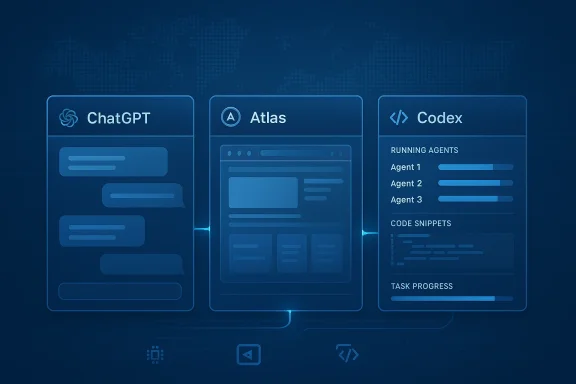
OpenAI has spent the last year moving from “chatbot company” to platform builder, and the superapp concept is the logical extension of that transition. The company’s Atlas browser positions ChatGPT as a web copilot that can understand what a user is doing on a page and help complete tasks without copy-pasting or context switching. The Codex app, meanwhile, gives developers a desktop command center for managing multiple agents, parallel work, and long-running tasks. Put together, these are not isolated launches; they look like the pieces of a broader operating layer for knowledge work.
The timing is important. OpenAI’s recent official funding and growth updates show a company with enough scale to justify a unification play, not merely a product experiment. It has publicly said ChatGPT now reaches more than 900 million weekly users, while business adoption has become a central revenue engine, with over 9 million paying business users and enterprise activity rising quickly. OpenAI also says weekly Codex usage has climbed sharply in 2026, reinforcing the idea that agentic tools are no longer niche utilities for engineers but entry points into broader workflow automation.
There is also a more subtle strategic shift underway. OpenAI has started talking about “surface unification” as a way to move users from consumer habits to enterprise deployment, which is an old platform trick in a new AI setting. If the same account, memory layer, and task model can follow someone from casual ChatGPT use to work in the browser to coding in Codex, then the company gains a lot more than convenience. It gains retention, data continuity, and a stronger wedge into enterprise workflows where switching costs are highest.
It also changes the competitive map. A chatbot can be copied; a multi-surface workflow environment is harder to displace once users organize their daily routines around it. That is why the browser layer, the coding layer, and the conversational layer are now converging so quickly.
That architecture makes sense because chat alone is not enough for agentic computing. A chatbot can reason, summarize, and draft, but it does not natively own the browser, the local desktop, or the development lifecycle. Atlas fills the navigation gap, while Codex fills the execution gap. The result is a product family that can plausibly support everything from research to code changes to task completion in one session.
The consumer layer is not just about free users. OpenAI has been explicit that paid and business subscriptions are central to sustaining access and infrastructure. That means ChatGPT is being shaped as a mass-market product and a funnel into enterprise purchasing at the same time. The superapp strategy gives OpenAI a cleaner path to monetize both ends of that funnel.
OpenAI’s engineering post about Atlas also made clear that the company rethought browser architecture so ChatGPT could act as a true copilot for the web. The browser is not a side project; it is a foundational layer for agentic behavior. Once the browser is part of the same product identity as ChatGPT, the idea of a “unified desktop app” starts looking less speculative and more inevitable.
That makes Codex more than a developer tool. Even if its earliest use cases are in software engineering, the design pattern is broader: delegate, monitor, review, and continue. OpenAI has repeatedly emphasized agentic workflows in recent product posts, which suggests Codex may eventually become the action layer inside the superapp rather than a separate destination.
This is the kind of scale that creates product pressure. Once a platform becomes this large, it starts to pay to unify identity, memory, billing, and task orchestration because fragmented surfaces create friction and missed monetization opportunities. A consumer who starts in chat, then opens a browser, then switches to an agent app is a user who can be lost at any step. A superapp reduces those losses.
There is a commercial reason as well. OpenAI’s advertising test began in the US for Free and Go users, and the company says ads are separated from model outputs and do not influence answers. A unified app with more entry points could create more inventory and more context for monetization, even if OpenAI is careful not to tie the concept directly to ads today. That is speculative, but it is a reasonable platform inference.
The enterprise angle also helps explain why OpenAI is expanding toolchain integrations. The more an AI platform connects to Drive, Slack, IDEs, cloud sandboxes, and browser workflows, the more indispensable it becomes. A unified app can function as the top-level orchestrator while still reaching into the systems companies already rely on.
Atlas makes that strategy especially provocative because browsers are one of the few surfaces where daily habits, search intent, and task context naturally converge. If OpenAI can pull even a modest share of browser time away from Chrome and Edge, it gains a powerful distribution channel for every other product in the stack. The browser is not just a feature; it is a traffic engine.
That creates a more competitive posture than the old “partner and supplier” relationship suggested. Microsoft still benefits from the relationship, but OpenAI is increasingly acting like a platform company with its own gravity. In practical terms, that means the companies may cooperate on infrastructure while competing for the same user attention.
The risk for Google is not just feature parity; it is interface drift. If users start treating OpenAI as the place where prompts become actions, Google could be pushed back into one component of a larger workflow rather than the gateway itself. That would be a meaningful change in the power balance of desktop AI.
This matters because the browser sees more of a user’s real context than a chat window ever can. It knows which tabs are open, which forms are being filled out, which services are being used, and where actions stall. That gives an AI browser enough situational awareness to do useful work without requiring the user to translate everything into a prompt.
The implication is that OpenAI wants the strategic benefit of a browser without the burden of rebuilding the web stack. That is smart, but it also means Atlas has to differentiate through AI behavior, UX quality, and seamless cross-app operation rather than through basic browser mechanics.
But the two markets are not identical, and that matters. Consumers care about convenience, delight, and speed, while enterprises care about control, auditability, compliance, and security. A superapp that excels in one context can still stumble in the other if it does not provide enough administrative depth and policy clarity.
The upside is obvious: one interface can reduce training costs and improve adoption. The downside is equally obvious: one interface can concentrate risk, create dependency, and make failures more visible. OpenAI is betting that the benefits will outweigh the governance burden.
That is a notable stance because it suggests OpenAI wants ads to feel adjacent rather than invasive. In a superapp, however, the line between helpful recommendation and commercial placement can become blurred very quickly. The company will need to protect trust aggressively if it expands ad surfaces across chat, browser, and task execution.
The superapp model helps because it broadens the number of moments when monetization can happen. Someone may start with a chat, move to a browser task, then delegate a coding workflow, then hand the tool to a team. Each step gives OpenAI more opportunities to justify a subscription upgrade or enterprise expansion.
The company will also have to prove that agentic computing can be safe enough for everyday use at scale. That means stronger controls, clearer separation between consumer and enterprise data, and a more mature story around what agents can and cannot do. OpenAI has the momentum to make the attempt; the unanswered question is whether it can make a superapp that feels indispensable without becoming unwieldy.
Source: thekeyword.co Official: OpenAI is Building an AI Superapp
 Overview
OpenAI has spent the last year moving from “chatbot company” to platform builder, and the superapp concept is the logical extension of that transition. The company’s Atlas browser positions ChatGPT as a web copilot that can understand what a user is doing on a page and help complete tasks without copy-pasting or context switching. The Codex app, meanwhile, gives developers a desktop command center for managing multiple agents, parallel work, and long-running tasks. Put together, these are not isolated launches; they look like the pieces of a broader operating layer for knowledge work.The timing is important. OpenAI’s recent official funding and growth updates show a company with enough scale to justify a unification play, not merely a product experiment. It has publicly said ChatGPT now reaches more than 900 million weekly users, while business adoption has become a central revenue engine, with over 9 million paying business users and enterprise activity rising quickly. OpenAI also says weekly Codex usage has climbed sharply in 2026, reinforcing the idea that agentic tools are no longer niche utilities for engineers but entry points into broader workflow automation.
There is also a more subtle strategic shift underway. OpenAI has started talking about “surface unification” as a way to move users from consumer habits to enterprise deployment, which is an old platform trick in a new AI setting. If the same account, memory layer, and task model can follow someone from casual ChatGPT use to work in the browser to coding in Codex, then the company gains a lot more than convenience. It gains retention, data continuity, and a stronger wedge into enterprise workflows where switching costs are highest.
Why the superapp framing matters
The phrase superapp is doing a lot of work here. In classic platform terms, it signals a product that tries to become the default place where many actions begin and end. For OpenAI, that means reducing friction between asking, browsing, building, and acting, which is exactly the kind of integration that can turn a model into a habit.It also changes the competitive map. A chatbot can be copied; a multi-surface workflow environment is harder to displace once users organize their daily routines around it. That is why the browser layer, the coding layer, and the conversational layer are now converging so quickly.
The Product Stack Behind the Strategy
OpenAI’s product stack now looks more like an ecosystem than a single app. ChatGPT remains the consumer front door, Atlas supplies web context and task execution, and Codex handles more structured work such as software tasks, long-running agent runs, and collaboration across environments. Each piece solves a different part of the same problem: how to keep the AI present when a user leaves one screen and enters another.That architecture makes sense because chat alone is not enough for agentic computing. A chatbot can reason, summarize, and draft, but it does not natively own the browser, the local desktop, or the development lifecycle. Atlas fills the navigation gap, while Codex fills the execution gap. The result is a product family that can plausibly support everything from research to code changes to task completion in one session.
ChatGPT as the front door
ChatGPT is still the strongest consumer asset in OpenAI’s portfolio because it is the broadest, most habitual interface. OpenAI says each week more than 900 million people use ChatGPT, and that scale gives the company a distribution advantage few rivals can match. It also explains why OpenAI keeps widening the app’s scope with memory, search, file work, and business integrations.The consumer layer is not just about free users. OpenAI has been explicit that paid and business subscriptions are central to sustaining access and infrastructure. That means ChatGPT is being shaped as a mass-market product and a funnel into enterprise purchasing at the same time. The superapp strategy gives OpenAI a cleaner path to monetize both ends of that funnel.
Atlas as the web layer
Atlas is particularly significant because browsers are where a huge amount of knowledge work actually happens. OpenAI’s own Atlas launch framed the browser as the place where “work, tools, and context come together,” and said the browser can help complete tasks without leaving the page. That is a direct challenge to the assumption that AI belongs in a chat box separate from the work itself.OpenAI’s engineering post about Atlas also made clear that the company rethought browser architecture so ChatGPT could act as a true copilot for the web. The browser is not a side project; it is a foundational layer for agentic behavior. Once the browser is part of the same product identity as ChatGPT, the idea of a “unified desktop app” starts looking less speculative and more inevitable.
Codex as the execution engine
Codex matters because it gives OpenAI something many consumer AI products still lack: a credible execution layer. The current Codex app is designed to manage multiple agents, run work in parallel, and handle long-running tasks, with support extending across the CLI, IDE, cloud, and app. OpenAI says the app lets users keep work moving without constantly switching tools.That makes Codex more than a developer tool. Even if its earliest use cases are in software engineering, the design pattern is broader: delegate, monitor, review, and continue. OpenAI has repeatedly emphasized agentic workflows in recent product posts, which suggests Codex may eventually become the action layer inside the superapp rather than a separate destination.
Scale, Revenue, and the Logic of Consolidation
OpenAI’s public numbers help explain why consolidation is happening now. The company says it now serves more than 900 million weekly ChatGPT users, has more than 9 million paying business users, and sees enterprise as a major and growing share of its revenue mix. In the same period, OpenAI has also announced major new funding and infrastructure partnerships, signaling that it intends to keep expanding aggressively.This is the kind of scale that creates product pressure. Once a platform becomes this large, it starts to pay to unify identity, memory, billing, and task orchestration because fragmented surfaces create friction and missed monetization opportunities. A consumer who starts in chat, then opens a browser, then switches to an agent app is a user who can be lost at any step. A superapp reduces those losses.
Why one interface can matter more than many tools
A single interface creates stronger behavioral gravity. It also makes it easier to ship updates to the same user across more contexts, which is valuable when the underlying product family changes quickly. For OpenAI, that matters because model improvements are now arriving alongside new interaction modes, new subscription tiers, and new enterprise integrations.There is a commercial reason as well. OpenAI’s advertising test began in the US for Free and Go users, and the company says ads are separated from model outputs and do not influence answers. A unified app with more entry points could create more inventory and more context for monetization, even if OpenAI is careful not to tie the concept directly to ads today. That is speculative, but it is a reasonable platform inference.
Enterprise adoption is the real prize
OpenAI’s own messaging makes clear that consumer familiarity is being positioned as a bridge into the workplace. The company has said business users already number in the millions, and its enterprise reports describe deepening seat adoption and broader workplace use. That means the superapp is not simply about making ChatGPT more convenient; it is about making it harder for businesses to ignore.The enterprise angle also helps explain why OpenAI is expanding toolchain integrations. The more an AI platform connects to Drive, Slack, IDEs, cloud sandboxes, and browser workflows, the more indispensable it becomes. A unified app can function as the top-level orchestrator while still reaching into the systems companies already rely on.
Competitive Stakes for Microsoft, Google, and the Browser Wars
The superapp concept puts OpenAI into direct competition with the companies that already own major work surfaces. Microsoft has Copilot embedded across Office, Teams, Windows, and Azure. Google has Gemini tied into Search, Chrome, Android, Gmail, and Workspace. OpenAI’s answer is not to own every productivity suite outright, but to become the neutral-ish intelligence layer that sits above them all.Atlas makes that strategy especially provocative because browsers are one of the few surfaces where daily habits, search intent, and task context naturally converge. If OpenAI can pull even a modest share of browser time away from Chrome and Edge, it gains a powerful distribution channel for every other product in the stack. The browser is not just a feature; it is a traffic engine.
Microsoft’s challenge
Microsoft’s advantage is deep enterprise integration. It can distribute AI through existing licenses, admin controls, and workflow habits, which makes adoption friction low in large organizations. But OpenAI’s superapp strategy threatens that advantage by making familiarity itself a distribution mechanism. If employees already use ChatGPT at home, they may prefer the OpenAI interface when it shows up at work.That creates a more competitive posture than the old “partner and supplier” relationship suggested. Microsoft still benefits from the relationship, but OpenAI is increasingly acting like a platform company with its own gravity. In practical terms, that means the companies may cooperate on infrastructure while competing for the same user attention.
Google’s challenge
Google’s challenge is equally serious, but structurally different. It owns the browser and the search habit, yet it has struggled to turn Gemini into a single, universal daily destination in the way ChatGPT has become for many users. OpenAI’s Atlas and superapp narrative directly attack the assumption that Google should own the browsing-to-action loop by default.The risk for Google is not just feature parity; it is interface drift. If users start treating OpenAI as the place where prompts become actions, Google could be pushed back into one component of a larger workflow rather than the gateway itself. That would be a meaningful change in the power balance of desktop AI.
What the Browser Layer Changes
Browsers have always been distribution platforms, but in the AI era they become execution environments. Atlas is OpenAI’s proof that the company understands this shift. By making ChatGPT part of the browser rather than a separate destination, OpenAI is trying to turn passive information retrieval into active assistance.This matters because the browser sees more of a user’s real context than a chat window ever can. It knows which tabs are open, which forms are being filled out, which services are being used, and where actions stall. That gives an AI browser enough situational awareness to do useful work without requiring the user to translate everything into a prompt.
Why Chromium still matters
OpenAI’s Atlas architecture work shows the company is not trying to reinvent the browser engine from scratch. Instead, it has built around Chromium in a way that preserves web compatibility while enabling more native behavior and faster iteration. That is a practical choice, and it reveals how much the company values shipping speed over architectural purity.The implication is that OpenAI wants the strategic benefit of a browser without the burden of rebuilding the web stack. That is smart, but it also means Atlas has to differentiate through AI behavior, UX quality, and seamless cross-app operation rather than through basic browser mechanics.
The Enterprise vs Consumer Divide
OpenAI’s superapp story works best when consumer and enterprise usage reinforce one another. Consumers discover the product in everyday life, then carry expectations into work; enterprises adopt it to standardize productivity and automate repetitive tasks. That creates a feedback loop where familiarity becomes procurement leverage.But the two markets are not identical, and that matters. Consumers care about convenience, delight, and speed, while enterprises care about control, auditability, compliance, and security. A superapp that excels in one context can still stumble in the other if it does not provide enough administrative depth and policy clarity.
Different expectations, same interface
A consumer may be happy with “it just works,” but an IT department wants to know where data lives, who can see what, and how the agent behaves under policy restrictions. OpenAI has been adding more enterprise controls and release-note detail, which suggests it understands this tension. Even so, the more powerful and persistent the superapp becomes, the more important governance will be.The upside is obvious: one interface can reduce training costs and improve adoption. The downside is equally obvious: one interface can concentrate risk, create dependency, and make failures more visible. OpenAI is betting that the benefits will outweigh the governance burden.
Monetization and the Ads Question
OpenAI’s advertising push adds another layer to the superapp story. The company has already said it is testing ads in the US for Free and Go users, while keeping Pro, Business, Enterprise, and Edu plans ad-free. It also says ads are separated from the model and do not shape ChatGPT answers.That is a notable stance because it suggests OpenAI wants ads to feel adjacent rather than invasive. In a superapp, however, the line between helpful recommendation and commercial placement can become blurred very quickly. The company will need to protect trust aggressively if it expands ad surfaces across chat, browser, and task execution.
Why monetization will shape the product
A platform at OpenAI’s scale has to solve for both usage growth and infrastructure cost. The company is spending heavily on compute partnerships and has announced multiple large funding rounds to support that buildout. That creates pressure to keep converting free usage into paid usage, business seats, and possibly ad revenue where appropriate.The superapp model helps because it broadens the number of moments when monetization can happen. Someone may start with a chat, move to a browser task, then delegate a coding workflow, then hand the tool to a team. Each step gives OpenAI more opportunities to justify a subscription upgrade or enterprise expansion.
Strengths and Opportunities
OpenAI’s superapp strategy has real strengths because it aligns product design, distribution, and monetization in a single direction. It is easier to build a category-defining habit when the same account, memory, browser context, and agentic workflow follow the user everywhere. The company is also starting from a position of unusual scale, which gives it room to iterate while many competitors are still trying to establish basic consumer loyalty.- Massive consumer reach gives the company a built-in funnel.
- Enterprise expansion creates higher-value revenue and stronger switching costs.
- Atlas adds a browser-native context layer for real-world tasks.
- Codex adds a credible execution layer for longer, more structured work.
- Unified identity and memory could make switching between use cases feel seamless.
- Cross-app task orchestration could redefine what users expect from AI assistants.
- Ads and subscriptions provide multiple monetization paths without relying on a single model.
Risks and Concerns
The risks are just as large as the opportunities. A superapp concentrates technical, reputational, and regulatory exposure in one place, and any failure can ripple across chat, browser, and enterprise workflows at once. If OpenAI wants this model to succeed, it will need to prove that convenience does not come at the expense of reliability, privacy, or trust.- Privacy concerns will intensify as browser context and memory become more central.
- Security risks rise when agents can operate across multiple applications.
- Regulatory scrutiny may follow ads, personalization, and workplace data usage.
- Enterprise resistance could appear if governance tools lag behind product ambition.
- Competitive retaliation from Microsoft, Google, and browser vendors is likely.
- Product complexity may make the app harder to explain and harder to debug.
- Trust erosion could happen quickly if ads or task execution feel intrusive.
Looking Ahead
The next phase will be about whether OpenAI can turn a collection of strong products into a genuinely coherent platform. If the company succeeds, the superapp will not just be a container for tools; it will become the place where users think, browse, build, and act. That is a much bigger ambition than any single release note or funding headline, and it explains why OpenAI keeps framing its product direction in terms of systems rather than apps.The company will also have to prove that agentic computing can be safe enough for everyday use at scale. That means stronger controls, clearer separation between consumer and enterprise data, and a more mature story around what agents can and cannot do. OpenAI has the momentum to make the attempt; the unanswered question is whether it can make a superapp that feels indispensable without becoming unwieldy.
- Watch for integration details that show whether ChatGPT, Atlas, and Codex are truly converging.
- Watch for enterprise controls that determine whether businesses can safely standardize on the platform.
- Watch for browser adoption signals, especially any shift away from Chrome or Edge habits.
- Watch for ad expansion and whether it stays isolated from core task flows.
- Watch for new agent capabilities that move beyond coding into general-purpose work.
Source: thekeyword.co Official: OpenAI is Building an AI Superapp
