

OpenAI’s hardware ambitions have moved from rumor into a near-term product timetable: the company is reportedly preparing to announce and ship a consumer device in the second half of 2026, and multiple leaks and industry reports now point to a bold, audio-first entry—codenamed “Sweetpea”—that may take the form of ChatGPT‑integrated earbuds built around a phone‑class, 2‑nanometer‑era processor and designed under the creative direction of Jony Ive.
OpenAI’s pivot toward consumer hardware accelerated after the company acquired Jony Ive’s device startup io in mid‑2025, folding Ive’s industrial design expertise into its product roadmap while keeping LoveFrom as an external creations for the io deal clustered around $6.4–$6.5 billion, underscoring how seriously OpenAI is treating the hardware play. Public confirmation of a device timeline came from OpenAI’s Chief Global Affairs Officer, Chris Lehane, who indicated an announcement of the company’s first hardware product is expected in the second half of 2026. That timetable turned a year of speculation—design leaks, prototype whispers and supply‑chain chatter—into a concrete milestone to watch.
This form factor also fits Ive’s past track record: design matters in wearables more than in many commodity categories, and a distinctive industrial design can make a device both aspirational and comfortable for daily wear.
At the same time, the specific claims in circulation—2‑nanometer processors in earbuds, 40–50 million first‑year shipments, and full local inference—remain primarily sourced to leaks and trade publications. Those claims are plausible in outline, but they raise material engineering, thermal and supply‑chain challenges that OpenAI will need to solve before a mass market release. Until OpenAI publishes concrete specs and partners, these should be treated as directional indicators rather than settled facts. For WindowsForum readers, the implications are both tactical and strategic: expect rapid innovation in voice and agent features across platforms, prepare procurement plans that account for hybrid cloud/device dependencies, and require clear privacy and support guarantees from vendors. Whether Sweetpea—or whatever form OpenAI’s first device takes—becomes the defining platform shift of the decade or a high‑profile experiment will depend on the hard, unspectacular work of shipping, supporting and integrating a new class of AI hardware into daily workflows.
Source: Windows Central Hint: OpenAI's super-secret hardware could be AI earbuds launching in 2026
 Background
OpenAI’s pivot toward consumer hardware accelerated after the company acquired Jony Ive’s device startup io in mid‑2025, folding Ive’s industrial design expertise into its product roadmap while keeping LoveFrom as an external creations for the io deal clustered around $6.4–$6.5 billion, underscoring how seriously OpenAI is treating the hardware play. Public confirmation of a device timeline came from OpenAI’s Chief Global Affairs Officer, Chris Lehane, who indicated an announcement of the company’s first hardware product is expected in the second half of 2026. That timetable turned a year of speculation—design leaks, prototype whispers and supply‑chain chatter—into a concrete milestone to watch. What’s being claimed: the “Sweetpea” earbuds rumor in plain language
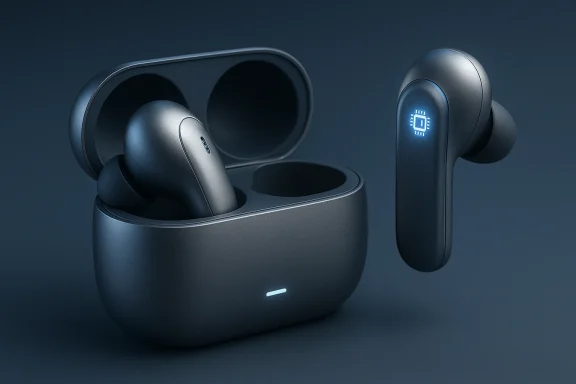
At the center of the current narrative is a consistent set of claims echoed across industry outlets and supply‑chain leaks:- The device is codenamed Sweetpea and is positioned as a screenless, audio‑first AI interface built around conversational agents.
- It may use a phone‑class 2‑nanometer process SoC—often mentioned alongside Samsung’s Exynos roadmap—enabling substantially more on‑device inference than today’s earbuds.
- Rather than routing every request to cloud servers, the design reportedly targets local processing for assigned AI tasks, using a custom silicon stack to support low‑latency voice interactions and private inference.
- Manufacturing partners in the rumor mill include Luxshare (initial reporting) and Foxconn (later realignment), with ambitious first‑year shipping targets on the order of 40–50 million units.
Why earbuds? The product logic behind a screenless device
A low‑friction interface for always‑on AI
Earbuds are the most plausible candidate for a “small family of devices” that OpenAI’s leadership has hinted at because they map naturally to conversational, ambient AI. Audio wearables solve several problems simultaneously: they are inherently personal, they enable continuous voice input without demanding visual attention, and they can deliver short, context‑sensitive actions (summaries, notifications, translation, meeting assistants) with low friction.This form factor also fits Ive’s past track record: design matters in wearables more than in many commodity categories, and a distinctive industrial design can make a device both aspirational and comfortable for daily wear.
Strategic distribution and lock‑in
A proprietary OpenAI device gives the company a direct channel to consumers for premium AI experiences—analogous to what Apple achieved with the iPhone and its integrated services. If OpenAI can deliver distinct functionality that requires its model family (unique agent workflows, exclusive GPTs, or superior latency for real‑time speech models), a dedicated device becomes a vehicle for deeper monetization and product differentiation.Technical claims and plausibility: can earbuds run meaningful AI locally?
The 2‑nanometer processor claim
Reports of a 2‑nanometer‑class SoC powering earbuds are striking because 2nm process chips are currently tailored to expensive smartphone SoCs; integrating such silicon into earbuds would imply a BOM (bill of materials) closer to a phone than a typical accessory. TechCrunch and other outlets have repeated this claim while noting the information stems from leaks and supply‑chain sources. If true, it would enable far more complex on‑device inference and multi‑modal processing—at a material and thermal cost.Local vs cloud inference: a hybrid reality
The more realistic architecture—given current energy and thermal constraints—would be a hybrid system: small, latency‑sensitive voice models and privacy‑critical processing run locally; larger reasoning tasks or extended context retrieval fall back to cloud inference. Multiple reports imply Sweetpea aims to offload some tasks locally to reduce round‑trip latency and preserve privacy, but the scale of “local intelligence” that can fit into an earbud-sized thermal envelope remains an engineering stretch.Battery, thermal and form‑factor tradeoffs
Packing phone‑class compute into a wearable forces tradeoffs:- Battery life vs compute: High NPU throughput drains batteries rapidly, necessitating a larger case or more frequent recharges.
- Thermal dissipation: Silicon that runs hot is uncomfortable behind the ear or in the ear canal; sustained AI tasks will likely be bursty rather than continuous.
- Connectivity and pairing: Real‑time performance requires robust, low‑latency wireless stacks and tight OS integrations across platforms.
Supply chain, manufacturing and the scale question
Luxshare vs Foxconn: what the reports say
Early rumors suggested OpenAI had eyed Luxshare as a manufacturing partner, a common choice for audio wearables, while later leaks point to Foxconn (with production possibly centered in Vietnam) preparing capacity for multiple OpenAI devices. Foxconn’s scale would be necessary to hit tens of millions of units in year one. Both manufacturing shifts and location choices align with industry practice for companies seeking diversified supply chains.The 40–50 million unit target: ambitious or reckless?
Projected first‑year shipments in the 40–50 million range are jaw‑dropping for a new hardware entrant. For context, large incumbents like Apple sell AirPods in the tens of millions annually, supported by mature retail channels, marketing muscle, and an established OS‑level integration. For OpenAI to hit those numbers it would need:- A mass distribution agreement or direct channel strategy to reach mainstream consumers.
- A price point and feature set compelling enough to displace incumbent earbuds.
- Massive manufacturing and logistics readiness.
Design, ergonomics and user experience expectations
Jony Ive’s role: a differentiator
Having Jony Ive’s design DNA in the product roadmap is a strategic signal: OpenAI isn’t aiming for a purely functional accessory, but a well‑designed device that leverages materials, industrial geometry and anthropometrics to make extended wear comfortable and fashionable. Ive’s involvement elevates expectations around fit, finish and the emotional resonance of the product—an important consideration in a market where style drives many purchases.Form‑factor rumors: pill‑style, behink imagery and supply‑chain diagrams suggest a novel form factor—pill‑shaped modules that may rest behind the ear within a pebble‑like case. If accurate, the design could aim to improve battery size and thermal dissipation while offering a distinctive aesthetic. But radical form factors must clear a high bar for comfort and user habits; consumers are notoriously conservative about earwear ergonomics.
Privacy, security and governance implications
On‑device processing as a privacy selling point
OpenAI and other platform owners have repeatedly emphasized privacy advantages for local processing: fewer transcripts sent to the cloud, less persistent telemetry, and lower exposure of sensitive audio. A device that performs vocal commands and short transcriptions locally would appeal to privacy‑sensitive users—if the implementation is transparent and auditable.New attack surfaces and governance needs
A dedicated AI earbud that listens continuously or intermittently creates fresh attack surfaces: microphones placed near private conversations, potential for always‑on transcription logs, and the risk of voice‑based spoofing or unintended activation. Enterprises and privacy regulators will scrutinize default retention policies, encryption for local storage, and how the device handles consent and account linking. These governance questions are as important as the product’s performance claims.Market impact and competitor response
Will it unseat AirPods or create a new category?
OpenAI’s device could take one of two strategic paths: it solves a new problem so convincingly that it creates a category (much like the iPhone did for smartphones), or it becomes a premium niche offering that augments existing device ecosystems. The former requires clear, repeatable user value—capabilities people cannot get from a phone plus headphones combo; the latter would still be strategically useful to OpenAI as a halo device for services but not a broad disruption.Incumbent reactions
Apple, Google and Samsung already put AI into their wearables roadmap and control OS‑level hooks that make deep integration easier. Competitors can respond by improving on‑device assistant features, optimizing latency for speech interactions, or bundling services with their hardware. OpenAI’s hardware push is as much a platform play as a product launch: the company wants an owned distribution channel for its AI stack. Expect rapid countermeasures from the major platforms.Verification, reliability and what remains speculative
- Confirmed: OpenAI acquired Jony Ive’s io (mid‑2025) and signaled an intent to build a family of devices; corporate filings and reputable outlets reported the acquisition price in the $6.4–$6.5B range.
- Confirmed: OpenAI executives (Chris Lehane) stated a first device announcement is expected in the second half of 2026.
- Unverified/Leaked: The exact form factor, codename Sweetpea, the 2‑nm SoC claim, local inference breadth, and the 40–50 million unit first‑year target are currently based on trade‑press leaks, tipster posts and supply‑chain reporting. These details should be treated as plausible but not definitive until OpenAI confirms them. Multiple outlets are repeating the same leaks—this increases credibility but does not replace an official disclosure.
Risks and operational considerations for enterprises and power users
For IT managers and procurement teams
- Avoid presuming lifecycle guarantees: hardware that depends on cloud services can become unsupported or feature‑reduced if agreements change. Secure SLAs and exit terms where possible.
- Prioritise interoperability: devices that lock users into a single model provider can complicate procurement and identity management. Ensure any fleet device can be administered, logged and audited through existing endpoint management tools.
For consumers and early adopters
- Expect a premium price if a phone‑class NPU and advanced sensors are truly included. That premium must be weighed against utility gains over existing earbuds and phones.
- Evaluate privacy posture, default data retention, and account binding before buying; look for explicit local processing guarantees and device‑side controls.
What to watch next (timeline and signals)
- Official OpenAI announcement window in H2 2026 (product reveal, pricing, partnerships). 2.mations—public statements or filings from Foxconn, Luxshare or contract manufacturers. Evidence of Foxconn involvement (capacity plans, investor notes) would substantiate ambitious unit targets.
- Component deals: semiconductor supplier announcements (Exynos, Samsung, Broadcom/TSMC partnerships) that confirm high‑end mobile silicon in the device.
- Developer program and ecosystem signals: APIs, SDKs, or a “GPT” marketplace that provides device‑exclusive experiences or integrations. If OpenAI opens developer channels for device‑specific features, it will indicate a platform strategy rather than a one‑off accessory.
Conclusion: disruptive potential meets practical constraints
OpenAI’s transition from software-first to hardware‑backed platform maker is one of the industry’s most consequential strategic moves. The company has assembled the pieces—top‑tier design talent, deep AI models, and cloud relationships—that could make an AI‑native device credible. A well‑executed product could reshape how people interact with conversational agents, especially if it genuinely reduces friction for everyday tasks while protecting privacy and providing real, repeatable value.At the same time, the specific claims in circulation—2‑nanometer processors in earbuds, 40–50 million first‑year shipments, and full local inference—remain primarily sourced to leaks and trade publications. Those claims are plausible in outline, but they raise material engineering, thermal and supply‑chain challenges that OpenAI will need to solve before a mass market release. Until OpenAI publishes concrete specs and partners, these should be treated as directional indicators rather than settled facts. For WindowsForum readers, the implications are both tactical and strategic: expect rapid innovation in voice and agent features across platforms, prepare procurement plans that account for hybrid cloud/device dependencies, and require clear privacy and support guarantees from vendors. Whether Sweetpea—or whatever form OpenAI’s first device takes—becomes the defining platform shift of the decade or a high‑profile experiment will depend on the hard, unspectacular work of shipping, supporting and integrating a new class of AI hardware into daily workflows.
Source: Windows Central Hint: OpenAI's super-secret hardware could be AI earbuds launching in 2026
