

OpenAI’s leadership has signaled a dramatic strategic pivot: the company is preparing to sell compute itself and to roll out an “AI cloud” that would compete directly with Microsoft Azure, Google Cloud and Amazon Web Services. Over the past three months OpenAI has restructured its relationships with long-time partners, signed multibillion-dollar capacity agreements across multiple hyperscalers and chipmakers, and publicly floated an audacious funding and buildout plan that — if executed — would reshape how AI is provisioned and priced. The proposal is simple in pitch and monstrous in scale: build and coordinate enough specialized compute, hardware and data‑center capacity to run the next generation of foundation models and then sell that capability as a product. The mechanics, costs and risks of that bet are enormous — and the industry is already reacting accordingly.
At the same time, OpenAI has been signing an unprecedented string of infrastructure agreements and restructuring strategic partnerships in ways that reduce supplier exclusivity and increase flexibility. Those moves, plus public comments by CEO Sam Altman and a flurry of company and partner announcements, have made a pivot from a pure model-and-software business toward a vertically integrated compute-and-service provider a credible possibility.
What this means:
Why the AWS tie matters:
Implications:
Key takeaways:
Economic realities to weigh:
Yet the scale of the challenge should not be understated. Building, financing and operating GW‑scale AI facilities across multiple geographies, procuring or co-designing accelerators, and commercializing compute while preserving partner relationships is extraordinarily complex. Financial commitments on the order of hundreds of billions — and headline aggregates that run into the low trillions — magnify any execution misstep.
If OpenAI can match execution to ambition, the industry could see an AI-native cloud category emerge: compute offerings and service levels tuned specifically for large foundation models and agentic applications. That would accelerate model training cycles, enable broader experimentation, and shift the economics of AI adoption. But the alternative is equally plausible: spending overshoots, capacity sits idle or underutilized, and OpenAI confronts both market discipline and political scrutiny.
This is a high‑stakes wager on how the next era of computing will be provisioned. The company’s credibility, and the broader industry’s appetite for mega‑scale infrastructure, will determine whether an OpenAI-led AI cloud becomes a defining layer of the new stack — or an instructive cautionary tale about scale, complexity and the limits of verticalization in the cloud era.
Source: Editorialge https://editorialge.com/openai-ai-cloud-launch-rival-azure-google/
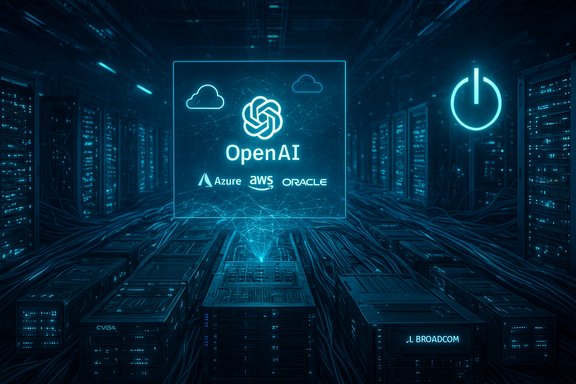 Background
Why the move matters now
OpenAI’s stated motivation is straightforward: the company is hitting a hard compute ceiling. Senior executives have described rate-limiting constraints that prevent new features and model rollouts because available infrastructure is too scarce or too costly. The company’s roadmap — more powerful multimodal models, agentic systems that execute tasks autonomously, and broader enterprise/industry deployments — all require sustained access to very large clusters of accelerators and networking that general-purpose clouds may not be optimized to deliver.At the same time, OpenAI has been signing an unprecedented string of infrastructure agreements and restructuring strategic partnerships in ways that reduce supplier exclusivity and increase flexibility. Those moves, plus public comments by CEO Sam Altman and a flurry of company and partner announcements, have made a pivot from a pure model-and-software business toward a vertically integrated compute-and-service provider a credible possibility.
What OpenAI has announced and what it has signaled
- A corporate restructuring that alters the relationship with Microsoft while preserving a deep commercial tie and significant Azure commitments.
- Multi‑year deals with multiple cloud and infrastructure firms, including a very large deal with AWS and major contracts with Oracle, CoreWeave and others to secure tens of thousands to millions of accelerator nodes.
- Partnerships with chipmakers and systems vendors to secure or co-design accelerators, including a custom-hardware collaboration with Broadcom.
- Public statements from leadership about selling compute capacity more directly, and broad spending and capacity targets that scale to tens of gigawatts of deployed computing power over the coming years.
The recent deal-making sweep: what was announced and what it implies
Microsoft: restructure, continued closeness, and an Azure commitment
OpenAI’s long-standing relationship with Microsoft has been reworked into a new arrangement. The new terms preserve Microsoft’s strategic stake and deep product ties but remove some earlier exclusivity constraints. Critically, OpenAI has agreed to a very large incremental Azure commitment, while concurrently gaining the freedom to deploy workloads on other providers.What this means:
- Microsoft remains a foundational partner but without the old exclusive compute umbrella.
- OpenAI gains negotiation flexibility to secure capacity elsewhere while still delivering Microsoft-targeted integrations and revenue share in certain products.
- The new arrangement may be intended to preserve product-level integration (e.g., embedding OpenAI models into Microsoft enterprise tools) while enabling an OpenAI push into raw compute provisioning.
AWS: a headline multi‑year compute pact
OpenAI’s deal with Amazon Web Services — presented as a seven‑year agreement for large-scale GPU and CPU capacity — represents a major shift in the landscape. Under the announced framework, AWS will provision large clusters built around NVIDIA’s latest Blackwell-series accelerators and EC2 UltraServer hardware, aimed at both training and inference at scale.Why the AWS tie matters:
- AWS gains a marquee AI client, boosting its position in the AI infrastructure market and validating its UltraServer architecture for frontier workloads.
- OpenAI gains additional supply diversity, reducing single-provider concentration risk and permitting multi-cloud deployment strategies.
- The AWS relationship also shows OpenAI’s preference for specialized cluster topologies (tightly coupled GPU clusters, low-latency networking) — not just raw VM hours.
Oracle and the Stargate initiative
OpenAI’s involvement in a multi‑partner data‑center initiative branded as a major infrastructure program signals a U.S. — centered, national-scale approach to capacity. Over time the Stargate program is intended to deliver very large gigawatt-class sites and to recruit a range of industrial, energy and data‑center partners.Implications:
- Large colocated facilities allow economies of scale (cooling, power procurement, high-density networking).
- Local economic and political dynamics become material; these projects require permitting, grid coordination and sustained Capital Expenditure (CapEx) plans.
- Oracle’s role highlights how database/cloud incumbents will monetize AI-era infrastructure growth.
CoreWeave, Broadcom and chip supply diversification
OpenAI has expanded arrangements with specialized AI cloud providers such as CoreWeave and announced partnerships with chip and systems vendors, including a multi‑gigawatt collaboration to co‑develop or procure custom accelerators. These deals reduce exposure to a single chip vendor and enable architectural heterogeneity.Key takeaways:
- CoreWeave-like providers play a critical role for short‑term capacity and agile deployment.
- Custom accelerator programs (co‑design with a vendor) aim to lower long‑term cost-per-inference and offer performance tailored to OpenAI’s models.
- Custom hardware develops operational complexity but can deliver order-of-magnitude efficiency improvements if executed well.
Technical architecture: what an “AI cloud” would actually look like
Core elements of an AI-optimized cloud
An AI cloud optimized for large models and agentic systems centers on a few non-negotiables:- High-density accelerator racks (GPU or ASIC) with large on‑board HBM memory and fast interconnects.
- Low-latency, high-bandwidth network fabric for model-parallel and data-parallel training across thousands of devices.
- Specialized server platforms (e.g., UltraServer-class systems) that integrate accelerators, CPUs and NVMe tiers for checkpointing and streaming.
- Power and cooling infrastructure engineered for sustained, high-PUE workloads and variable renewable inputs where possible.
- Software stack — from device drivers to custom model-serving frameworks — optimized for distributed, mixed-precision training and low-latency inference.
Hardware building blocks and vendor roles
- NVIDIA Blackwell-series accelerators and high‑memory variants remain the standard for many workloads, but custom accelerators designed jointly with silicon vendors can shift the cost curve for inference-heavy services.
- EC2 UltraServer-like systems deliver a vendor-specific packaging of accelerators and networking; mixing these with OpenAI‑designed racks requires software portability work.
- Data-center scale measured in gigawatts (GW) reflects power draw, not compute directly. At scale, gigawatts imply major grid coordination and large CapEx for substations, transformers and renewable procurement.
Performance and platform claims: treat specifics with care
Vendor-quoted peak metrics (petaflops, HBM capacity per node, interconnect bandwidth) are useful guides but rarely capture real-world efficiency, end-to-end latency or cost per useful operation. Performance claims should be interpreted as vendor‑level maxima under optimized conditions, not the day-to-day operational baseline of a global AI service supporting millions of users.Financial scale and feasibility: the numbers that dominate headlines
Committing to hundreds of billions
OpenAI’s recent comments and the announced deals imply multihundred‑billion dollar commitments across clouds, data centers and chips. Whether you aggregate signed contracts, multi‑year purchase commitments, or projected infrastructure spending, the scale is unprecedented for a single AI company.Economic realities to weigh:
- Building and operating GW‑scale facilities and buying tens of thousands of accelerator racks is capital‑intensive. Typical industry math places chip-only costs at tens of billions per gigawatt at current prices; full deployment (including facilities, networking and power) can vastly exceed chip line‑items.
- Running AI services at scale also carries large operating expenses: electricity, cooling, component refreshes, and human capital to operate and secure infrastructure.
- Revenue timing matters: even if OpenAI reaches the headline run-rate projections being discussed, cash flows may lag CapEx commitments by years.
Revenue vs commitments: mismatch risk
If compute commitments and capacity buildouts accelerate faster than revenue growth or financing terms, the company could face material cash-flow stress. Conversely, if OpenAI monetizes unique compute offerings (e.g., AI‑optimized clusters, high‑value enterprise model hosting or verticalized inference services), it could create a sustainable revenue stream with high margins — but that is not guaranteed.Financing options and market reactions
The spending program can be financed via:- Partner financing and revenue commitments (prepaid purchases with hyperscalers).
- Debt (project finance for facilities).
- Equity (private or public markets).
Each channel has tradeoffs: commercial commitments can lock in customers but may create concentration risk; debt increases leverage and covenants; equity dilutes existing shareholders and requires market appetite.
Strategic strengths and potential competitive advantages
- Brand and model leadership. OpenAI’s position as a model provider gives it a unique go-to-market advantage: customers may prefer compute sold by the company that designs the models they want to run.
- Vertical integration potential. Controlling more of the stack — from silicon to data center — could deliver efficiency gains, differentiated SLAs, and proprietary integrations (e.g., optimized runtimes for GPT-family models).
- Multi‑provider hedging. The strategy to place capacity across multiple hyperscalers and specialized providers reduces single‑point-of-failure and negotiation risk.
- Ecosystem leverage. If OpenAI bundles compute with direct model access and development tools, it could create a sticky offering for enterprises building AI-native applications.
Key risks, tradeoffs and public-policy concerns
Channel conflict and partner pushback
Selling compute directly puts OpenAI in partial competition with partners that currently supply its infrastructure. This dual role creates:- Potential partner friction, especially where partners are also customers of OpenAI models or vice versa.
- Commercial complexity in negotiating usage rights, IP and priority access to new models.
Financial exposure and execution risk
Large-scale infrastructure projects are notoriously difficult to execute on budget and on time. Key risks:- Supply-chain shortages (accelerators, networking gear, power infrastructure).
- Cost overruns in construction and deployment.
- Underutilization if demand doesn’t scale as projected.
A misstep could saddle the company with long-term capacity that yields poor returns.
Energy, land and local politics
Gigawatt-scale data centers have large environmental footprints and require substantial grid coordination. Expect:- Heightened regulatory scrutiny over energy sourcing and emissions.
- Local political debates on tax incentives and community impacts.
- Permitting and interconnection delays that can materially shift timelines.
Concentration and systemic risk
If a single company controls large slices of both models and the underlying capacity that powers them, systemic risk questions emerge: what happens if that provider suffers a prolonged outage, or if its pricing power distorts market competition?Antitrust and national-security scrutiny
Rapidly concentrated capital flows across cloud, chip and data‑center markets raise potential antitrust flags. Additionally, projects framed as national or strategic (e.g., large domestic capacity builds) may attract closer governmental oversight and conditional approvals.How incumbents and rivals are likely to respond
- Price and product adjustments by hyperscalers to protect share (more aggressive discounting, AI-optimized SKUs).
- Faster vertical integration from chip makers and cloud providers to lock in customers and co-design systems.
- Ecosystem plays (managed AI platforms, proprietary model offerings) to keep developer mind‑share.
- Regulatory engagement to ensure preferential procurement or public funding is not granted unfairly.
What success and failure would look like
Best‑case scenario (OpenAI succeeds)
- The company delivers differentiated, efficient AI compute that integrates tightly with its advanced models.
- Enterprises adopt OpenAI’s AI cloud for model training and inference where it offers unique performance or cost advantages.
- The verticalized stack yields high-margin revenue, and OpenAI scales to become a credible cloud-class player for AI workloads, forcing incumbents to innovate.
Middling outcome
- OpenAI becomes a meaningful but niche supplier: useful for specific model families, research workloads and high-end enterprise use cases while mainstream customers continue to prefer hyperscaler clouds for cost and geographic coverage.
- OpenAI’s compute offerings coexist with incumbents, and the company monetizes through a combination of enterprise subscriptions, API fees and compute sales without fully displacing dominant cloud vendors.
Downside
- Execution, financing or political obstacles slow deployments and make capacity expensive to operate.
- Partner relationships fray, complicating both supply and market access.
- Long-term underutilization causes substantial write-downs and damages credibility.
Practical implications for enterprises and developers
- Companies that rely on large-model training should anticipate more supplier choice, with specialized AI clouds offering competitive performance or pricing.
- Enterprises should evaluate total cost of ownership, including data egress, compliance, and integration with existing on‑premise or hybrid architectures.
- Developers and start-ups may gain more tailored options (AI-optimized clusters, turnkey model-hosting), but must watch for potential vendor lock-in tied to specific model runtimes or hardware stacks.
Final assessment: an audacious bet with enormous upside and commensurate peril
OpenAI’s potential launch of an “AI cloud” is one of the most consequential strategic moves in the technology sector in years. It’s a logical response to genuine compute bottlenecks and a clear attempt to monetize a unique position at the top of the model stack. The company’s recent deal-making shows a pragmatic appetite for multi‑vendor supply and co‑design with systems and silicon partners.Yet the scale of the challenge should not be understated. Building, financing and operating GW‑scale AI facilities across multiple geographies, procuring or co-designing accelerators, and commercializing compute while preserving partner relationships is extraordinarily complex. Financial commitments on the order of hundreds of billions — and headline aggregates that run into the low trillions — magnify any execution misstep.
If OpenAI can match execution to ambition, the industry could see an AI-native cloud category emerge: compute offerings and service levels tuned specifically for large foundation models and agentic applications. That would accelerate model training cycles, enable broader experimentation, and shift the economics of AI adoption. But the alternative is equally plausible: spending overshoots, capacity sits idle or underutilized, and OpenAI confronts both market discipline and political scrutiny.
This is a high‑stakes wager on how the next era of computing will be provisioned. The company’s credibility, and the broader industry’s appetite for mega‑scale infrastructure, will determine whether an OpenAI-led AI cloud becomes a defining layer of the new stack — or an instructive cautionary tale about scale, complexity and the limits of verticalization in the cloud era.
Source: Editorialge https://editorialge.com/openai-ai-cloud-launch-rival-azure-google/
