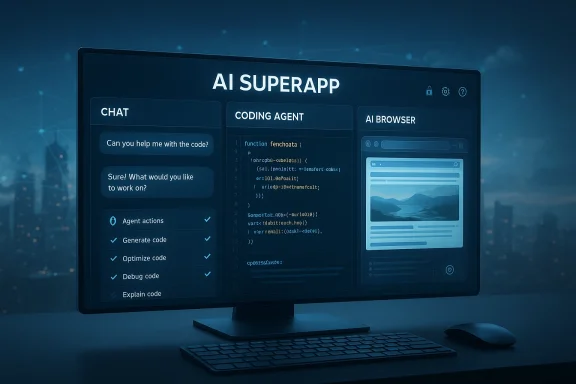
OpenAI’s reported push to merge ChatGPT, Codex, and its browser into a single desktop “superapp” is more than a UI refresh; it is a bet that the next phase of AI competition will be won by consolidation, not just raw model quality. The move comes as OpenAI is already deepening Codex’s role in developer workflows and broadening ChatGPT’s desktop reach, while rivals like Microsoft, Google, and Anthropic are building more integrated AI experiences of their own. If OpenAI can unify these products without making them feel bloated, it could turn ChatGPT into the default front door for consumer and professional AI. If it cannot, the company risks turning one of its biggest strengths — breadth of ambition — into the very fragmentation it now says it wants to fix.
OpenAI’s product story has evolved rapidly over the past two years. What began as a chat interface has expanded into search, desktop apps, coding agents, and now browser-first and app-centric experiences, reflecting the company’s belief that the assistant should not just answer questions but mediate work across the entire computer. The company’s own announcements show how quickly that philosophy has matured: ChatGPT search moved the product toward web access, the ChatGPT desktop app made the assistant more ambient, and Codex shifted OpenAI into serious agentic software engineering tooling.
That expansion has also created complexity. OpenAI’s Codex launch posts describe a “command center for agents,” with multi-agent orchestration, parallel task execution, and support across CLI, IDE, and cloud environments; by March 2026, the company had already brought the Codex app to Windows as well. The same company that once focused on a single conversational surface now has to maintain multiple interfaces, multiple usage patterns, and multiple user expectations. That kind of sprawl is manageable at startup scale, but it becomes a real drag when a company is trying to serve everyone from casual ChatGPT users to enterprise developers.
The reported reorganization also fits a broader industry shift. OpenAI’s rivals are not standing still, and the market is moving toward integrated experiences rather than isolated tools. Anthropic has pushed Claude deeper into workflow tools like Slack, Canva, and Figma, while Microsoft continues to embed Copilot into Word, Excel, Teams, GitHub, and other products. Google, too, is weaving Gemini across Workspace and developer tools, treating AI as a layer rather than a separate destination.
Fidji Simo’s reported internal message about OpenAI spreading itself across too many apps and stacks is therefore not just an admission of product fatigue; it is an acknowledgment that the company is now operating in a platform war. In a market where users increasingly expect one identity, one workflow, and one memory layer, fragmentation becomes a strategic liability. The question is whether OpenAI can simplify fast enough without losing the experimental velocity that made it dominant in the first place.
That is a meaningful shift because it changes how people perceive value. Instead of “I use ChatGPT for answers and Codex for code,” the pitch becomes “I use OpenAI for my daily workflow.” That is a much stickier relationship, and it helps explain why the company may be willing to tolerate a difficult restructuring now in exchange for a cleaner long-term platform narrative.
That makes the browser less of a product add-on and more of an orchestration layer. It is where the assistant can observe context, act on websites, pull in documents, and bridge the gap between “tell me” and “do it.” For users, that could reduce friction. For OpenAI, it creates a powerful path to deeper engagement and more session time.
That matters because AI products are unusually sensitive to inconsistency. If one app feels polished while another feels experimental, users do not mentally separate them by internal organization charts. They simply conclude that the company’s quality bar is uneven. For a brand as visible as OpenAI’s, that can become a trust issue.
That separation can be healthy if it reduces confusion. It can also backfire if the product story becomes too centrally managed and loses the spontaneity that helped OpenAI move quickly. In other words, clarity is the goal, but overcontrol is the risk.
That tension is not unique to OpenAI, but it is especially acute for a company whose identity is still closely tied to ChatGPT as a consumer brand. The next version of the product has to feel powerful enough for developers and simple enough for everyone else.
OpenAI cannot easily replicate Microsoft’s native distribution advantage. What it can do is offer a more coherent, model-forward experience that feels less like an add-on and more like a purpose-built AI workspace. That distinction matters. Microsoft has the plumbing; OpenAI wants the front door.
For OpenAI, this creates a strategic challenge. If users can get embedded assistance inside Google or Microsoft products, ChatGPT has to justify why it deserves to be the center of the workflow. A superapp strategy is one answer: make OpenAI itself the environment.
This is why the OpenAI move should be read as defensive as well as ambitious. The company is trying to prevent competitors from defining the category around integrations while OpenAI remains known only for conversation.
That is especially valuable for power users. The less time you spend re-explaining context, the more the model feels like a collaborator. And for a product like ChatGPT, collaboration is the real value proposition.
That said, there is a downside. Developers often prefer specialized tools because they expose more control. If OpenAI overgeneralizes Codex to serve casual users, it could dilute the power-user workflows that made the tool compelling in the first place.
That is where taste matters. A unified product can still feel elegant if the defaults are good and the complexity stays hidden. But if every feature becomes visible at once, the app risks feeling like a dashboard rather than an assistant.
That could help OpenAI move from “AI tool” to “AI platform.” And for enterprise buyers, platform status often matters more than feature novelty. Once a product becomes part of the stack, it becomes harder to rip out.
This is where Microsoft’s Copilot play, especially in enterprise settings, creates competitive pressure. Microsoft has spent years building trust around identity, compliance, and admin controls. OpenAI will need to show that a unified app can be both powerful and safe.
But the enterprise market is also unforgiving. Buyers notice when product roadmaps shift too fast. They want confidence that today’s app will still support tomorrow’s policies, audit requirements, and integration needs.
If ChatGPT becomes the shell for everything, the app must manage progressive disclosure extremely well. Beginners need a simple way in. Power users need depth. Enterprises need controls. That is a difficult triangle to balance.
That is why the browser piece is so important. It is not just another product. It may become the connective tissue that determines whether the superapp feels coherent or merely crowded.
The market will also watch how OpenAI handles the tension between openness and control. A desktop superapp that spans chat, code, and browser actions will need strong safety boundaries, especially in enterprise settings. At the same time, it has to remain flexible enough that advanced users do not feel boxed in by simplified defaults.
What to watch next:
Source: The American Bazaar OpenAI joins AI ‘superapp’ race: What it means for ChatGPT users
 Background
OpenAI’s product story has evolved rapidly over the past two years. What began as a chat interface has expanded into search, desktop apps, coding agents, and now browser-first and app-centric experiences, reflecting the company’s belief that the assistant should not just answer questions but mediate work across the entire computer. The company’s own announcements show how quickly that philosophy has matured: ChatGPT search moved the product toward web access, the ChatGPT desktop app made the assistant more ambient, and Codex shifted OpenAI into serious agentic software engineering tooling.That expansion has also created complexity. OpenAI’s Codex launch posts describe a “command center for agents,” with multi-agent orchestration, parallel task execution, and support across CLI, IDE, and cloud environments; by March 2026, the company had already brought the Codex app to Windows as well. The same company that once focused on a single conversational surface now has to maintain multiple interfaces, multiple usage patterns, and multiple user expectations. That kind of sprawl is manageable at startup scale, but it becomes a real drag when a company is trying to serve everyone from casual ChatGPT users to enterprise developers.
The reported reorganization also fits a broader industry shift. OpenAI’s rivals are not standing still, and the market is moving toward integrated experiences rather than isolated tools. Anthropic has pushed Claude deeper into workflow tools like Slack, Canva, and Figma, while Microsoft continues to embed Copilot into Word, Excel, Teams, GitHub, and other products. Google, too, is weaving Gemini across Workspace and developer tools, treating AI as a layer rather than a separate destination.
Fidji Simo’s reported internal message about OpenAI spreading itself across too many apps and stacks is therefore not just an admission of product fatigue; it is an acknowledgment that the company is now operating in a platform war. In a market where users increasingly expect one identity, one workflow, and one memory layer, fragmentation becomes a strategic liability. The question is whether OpenAI can simplify fast enough without losing the experimental velocity that made it dominant in the first place.
What OpenAI Is Really Building
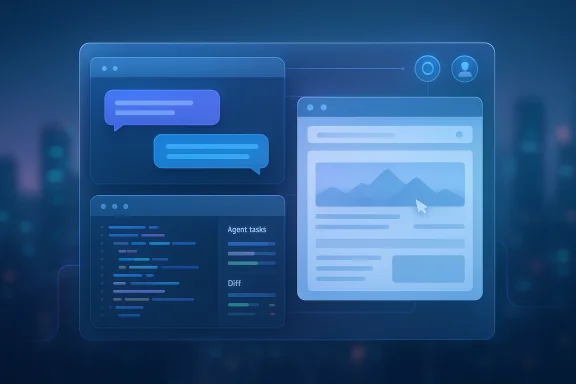
The phrase “superapp” matters here because it suggests a move beyond a chatbot with extras. A true superapp is not just a bundle of features; it is a single container for many tasks, with identity, context, and workflow flowing across them. In OpenAI’s case, that means the company is trying to make ChatGPT, Codex, and browser-like behavior feel like different modes of the same AI operating environment rather than disconnected products.One interface, many jobs
The core logic is straightforward. Users do not want to keep switching between a chat window, a coding tool, and a browser if the same model family can support all three. OpenAI’s own Codex posts already point in this direction, describing a tool that lets developers supervise multiple agents, review diffs, and move between threads without losing context. A superapp would extend that concept beyond coding and into the broader productivity stack.That is a meaningful shift because it changes how people perceive value. Instead of “I use ChatGPT for answers and Codex for code,” the pitch becomes “I use OpenAI for my daily workflow.” That is a much stickier relationship, and it helps explain why the company may be willing to tolerate a difficult restructuring now in exchange for a cleaner long-term platform narrative.
The browser as the glue
The browser is the most interesting piece of the puzzle. OpenAI has already demonstrated, through Operator and later ChatGPT Atlas, that it sees browser-mediated tasks as central to the agent era. If a browser becomes the control surface for agentic work, then it can connect research, content creation, code, and execution in a way that a standalone chat app cannot.That makes the browser less of a product add-on and more of an orchestration layer. It is where the assistant can observe context, act on websites, pull in documents, and bridge the gap between “tell me” and “do it.” For users, that could reduce friction. For OpenAI, it creates a powerful path to deeper engagement and more session time.
- Chat becomes the entry point.
- Codex becomes the execution engine for developers.
- The browser becomes the context and action layer.
- Memory and identity unify the experience.
- The desktop app becomes the default shell.
Why the Reorg Matters Now
This is not the kind of restructuring companies do when everything is calm. It usually happens when product lines are growing faster than the organization can support them. OpenAI’s reported decision to simplify its app and stack choices suggests leadership believes the company is at risk of winning mindshare while losing operational coherence.Product sprawl is expensive
Every additional app means more surface area to maintain. Different codebases, different UX assumptions, different update schedules, and different support paths all create friction. OpenAI’s internal comment, as reported, that fragmentation was slowing the company down tracks with what often happens when fast-moving AI teams outgrow the “ship first, unify later” model.That matters because AI products are unusually sensitive to inconsistency. If one app feels polished while another feels experimental, users do not mentally separate them by internal organization charts. They simply conclude that the company’s quality bar is uneven. For a brand as visible as OpenAI’s, that can become a trust issue.
Leadership signal, not just management housekeeping
The reported roles for Greg Brockman and Fidji Simo are also significant. Brockman temporarily overseeing product revamp and organizational changes implies OpenAI sees this as a technical and structural reset, not merely a marketing exercise. Simo’s hand on sales suggests the company wants tighter alignment between what it builds and how it monetizes it.That separation can be healthy if it reduces confusion. It can also backfire if the product story becomes too centrally managed and loses the spontaneity that helped OpenAI move quickly. In other words, clarity is the goal, but overcontrol is the risk.
Enterprise and consumer pressures are converging
The timing is especially important because OpenAI is trying to serve two very different audiences. Consumers want convenience, speed, and a simple interface. Enterprises want governance, reliability, permissions, and predictable product boundaries. A unified app could help bridge those worlds, but only if it does not force everyone into the same workflow assumptions.That tension is not unique to OpenAI, but it is especially acute for a company whose identity is still closely tied to ChatGPT as a consumer brand. The next version of the product has to feel powerful enough for developers and simple enough for everyone else.
The Competitive Pressure from Microsoft, Google, and Anthropic
OpenAI is not inventing the integrated-assistant trend; it is reacting to it. The industry is moving toward embedded AI experiences where the assistant lives inside the tools people already use. That puts pressure on OpenAI to create a similarly seamless environment, even if it does so through a standalone desktop app rather than through a software suite.Microsoft’s integrated Copilot play
Microsoft has spent years turning Copilot into a layer across Windows, Office, Teams, GitHub, and its broader cloud stack. Recent Microsoft moves show a company increasingly focused on unity of experience and ownership of the AI layer, not just on having a chatbot tucked into a product menu. That makes Microsoft a formidable comparison point, because it already has distribution inside the tools knowledge workers use all day.OpenAI cannot easily replicate Microsoft’s native distribution advantage. What it can do is offer a more coherent, model-forward experience that feels less like an add-on and more like a purpose-built AI workspace. That distinction matters. Microsoft has the plumbing; OpenAI wants the front door.
Google’s Workspace and Gemini strategy
Google is pursuing a similar integrated approach through Gemini, Workspace, and developer tooling. The company has been extending AI across Docs, Sheets, Slides, Drive, and GitHub-oriented workflows, making the assistant feel like part of the environment rather than a separate destination. That is a powerful model because it lowers the burden on users to “go to AI.”For OpenAI, this creates a strategic challenge. If users can get embedded assistance inside Google or Microsoft products, ChatGPT has to justify why it deserves to be the center of the workflow. A superapp strategy is one answer: make OpenAI itself the environment.
Anthropic’s workflow-first positioning
Anthropic’s Claude strategy has been more measured, but it is also extremely relevant. By integrating with Slack and other workplace tools, Claude is positioning itself as a practical assistant for teams rather than just a clever chatbot. That is exactly the kind of product posture that enterprises value: useful, composable, and relatively easy to place into existing workflows.This is why the OpenAI move should be read as defensive as well as ambitious. The company is trying to prevent competitors from defining the category around integrations while OpenAI remains known only for conversation.
- Microsoft wins on distribution.
- Google wins on ecosystem familiarity.
- Anthropic wins on workflow credibility.
- OpenAI wins when it can combine model quality with a cleaner product surface.
- A superapp could help OpenAI keep the center of gravity.
What This Means for ChatGPT Users
For ordinary ChatGPT users, the most immediate effect should be less app switching and more continuity. If the reported consolidation works, a user could research something, draft something, code something, and browse or act on it in one place. That sounds simple, but simplicity in AI is often the hardest thing to build.Better continuity, fewer handoffs
The biggest user-facing benefit would likely be context retention. Today, many people bounce between ChatGPT, Codex, browser tabs, and external tools. A single desktop app could preserve conversation history, project state, and user identity more cleanly, which would make the whole system feel more intelligent and less like a collection of experiments.That is especially valuable for power users. The less time you spend re-explaining context, the more the model feels like a collaborator. And for a product like ChatGPT, collaboration is the real value proposition.
A cleaner path for developers
For developers, unifying Codex into the broader app could make agentic coding feel less like a separate workflow and more like one mode of a larger assistant. OpenAI’s Codex desktop app already emphasizes parallel agents, isolated worktrees, and long-running tasks. Folding that into a single desktop shell could make it easier for developers to move between coding, debugging, and research without changing tools.That said, there is a downside. Developers often prefer specialized tools because they expose more control. If OpenAI overgeneralizes Codex to serve casual users, it could dilute the power-user workflows that made the tool compelling in the first place.
Consumer expectations are rising
The consumer side is just as important. ChatGPT users increasingly expect the app to remember, act, and connect across tasks. They do not want a demo of AI; they want a dependable assistant that reduces effort. A superapp could meet those expectations, but only if it avoids turning into an overloaded interface full of too many modes and too many prompts.That is where taste matters. A unified product can still feel elegant if the defaults are good and the complexity stays hidden. But if every feature becomes visible at once, the app risks feeling like a dashboard rather than an assistant.
The Enterprise Angle: Bundling, Control, and Governance
The enterprise implications may be even bigger than the consumer ones. In businesses, platform consolidation is often welcomed if it reduces procurement complexity, simplifies security review, and improves policy enforcement. OpenAI’s superapp direction could therefore be a serious push into the enterprise operating layer.One vendor, fewer procurement headaches
Large organizations do not love app sprawl. They want fewer vendors, fewer authentication paths, fewer data-flow questions, and fewer training programs. If OpenAI can present ChatGPT, Codex, and browser-based automation as one controlled environment, it may become easier for CIOs and IT departments to justify broader rollout.That could help OpenAI move from “AI tool” to “AI platform.” And for enterprise buyers, platform status often matters more than feature novelty. Once a product becomes part of the stack, it becomes harder to rip out.
Governance becomes the differentiator
The flip side is that enterprise users will expect serious governance. A superapp that can browse, code, and operate across tasks must also have strong permissioning, logging, and policy controls. That is not optional. The more OpenAI centralizes the workflow, the more damage a single misconfiguration could do.This is where Microsoft’s Copilot play, especially in enterprise settings, creates competitive pressure. Microsoft has spent years building trust around identity, compliance, and admin controls. OpenAI will need to show that a unified app can be both powerful and safe.
Platform consolidation can change buying behavior
If the app succeeds, it could change how companies buy AI. Instead of purchasing point solutions for coding, chat, and browser tasks separately, they might standardize around one OpenAI environment. That would be a major commercial win, especially if the company can cross-sell usage tiers, enterprise seats, and workflow automation features.But the enterprise market is also unforgiving. Buyers notice when product roadmaps shift too fast. They want confidence that today’s app will still support tomorrow’s policies, audit requirements, and integration needs.
Product Design: The Hard Part Nobody Sees
The deeper challenge is not whether OpenAI can merge products on paper. It is whether it can do so without destroying the clarity each product currently has in isolation. This is a design problem as much as a business problem.Unification can create drag
When companies merge product lines, they often assume users will appreciate the simplicity. Sometimes they do. Other times, the result is a cluttered interface where every user sees features meant for someone else. In AI, that is especially dangerous because the user experience is already abstract and cognitively demanding.If ChatGPT becomes the shell for everything, the app must manage progressive disclosure extremely well. Beginners need a simple way in. Power users need depth. Enterprises need controls. That is a difficult triangle to balance.
The browser layer could either simplify or confuse
If the browser becomes the place where everything converges, it can feel magical. The assistant can see context, take actions, and keep the user inside the same environment. But if the browser is poorly integrated, it becomes one more object to maintain, one more mental model to learn, and one more reason to get lost.That is why the browser piece is so important. It is not just another product. It may become the connective tissue that determines whether the superapp feels coherent or merely crowded.
Skills and automation should be invisible until needed
A strong superapp should let users ignore most of the system until they need it. The best workflow tools do not make people think about the machinery. They simply make work flow. OpenAI’s existing agent and automation language suggests it understands this direction, but execution will matter enormously.- Defaults must stay simple.
- Advanced controls must remain accessible.
- Memory should feel helpful, not invasive.
- Context sharing must be reliable.
- Different tasks must stay visually distinct.
Strengths and Opportunities
OpenAI still enters this phase with real advantages. It has brand recognition, developer mindshare, strong model capability, and a chance to define what an AI workspace should look like before the market hardens around rival defaults.- Brand gravity: ChatGPT remains one of the most recognizable AI products in the world.
- Workflow breadth: Few rivals can span chat, coding, search, and browser-mediated action as credibly.
- Developer momentum: Codex gives OpenAI a stronger foothold in software creation than a pure chatbot ever could.
- Desktop opportunity: A native app can create stickier, more frequent use than web-only access.
- Enterprise upside: A unified stack could simplify security review and procurement.
- Product clarity: Consolidation may eliminate duplicated interfaces and overlapping stacks.
- Platform leverage: If executed well, OpenAI can become the default AI operating layer rather than just another tool.
Risks and Concerns
The risks are just as real. A superapp strategy can fail if the company confuses consolidation with simplification, or if it tries to force too much into one container too quickly.- UX bloat: Too many modes can make the product harder to understand.
- Execution drag: Replatforming can slow feature velocity in the short term.
- Enterprise anxiety: Bigger surface area means more governance questions.
- Consumer confusion: Users may not know which task belongs where.
- Internal disruption: Organizational reshuffling can create uncertainty for teams.
- Quality risk: One weak component can tarnish the whole app family.
- Competitive catch-up: Rivals are also integrating, so OpenAI may lose first-mover advantage if it moves too slowly.
Looking Ahead
The next few months will reveal whether this is a genuine platform reset or just another chapter in OpenAI’s fast-moving product expansion. The company will need to prove that consolidation improves reliability, reduces confusion, and creates a more intuitive path for both casual users and developers. If it does, the superapp could become the company’s most important product shift since ChatGPT itself.The market will also watch how OpenAI handles the tension between openness and control. A desktop superapp that spans chat, code, and browser actions will need strong safety boundaries, especially in enterprise settings. At the same time, it has to remain flexible enough that advanced users do not feel boxed in by simplified defaults.
What to watch next:
- Product naming and whether ChatGPT remains the primary consumer brand.
- Codex integration depth, especially how much of its agent workflow becomes native to the unified app.
- Browser strategy, including whether it behaves as a true control surface or a separate companion.
- Enterprise controls, such as permissions, auditing, and admin policy support.
- Release cadence, which will show whether consolidation is speeding up or slowing down shipping.
- Competitive responses from Microsoft, Google, and Anthropic as they sharpen their own integrated AI stories.
Source: The American Bazaar OpenAI joins AI ‘superapp’ race: What it means for ChatGPT users