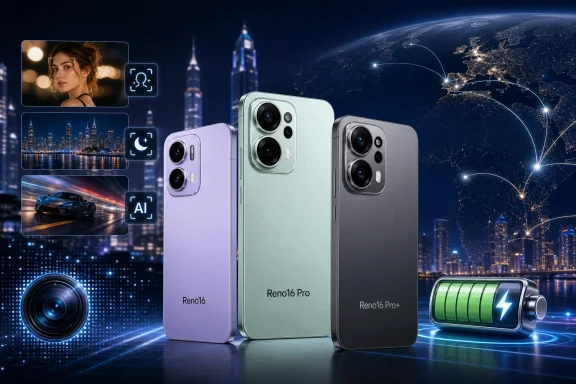
OPPO will begin the global launch of its Reno16 smartphone series on June 25, 2026, with Thailand and Spain among the first confirmed markets and a broader rollout expected to follow in selected regions. The launch turns a China-first midrange refresh into a test of how much weight design, AI imaging, and pop-culture marketing can still carry in a crowded Android market. OPPO is not merely selling another camera phone; it is trying to make the Reno line feel like a lifestyle object again. That is harder than it sounds in 2026, when every phone maker has discovered the same three slogans: AI, creativity, and pro-grade photography.
The Reno16 launch matters because Reno has long been OPPO’s showcase for the company’s most consumer-friendly instincts. The Find series is where OPPO tends to push premium hardware and flagship optics; Reno is where it packages style, portrait photography, slim design, and social-media-ready features into something more approachable. That positioning has worked before, especially in Asia and parts of Europe, but the midrange phone market is no longer forgiving.
The June 25 global debut follows the Reno16 series’ China launch in May, where OPPO emphasized high-resolution imaging, large batteries, and a more theatrical industrial design. The global announcement so far is more restrained. OPPO has confirmed the date, the first markets, the 3D Pop Planet Design branding, AI-powered imaging tools, and the BABYMONSTER ambassador campaign, while leaving pricing, final regional specs, and exact model availability for launch day.
That last part is important. Android brands frequently reuse names across regions while changing chips, cameras, charging speeds, memory configurations, or even model lineups. A Reno16 Pro in one market may not be the same proposition as a Reno16 Pro elsewhere, and buyers should treat early China-spec comparisons as clues rather than contracts.
Still, OPPO’s message is already clear. The Reno16 series is being framed less as a spec-sheet race and more as a phone for people who see their handset as a camera, editing station, fashion accessory, and social object. The hardware may end up strong, but the campaign is built around identity.
The cosmic visual language is aimed squarely at younger buyers who want a device that looks deliberate rather than generic. That does not mean every buyer wants a glittering space-rock finish, but it does mean OPPO understands that design is one of the few remaining ways to create emotional distance between midrange Android phones. Performance has normalized. Displays are mostly good. Cameras are good enough until they are not. Visual identity is still visible from across a table.
This is also where Reno’s legacy gives OPPO some room to maneuver. The Reno line has often been less conservative than rivals in finish, color, and camera styling. A distinctive design can be dismissed as frivolous by spec purists, but it often matters more in the actual buying process than synthetic benchmark scores.
The danger is that design language can become a substitute for product clarity. If OPPO wants the Reno16 series to land globally, it needs to make the model ladder obvious. Consumers should not need a spreadsheet to understand what separates Reno16, Reno16 Pro, Reno16 Pro+, and any region-specific variants that follow.
That does not make the features meaningless. For Reno buyers, software-assisted editing may be more important than raw sensor size or lens branding. If a phone can remove distractions, remix images, build stylized collages, improve low-light portraits, and make short-form content easier to publish, that has practical value. The question is whether OPPO’s tools feel immediate and reliable or whether they become another set of novelty features buried three taps deep in the gallery app.
This is where OPPO has a plausible advantage. The company has spent years tuning portrait photography, beauty modes, low-light processing, and social-camera features for markets where phones are primary creative devices. Reno users are not necessarily pixel peeping RAW files on a desktop monitor. They are capturing people, food, travel, concerts, pets, outfits, and daily life, then sharing those images quickly.
But AI imaging also raises expectations. If OPPO uses the language of AI, users will expect tools that are fast, local where possible, privacy-conscious, and consistent across the lineup. A feature that only works on the Pro+ or requires a cloud round trip may be less persuasive than a simpler tool that works instantly on the base model.
K-pop partnerships are particularly useful because they travel well across Southeast Asia, Europe, and online youth culture. BABYMONSTER brings fandom infrastructure: social sharing, short-form video, fan edits, launch reactions, and a built-in visual vocabulary. That fits neatly with Reno’s pitch as a phone for self-expression and creative output.
The risk is that ambassador campaigns can oversell personality while underselling the product. A phone cannot survive on campaign energy alone once reviews begin comparing battery life, thermal performance, camera consistency, update policy, and value against Samsung, Xiaomi, Honor, Vivo, Google, and OnePlus. Pop culture gets attention; execution keeps it.
Still, OPPO’s choice signals that Reno16 is not being aimed primarily at enterprise procurement managers or spec absolutists. It is being positioned for consumers who buy into a device’s look, camera behavior, and identity. That makes the WindowsForum angle a little unusual, but not irrelevant: many readers here manage mixed-device households, BYOD environments, Android-to-Windows workflows, and cross-platform photo ecosystems.
This is normal, but it can frustrate buyers. Phone makers often adapt lineups based on carrier relationships, certification requirements, pricing bands, and local competition. A Pro+ model may be reserved for selected countries, while other regions receive a base and Pro pairing. In some places, F-series or FS-series variants may carry the Reno16 branding into lower price tiers.
That makes June 25 less of a single launch and more of a switch being flipped on a staggered campaign. Buyers should wait for local OPPO pages, retailer listings, and carrier details before assuming that any one configuration is coming to their market. Reviewers should also be careful not to treat China-market specs as globally settled facts.
For administrators and technically minded buyers, this matters beyond shopping convenience. Regional variants can affect firmware cadence, band support, eSIM availability, warranty handling, repair parts, and update timelines. Those details are less glamorous than a cosmic back panel, but they determine whether a phone is a good long-term purchase.
That is why OPPO is leaning into the package rather than one isolated feature. A 200MP camera, if offered globally in some models, sounds impressive, but high megapixel counts alone do not guarantee better photos. A large battery is useful, but it is no longer unique. A distinctive finish helps, but only if the rest of the phone holds up.
The successful midrange phone in 2026 is not the one with the most dramatic single number. It is the one with the fewest obvious compromises at the price. That includes display calibration, haptics, speakers, modem performance, thermal behavior, camera processing, software cleanliness, update reliability, and repair support. Buyers have become more sophisticated because the alternatives are stronger.
OPPO’s challenge is therefore not to prove that Reno16 can win a spec war on launch day. It is to prove that the Reno16 identity translates into daily satisfaction. If the camera opens quickly, portraits look good without fuss, the battery lasts, the software stays out of the way, and the design feels premium in hand, OPPO has a compelling pitch. If the phone is mostly branding wrapped around ordinary internals, the market will notice.
Spain is also useful because European launches force sharper conversations around pricing, carrier support, warranty expectations, and software policy. A phone that looks attractive in Southeast Asia must still justify itself in a European market where consumers compare it against discounted flagships, Google’s Pixel A-series, Samsung’s Galaxy A-series, Xiaomi’s Redmi and Xiaomi-branded devices, and Honor’s camera-focused models.
Thailand, meanwhile, is a market where design, social photography, and pop-culture campaigns can produce fast consumer feedback. If the Reno16 series catches attention there, OPPO can use that momentum in nearby markets. If it stumbles, the company will learn quickly.
The broader rollout will reveal how confident OPPO really is. A limited release suggests a carefully managed campaign; a wide release with aggressive pricing would signal that OPPO sees Reno16 as a volume play. The difference will matter.
The practical question is how well the Reno16 series will handle the basics of cross-device life. Does it pair cleanly with Windows Phone Link? Do notifications, messages, photos, and calls sync reliably? Are HEIF images, video codecs, and AI-edited files easy to move into Windows workflows? Does OPPO’s gallery software export cleanly, or does it trap edits in proprietary layers?
These questions rarely make the launch keynote, but they define real-world ownership. A phone can take excellent photos and still irritate users if transferring them to a PC is clumsy. A phone can have clever AI tools and still be a poor choice for professionals if outputs are hard to archive, audit, or edit elsewhere.
For sysadmins, BYOD policy adds another layer. OPPO’s global update commitments, Android Enterprise behavior, patch cadence, and regional firmware support will matter more than the BABYMONSTER campaign. If Reno16 devices start appearing in workplaces, IT teams will want predictable security updates, reliable enrollment behavior, and minimal vendor software interference.
Reno’s target audience may love vivid, ready-to-share images, but there is a fine line between pleasing processing and artificial processing. AI tools can help recover detail, correct exposure, and simplify editing. They can also flatten faces, hallucinate textures, over-brighten night scenes, or create images that look impressive at first glance and strange at full size.
The Pro and Pro+ models will likely carry the burden of proving OPPO’s imaging claims. The base Reno16 can be judged as a stylish mainstream device, but the upper models must justify their names. “Pro” has become one of the most abused words in consumer electronics, and buyers are increasingly alert to the gap between branding and capability.
If OPPO delivers consistent camera behavior across the range, Reno16 could become one of the more interesting global Android launches of the summer. If the best features are confined to the top model or vary heavily by region, the line risks confusing the very buyers it is trying to attract.
OPPO has not yet detailed exactly which AI tools will ship globally, how they will work, or whether they will rely on cloud processing. Those details matter. Image editing touches personal photos, faces, location data, children, documents, and private spaces. The more powerful the tool, the more important the trust model becomes.
This is not just a privacy abstraction. European buyers in particular are more likely to scrutinize data handling, consent flows, and cloud dependencies. Enterprise users will care whether AI features can be disabled, managed, or separated from work profiles. Parents may care whether creative tools alter images too aggressively or encourage synthetic outputs without clear labeling.
The companies that win the AI phone transition will not be the ones that attach “AI” to the most menu items. They will be the ones that make features understandable, controllable, and useful. OPPO has an opening here, but the launch-day details will decide whether the Reno16’s AI story is substance or decoration.
If OPPO prices aggressively, the Reno16 series could become a strong alternative for buyers who want something more expressive than a Samsung Galaxy A-series phone and more polished than budget-first Chinese rivals. If it prices too close to flagship territory, the burden shifts. At that point, buyers will expect flagship-grade cameras, long software support, premium build quality, and fewer compromises.
This is where OPPO’s brand strength varies by market. In some regions, OPPO is a mainstream household name with retail muscle and carrier visibility. In others, it is still competing for recognition against Samsung, Apple, Google, Xiaomi, Honor, and Motorola. A design-led campaign can help, but it cannot erase local price sensitivity.
The Pro+ model, if widely released, will be particularly interesting. It could give OPPO a higher-margin halo device inside the Reno family, but it could also muddy the boundary between Reno and Find. OPPO will need to explain why a buyer should choose a Reno16 Pro+ instead of stretching to a discounted flagship or waiting for the next Find-series deal.
OPPO’s June 25 launch will not remake the smartphone market by itself, but it will show whether a midrange Android phone can still win attention by being visibly different and genuinely useful at the same time. If Reno16 pairs its design confidence with clear pricing, dependable software, and camera tools that work outside a launch demo, OPPO will have more than another seasonal refresh. It will have a credible argument that personality still matters in a phone market increasingly defined by sameness.
 OPPO Puts the Reno Line Back on the Global Stage
The Reno16 launch matters because Reno has long been OPPO’s showcase for the company’s most consumer-friendly instincts. The Find series is where OPPO tends to push premium hardware and flagship optics; Reno is where it packages style, portrait photography, slim design, and social-media-ready features into something more approachable. That positioning has worked before, especially in Asia and parts of Europe, but the midrange phone market is no longer forgiving.The June 25 global debut follows the Reno16 series’ China launch in May, where OPPO emphasized high-resolution imaging, large batteries, and a more theatrical industrial design. The global announcement so far is more restrained. OPPO has confirmed the date, the first markets, the 3D Pop Planet Design branding, AI-powered imaging tools, and the BABYMONSTER ambassador campaign, while leaving pricing, final regional specs, and exact model availability for launch day.
That last part is important. Android brands frequently reuse names across regions while changing chips, cameras, charging speeds, memory configurations, or even model lineups. A Reno16 Pro in one market may not be the same proposition as a Reno16 Pro elsewhere, and buyers should treat early China-spec comparisons as clues rather than contracts.
Still, OPPO’s message is already clear. The Reno16 series is being framed less as a spec-sheet race and more as a phone for people who see their handset as a camera, editing station, fashion accessory, and social object. The hardware may end up strong, but the campaign is built around identity.
The 3D Pop Planet Design Is Doing More Than Looking Pretty
The phrase 3D Pop Planet Design sounds like it came from the same marketing lab that gives laptop hinges heroic names, but there is a real strategy underneath it. OPPO is trying to make the Reno16 instantly recognizable in a market where most phones have converged on flat glass slabs, circular camera islands, and muted colors that photograph well in product renders but disappear in real life.The cosmic visual language is aimed squarely at younger buyers who want a device that looks deliberate rather than generic. That does not mean every buyer wants a glittering space-rock finish, but it does mean OPPO understands that design is one of the few remaining ways to create emotional distance between midrange Android phones. Performance has normalized. Displays are mostly good. Cameras are good enough until they are not. Visual identity is still visible from across a table.
This is also where Reno’s legacy gives OPPO some room to maneuver. The Reno line has often been less conservative than rivals in finish, color, and camera styling. A distinctive design can be dismissed as frivolous by spec purists, but it often matters more in the actual buying process than synthetic benchmark scores.
The danger is that design language can become a substitute for product clarity. If OPPO wants the Reno16 series to land globally, it needs to make the model ladder obvious. Consumers should not need a spreadsheet to understand what separates Reno16, Reno16 Pro, Reno16 Pro+, and any region-specific variants that follow.
AI Imaging Is Now the Price of Admission
OPPO’s promise of AI-powered imaging and creative tools is not surprising; it would be more surprising if the company did not lead with AI. The smartphone industry has decided that computational photography is no longer enough as a phrase, so every editing feature, portrait enhancement, object manipulation tool, and collage generator now lives under the AI banner.That does not make the features meaningless. For Reno buyers, software-assisted editing may be more important than raw sensor size or lens branding. If a phone can remove distractions, remix images, build stylized collages, improve low-light portraits, and make short-form content easier to publish, that has practical value. The question is whether OPPO’s tools feel immediate and reliable or whether they become another set of novelty features buried three taps deep in the gallery app.
This is where OPPO has a plausible advantage. The company has spent years tuning portrait photography, beauty modes, low-light processing, and social-camera features for markets where phones are primary creative devices. Reno users are not necessarily pixel peeping RAW files on a desktop monitor. They are capturing people, food, travel, concerts, pets, outfits, and daily life, then sharing those images quickly.
But AI imaging also raises expectations. If OPPO uses the language of AI, users will expect tools that are fast, local where possible, privacy-conscious, and consistent across the lineup. A feature that only works on the Pro+ or requires a cloud round trip may be less persuasive than a simpler tool that works instantly on the base model.
BABYMONSTER Gives the Launch a Cultural Hook, Not Just a Celebrity Face
The BABYMONSTER partnership is easy to wave away as standard celebrity marketing, but that misses the point. OPPO is using the K-pop group to give the Reno16 series a recognizable cultural frame before the phones even reach shelves. For a design-led phone, that may be as important as any single camera specification.K-pop partnerships are particularly useful because they travel well across Southeast Asia, Europe, and online youth culture. BABYMONSTER brings fandom infrastructure: social sharing, short-form video, fan edits, launch reactions, and a built-in visual vocabulary. That fits neatly with Reno’s pitch as a phone for self-expression and creative output.
The risk is that ambassador campaigns can oversell personality while underselling the product. A phone cannot survive on campaign energy alone once reviews begin comparing battery life, thermal performance, camera consistency, update policy, and value against Samsung, Xiaomi, Honor, Vivo, Google, and OnePlus. Pop culture gets attention; execution keeps it.
Still, OPPO’s choice signals that Reno16 is not being aimed primarily at enterprise procurement managers or spec absolutists. It is being positioned for consumers who buy into a device’s look, camera behavior, and identity. That makes the WindowsForum angle a little unusual, but not irrelevant: many readers here manage mixed-device households, BYOD environments, Android-to-Windows workflows, and cross-platform photo ecosystems.
The Global Model Mix Is the Real Story to Watch
The supplied launch note names Reno16, Reno16 Pro, and Pro+, but global availability may not be uniform. OPPO has not yet laid out the exact regional matrix, and that matters because “global launch” in the smartphone industry rarely means every model reaches every country at the same time. Thailand and Spain are first-wave markets; Italy is reportedly close behind; other territories may get different timing or different model names.This is normal, but it can frustrate buyers. Phone makers often adapt lineups based on carrier relationships, certification requirements, pricing bands, and local competition. A Pro+ model may be reserved for selected countries, while other regions receive a base and Pro pairing. In some places, F-series or FS-series variants may carry the Reno16 branding into lower price tiers.
That makes June 25 less of a single launch and more of a switch being flipped on a staggered campaign. Buyers should wait for local OPPO pages, retailer listings, and carrier details before assuming that any one configuration is coming to their market. Reviewers should also be careful not to treat China-market specs as globally settled facts.
For administrators and technically minded buyers, this matters beyond shopping convenience. Regional variants can affect firmware cadence, band support, eSIM availability, warranty handling, repair parts, and update timelines. Those details are less glamorous than a cosmic back panel, but they determine whether a phone is a good long-term purchase.
The Midrange Android Fight Has Moved Beyond Specs
The Reno16 series enters a market where midrange Android phones are better than ever and harder than ever to differentiate. High-refresh OLED displays are common. Fast charging is common. Multi-camera arrays are common. AI editing is increasingly common. Even large batteries are no longer shocking.That is why OPPO is leaning into the package rather than one isolated feature. A 200MP camera, if offered globally in some models, sounds impressive, but high megapixel counts alone do not guarantee better photos. A large battery is useful, but it is no longer unique. A distinctive finish helps, but only if the rest of the phone holds up.
The successful midrange phone in 2026 is not the one with the most dramatic single number. It is the one with the fewest obvious compromises at the price. That includes display calibration, haptics, speakers, modem performance, thermal behavior, camera processing, software cleanliness, update reliability, and repair support. Buyers have become more sophisticated because the alternatives are stronger.
OPPO’s challenge is therefore not to prove that Reno16 can win a spec war on launch day. It is to prove that the Reno16 identity translates into daily satisfaction. If the camera opens quickly, portraits look good without fuss, the battery lasts, the software stays out of the way, and the design feels premium in hand, OPPO has a compelling pitch. If the phone is mostly branding wrapped around ordinary internals, the market will notice.
Spain and Thailand Are Sensible First-Wave Markets
Choosing Thailand and Spain as early global markets makes strategic sense. Thailand is a strong OPPO territory and a natural proving ground for camera-centric Android phones with youth-oriented branding. Spain gives OPPO a visible European beachhead, especially as Chinese smartphone brands continue competing aggressively for share outside the premium Apple-Samsung duopoly.Spain is also useful because European launches force sharper conversations around pricing, carrier support, warranty expectations, and software policy. A phone that looks attractive in Southeast Asia must still justify itself in a European market where consumers compare it against discounted flagships, Google’s Pixel A-series, Samsung’s Galaxy A-series, Xiaomi’s Redmi and Xiaomi-branded devices, and Honor’s camera-focused models.
Thailand, meanwhile, is a market where design, social photography, and pop-culture campaigns can produce fast consumer feedback. If the Reno16 series catches attention there, OPPO can use that momentum in nearby markets. If it stumbles, the company will learn quickly.
The broader rollout will reveal how confident OPPO really is. A limited release suggests a carefully managed campaign; a wide release with aggressive pricing would signal that OPPO sees Reno16 as a volume play. The difference will matter.
Windows Users Should Care About the Ecosystem Friction
A WindowsForum feature on an OPPO phone should not pretend that Reno16 is a Windows device. It is not. But the modern Windows user increasingly lives in a mixed ecosystem, and Android phones are often the other half of the PC experience. That makes OPPO’s software choices relevant even for readers who spend their day in Windows 11, Microsoft 365, Azure dashboards, or remote management tools.The practical question is how well the Reno16 series will handle the basics of cross-device life. Does it pair cleanly with Windows Phone Link? Do notifications, messages, photos, and calls sync reliably? Are HEIF images, video codecs, and AI-edited files easy to move into Windows workflows? Does OPPO’s gallery software export cleanly, or does it trap edits in proprietary layers?
These questions rarely make the launch keynote, but they define real-world ownership. A phone can take excellent photos and still irritate users if transferring them to a PC is clumsy. A phone can have clever AI tools and still be a poor choice for professionals if outputs are hard to archive, audit, or edit elsewhere.
For sysadmins, BYOD policy adds another layer. OPPO’s global update commitments, Android Enterprise behavior, patch cadence, and regional firmware support will matter more than the BABYMONSTER campaign. If Reno16 devices start appearing in workplaces, IT teams will want predictable security updates, reliable enrollment behavior, and minimal vendor software interference.
The Camera Pitch Needs Proof in Hard Conditions
OPPO is expected to emphasize imaging heavily, and that is where Reno phones usually want to be judged. But smartphone camera quality has become more complicated than daytime sharpness or megapixel counts. The hard tests now are motion, mixed lighting, skin tones, HDR consistency, zoom transitions, shutter lag, low-light video, and how aggressively AI processing changes a scene.Reno’s target audience may love vivid, ready-to-share images, but there is a fine line between pleasing processing and artificial processing. AI tools can help recover detail, correct exposure, and simplify editing. They can also flatten faces, hallucinate textures, over-brighten night scenes, or create images that look impressive at first glance and strange at full size.
The Pro and Pro+ models will likely carry the burden of proving OPPO’s imaging claims. The base Reno16 can be judged as a stylish mainstream device, but the upper models must justify their names. “Pro” has become one of the most abused words in consumer electronics, and buyers are increasingly alert to the gap between branding and capability.
If OPPO delivers consistent camera behavior across the range, Reno16 could become one of the more interesting global Android launches of the summer. If the best features are confined to the top model or vary heavily by region, the line risks confusing the very buyers it is trying to attract.
The AI Phone Era Is Becoming a Software Trust Test
The Reno16 announcement arrives at a moment when “AI phone” is becoming both a selling point and a source of skepticism. Consumers have seen enough demos to know that AI features can be impressive. They have also seen enough overpromising to know that some features are gimmicks, some require subscriptions, and some disappear behind regional restrictions.OPPO has not yet detailed exactly which AI tools will ship globally, how they will work, or whether they will rely on cloud processing. Those details matter. Image editing touches personal photos, faces, location data, children, documents, and private spaces. The more powerful the tool, the more important the trust model becomes.
This is not just a privacy abstraction. European buyers in particular are more likely to scrutinize data handling, consent flows, and cloud dependencies. Enterprise users will care whether AI features can be disabled, managed, or separated from work profiles. Parents may care whether creative tools alter images too aggressively or encourage synthetic outputs without clear labeling.
The companies that win the AI phone transition will not be the ones that attach “AI” to the most menu items. They will be the ones that make features understandable, controllable, and useful. OPPO has an opening here, but the launch-day details will decide whether the Reno16’s AI story is substance or decoration.
Pricing Will Decide Whether the Design Story Lands
The biggest missing piece is price. OPPO can make Reno16 look exciting, but the value calculation only begins when regional pricing appears. In Spain, Thailand, and later markets, the Reno16 series will have to sit against a brutal field of discounted older flagships and new midrange devices that are already very capable.If OPPO prices aggressively, the Reno16 series could become a strong alternative for buyers who want something more expressive than a Samsung Galaxy A-series phone and more polished than budget-first Chinese rivals. If it prices too close to flagship territory, the burden shifts. At that point, buyers will expect flagship-grade cameras, long software support, premium build quality, and fewer compromises.
This is where OPPO’s brand strength varies by market. In some regions, OPPO is a mainstream household name with retail muscle and carrier visibility. In others, it is still competing for recognition against Samsung, Apple, Google, Xiaomi, Honor, and Motorola. A design-led campaign can help, but it cannot erase local price sensitivity.
The Pro+ model, if widely released, will be particularly interesting. It could give OPPO a higher-margin halo device inside the Reno family, but it could also muddy the boundary between Reno and Find. OPPO will need to explain why a buyer should choose a Reno16 Pro+ instead of stretching to a discounted flagship or waiting for the next Find-series deal.
The Launch-Day Checklist OPPO Cannot Hide Behind the Glitter
The Reno16 series has already done the easy part: it has created a recognizable pre-launch identity. The harder part begins on June 25, when OPPO must turn campaign language into region-specific facts. The phones do not need to satisfy every enthusiast demand, but they do need to answer the questions that determine whether a stylish launch becomes a durable product.- OPPO needs to state exactly which Reno16 models are coming to each launch market and whether the Pro+ is part of the first global wave.
- The company needs to publish regional specifications clearly, because China-market hardware does not automatically define global hardware.
- Pricing will determine whether the Reno16 series competes as a stylish midrange line or gets judged against discounted flagships.
- OPPO’s AI imaging features need clear explanations of what runs on-device, what uses the cloud, and which models receive which tools.
- Software update commitments should be stated plainly, because Android buyers increasingly treat patch support as part of the purchase price.
- Windows and cross-device users should watch for practical compatibility details, including file transfer behavior, Phone Link reliability, and work-profile support.
OPPO’s June 25 launch will not remake the smartphone market by itself, but it will show whether a midrange Android phone can still win attention by being visibly different and genuinely useful at the same time. If Reno16 pairs its design confidence with clear pricing, dependable software, and camera tools that work outside a launch demo, OPPO will have more than another seasonal refresh. It will have a credible argument that personality still matters in a phone market increasingly defined by sameness.
References
- Primary source: YugaTech
Published: 2026-06-20T07:50:08.642322
OPPO Reno16, Reno16 Pro, Pro+ launching globally on June 25 » YugaTech | Philippines Tech News & Reviews
OPPO confirms that the Reno16 Series will launch globally starting June 25, with Thailand and Spain among the first markets...www.yugatech.com - Related coverage: brandinginasia.com
- Related coverage: gizmochina.com
Official: Oppo Reno 16 series is launching on May 25 - Gizmochina
Oppo Reno 16 series launches on May 25 in China with tipped 200MP cameras, up to 7,000mAh battery, LTPO OLED displays, and Dimensity chipsets. www.gizmochina.com
- Related coverage: techgenyz.com
OPPO Reno16 Series Launches With Striking 2026 Upgrades
The new OPPO Reno16 Series officially launches globally on June 25, 2026. Discover the revised international specs and unique features.techgenyz.com - Related coverage: droidpanic.com
OPPO presentará el próximo 25 de junio la serie Reno16 en España, “Your Pro Trendy Camera” – Droid Panic
La nueva serie Reno16 llega con cámaras de nivel flagship, AI Remix Collage y el distintivo diseño 3D Pop Planet de OPPOdroidpanic.com - Related coverage: gizguide.com
OPPO Reno 16 Series, Bubble magnetic display confirmed to launch on May 25
Months after the release of the Reno 15 Series, OPPO is set to reveal its successor, called the Reno 16 Series, along with a new tablet and accessoriewww.gizguide.com
- Related coverage: businesspeople.it
Oppo Reno16 arriva con le BabyMonster, star del K-Pop
Oppo lancerà Reno16 Series in Italia dal 1° luglio e annuncia le BabyMonster come nuove Reno Ambassador in mercati selezionatiwww.businesspeople.it
- Related coverage: qooah.com
OPPO Reno16 系列 5月25日發佈,宋雨琦代言+怦然星動配色 - Qooah
據消息稱,OPPO Reno16 系列將在5 月 25 日正式發佈,該系列包含 Reno16 和 R... qooah.com
- Related coverage: the-gadgeteer.com
OPPO's Reno 16 Series Is Official for May 25, and the Pro Looks Like the Real Story
OPPO's Reno 16 series launches May 25 in China. The Pro packs a 200MP camera, 7,000mAh battery, Dimensity 9500s, and a new Snap Key button.the-gadgeteer.com - Related coverage: los40.com
OPPO quiere revolucionar la fotografía móvil en España con la nueva serie Reno16 | Dispositivos | LOS40
La compañía ha anunciado que la presentación oficial de los nuevos dispositivos será el 25 de junio.los40.com - Related coverage: root-nation.com
OPPO introduces Reno16 and Reno16 Pro with 7000 mAh battery - Root-Nation.com
OPPO has introduced Reno16 and Reno16 Pro smartphones. They have OLED displays, high-capacity batteries, and MediaTek Dimensity chips. root-nation.com
- Related coverage: cincodias.elpais.com
Los OPPO Reno16 y Reno16 Pro ya son oficiales, con cámaras de 200 MP, baterías gigantes y mucha IA | Smartphones | Smartlife | Cinco Días
Acaban de llegar a Chinacincodias.elpais.com - Related coverage: techgear-guide.com
Oppo Reno16シリーズが5月25日に中国デビュー——Pad 6・Enco Air 5s・新アクセサリ「Bubble」も同時発表へ | Tech Gear Guide
Oppoが2026年5月25日にReno16シリーズ・Pad 6・Enco Air 5s・新アクセサリ「Bubble」を中国で同時発表すると公式告知。200MPトリプルカメラやカラー・構成のラインナップ、背面装着型ディスプレイの概要を整理します。techgear-guide.com - Related coverage: techzilla.it
OPPO Reno16 Series arriva in Italia dal 1° luglio: debutta il nuovo design 3D Pop Planet e parte la campagna con BABYMONSTER
Leggi OPPO Reno16 Series arriva in Italia dal 1° luglio: debutta il nuovo design 3D Pop Planet e parte la campagna con BABYMONSTER su Techzilla.itwww.techzilla.it