

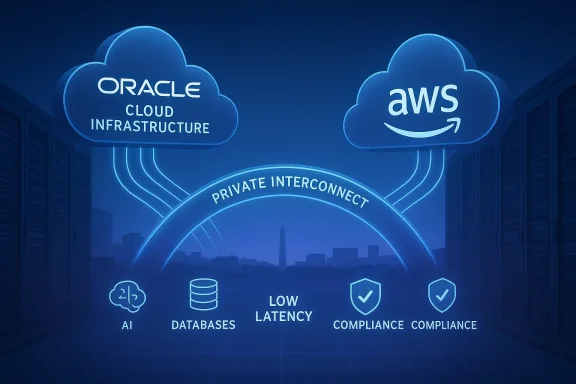
Oracle’s new AWS interconnect is less a flashy partnership announcement than a strategic signal that the multicloud era is no longer theoretical. By giving enterprise customers a private, high-speed path between Oracle Cloud Infrastructure and AWS, Oracle is making it easier for customers to keep data, applications, and AI workloads in the environments they already trust. That matters because the biggest cloud buyers increasingly want flexibility, not allegiance, and Oracle appears ready to profit from that shift.
The timing is important. Oracle’s cloud infrastructure business has been accelerating fast, with the company reporting 84% year-over-year IaaS growth to $4.9 billion in fiscal Q3 2026, while total cloud revenue reached $8.9 billion, up 44% year over year. The AWS deal builds on Oracle’s existing interconnect strategy with Microsoft Azure and Google Cloud, completing a full multicloud set that strengthens Oracle’s role as the enterprise data layer sitting between the hyperscalers.
Oracle has spent years repositioning itself from a legacy database vendor into a cloud infrastructure and data platform company. That transition was never going to be driven by consumer mindshare or broad developer hype. Instead, Oracle’s advantage has always come from something more durable and less glamorous: the reality that enterprise data is sticky, regulated, expensive to move, and often too mission-critical to rip out lightly.
The company’s multicloud posture reflects that reality. Oracle already has interconnect arrangements with Microsoft Azure and Google Cloud, and the AWS deal extends the same logic to the largest cloud ecosystem in the market. In practical terms, Oracle is saying that customers should be able to run Oracle databases and OCI services close to where their AWS applications already live, without forcing a disruptive migration.
That approach matters because cloud competition has changed. The old model was about winning a single migration and locking customers into one hyperscaler for everything. The new model is about making sure your platform becomes indispensable inside a broader, more fragmented enterprise stack. Oracle appears to understand that control of the data path may be more valuable than control of the entire application stack.
The AWS partnership also arrives at a moment when Oracle’s cloud business is showing real operating momentum. With cloud infrastructure revenue growing far faster than the market’s larger incumbents in percentage terms, Oracle is no longer just defending legacy software cash flows. It is trying to establish itself as a multicloud infrastructure enabler for AI, analytics, and regulated enterprise workloads. That is a very different strategic posture, and one that deserves closer scrutiny.
The result is a more fragmented but also more realistic enterprise architecture. Oracle’s move acknowledges that fragmentation instead of fighting it. That is a smart concession, because the vendors that profit in multicloud are the ones that make fragmentation easier to manage.
This is not simply a networking tweak. It is infrastructure designed to reduce the hidden tax of hybrid and multicloud architecture. In enterprise cloud, the hardest problems are often not compute or storage in isolation, but the movement of data between systems that were never designed to work together. Oracle is selling itself as the company that can make that movement feel native.
The announcement also builds on Oracle Database@AWS, a service that places Oracle workloads inside AWS data centers while preserving Oracle’s database stack and licensing relationships. That matters because a lot of enterprise demand is not about replacing Oracle. It is about preserving Oracle while making it easier to consume within AWS-native environments. Oracle is effectively telling customers: you do not have to choose between your AWS standardization and your Oracle dependency.
That regional focus hints at the real objective: to win workloads where latency, compliance, and availability are business-critical. In cloud strategy, the first region is rarely the story. The story is whether the architecture proves valuable enough to expand across more geographies and deeper into customer estates.
Oracle’s pitch is that enterprises can run Oracle Autonomous Database or Exadata workloads close to AWS while still feeding data into AWS services like Bedrock and SageMaker. That combination could appeal to customers that have standardized on Oracle for transactional or analytical data, but still want access to AWS’s broader AI tooling. In other words, Oracle is trying to become the bridge between the old data estate and the new AI estate.
This is where Oracle’s moat becomes more interesting. Databases remain one of the stickiest layers in enterprise software. If Oracle can keep those databases relevant while making them cloud-portable across the major hyperscalers, it gains a durable position in the AI-era stack. That is a very strong place to be.
Oracle’s business model benefits from that reality. It does not need to win the consumer AI narrative. It needs to make itself indispensable in enterprise data movement, data storage, and workload orchestration. The AWS interconnect reinforces that strategy.
The market also seems to be buying that story. The stock was reported up modestly on the partnership news, and the company’s forward guidance points to substantial revenue expansion in fiscal 2027. Investors are clearly rewarding Oracle for proving that it can translate database strength into cloud growth without abandoning its enterprise identity.
That said, this is still a capital-intensive transition. Oracle is spending heavily on data center build-out, and its free-cash-flow profile has been pressured by those investments. That is not unusual in hyperscale infrastructure, but it does mean the bull case depends on execution staying ahead of spend.
This is where a lot of investors can misread the situation. A fast-growing cloud business is exciting, but it is also expensive to sustain. Oracle needs to prove not just demand, but repeatable monetization.
AWS also gets another proof point for its multicloud posture. The cloud giant has an obvious interest in making itself the center of enterprise buying even when it is not the sole destination for every workload. If customers can run Oracle databases, AI apps, and adjacent cloud services in a more integrated way, AWS can sell more services around the edges.
That may sound incremental, but it matters. In cloud markets, adjacent revenue is often the most durable revenue. Once a customer’s architecture deepens, switching becomes harder and broader platform usage becomes more likely.
AWS gets to be the place where Oracle-heavy enterprises keep doing business, while Oracle gets to remain central to the data layer. It is a partnership based on coexistence, not conquest. That makes it commercially pragmatic, even if it lacks the drama of a classic platform war.
For Azure, the risk is not that Oracle suddenly becomes a direct replacement. The risk is that Azure loses some of the exclusivity aura around enterprise cloud partnerships. If Oracle can work smoothly with AWS and Google as well as Microsoft, then Azure is just one part of a larger multicloud matrix, not the central one. That matters in enterprise sales conversations, where perception shapes procurement.
Google Cloud faces a slightly different challenge. It has strong technical credentials and data strengths, but Oracle’s multicloud push emphasizes interoperability over ideological purity. That means Google has to keep proving value in a market where customers are increasingly choosing flexibility over alignment.
That erosion is not bad for customers, but it is more competitive for vendors. Everyone now has to fight harder for each workload, each region, and each data path.
The stock’s valuation already reflects confidence in Oracle’s cloud transformation, so the bar is higher now. Oracle is no longer being priced as a sleepy legacy software name. It is being priced as a cloud-enabled infrastructure and AI-enablement story, which means execution misses would be punished more severely than in the past.
At the same time, the partnership could improve Oracle’s customer stickiness. If Oracle becomes the connective tissue between clouds, then it becomes harder for customers to treat it as optional. That could support better retention and pricing over time, especially with enterprise accounts that depend on Oracle databases and adjacent services.
The most important opportunity is that Oracle can become the default infrastructure connector for enterprises that want flexibility across AWS, Azure, and Google Cloud. That is a lucrative position because it sits close to data, compliance, and operational continuity.
There is also execution risk around Oracle’s heavy infrastructure spending. Fast cloud growth can justify capex, but only if utilization and margin discipline keep pace. If Oracle builds too aggressively, it could end up with a more impressive footprint and weaker near-term cash generation.
The next few quarters should also reveal whether Oracle can sustain this growth rate without creating uncomfortable balance-sheet strain. That will be especially important because investors tend to reward cloud build-outs when demand is obvious and punish them when spend appears to run ahead of monetization. Oracle will need to show that it can expand infrastructure and preserve discipline at the same time.
Oracle’s AWS partnership is not a flashy detour from the cloud wars; it is a mature answer to how those wars are actually being fought now. The winners are increasingly the companies that make enterprise data easier to move, govern, and monetize across multiple clouds, not the ones that insist every customer must choose one side forever. If Oracle can keep turning that reality into revenue, it may have found a way to be more important in the AI era than many investors once thought possible.
Source: 24/7 Wall St. Oracle's New AWS Partnership Just Put It Ahead of Azure and Google Cloud
The timing is important. Oracle’s cloud infrastructure business has been accelerating fast, with the company reporting 84% year-over-year IaaS growth to $4.9 billion in fiscal Q3 2026, while total cloud revenue reached $8.9 billion, up 44% year over year. The AWS deal builds on Oracle’s existing interconnect strategy with Microsoft Azure and Google Cloud, completing a full multicloud set that strengthens Oracle’s role as the enterprise data layer sitting between the hyperscalers.
 Background
Oracle has spent years repositioning itself from a legacy database vendor into a cloud infrastructure and data platform company. That transition was never going to be driven by consumer mindshare or broad developer hype. Instead, Oracle’s advantage has always come from something more durable and less glamorous: the reality that enterprise data is sticky, regulated, expensive to move, and often too mission-critical to rip out lightly.The company’s multicloud posture reflects that reality. Oracle already has interconnect arrangements with Microsoft Azure and Google Cloud, and the AWS deal extends the same logic to the largest cloud ecosystem in the market. In practical terms, Oracle is saying that customers should be able to run Oracle databases and OCI services close to where their AWS applications already live, without forcing a disruptive migration.
That approach matters because cloud competition has changed. The old model was about winning a single migration and locking customers into one hyperscaler for everything. The new model is about making sure your platform becomes indispensable inside a broader, more fragmented enterprise stack. Oracle appears to understand that control of the data path may be more valuable than control of the entire application stack.
The AWS partnership also arrives at a moment when Oracle’s cloud business is showing real operating momentum. With cloud infrastructure revenue growing far faster than the market’s larger incumbents in percentage terms, Oracle is no longer just defending legacy software cash flows. It is trying to establish itself as a multicloud infrastructure enabler for AI, analytics, and regulated enterprise workloads. That is a very different strategic posture, and one that deserves closer scrutiny.
Why multicloud became unavoidable
Enterprises are not choosing a single cloud in the way they once chose a single ERP vendor. Instead, they are spreading workloads across providers for reasons that are both technical and political. Some applications need low latency. Some data sets must stay near specific compliance boundaries. Some AI workloads need the best model or GPU availability regardless of vendor.The result is a more fragmented but also more realistic enterprise architecture. Oracle’s move acknowledges that fragmentation instead of fighting it. That is a smart concession, because the vendors that profit in multicloud are the ones that make fragmentation easier to manage.
- Multicloud reduces single-vendor dependency.
- It gives enterprises more negotiating leverage.
- It helps regulated industries keep sensitive data in preferred locations.
- It allows AI workloads to be placed where compute and services are best.
- It makes connectivity and interoperability more valuable than ever.
What Oracle Actually Announced
The core announcement is straightforward: Oracle and AWS are creating a private, managed, high-speed interconnect between Oracle Cloud Infrastructure and AWS data centers, beginning later this year in the AWS US East region in Northern Virginia. The goal is to let customers move data and workloads seamlessly between the two clouds while avoiding the friction, latency, and security concerns associated with public internet routing.This is not simply a networking tweak. It is infrastructure designed to reduce the hidden tax of hybrid and multicloud architecture. In enterprise cloud, the hardest problems are often not compute or storage in isolation, but the movement of data between systems that were never designed to work together. Oracle is selling itself as the company that can make that movement feel native.
The announcement also builds on Oracle Database@AWS, a service that places Oracle workloads inside AWS data centers while preserving Oracle’s database stack and licensing relationships. That matters because a lot of enterprise demand is not about replacing Oracle. It is about preserving Oracle while making it easier to consume within AWS-native environments. Oracle is effectively telling customers: you do not have to choose between your AWS standardization and your Oracle dependency.
Why the Northern Virginia launch matters
Starting in US East, Northern Virginia is a sensible first step. It is one of the most important cloud regions in the United States and a natural anchor point for enterprise workloads on the East Coast. Launching there first also signals that Oracle and AWS are targeting customers with dense enterprise footprints, not just experimental AI teams.That regional focus hints at the real objective: to win workloads where latency, compliance, and availability are business-critical. In cloud strategy, the first region is rarely the story. The story is whether the architecture proves valuable enough to expand across more geographies and deeper into customer estates.
- First-region launches are often tests of operational reliability.
- Regional depth can determine enterprise adoption speed.
- East Coast proximity matters for finance, government, and regulated industries.
- A successful rollout can become a template for broader expansion.
- Early adoption in one region can create momentum for broader contracts.
Why This Matters for Enterprise AI
The biggest strategic value of the Oracle-AWS link is not ordinary application hosting. It is enterprise AI, where data gravity, security, and compute routing matter just as much as model quality. Businesses increasingly want to run AI where their data already sits, or at least move the minimum amount of sensitive information necessary to get the job done. That makes low-friction interconnects a competitive necessity, not a luxury.Oracle’s pitch is that enterprises can run Oracle Autonomous Database or Exadata workloads close to AWS while still feeding data into AWS services like Bedrock and SageMaker. That combination could appeal to customers that have standardized on Oracle for transactional or analytical data, but still want access to AWS’s broader AI tooling. In other words, Oracle is trying to become the bridge between the old data estate and the new AI estate.
This is where Oracle’s moat becomes more interesting. Databases remain one of the stickiest layers in enterprise software. If Oracle can keep those databases relevant while making them cloud-portable across the major hyperscalers, it gains a durable position in the AI-era stack. That is a very strong place to be.
The data layer is becoming the AI layer
A lot of the market’s AI excitement focuses on models, agents, and user-facing applications. But enterprise adoption often depends on something less glamorous: clean, governed, accessible data. Without that layer, AI projects stall in pilots, compliance reviews, or integration bottlenecks.Oracle’s business model benefits from that reality. It does not need to win the consumer AI narrative. It needs to make itself indispensable in enterprise data movement, data storage, and workload orchestration. The AWS interconnect reinforces that strategy.
- AI needs governed data more than it needs marketing buzz.
- Enterprise buyers want architecture that passes security review.
- Data locality can determine whether AI projects are deployable.
- Interconnects reduce the operational cost of experimentation.
- The infrastructure layer often captures value before the model layer does.
Oracle’s Growth Story Is No Longer Incremental
Oracle’s fiscal Q3 2026 results give the partnership context. Total cloud revenue hit $8.9 billion, up 44% year over year, while IaaS alone rose 84% to $4.9 billion. Those numbers matter because they show Oracle is not relying on nostalgia or software maintenance revenues to tell its growth story. It is being re-rated as a cloud infrastructure player.The market also seems to be buying that story. The stock was reported up modestly on the partnership news, and the company’s forward guidance points to substantial revenue expansion in fiscal 2027. Investors are clearly rewarding Oracle for proving that it can translate database strength into cloud growth without abandoning its enterprise identity.
That said, this is still a capital-intensive transition. Oracle is spending heavily on data center build-out, and its free-cash-flow profile has been pressured by those investments. That is not unusual in hyperscale infrastructure, but it does mean the bull case depends on execution staying ahead of spend.
Growth at scale changes the conversation
When a cloud business grows 84% year over year, the question is no longer whether the market exists. The question becomes whether the company can build capacity fast enough, maintain reliability, and avoid compressing margins too aggressively. Oracle is moving from “cloud challenger” to “cloud platform with real scale,” and that creates both opportunity and scrutiny.This is where a lot of investors can misread the situation. A fast-growing cloud business is exciting, but it is also expensive to sustain. Oracle needs to prove not just demand, but repeatable monetization.
- Fast revenue growth can hide heavy capex.
- Infrastructure expansion can strain free cash flow.
- Enterprise customers reward reliability over speed.
- Cloud scale only matters if utilization follows capacity.
- Market enthusiasm can outrun operating discipline.
Why AWS Is Also a Winner
This deal is not a one-sided victory for Oracle. AWS benefits too, because the partnership makes AWS more attractive to enterprises that already depend on Oracle technology but want to stay inside the AWS ecosystem. In effect, AWS gains a better way to capture Oracle-anchored workloads without forcing customers into unnatural migrations. That improves retention and deepens AWS’s value proposition for large enterprise accounts.AWS also gets another proof point for its multicloud posture. The cloud giant has an obvious interest in making itself the center of enterprise buying even when it is not the sole destination for every workload. If customers can run Oracle databases, AI apps, and adjacent cloud services in a more integrated way, AWS can sell more services around the edges.
That may sound incremental, but it matters. In cloud markets, adjacent revenue is often the most durable revenue. Once a customer’s architecture deepens, switching becomes harder and broader platform usage becomes more likely.
AWS is defending relevance in the multicloud era
There is a subtle strategic shift happening in the cloud market. The leaders are no longer trying to convince enterprises that they can own everything. They are trying to prove they can be the most important part of a broader architecture. Oracle’s relationship with AWS fits that trend neatly.AWS gets to be the place where Oracle-heavy enterprises keep doing business, while Oracle gets to remain central to the data layer. It is a partnership based on coexistence, not conquest. That makes it commercially pragmatic, even if it lacks the drama of a classic platform war.
- AWS expands the pool of compatible enterprise workloads.
- Oracle becomes easier to adopt for AWS-native customers.
- The partnership reduces customer friction.
- Both companies gain more enterprise mindshare.
- The deal reinforces multicloud as the default assumption.
Competitive Pressure on Azure and Google Cloud
Oracle’s announcement has obvious competitive implications for Microsoft Azure and Google Cloud. Both companies already have interconnect relationships with Oracle, and Oracle’s move to complete the multicloud set means it can now market itself as broadly interoperable across all the major hyperscalers. That weakens any rival’s claim to be the most natural home for Oracle-dependent enterprise workloads.For Azure, the risk is not that Oracle suddenly becomes a direct replacement. The risk is that Azure loses some of the exclusivity aura around enterprise cloud partnerships. If Oracle can work smoothly with AWS and Google as well as Microsoft, then Azure is just one part of a larger multicloud matrix, not the central one. That matters in enterprise sales conversations, where perception shapes procurement.
Google Cloud faces a slightly different challenge. It has strong technical credentials and data strengths, but Oracle’s multicloud push emphasizes interoperability over ideological purity. That means Google has to keep proving value in a market where customers are increasingly choosing flexibility over alignment.
The market is shifting from lock-in to leverage
The old cloud model rewarded lock-in. The new model rewards leverage. Enterprises want bargaining power, workload portability, and routing options that reduce dependence on any single vendor. Oracle’s strategy makes that easier, which means Oracle is participating in the broader erosion of hyperscaler exclusivity.That erosion is not bad for customers, but it is more competitive for vendors. Everyone now has to fight harder for each workload, each region, and each data path.
- Multicloud reduces switching pain for customers.
- It increases pricing pressure on cloud vendors.
- It rewards the companies that solve integration problems.
- It weakens the “all-in-one-cloud” sales pitch.
- It pushes the market toward modular architecture.
Financial Implications for Investors
Investors tend to love cloud growth stories, but they can sometimes miss what makes a growth story durable. In Oracle’s case, the AWS partnership is not just a headline; it potentially expands Oracle’s addressable market without forcing a costly rip-and-replace migration cycle. That is exactly the kind of organic expansion long-term shareholders want to see.The stock’s valuation already reflects confidence in Oracle’s cloud transformation, so the bar is higher now. Oracle is no longer being priced as a sleepy legacy software name. It is being priced as a cloud-enabled infrastructure and AI-enablement story, which means execution misses would be punished more severely than in the past.
At the same time, the partnership could improve Oracle’s customer stickiness. If Oracle becomes the connective tissue between clouds, then it becomes harder for customers to treat it as optional. That could support better retention and pricing over time, especially with enterprise accounts that depend on Oracle databases and adjacent services.
What the numbers are really saying
Revenue growth is one thing. Quality of revenue is another. Oracle’s cloud momentum suggests that enterprise demand is strong, but the market will want to see whether that demand converts into operating leverage rather than just more spending. That is the central trade-off in any infrastructure build-out.- Strong cloud growth can support multiple years of expansion.
- High capex can pressure margins in the near term.
- Interconnect services can improve customer retention.
- Enterprise contracts can be long-dated and sticky.
- Valuation depends on whether growth remains profitable.
Strengths and Opportunities
The Oracle-AWS move has several clear strengths. It plays to Oracle’s database legacy, aligns with the way enterprise customers actually buy cloud services, and creates a cleaner bridge between traditional workloads and AI adoption. It also allows Oracle to participate in the multicloud trend without pretending that one provider will dominate every workload.The most important opportunity is that Oracle can become the default infrastructure connector for enterprises that want flexibility across AWS, Azure, and Google Cloud. That is a lucrative position because it sits close to data, compliance, and operational continuity.
- Oracle can deepen its role in enterprise data infrastructure.
- AWS can capture more Oracle-related workloads.
- Customers gain simpler multicloud integration.
- AI adoption becomes easier for regulated enterprises.
- Oracle’s database franchise becomes more cloud-native.
- The partnership may improve customer retention and expansion.
- Multicloud demand should keep rising as enterprises diversify risk.
Risks and Concerns
The biggest risk is that the partnership creates complexity faster than it creates revenue. Multicloud architecture sounds elegant in press releases, but it can be messy in implementation. Enterprises still have to manage governance, security boundaries, billing, support ownership, and performance tuning. If those operational issues are not handled cleanly, the interconnect may be underused relative to its promise.There is also execution risk around Oracle’s heavy infrastructure spending. Fast cloud growth can justify capex, but only if utilization and margin discipline keep pace. If Oracle builds too aggressively, it could end up with a more impressive footprint and weaker near-term cash generation.
- Integration complexity can slow enterprise adoption.
- Overlapping sales motions can confuse customers.
- Capex intensity can pressure free cash flow.
- Cloud interconnects do not eliminate governance burden.
- Rival hyperscalers may respond with better pricing or incentives.
- Customer enthusiasm may not convert to immediate workload migration.
- A lot depends on region-by-region execution.
What to Watch Next
The most important near-term question is whether the Oracle-AWS interconnect translates into visible customer wins, not just press coverage. If enterprises begin citing the partnership as a reason to move workloads or consolidate data workflows, Oracle’s strategy gains credibility very quickly. If adoption remains narrow, the deal will still matter, but more as a positioning move than a revenue catalyst.The next few quarters should also reveal whether Oracle can sustain this growth rate without creating uncomfortable balance-sheet strain. That will be especially important because investors tend to reward cloud build-outs when demand is obvious and punish them when spend appears to run ahead of monetization. Oracle will need to show that it can expand infrastructure and preserve discipline at the same time.
Key signals to monitor
- Whether the Northern Virginia launch expands to additional AWS regions.
- Whether Oracle discloses meaningful customer adoption tied to the interconnect.
- Whether cloud infrastructure growth remains above peer rates.
- Whether capex intensity starts to stabilize as capacity comes online.
- Whether Oracle’s multicloud positioning produces new enterprise contract wins.
Oracle’s AWS partnership is not a flashy detour from the cloud wars; it is a mature answer to how those wars are actually being fought now. The winners are increasingly the companies that make enterprise data easier to move, govern, and monetize across multiple clouds, not the ones that insist every customer must choose one side forever. If Oracle can keep turning that reality into revenue, it may have found a way to be more important in the AI era than many investors once thought possible.
Source: 24/7 Wall St. Oracle's New AWS Partnership Just Put It Ahead of Azure and Google Cloud
Last edited:
