

Oracle’s latest surge looks less like a one-week trading anomaly and more like a market verdict on the company’s evolving identity. Investors are increasingly treating Oracle as an infrastructure utility for the AI era, not just a legacy enterprise software vendor, and this week’s sharp rally underscored that shift. The catalysts were unusually concrete: a large-scale power agreement with Bloom Energy and a new direct multicloud connection with AWS. Together, they attack the two bottlenecks that matter most in modern cloud expansion — electricity supply and low-latency network access.
For years, Oracle has been trying to reframe itself from a database-and-applications incumbent into a serious cloud infrastructure player. That effort was long on ambition and short on proof in the eyes of many investors, especially when compared with the scale and brand recognition of Amazon Web Services, Microsoft Azure, and Google Cloud. The company’s latest announcements suggest that the strategy is no longer theoretical. It is becoming operational, physical, and measurable.
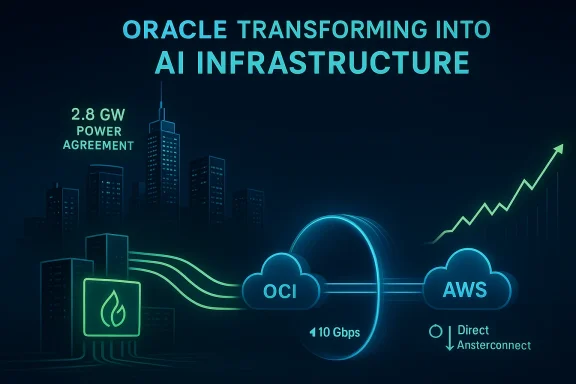
The first turning point came with Oracle’s expanded partnership with Bloom Energy, under which Oracle intends to procure up to 2.8 gigawatts of fuel cell systems, including 1.2 gigawatts already under firm contract. Bloom said the arrangement is designed to support Oracle’s AI and cloud infrastructure build-out, which immediately made the market think about one thing: power. Data centers are no longer limited mainly by server racks and fiber; they are limited by whether enough dependable electricity can be delivered at scale.
The second turning point was the Oracle-AWS multicloud interconnect announcement. Oracle and Amazon Web Services said they would provide a private, managed, high-speed connection between OCI and AWS, starting in the AWS US East region in Northern Virginia. That matters because enterprise customers increasingly want to split workloads across clouds without paying the latency and security penalty of the public internet. Oracle already has similar connections with Microsoft Azure and Google Cloud, so the AWS link fills in a strategic gap and completes a more coherent multicloud story.
The financial backdrop is just as important as the headline deals. Oracle recently reported quarterly revenue of $17.2 billion, up 22%, while cloud revenue kept growing at a much faster pace. Even more eye-catching was the company’s remaining performance obligations, or RPO, which climbed to $553 billion, giving management enormous visibility into future demand. Oracle also raised its fiscal 2027 revenue target to $90 billion, signaling that leadership believes the current build-out is only the opening chapter.
The Bloom Energy agreement is especially notable because the AI boom has changed how investors think about data center economics. A cloud provider can order GPUs, lease land, and line up networking gear, but none of that matters without reliable megawatt-scale electricity. Oracle’s deal suggests it is trying to de-risk one of the most serious operational challenges in its expansion plan.
The AWS interconnect announcement matters for a different reason. Cloud customers increasingly operate in multicloud environments for resilience, regulatory, vendor-diversification, or performance reasons. Oracle’s ability to offer direct, private links into the two other largest hyperscalers means it can position itself as part of the connective tissue of enterprise computing rather than an isolated destination.
Key takeaways from the week include:
The scale of the agreement is what makes it extraordinary. 2.8 gigawatts is not a normal procurement headline; it is a strategic supply commitment large enough to shape how investors think about Oracle’s infrastructure footprint. The firm contract portion alone, at 1.2 gigawatts, indicates that this is not just aspirational language. It is a plan with real commercial weight.
Oracle’s broader expansion requires that kind of certainty because cloud capacity is now being built against a backdrop of intense AI demand. If a company cannot secure enough power, it cannot monetize the land, fiber, chips, or customer contracts it has already assembled. In that sense, the Bloom deal is not just a supply agreement. It is a revenue-enablement mechanism.
At the same time, fuel cells are not a magic solution. They can be expensive, operationally complex, and dependent on fuel availability and permitting. Oracle’s choice suggests it is willing to accept those tradeoffs in exchange for speed and reliability.
Oracle already had established interconnects with Microsoft Azure and Google Cloud, so the AWS deal completes a more symmetrical strategy. The company is effectively ensuring that customers using Oracle database services or OCI can integrate with every major hyperscaler without redesigning their network architecture from scratch. That makes Oracle more relevant to hybrid and multicloud buyers, which is where many large enterprise budgets are heading.
The technical details matter. The private connection avoids the public internet, supports speeds up to 100 gigabits per second, and in Oracle’s case includes no outbound data transfer fees from OCI for the relevant setup described in the announcement. Those are not marketing flourishes. They directly target the pain points that make multicloud deployments slow, costly, and operationally fragile.
It also gives Oracle an edge in cross-cloud AI workflows. A customer might train a model in one environment, keep sensitive data in another, and run database operations closer to Oracle’s infrastructure. The interconnect makes that choreography more practical.
Important implications include:
The most striking metric remains the RPO figure, which reached $553 billion. RPO is not revenue in hand, but it is a powerful signal of contracted future demand. When that number rises this quickly, investors tend to assume the company has a line of sight to years of expansion rather than quarters of hope.
Oracle’s updated fiscal 2027 revenue target of $90 billion reinforces that view. Management is effectively telling the market that it expects the current AI infrastructure cycle to be large, durable, and monetizable. That is a big claim, but one the company can now support with backlog, cloud growth, and strategic capacity investments.
That is where execution matters more than narrative. If Oracle can convert contracted demand into recurring revenue at scale, the debt burden may look like a bridge to an attractive future. If it cannot, the market may eventually reassess the premium it has started to assign to the stock.
Oracle’s long-standing strength in databases gives it an advantage that newer cloud players do not easily replicate. Enterprise customers already trust Oracle with critical workloads, which lowers the barrier to adopting adjacent cloud and interconnect services. The company is not trying to sell a blank-slate platform. It is trying to extend a deep installed base into the cloud era.
The market also likes visibility. Management’s large RPO number and long-range revenue targets provide a framework for modeling growth, even if the path contains execution risk. That kind of visibility is especially attractive in an environment where many AI-related companies still rely on big promises and smaller proof points.
Instead, the bullish case rests on several ideas:
The AWS interconnect is particularly revealing because it turns a competitor into a connectivity partner. That does not mean Oracle and AWS are suddenly aligned on everything. It does mean both companies recognize that customers want fewer barriers between clouds. In that sense, Oracle is leaning into a market reality rather than resisting it.
Against Microsoft, Oracle already has a credible multicloud story through Oracle Database services in Azure environments. Against Google Cloud, the company has similar positioning. Adding AWS rounds out the picture and removes any sense that Oracle is selectively multicloud only where convenient. The company is building an ecosystem of interdependence.
That also means Oracle’s opportunity set is narrower but deeper. It is not chasing broad consumer adoption. It is chasing recurring contracts, mission-critical workloads, and infrastructure decisions that are hard to unwind.
There is also the broader strategic question of whether Oracle can keep its enterprise software franchise relevant if AI-native competitors continue to reshape how applications are built and deployed. If customers increasingly adopt modern data and application layers that bypass legacy enterprise systems, Oracle could face pressure in its core business even as its cloud infrastructure gains momentum. That tension is important because it means the company is fighting on two fronts at once.
Another issue is concentration risk. Massive AI infrastructure commitments can create future dependence on a small number of very large customers or a narrow range of demand assumptions. If that demand changes, the economics of capacity expansion can become much less attractive.
The core concerns are straightforward:
That said, the market is also susceptible to overreacting. A week-long surge can reflect genuine strategic progress while still overshooting what the underlying business can justify in the short run. The key question is not whether Oracle has momentum. It is whether that momentum can be converted into a sustainable re-rating over multiple quarters.
The next earnings cycle will matter enormously because it will show whether the company’s backlog is turning into revenue at a pace that supports the new valuation. Investors will want evidence that capacity build-out, customer adoption, and cash generation are moving together rather than pulling apart.
The broader significance goes beyond Oracle itself. If this strategy works, it may encourage other cloud providers to treat power procurement and direct interconnects as strategic differentiators rather than background infrastructure tasks. In that sense, Oracle is not just participating in the AI infrastructure race. It is helping define what the race is actually about.
Source: AD HOC NEWS Oracle's Cloud Gambit Pays Off with Historic Weekly Surge
 Overview
For years, Oracle has been trying to reframe itself from a database-and-applications incumbent into a serious cloud infrastructure player. That effort was long on ambition and short on proof in the eyes of many investors, especially when compared with the scale and brand recognition of Amazon Web Services, Microsoft Azure, and Google Cloud. The company’s latest announcements suggest that the strategy is no longer theoretical. It is becoming operational, physical, and measurable.The first turning point came with Oracle’s expanded partnership with Bloom Energy, under which Oracle intends to procure up to 2.8 gigawatts of fuel cell systems, including 1.2 gigawatts already under firm contract. Bloom said the arrangement is designed to support Oracle’s AI and cloud infrastructure build-out, which immediately made the market think about one thing: power. Data centers are no longer limited mainly by server racks and fiber; they are limited by whether enough dependable electricity can be delivered at scale.
The second turning point was the Oracle-AWS multicloud interconnect announcement. Oracle and Amazon Web Services said they would provide a private, managed, high-speed connection between OCI and AWS, starting in the AWS US East region in Northern Virginia. That matters because enterprise customers increasingly want to split workloads across clouds without paying the latency and security penalty of the public internet. Oracle already has similar connections with Microsoft Azure and Google Cloud, so the AWS link fills in a strategic gap and completes a more coherent multicloud story.
The financial backdrop is just as important as the headline deals. Oracle recently reported quarterly revenue of $17.2 billion, up 22%, while cloud revenue kept growing at a much faster pace. Even more eye-catching was the company’s remaining performance obligations, or RPO, which climbed to $553 billion, giving management enormous visibility into future demand. Oracle also raised its fiscal 2027 revenue target to $90 billion, signaling that leadership believes the current build-out is only the opening chapter.
Why This Week Mattered So Much
Markets rarely reward a company this dramatically for two announcements unless those announcements solve a real bottleneck. That is exactly what happened here. Oracle did not simply unveil another software feature or pricing tweak; it addressed two core constraints that can slow the AI infrastructure race for years: power availability and interconnect quality.The Bloom Energy agreement is especially notable because the AI boom has changed how investors think about data center economics. A cloud provider can order GPUs, lease land, and line up networking gear, but none of that matters without reliable megawatt-scale electricity. Oracle’s deal suggests it is trying to de-risk one of the most serious operational challenges in its expansion plan.
The AWS interconnect announcement matters for a different reason. Cloud customers increasingly operate in multicloud environments for resilience, regulatory, vendor-diversification, or performance reasons. Oracle’s ability to offer direct, private links into the two other largest hyperscalers means it can position itself as part of the connective tissue of enterprise computing rather than an isolated destination.
The Market’s Message
Investors were not just betting on a single quarter. They were voting on Oracle’s ability to become a durable AI infrastructure platform. In other words, the market is increasingly willing to pay for future optionality, not just current earnings.Key takeaways from the week include:
- Power is now strategic in cloud competition, not merely a utility expense.
- Multicloud connectivity is becoming a product feature, not a custom integration project.
- Oracle’s AI narrative is finally backed by tangible operating moves.
- Scale and backlog are beginning to matter more than software nostalgia.
- The company’s capital intensity is becoming part of the investment thesis rather than a footnote.
Power, the Hidden Constraint Behind AI Ambition
AI infrastructure is often discussed in terms of chips, models, and software. In practice, the binding constraint is increasingly electricity. Large-scale training and inference clusters require dense power delivery, grid access, and often bespoke energy arrangements. Oracle’s move with Bloom Energy shows that the company understands this reality better than many of its skeptics expected.The scale of the agreement is what makes it extraordinary. 2.8 gigawatts is not a normal procurement headline; it is a strategic supply commitment large enough to shape how investors think about Oracle’s infrastructure footprint. The firm contract portion alone, at 1.2 gigawatts, indicates that this is not just aspirational language. It is a plan with real commercial weight.
Oracle’s broader expansion requires that kind of certainty because cloud capacity is now being built against a backdrop of intense AI demand. If a company cannot secure enough power, it cannot monetize the land, fiber, chips, or customer contracts it has already assembled. In that sense, the Bloom deal is not just a supply agreement. It is a revenue-enablement mechanism.
Why Fuel Cells Matter
Fuel cells are attractive in the current environment because they can offer on-site generation and a degree of independence from stressed local grids. That is particularly useful for data center operators that need predictable uptime and scalable deployment timelines. It also gives Oracle another way to reduce exposure to traditional grid bottlenecks.At the same time, fuel cells are not a magic solution. They can be expensive, operationally complex, and dependent on fuel availability and permitting. Oracle’s choice suggests it is willing to accept those tradeoffs in exchange for speed and reliability.
- On-site generation can shorten deployment timelines.
- Predictability matters more than theoretical efficiency in AI operations.
- Permitting and fuel logistics remain real execution risks.
- Diversified power sourcing helps Oracle reduce grid dependence.
- Energy procurement is becoming a competitive differentiator.
Multicloud Connectivity Becomes a Differentiator
If power is the physical bottleneck, connectivity is the digital one. Oracle’s new direct link with AWS is significant because it lowers friction for customers who need to move data and applications between clouds. In enterprise architecture, that can be the difference between a clean multicloud design and a complicated, expensive workaround.Oracle already had established interconnects with Microsoft Azure and Google Cloud, so the AWS deal completes a more symmetrical strategy. The company is effectively ensuring that customers using Oracle database services or OCI can integrate with every major hyperscaler without redesigning their network architecture from scratch. That makes Oracle more relevant to hybrid and multicloud buyers, which is where many large enterprise budgets are heading.
The technical details matter. The private connection avoids the public internet, supports speeds up to 100 gigabits per second, and in Oracle’s case includes no outbound data transfer fees from OCI for the relevant setup described in the announcement. Those are not marketing flourishes. They directly target the pain points that make multicloud deployments slow, costly, and operationally fragile.
Why This Is More Than Networking
The multicloud link is really about reducing switching costs. If customers can use Oracle services inside a broader AWS-centered architecture, they are less likely to treat Oracle as a silo. That increases Oracle’s chances of winning workloads that might otherwise have been locked into another cloud.It also gives Oracle an edge in cross-cloud AI workflows. A customer might train a model in one environment, keep sensitive data in another, and run database operations closer to Oracle’s infrastructure. The interconnect makes that choreography more practical.
Important implications include:
- Lower latency for distributed enterprise applications.
- Improved security through private rather than public routing.
- Simpler operations for teams managing multiple clouds.
- Better AI data locality for workloads that span environments.
- More realistic multicloud adoption for large enterprises.
Financial Backing for the Strategy
Oracle’s infrastructure push is easier to believe because its recent financial results have been strong enough to support the story. The company reported quarterly revenue of $17.2 billion, a 22% increase, while cloud revenue grew even faster. That kind of acceleration gives management room to argue that its infrastructure bets are not speculative moonshots but responses to actual demand.The most striking metric remains the RPO figure, which reached $553 billion. RPO is not revenue in hand, but it is a powerful signal of contracted future demand. When that number rises this quickly, investors tend to assume the company has a line of sight to years of expansion rather than quarters of hope.
Oracle’s updated fiscal 2027 revenue target of $90 billion reinforces that view. Management is effectively telling the market that it expects the current AI infrastructure cycle to be large, durable, and monetizable. That is a big claim, but one the company can now support with backlog, cloud growth, and strategic capacity investments.
The Debt Question
Of course, none of this comes free. Oracle’s AI infrastructure expansion has been financed in part by substantial borrowing, and the company’s debt load has become a central talking point among bears. The question is whether the returns on this capital will arrive quickly enough to justify the balance-sheet risk.That is where execution matters more than narrative. If Oracle can convert contracted demand into recurring revenue at scale, the debt burden may look like a bridge to an attractive future. If it cannot, the market may eventually reassess the premium it has started to assign to the stock.
- Revenue growth validates the strategic shift.
- RPO growth supports long-term visibility.
- Debt financing amplifies both upside and risk.
- Capital intensity is unavoidable in AI infrastructure.
- Execution speed will determine whether the strategy compounds or stalls.
Why Analysts Turned More Constructive
The analyst community’s reaction shows how quickly sentiment can shift when a company proves it can meet a structural need. Several firms have lifted their expectations on Oracle, arguing that the company is well positioned to benefit from the AI infrastructure cycle. That positive stance is not simply about enthusiasm; it is about the growing belief that Oracle has a credible moat in enterprise data workloads and multicloud plumbing.Oracle’s long-standing strength in databases gives it an advantage that newer cloud players do not easily replicate. Enterprise customers already trust Oracle with critical workloads, which lowers the barrier to adopting adjacent cloud and interconnect services. The company is not trying to sell a blank-slate platform. It is trying to extend a deep installed base into the cloud era.
The market also likes visibility. Management’s large RPO number and long-range revenue targets provide a framework for modeling growth, even if the path contains execution risk. That kind of visibility is especially attractive in an environment where many AI-related companies still rely on big promises and smaller proof points.
What Bulls Are Really Buying
The bullish case is not just “Oracle is growing.” It is that Oracle is becoming a picks-and-shovels provider for enterprise AI and multicloud architecture. That means its success does not depend on winning every AI model war or every developer mindshare contest.Instead, the bullish case rests on several ideas:
- Oracle can monetize enterprise database gravity.
- OCI can grow as a specialized AI infrastructure layer.
- Multicloud links can improve customer retention.
- Power supply arrangements can support faster capacity expansion.
- Backlog can translate into multi-year revenue compounding.
Competition: Oracle’s Position Against the Hyperscalers
Oracle is not trying to replace Amazon, Microsoft, or Google as the dominant public cloud choice. It is trying to become indispensable around the edges where those ecosystems intersect. That is a more pragmatic strategy, and perhaps a more realistic one.The AWS interconnect is particularly revealing because it turns a competitor into a connectivity partner. That does not mean Oracle and AWS are suddenly aligned on everything. It does mean both companies recognize that customers want fewer barriers between clouds. In that sense, Oracle is leaning into a market reality rather than resisting it.
Against Microsoft, Oracle already has a credible multicloud story through Oracle Database services in Azure environments. Against Google Cloud, the company has similar positioning. Adding AWS rounds out the picture and removes any sense that Oracle is selectively multicloud only where convenient. The company is building an ecosystem of interdependence.
Enterprise Versus Consumer Relevance
This story is overwhelmingly enterprise-driven. Consumers are unlikely to care whether Oracle has a 100 Gbps private link to AWS or a fuel cell agreement measured in gigawatts. But enterprise IT leaders, procurement teams, and cloud architects care deeply because these details affect uptime, cost, latency, and governance.That also means Oracle’s opportunity set is narrower but deeper. It is not chasing broad consumer adoption. It is chasing recurring contracts, mission-critical workloads, and infrastructure decisions that are hard to unwind.
- Hyperscalers remain the main competitors, not the only partners.
- Enterprise buyers drive the economics here.
- Consumer awareness is mostly irrelevant.
- Database lock-in remains a structural advantage.
- Cross-cloud interoperability is the new battleground.
The Bear Case Still Has Teeth
The rally does not erase legitimate concerns. Oracle’s debt burden is real, and capital-intensive infrastructure growth can look fantastic until the cycle cools or execution slips. Markets often reward visible demand long before they fully price in financing risk.There is also the broader strategic question of whether Oracle can keep its enterprise software franchise relevant if AI-native competitors continue to reshape how applications are built and deployed. If customers increasingly adopt modern data and application layers that bypass legacy enterprise systems, Oracle could face pressure in its core business even as its cloud infrastructure gains momentum. That tension is important because it means the company is fighting on two fronts at once.
Another issue is concentration risk. Massive AI infrastructure commitments can create future dependence on a small number of very large customers or a narrow range of demand assumptions. If that demand changes, the economics of capacity expansion can become much less attractive.
Why Skeptics Remain Cautious
Skeptics are not necessarily arguing that Oracle’s strategy is wrong. They are arguing that the stock may already be pricing in a lot of success. That leaves less room for disappointment if growth moderates, construction delays appear, or the market rotates away from AI infrastructure names.The core concerns are straightforward:
- Leverage amplifies both gains and losses.
- Execution risk rises with every major capacity commitment.
- Customer concentration can complicate long-term forecasting.
- Legacy business pressure may eventually matter again.
- Valuation can outrun fundamentals in a hot market.
What the Infrastructure Cycle Means for Investors
Oracle’s week provides a useful snapshot of how the market currently values AI infrastructure plays. Investors want companies that can solve real-world bottlenecks, not just talk about generative AI in abstract terms. Power, interconnectivity, and enterprise trust are now premium assets.That said, the market is also susceptible to overreacting. A week-long surge can reflect genuine strategic progress while still overshooting what the underlying business can justify in the short run. The key question is not whether Oracle has momentum. It is whether that momentum can be converted into a sustainable re-rating over multiple quarters.
The next earnings cycle will matter enormously because it will show whether the company’s backlog is turning into revenue at a pace that supports the new valuation. Investors will want evidence that capacity build-out, customer adoption, and cash generation are moving together rather than pulling apart.
Metrics That Matter Most
To judge whether this is a durable shift or a sharp but temporary revaluation, keep an eye on these items:- OCI revenue growth and whether it sustains current acceleration.
- RPO conversion, especially how quickly backlog turns into bookings and revenue.
- Capital spending discipline relative to debt growth.
- Data center and power deployment timelines.
- Multicloud adoption rates for Oracle’s cross-cloud services.
Strengths and Opportunities
Oracle’s current positioning is unusually strong because it combines legacy enterprise credibility with a more modern infrastructure story. The company is benefiting from a rare convergence of software trust, cloud demand, and AI-era capacity constraints, and that gives it multiple paths to monetization.- Enterprise database strength gives Oracle a durable installed base.
- AI infrastructure demand is lifting the importance of OCI.
- Power sourcing through Bloom Energy addresses a major bottleneck.
- Multicloud links reduce friction for enterprise adopters.
- Large RPO visibility supports long-term planning.
- Improved investor sentiment can lower the cost of capital over time.
- Cross-cloud relevance expands Oracle’s addressable market.
Risks and Concerns
The same strategy that makes Oracle more compelling also makes it more exposed. Heavy infrastructure investment, debt financing, and competitive pressure mean the company must execute almost flawlessly to preserve the current enthusiasm. That is a high bar, especially in a rapidly changing AI market.- High leverage could weigh on flexibility if growth slows.
- Capital intensity may compress returns if utilization lags.
- Operational complexity rises with power and network commitments.
- Competitors can respond quickly with pricing and product changes.
- AI-native platforms may erode parts of Oracle’s legacy moat.
- Valuation risk increases after a dramatic share-price run.
- Project timing delays can hit sentiment hard.
Looking Ahead
Oracle’s next phase will be judged less by announcements and more by delivery. The company has now shown it can make bold moves in energy procurement and multicloud networking, but the market will expect those moves to produce visible operating results. That means more data center capacity, more cloud revenue, and more evidence that the company can convert demand into durable cash flow.The broader significance goes beyond Oracle itself. If this strategy works, it may encourage other cloud providers to treat power procurement and direct interconnects as strategic differentiators rather than background infrastructure tasks. In that sense, Oracle is not just participating in the AI infrastructure race. It is helping define what the race is actually about.
- Watch quarterly cloud revenue for sustained acceleration.
- Track new capacity announcements and whether they arrive on schedule.
- Monitor debt and financing activity for signs of stress or confidence.
- Follow multicloud adoption as an indicator of product-market fit.
- Compare Oracle’s execution with rival hyperscalers’ infrastructure moves.
Source: AD HOC NEWS Oracle's Cloud Gambit Pays Off with Historic Weekly Surge
