

Oracle’s Clinical AI Agent, billed as an ambient “AI note‑taker,” has moved from pilot to general availability in the UK — and with that shift comes a high‑stakes reckoning for NHS trusts, clinicians and procurement teams balancing real productivity gains against complex clinical‑safety, data‑governance and regulatory obligations.
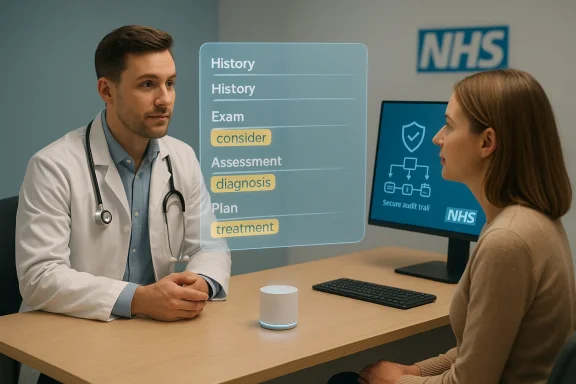
The rise of ambient voice technologies — sometimes called AI scribes or clinical scribes — has accelerated in health services worldwide as organisations seek to reduce clinician administrative burden and reclaim face‑to‑face time with patients. These systems listen to patient‑clinician conversations (via a smartphone or dedicated device), transcribe and structure the interaction, and generate draft clinical notes for clinician review and approval. Vendors frame the workflow as “human in the loop”: AI drafts, clinician signs off.
NHS England’s recent move to publish a self‑certified Ambient Voice Technology (AVT) Supplier Registry and updated guidance on the use of AI‑enabled ambient scribing products has formalised the procurement and assurance expectations for these platforms. The policy intent is clear: trusts should be able to identify suppliers who have declared compliance with standards for clinical safety, information governance, integration capability and post‑market surveillance before local adoption.
Into this policy environment Oracle Health has announced availability in the UK of its Clinical AI Agent product — marketed specifically as “Clinical Note” for ambient drafting of structured notes — after pilot deployments at multiple NHS organisations.
Oracle has disclosed pilot activity and early deployments at several high‑profile NHS organisations. The vendor named Barts Health NHS Trust, Imperial College Healthcare NHS Trust and Milton Keynes University Hospital as pilot sites and says those organisations are moving to broader deployment. In public statements quoted by Oracle, clinicians involved in the pilots describe faster letter turnaround, improved accuracy of documentation and the ability to share near‑real‑time notes across the team.
Oracle also reiterated earlier claims about the product’s US footprint — citing hundreds of organisations using the Clinical AI Agent and company figures for aggregate clinician hours “saved” in previous rollouts. Those vendor metrics speak to scale and momentum, but they remain company‑reported outcomes and therefore should be read as vendor evidence rather than independent audit findings.
However, the launch of the AVT registry also raises questions about who is included and who is not. The early public list contains a set of mostly specialist AVT vendors; some large EHR vendors and new entrants have not appeared on the registry in the initial publication window. That gap is material: being listed provides a level of assurance and transparency over evidence documents NHS teams can view when forming their own procurement decisions, so absence from that list creates practical friction for adoption.
Oracle’s UK availability announcement did not place the product on the NHS AVT registry at the same time; vendor availability and registry admittance are distinct processes. The difference matters operationally: trusts must still carry out local assurance exercises that map a supplier’s claims to evidence and risk assessments in their own settings.
Oracle’s declared investment in UK cloud infrastructure and its positioning of Clinical AI Agent as part of a broader clinical suite could strengthen its procurement case for trusts already using Oracle‑owned EPRs. At the same time, procurement teams should weigh the costs and lock‑in risks of vertically integrated solutions versus best‑of‑breed AVT tools that might better match local specialities.
That promise, however, will be realised only where adoption is governed by rigorous clinical safety oversight, watertight data governance, careful attention to consent and equality impacts, and realistic, independently audited measures of time‑savings and accuracy. For trusts, the right approach is cautious pragmatism: pilot with clear KPIs, require demonstrable evidence mapped to NHS expectations, and retain clinical accountability at every step.
Ambient AI will not replace clinicians’ judgments. But properly governed, it can be a powerful tool to unclog administrative overhead and restore attention to the patient — provided healthcare leaders keep safety, privacy and equity at the centre of every deployment.
Source: Computer Weekly Oracle readies AI note-taker for NHS | Computer Weekly
 Background
The rise of ambient voice technologies — sometimes called AI scribes or clinical scribes — has accelerated in health services worldwide as organisations seek to reduce clinician administrative burden and reclaim face‑to‑face time with patients. These systems listen to patient‑clinician conversations (via a smartphone or dedicated device), transcribe and structure the interaction, and generate draft clinical notes for clinician review and approval. Vendors frame the workflow as “human in the loop”: AI drafts, clinician signs off.NHS England’s recent move to publish a self‑certified Ambient Voice Technology (AVT) Supplier Registry and updated guidance on the use of AI‑enabled ambient scribing products has formalised the procurement and assurance expectations for these platforms. The policy intent is clear: trusts should be able to identify suppliers who have declared compliance with standards for clinical safety, information governance, integration capability and post‑market surveillance before local adoption.
Into this policy environment Oracle Health has announced availability in the UK of its Clinical AI Agent product — marketed specifically as “Clinical Note” for ambient drafting of structured notes — after pilot deployments at multiple NHS organisations.
What Oracle announced and where it has been piloted
Oracle Health’s recent UK announcement presents Clinical AI Agent, Clinical Note as an integrated ambient scribing capability within Oracle’s clinical software stack. Oracle says the product automatically drafts structured notes from patient‑clinician interactions and populates the electronic record so clinicians need only review and approve content rather than type it live.Oracle has disclosed pilot activity and early deployments at several high‑profile NHS organisations. The vendor named Barts Health NHS Trust, Imperial College Healthcare NHS Trust and Milton Keynes University Hospital as pilot sites and says those organisations are moving to broader deployment. In public statements quoted by Oracle, clinicians involved in the pilots describe faster letter turnaround, improved accuracy of documentation and the ability to share near‑real‑time notes across the team.
Oracle also reiterated earlier claims about the product’s US footprint — citing hundreds of organisations using the Clinical AI Agent and company figures for aggregate clinician hours “saved” in previous rollouts. Those vendor metrics speak to scale and momentum, but they remain company‑reported outcomes and therefore should be read as vendor evidence rather than independent audit findings.
Why the timing matters: NHS policy and the AVT registry
NHS England’s AVT guidance and the creation of a national, self‑certified supplier registry change the procurement landscape. The registry is intended to be a single place where NHS buyers can see which vendors have self‑declared compliance with technical, clinical safety and data‑protection expectations. For trusts, the registry is not a procurement framework but a starting point for local due diligence.However, the launch of the AVT registry also raises questions about who is included and who is not. The early public list contains a set of mostly specialist AVT vendors; some large EHR vendors and new entrants have not appeared on the registry in the initial publication window. That gap is material: being listed provides a level of assurance and transparency over evidence documents NHS teams can view when forming their own procurement decisions, so absence from that list creates practical friction for adoption.
Oracle’s UK availability announcement did not place the product on the NHS AVT registry at the same time; vendor availability and registry admittance are distinct processes. The difference matters operationally: trusts must still carry out local assurance exercises that map a supplier’s claims to evidence and risk assessments in their own settings.
How Clinical Note works (technical overview)
- Capture: clinicians or members of the care team place a phone or microphone near the consultation to capture ambient audio; some deployments use dedicated hardware.
- Transcription: a speech recognition engine converts audio to text in near real time.
- Natural language processing: an LLM or specialised clinical NLP extracts clinical concepts, coding cues and temporal details, and organizes the encounter into a structured note template (history, exam, assessment, plan).
- Drafting and routing: the system generates a draft clinical note and (where integrated) can propose coding, referrals or orders for clinician review.
- Clinician review and sign‑off: the clinician edits, validates and signs the note; the final version is written back to the trust’s EPR.
Claimed benefits and the evidence base
Vendors and early adopter trusts point to clear productivity improvements: shorter documentation time, faster correspondence to patients, and near‑real‑time shared notes for teams. Reported metric ranges from pilots and vendor summaries fall into the following bands:- Time saved per patient consultation: vendor claims vary from a few minutes (2–3 minutes per consultation cited in NHS guidance summaries) to larger percentage reductions (Oracle has referenced roughly 30–40% reductions in documentation time in some of its corporate announcements).
- Aggregate clinician hours: Oracle has published company totals (hundreds of thousands of clinician hours “saved” across its deployed base); these are useful headline metrics but are vendor reported and depend on underlying assumptions about baseline documentation time and deployment scope.
- Patient throughput and appointment length: independent program evaluations that NHS England referenced assessed thousands of encounters and reported modest reductions in appointment length and increases in clinician face‑to‑face time in some settings.
Notable strengths
- Direct clinician productivity gains: in busy clinics and emergency settings, shaving minutes off documentation can meaningfully increase capacity and reduce backlog pressure.
- Better patient experience: clinicians who avoid looking at a screen during consultations can improve rapport and provide more attentive care.
- Faster, more consistent records: automated drafting can help ensure key elements are captured consistently and that discharge letters or clinic correspondence are ready earlier.
- Integration opportunity: vendors that integrate with the core EPR can remove repetitive manual entry points and reduce transcription errors stemming from dual recording systems.
- Language and accessibility features: some deployments include multi‑language transcription and structured templates for specialities, which can widen accessibility.
Risks, limitations and safety concerns
- Clinical safety and accuracy
- NLP and generative models are not infallible. Transcription errors, misattributed statements, or incorrect clinical inferences can introduce safety risks if clinicians are over‑reliant on unverified outputs.
- “Hallucinations” — where generative models invent facts or diagnoses — remain a known failure mode. Even when framed as draft content, these errors can propagate if clinician review is cursory.
- Data protection, consent and recording practice
- Ambient capture of clinician‑patient conversations raises nuanced consent questions. Trusts must establish processes ensuring informed patient consent, options to pause recording for sensitive material, and clear retention policies.
- Recordings and derived transcripts are special categories of health data under GDPR and require robust DPIAs, access controls, encryption in transit and at rest, and strict retention and deletion policies.
- Integration and workflow risk
- Poorly designed rollouts can shift burden rather than reduce it — for example, if the AI creates messy drafts that require more editing than traditional notes, or if clinicians must learn new apps that interrupt patient flow.
- Interoperability assumptions matter: not every trust uses Oracle EHR as core, so integration complexity and additional middleware costs can be material.
- Regulatory and procurement exposure
- Ambient scribing tools are increasingly treated as medical devices when their outputs directly influence clinical decisions. Trusts must consider whether products need MHRA registration, class designation, and post‑market surveillance.
- Inclusion on a national AVT registry is helpful but not a substitute for trust‑level due diligence and legal procurement frameworks.
- Medico‑legal accountability and audit trails
- The clinician remains legally accountable for documentation and decisions. Trusts must preserve auditable trails showing who approved a note and when edits were made, and they must maintain policies for managing disputed or erroneous transcripts.
- Equity, inclusion and bias
- Speech recognition accuracy can vary by accent, language, speech impediment or background noise, which risks systematic quality differences across patient groups.
- Clinical NLP trained on particular data distributions may underperform in specialties or populations not well represented in training data.
Governance checklist: what trusts should demand before deployment
- Evidence of clinical safety: independent evaluation reports, adverse event logs, and a post‑market surveillance plan.
- Technical assurance: DTAC (or equivalent) evidence, security testing results, data residency guarantees, and integration API documentation.
- Regulatory compliance: MHRA classification clarity, medical device registration where applicable, and clarity on who is the manufacturer vs. the local data controller.
- Data protection: DPIA, access controls, encryption standards, data minimisation, retention schedules and secure deletion procedures.
- Consent protocols: documented patient consent workflows, the ability to pause recording, and staff training on when to disable ambient capture.
- User training and UI ergonomics: time for clinicians to trial, feedback loops to reduce edit overhead, and mechanisms to escalate transcription clarifications.
- Audit and forensic logging: immutable audit trails for note generation, edits, sign‑off and any automated coding or orders.
- Clear SLA and liability terms: responsibilities for errors that arise from transcription or NLP outputs, and indemnity clauses aligned with clinical risk.
- Equality impact assessment: evaluate performance across accents, languages, disabilities and vulnerable groups.
Practical implementation considerations
- Start small and measure: pilot within a contained specialty or clinic, measure documentation time saved versus editing time added, and audit clinical accuracy on a random sample of encounters.
- Make clinician sign‑off mandatory and visible: ensure the workflow requires explicit clinician review and that the signed note is clearly attributable to the clinician.
- Train staff in consent language: patients must be informed about recording and offered an opt‑out. Build scripts into triage and front‑desk workflows.
- Establish a “sensitive content” protocol: mechanisms for clinicians to flag parts of an encounter that should not be recorded or transcribed (domestic abuse, sexual health details, etc.).
- Monitor for bias and unequal performance: include performance metrics broken down by language, age, gender and clinic location.
- Keep patients in the loop: make generated patient letters understandable and provide routes for patients to query or correct notes.
Market and strategic implications
Oracle’s announcement underscores two market dynamics. First, established EHR vendors are moving up the stack to embed ambient AI features, converting a previously fragmented AVT market into one where platform incumbents can offer integrated solutions. Second, the AVT supplier registry and NHS guidance will shape procurement patterns: specialist AVT vendors will compete on niche accuracy and domain expertise, while large platform vendors will compete on integration and scale.Oracle’s declared investment in UK cloud infrastructure and its positioning of Clinical AI Agent as part of a broader clinical suite could strengthen its procurement case for trusts already using Oracle‑owned EPRs. At the same time, procurement teams should weigh the costs and lock‑in risks of vertically integrated solutions versus best‑of‑breed AVT tools that might better match local specialities.
Where the evidence is still thin
- Long‑term safety and clinical outcomes: we lack large, independent longitudinal studies quantifying whether ambient scribing changes clinical outcomes (not just documentation speed) across diverse NHS settings.
- Real‑world editing overhead: vendor time‑saved figures are encouraging, but independent audits comparing draft‑editing workloads across specialties are fewer and show more nuanced results.
- Regulatory clarity across product types: the boundary between transcription tools and decision‑support tools can be blurry; MHRA classification decisions will be device‑ and use‑case specific, so vendors and trust regulators must engage early.
A pragmatic recommendation for trusts
- Use the AVT registry as an evidence filter but do not treat registry inclusion as the final say. Conduct local DTAC‑level technical assessment, DPIA and clinical safety review.
- Insist on measurable pilot KPIs: median clinician documentation time, edit time per note, transcription error rate, patient consent uptake, and downstream coding accuracy.
- Build a governance forum with clinical leads, informatics, Caldicott guardians, legal and procurement to sign off go/no‑go decisions and to review adverse events transparently.
- Negotiate contractual protections: data residency commitments, deletion rights, incident response times and clear accountability for defective outputs.
- Prioritise clinician workflows: choose deployments that reduce friction, not ones that merely offload typing to a different place in the workflow.
Conclusion
Oracle’s Clinical AI Agent arrival in the UK is a meaningful inflection point for ambient scribing in the NHS. The promise — giving clinicians more time with patients, producing faster and more consistent documentation, and freeing capacity across stretched services — is compelling. Vendor results and early adopter comments suggest real operational uplift is possible.That promise, however, will be realised only where adoption is governed by rigorous clinical safety oversight, watertight data governance, careful attention to consent and equality impacts, and realistic, independently audited measures of time‑savings and accuracy. For trusts, the right approach is cautious pragmatism: pilot with clear KPIs, require demonstrable evidence mapped to NHS expectations, and retain clinical accountability at every step.
Ambient AI will not replace clinicians’ judgments. But properly governed, it can be a powerful tool to unclog administrative overhead and restore attention to the patient — provided healthcare leaders keep safety, privacy and equity at the centre of every deployment.
Source: Computer Weekly Oracle readies AI note-taker for NHS | Computer Weekly
