

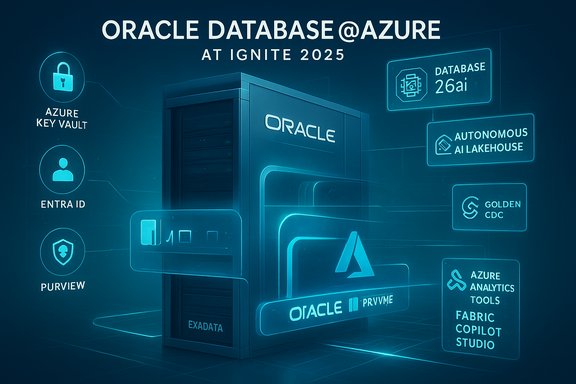
Microsoft Ignite 2025 felt like a landmark moment for enterprise cloud and AI: Oracle used the stage and partner booth time to show how its database portfolio is explicitly engineered to run within Microsoft Azure data centers while remaining managed by Oracle — a multicloud play that now ties Oracle’s AI‑native database capabilities directly into Azure’s security, identity, and AI services. The announcements and product rollouts discussed at Ignite — including expanded regional coverage for Oracle Database@Azure, the arrival of Exadata on Exascale Infrastructure, the General Availability of Oracle’s Autonomous AI Lakehouse and AI Database family, and tighter integrations with Azure Key Vault, Entra ID and Copilot — were more than marketing; they represent a concrete operational pathway for enterprises that need low‑latency access to Oracle data while building AI workloads on Azure.
Microsoft and Oracle’s multicloud partnership has been unfolding for several years, and Ignite 2025 was the latest checkpoint where both vendors translated integration roadmaps into production features and availability milestones. The core idea is straightforward: run Oracle Database services (Exadata, Autonomous/AI Database, Base Database Service) physically inside Azure data centers, managed by Oracle, and allow Azure services — analytics, AI, identity and security — to access and act on that data with enterprise controls, low latency, and consistent governance.
That arrangement preserves Oracle’s operational model (managed database, Oracle SLAs, Exadata performance) while giving Azure customers native‑feeling access to Oracle data for analytics, real‑time replication, and AI. Key architectural and product shifts surfaced at Ignite and related 2025 product posts include:
From a product standpoint, the combination of Exascale’s storage‑level intelligence and Oracle’s vector/vector search enhancements does deliver a compelling execution model for enterprise AI — especially when paired with Fabric’s analytics and Copilot tooling. The openness of the lakehouse (Apache Iceberg) is a welcome move that reduces long‑term vendor lock‑in risk for analytics teams.
Key items to monitor in the coming months:
Conclusion
Microsoft Ignite 2025 was more than a showcase — it was a functional milestone in multicloud engineering. Oracle Database@Azure’s growth, Exascale’s economics, Autonomous AI Lakehouse’s openness, and the new replication and security integrations together form a credible platform for enterprises that must marry Oracle’s database pedigree with Azure’s AI and analytics ecosystem. The partnership reduces some historical barriers between those worlds, but it does not eliminate the need for careful planning: validate region availability, choose the right replication path, confirm key management and compliance postures, and pilot before full production migration. When those steps are followed, the result is a compelling environment for building secure, governed, and performant AI‑driven applications that use trusted enterprise data.
Source: blogs.oracle.com https://blogs.oracle.com/cloud-infrastructure/microsoft-ignite-2025-oracle-database-at-azure-wrapup/
 Background / Overview
Microsoft and Oracle’s multicloud partnership has been unfolding for several years, and Ignite 2025 was the latest checkpoint where both vendors translated integration roadmaps into production features and availability milestones. The core idea is straightforward: run Oracle Database services (Exadata, Autonomous/AI Database, Base Database Service) physically inside Azure data centers, managed by Oracle, and allow Azure services — analytics, AI, identity and security — to access and act on that data with enterprise controls, low latency, and consistent governance.That arrangement preserves Oracle’s operational model (managed database, Oracle SLAs, Exadata performance) while giving Azure customers native‑feeling access to Oracle data for analytics, real‑time replication, and AI. Key architectural and product shifts surfaced at Ignite and related 2025 product posts include:
- Expanded regional footprint for Oracle Database@Azure to meet data residency and latency needs.
- General Availability of Oracle Exadata Database Service on Exascale Infrastructure (Exascale) inside Azure, lowering the cost of entry for Exadata capabilities.
- New database options on Azure: Oracle Base Database Service for VM‑based deployments, Exadata on Exascale, and updated Autonomous/AI Database offerings (branded around Oracle AI Database 26ai).
- Deeper data‑movement and AI‑readiness features: OCI GoldenGate native integration on Azure and Oracle Database mirroring into OneLake (Microsoft Fabric) as a public preview, enabling zero‑ETL mirroring for analytics and Copilot‑driven use cases.
What changed at Ignite 2025: Product and platform highlights
Oracle Database@Azure: regional expansion and availability choices
Oracle Database@Azure continues to expand rapidly. Public statements from both Oracle and Microsoft outline an accelerating roll‑out: Microsoft’s community blog and Oracle press releases indicate a multi‑phased expansion (tens of regions added through late 2025), and by November 2025 Microsoft was reporting Oracle Database@Azure live in 31 regions with plans to reach 33. This expanded footprint is aimed squarely at enterprises with strict latency, sovereignty, or compliance needs. Why this matters:- Lower latency: colocating Oracle managed databases inside Azure datacenters reduces round‑trip time for Azure analytics and AI services.
- Data locality and compliance: more regions mean customers can meet residency laws without rearchitecting their applications.
- Operational choice: enterprises can pick between Exadata, Exascale, or Base Database Service depending on cost, scale, and feature needs.
Exadata on Exascale: Exadata reimagined for shared cloud economics
Exascale is a big deal for Oracle’s cloud strategy: it removes the need to provision dedicated physical database and storage servers for Exadata‑class performance by offering an RDMA‑capable, intelligent storage cloud that supports massive parallelism and AI‑optimized offload features (AI Smart Scan, columnarization, vector search acceleration). Ignite messaging and the accompanying Exascale documentation emphasize:- Up to orders‑of‑magnitude lower minimum infrastructure cost for Exadata‑level capabilities.
- AI Smart Scan and storage‑level acceleration for vector search and analytic queries, designed to support thousands of concurrent vector searches.
- Elastic VM clusters, single‑node VM cluster support for smaller workloads, and features like scale‑to‑zero ECPU to reduce costs in dev/test scenarios.
AI‑native database and lakehouse: Oracle AI Database 26ai & Autonomous AI Lakehouse
Oracle reframed several products under an “AI‑native” umbrella during 2025. The key items:- Oracle AI Database 26ai — the new versioning/branding that integrates AI capabilities into the DB engine for embeddings, vector search, and model‑aware operations.
- Oracle Autonomous AI Database — the managed offering tuned for AI workloads.
- Oracle Autonomous AI Lakehouse — a GA product built on Apache Iceberg, designed for open interoperability with Microsoft Fabric, Power BI, and other analytics tooling. It’s pitched as the next generation of Autonomous Data Warehouse with built‑in integrations for AI model training and inference.
Real‑time data replication and AI‑ready estates: GoldenGate + OneLake mirroring
Ignite showcased two complementary paths for getting Oracle operational data into Azure analytics and AI:- OCI GoldenGate native integration on Azure (GA): low‑latency, managed CDC for enterprise replication scenarios — now purchasable and manageable through Azure consumption models. GoldenGate provides the highest SLAs and is suitable for mission‑critical, heterogenous replication topologies.
- Oracle Database mirroring into Microsoft Fabric OneLake (public preview): a lower‑cost “zero‑ETL” mirroring path for analytics and Fabric integration. This mirroring is intended for rapid prototyping, analytics, and AI use cases where near‑real‑time freshness is essential. Microsoft’s Fabric mirroring docs list Oracle mirroring as a preview capability.
- Use GoldenGate for enterprise transactional replication and bidirectional scenarios.
- Use OneLake mirroring for low‑cost analytics mirroring and Copilot/Foundry integration.
Security and governance: Azure Key Vault, Entra ID, Defender, Purview, Sentinel
Security was central to the announcements. Notable integrations:- Azure Key Vault support for TDE keys — customers can store Transparent Data Encryption master keys in AKV Standards, Premium, or Managed HSM when running Exadata or Autonomous AI Database inside Azure. This brings Oracle TDE key lifecycle under Azure governance controls.
- Identity and access integration via Microsoft Entra ID — unified identity, RBAC, and single sign‑on for management planes.
- SIEM & defender interoperability — Microsoft Defender and Sentinel integrations for monitoring and threat detection across the hybrid estate.
- Data governance via Microsoft Purview — a single pane for compliance and labels across datasets that span Oracle and Azure.
Real‑world implications for IT leaders, architects and developers
For database and ops teams
- Lift‑and‑shift without losing SLAs: Oracle Database@Azure enables moving mission‑critical databases into Azure datacenters while preserving Oracle management, support, and Exadata performance characteristics. For teams that need to retain Oracle operational models, this reduces migration risk.
- Choice of cost/performance models: Exascale gives a lower‑cost entry to Exadata‑class performance; Dedicated Exadata remains for highest isolation and control. That flexibility matters for chargeback and TCO planning.
- Key management & compliance: Azure Key Vault integration lowers friction for auditors and simplifies key lifecycle operations for teams bound by strict compliance mandates.
For data engineers and analytics teams
- Near‑real‑time AI data pipelines: GoldenGate and OneLake mirroring enable fresher data in Fabric/Power BI and into model training pipelines, reducing the ETL burden and accelerating time‑to‑insight.
- Open lakehouse compatibility: Autonomous AI Lakehouse using Apache Iceberg opens data to a wider ecosystem, reducing vendor lock‑in concerns for analytics teams that rely on Fabric, Databricks, or other engines.
For developers and AI teams
- Direct integration with Copilot and Azure AI Foundry: Copilot Studio/Foundry connectors enable low‑code/no‑code access to Oracle data for building information agents, copilots, and enterprise bots that are governed and auditable. This reduces the friction for delivering business‑focused AI apps that need to reference live corporate data.
- Vector and retrieval capabilities in the DB: Built‑in vector search and AI‑aware operations in Oracle AI Database mean that certain embedding and retrieval tasks can be performed closer to the data, reducing data movement and latency for inference.
Notable strengths of the announcements
- Real, pragmatic multicloud engineering: The approach preserves Oracle’s management model while enabling Azure services to act on Oracle data with low latency. That hybrid operational model is realistic for large, regulated organizations that cannot simply replatform overnight.
- Multiple graded options for cost and scale: Exascale lowers the entry cost for Exadata features; Base Database Service provides VM‑based choices; Dedicated Exadata remains for the highest SLAs. This portfolio approach lets teams match spend to workload criticality.
- AI‑first data architecture: By putting vector search and lakehouse openness (Apache Iceberg) into the product set, Oracle and Microsoft are addressing one of the biggest friction points for enterprise AI: getting governed, fresh data into model pipelines without losing control.
- Enterprise security integrations: Support for Azure Key Vault for TDE keys and Entra ID integration is essential for regulated customers and simplifies compliance posture.
Risks, caveats and things IT teams must verify
- Regional availability is a moving target. Vendor statements throughout 2025 list different region counts at different times. Always confirm the exact Azure region list and SLAs for your geography before committing to production deployment.
- Preview vs GA differences. Several items (OneLake mirroring, certain Fabric integrations) were explicitly public preview at the time of announcements. Preview features are useful for pilots but may not carry production SLAs or full compliance guarantees — treat them as evaluation paths until GA is announced.
- Operational boundaries and support model complexity. While management and support are a selling point, multicloud operations still require clear runbooks, cross‑vendor escalation paths, and tested DR/backup strategies. Customers must validate RPO/RTO, backup portability, and cross‑service Disaster Recovery prescriptions.
- Cost profiling and egress considerations. Even with more favorable consumption models, mixing two hyperscalers demands careful financial modeling — egress, interconnect, license mobility (BYOL), and marketplace offer constraints can significantly affect total cost. Validate pricing models and marketplace purchasing options (e.g., MACC) for GoldenGate or Exascale purchases.
- Governance complexity for multi‑model AI (BYOM, model routing). Copilot Studio and Foundry bring great flexibility, but enterprises should prepare for model governance, auditing, and cost tracking across multiple model providers and runtimes. Expect to invest in model lifecycle and provenance tooling.
Practical next steps for teams considering Oracle Database@Azure
- Inventory workloads and categorize by criticality (mission‑critical, analytics, dev/test).
- For mission‑critical workloads, run a micro‑pilot with Exadata (or Exascale) in the target Azure region and validate latency, backup/restore, and Data Guard scenarios.
- For analytics and AI scenarios, pilot OneLake mirroring or GoldenGate to test freshness, schema drift, and Copilot/Foundry integration.
- Confirm key management strategy: decide whether AKV (Standard/Premium/Managed HSM) will host TDE keys and map governance/audit controls accordingly.
- Validate commercial terms: confirm BYOL eligibility, marketplace purchasing options, and how Azure commitments or MACC credits apply to GoldenGate and Exascale consumption.
Critical analysis — what the Oracle‑Microsoft partnership really delivers
Ignite 2025 transitioned the Oracle‑Azure partnership from concept to a demonstrable platform stack. The announcements are strategically strong for enterprises that:- Must keep Oracle operational models intact for transactional workloads, but want to exploit Azure’s scale for analytics and AI.
- Need low‑latency access to Oracle data for modern AI applications without wholesale replatforming.
- Require enterprise key management and governance under Azure control while retaining Oracle management for the database layer.
From a product standpoint, the combination of Exascale’s storage‑level intelligence and Oracle’s vector/vector search enhancements does deliver a compelling execution model for enterprise AI — especially when paired with Fabric’s analytics and Copilot tooling. The openness of the lakehouse (Apache Iceberg) is a welcome move that reduces long‑term vendor lock‑in risk for analytics teams.
Final verdict and what to watch next
Microsoft Ignite 2025 showcased a mature, pragmatic multicloud partnership that moves beyond announcements into broadly usable enterprise capabilities. The strengths are the clear division of operational responsibility (Oracle manages the DB inside Azure datacenters) and the deep technical integrations that allow Azure AI and analytics to operate against Oracle data with low latency and enterprise controls.Key items to monitor in the coming months:
- Exact region lists and the availability of specific SKUs in your targeted Azure regions.
- GA timing and SLA guarantees for OneLake mirroring and Fabric integrations.
- Pricing and procurement mechanics for GoldenGate, Exascale, and Base Database Service on Azure.
Conclusion
Microsoft Ignite 2025 was more than a showcase — it was a functional milestone in multicloud engineering. Oracle Database@Azure’s growth, Exascale’s economics, Autonomous AI Lakehouse’s openness, and the new replication and security integrations together form a credible platform for enterprises that must marry Oracle’s database pedigree with Azure’s AI and analytics ecosystem. The partnership reduces some historical barriers between those worlds, but it does not eliminate the need for careful planning: validate region availability, choose the right replication path, confirm key management and compliance postures, and pilot before full production migration. When those steps are followed, the result is a compelling environment for building secure, governed, and performant AI‑driven applications that use trusted enterprise data.
Source: blogs.oracle.com https://blogs.oracle.com/cloud-infrastructure/microsoft-ignite-2025-oracle-database-at-azure-wrapup/
