Oracle and Microsoft’s evolving multicloud play is no longer just a strategic press release — it’s an operational blueprint enterprises are using today to combine Oracle’s mission‑critical database capabilities with Azure’s AI, analytics, and governance stack. Recent announcements and product updates deliver tighter co‑location of Oracle database services inside Azure datacenters, native data replication into Microsoft Fabric/OneLake, integrated key management via Azure Key Vault, and a new AI‑native Oracle database family designed to natively power lakehouse and vector workloads. The result is a practical, low‑latency pipeline for bringing transactional Oracle data into Azure analytics and AI surfaces — but it also creates new operational, contractual, and governance responsibilities that IT teams must validate before they go all‑in.
Enterprises have operated complex Oracle estates for decades. Moving those workloads to public cloud — or making them interoperable with cloud AI services — has historically meant expensive re‑engineering, high operational risk, or loss of enterprise database features. The joint Oracle–Microsoft approach reframes that choice: run Oracle Database services (Exadata, Autonomous, Base DB) on Oracle‑managed infrastructure placed physically inside Azure datacenters, then allow Azure services (Microsoft Fabric, Power BI, Azure AI, Copilot Studio) to access that data with low latency and enterprise controls.
This is more than marketing. The vendors have shipped concrete capabilities that address the three most common blockers for enterprise AI and analytics:
That potential comes with responsibility. The architecture spans two major vendor ecosystems and introduces operational, contractual, and governance complexity that must be proactively managed. For teams that run thorough pilots, validate security and failover, and negotiate crystal‑clear SLAs and pricing, the stack can materially accelerate AI use cases. For teams that skip those validation steps, ambiguous responsibilities, unexpected costs, and governance gaps are the most likely outcomes. The pragmatic path forward is deliberate: test end‑to‑end, enforce governance, and preserve portability — then use the power of Oracle’s database and Azure’s AI together to drive measurable business outcomes.
Source: Express Computer How Enterprises Are Innovating with the Best of Oracle Database and Microsoft Azure – Six Five Media - Express Computer
 Background / Overview
Enterprises have operated complex Oracle estates for decades. Moving those workloads to public cloud — or making them interoperable with cloud AI services — has historically meant expensive re‑engineering, high operational risk, or loss of enterprise database features. The joint Oracle–Microsoft approach reframes that choice: run Oracle Database services (Exadata, Autonomous, Base DB) on Oracle‑managed infrastructure placed physically inside Azure datacenters, then allow Azure services (Microsoft Fabric, Power BI, Azure AI, Copilot Studio) to access that data with low latency and enterprise controls.This is more than marketing. The vendors have shipped concrete capabilities that address the three most common blockers for enterprise AI and analytics:
- Data locality and latency for transactional workloads.
- Secure, auditable key and identity management.
- Near‑real‑time movement of trusted operational data into analytics and lakehouse formats.
What was announced and why it matters
Major product and program highlights
- Oracle Database@Azure (Oracle‑managed databases inside Azure): Expanded regional footprint and multiple service choices (Exadata Database Service, Autonomous AI Database, Base Database Service). The offering places Oracle database infrastructure in Azure data centers while Oracle keeps operational control.
- Oracle AI Database (26ai) and Autonomous AI Lakehouse: Oracle launched an AI‑native database release that natively supports vector search, agentic AI workflows, and the Apache Iceberg open table format for lakehouse tables — enabling interoperability with Databricks, Snowflake and Microsoft Fabric/OneLake. Oracle positions Autonomous AI Lakehouse as an enterprise lakehouse built on Iceberg to reduce ETL friction.
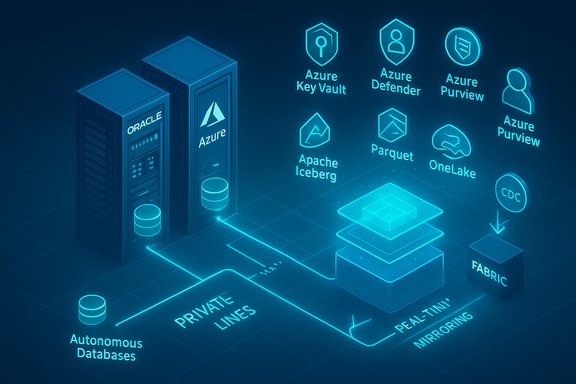
- Real‑time replication and open mirroring into Microsoft Fabric / OneLake: Oracle’s GoldenGate has been extended to support open mirroring into Microsoft Fabric’s mirrored databases and OneLake landing zones, enabling near‑real‑time replicas of Oracle tables in Delta/Parquet formats for analytics and AI. Microsoft’s Open Mirroring design makes OneLake a first‑class destination for change data capture (CDC) streams.
- Azure Key Vault integration for TDE keys: Customers can store and manage Oracle Transparent Data Encryption (TDE) master keys in Azure Key Vault (Standard, Premium, or Managed HSM). This centralizes cryptographic control inside Azure while Oracle databases use those keys for data‑at‑rest protection. Both Microsoft documentation and Oracle posts describe configuration, key migration, and best practices.
- Security and governance stack integration: Oracle Database@Azure now advertises deep interoperability with Microsoft Entra ID, Microsoft Defender for Cloud, Microsoft Sentinel, and Microsoft Purview, creating an end‑to‑end security and governance path from identity through detection to data classification and lineage.
Technical deep dive: how the pieces fit
Co‑location and low‑latency access
Oracle installs and manages Exadata‑class and Oracle database services on OCI infrastructure physically colocated in Azure datacenters. This co‑location uses private interconnects (FastConnect + ExpressRoute in government/regulated scenarios) to keep latency low, which is essential for chatty transactional workloads and near‑real‑time inference. For regulated government deployments, specialized interconnects and FedRAMP/AZ‑gov region pairings are supported to maintain compliance. The operational model preserves Oracle control planes (patching, RAC, Data Guard) while enabling Azure tooling to see and interact with the database as a native service. That hybrid operational boundary is important: Oracle remains responsible for the database service layer, while Azure provides the compute/AI front end and unified governance/identity.Data movement: GoldenGate, Open Mirroring, and OneLake
The modern pattern for analytics and AI is not batch ETL but continuous CDC. Oracle GoldenGate has been extended to support Open Mirroring into Microsoft Fabric’s mirrored databases and OneLake landing zones. Practically this means:- GoldenGate replicates inserts/updates/deletes into OneLake using a Fabric‑compatible landing format (Delta/Parquet).
- Mirrored databases in Fabric expose a SQL analytics endpoint and integrate with Power BI, Spark and Fabric’s Data Science/ML tooling.
- Open Mirroring is open and extensible; vendors and partners (including Tessell, Striim and others) already appear in the partner ecosystem for one‑click or programmatic integration.
Lakehouse and open formats: Apache Iceberg
Oracle’s Autonomous AI Lakehouse and Oracle AI Database 26ai support Apache Iceberg, an open table format that enables compatibility across lakehouse platforms and prevents file‑format lock‑in. Iceberg support matters because it allows organizations to:- Share curated tables (with schema evolution and ACID semantics) across Databricks, Snowflake, Oracle Autonomous Lakehouse, and Microsoft Fabric.
- Move from proprietary lake formats to a vendor‑agnostic catalog that supports governance and lineage.
- Mix vector and tabular data in enterprise AI workflows (Oracle’s AI Database integrates vector search with relational and JSON data).
Key management and cryptography: Azure Key Vault for TDE
For enterprises with strict compliance or centralized cryptographic control, Oracle Database@Azure offers Azure Key Vault integration for Transparent Data Encryption (TDE) master keys. The integration supports software and HSM tiers and allows customers to rotate keys and manage lifecycles through Azure tooling. Implementation details and step‑by‑step docs are published by Microsoft and Oracle; they recommend Managed HSM or Premium tiers for production and private endpoints for secure connectivity.Security, governance, and operational controls
Identity, monitoring, and SIEM integration
The stack integrates Oracle database telemetry with Azure identity and security tooling:- Microsoft Entra ID provides unified authentication and conditional access.
- Microsoft Defender for Cloud assesses configuration, detects Oracle‑specific threats, and recommends hardening.
- Microsoft Sentinel ingests logs and creates SIEM and SOAR playbooks for incident detection and automated response.
- Microsoft Purview manages data classification, lineage, and governance across Oracle and mirrored OneLake datasets.
Data governance and model risk
When Oracle operational data is mirrored to OneLake and used to train LLMs or vector indexes, enterprises must treat the model lifecycle with the same governance rigor as any regulated pipeline. That means:- Cataloging and versioning training datasets.
- Defining retention and access policies for mirrored tables.
- Enforcing differential access controls between operational Oracle instances and analytic copies in OneLake.
- Monitoring data exposure in RAG and retrieval scenarios (PII, regulated attributes).
Real‑world adoption and customer stories
Vendors are not just prototyping — customers across industries are adopting the stack.- Activision Blizzard announced using Oracle Database@Azure to accelerate agentic AI, citing native access to Oracle data combined with Microsoft Fabric and Copilot Studio to speed AI workflows. Oracle and Microsoft named Activision Blizzard as a customer at Oracle AI World.
- Vodafone highlighted multicloud flexibility and continuity, noting Oracle databases on Exadata have powered mission‑critical apps for years and that Oracle Database@Azure helps unify workloads across clouds while preserving performance and investments.
- Public sector examples (Dubai’s MBRHE) show that government entities are leveraging the co‑located model to keep local residency, low latency, and Exadata performance while using Azure AI for analytics and citizen services. These deployments underscore the offering’s appeal to regulated environments where locality and compliance matter.
Practical validation checklist for IT teams
Before committing critical workloads, enterprise architects should treat the combined offering like any cross‑vendor architecture: rigorously validate performance, security, operational responsibility and cost.- Validate latency and replication behavior
- Measure round‑trip latency between Azure compute/AI nodes and the Oracle Database@Azure instance under representative load.
- Exercise GoldenGate / open mirroring at production throughput and verify end‑to‑end lag and data consistency.
- Test failover, backup and DR
- Run failover drills that include both Oracle control plane recovery and Azure‑side consumers (Fabric, AI services).
- Confirm RPO/RTO across the stack and whether disaster recovery brings mirrored data into sync.
- Verify key lifecycle and access controls
- Test Azure Key Vault key rotation and recovery workflows with TDE.
- Confirm the cryptographic and audit metadata flows into Sentinel and your SIEM.
- Confirm governance, DLP and lineage
- Validate Purview lineages for mirrored OneLake tables and confirm DLP policies block unauthorized vectorization or model training on sensitive data.
- Ensure access controls are enforced consistently between the authoritative Oracle instance and mirrored analytic copies.
- Cost and contract clarity
- Request detailed pricing for Oracle services delivered inside Azure (GoldenGate licensing, Exadata/Exascale charge models, network egress or internal transfer costs).
- Define SLOs, support boundaries, escalation matrices and incident responsibilities across Oracle and Microsoft in writing.
- Design for portability
- Prefer open formats (Apache Iceberg) and exportable catalogs to avoid future lock‑in and to make exit strategies feasible.
Strengths and practical benefits
- Preserve mission‑critical Oracle features: Active‑active, RAC, Exadata performance optimizations, and Oracle’s operational controls remain available while enabling Azure consumption.
- Faster time‑to‑insight: Near‑real‑time replication into OneLake reduces ETL windows and lets analytics and AI teams work on fresh data.
- Unified security and governance: Centralized key control in Azure Key Vault plus integration with Entra ID, Defender and Purview gives a coherent enterprise control plane.
- Open table formats: Apache Iceberg support helps reduce vendor lock‑in and allows enterprise lakehouse interoperability across clouds.
Risks, trade‑offs and red flags
- Operational complexity across vendor boundaries: Two control planes (Oracle for the database service, Microsoft for the Azure tenant and Fabric) create complexity in incident response — clear SLAs and runbooks are obligatory. Treat this as a joint operational model rather than a single‑vendor service.
- Potential hidden costs: GoldenGate licensing, internal marketplace fees, cross‑tenant networking or gateway costs, and fabric compute for mirroring queries must be modeled realistically. Always request detailed line‑item pricing and run a cost pilot.
- Governance gaps if not tested: Differences in audit logs, retention, and data masking between the Oracle source and OneLake copies can create compliance gaps. Validate DLP, lineage, and auditing across both sides before training models or exposing data to broader teams.
- Vendor concentration risk: While the approach reduces application refactoring, it does deepen reliance on an integrated Oracle–Microsoft stack. Negotiate contract terms that preserve portability and clear exit options (data export formats, catalogs, and a migration runway).
- Unproven edge cases: Some enterprise integrations (complex GoldenGate topologies, vendor‑supplied packaged apps with specific Oracle extensions) may surface incompatibilities. Run full‑stack pilots with the actual application workload.
Recommendations for enterprise architects and DBAs
- Start with a focused pilot: choose a high‑value, low‑risk application that needs fresher data for analytics but does not endanger core business continuity if the pilot shows limitations.
- Treat governance and model risk as first‑class requirements: apply the same auditing, lineage, and access controls to mirrored OneLake datasets as you do to operational Oracle data.
- Insist on explicit cross‑vendor SLAs: define incident response, forensic responsibilities, and a shared escalation matrix between Oracle and Microsoft.
- Prefer open formats (Iceberg/Parquet/Delta) and keep metadata exportable: this protects you if you need to move away in the future.
- Budget for end‑to‑end testing: replication lag, TDE key rotation, and failover behavior are non‑trivial and must be validated under production loads.
- Negotiate contractual guarantees for data portability and pricing transparency to reduce surprises over GoldenGate or marketplace fees.
Final perspective
The combined Oracle + Microsoft approach addresses a real enterprise problem: how to operationalize AI without dismantling decades of transactional database investments. The offering’s strengths are obvious — low‑latency access to Oracle data for Azure AI services, supported open lakehouse formats, and enterprise controls like Azure Key Vault and Sentinel integration. Those features make it possible to build practical, auditable AI systems that use trusted operational data.That potential comes with responsibility. The architecture spans two major vendor ecosystems and introduces operational, contractual, and governance complexity that must be proactively managed. For teams that run thorough pilots, validate security and failover, and negotiate crystal‑clear SLAs and pricing, the stack can materially accelerate AI use cases. For teams that skip those validation steps, ambiguous responsibilities, unexpected costs, and governance gaps are the most likely outcomes. The pragmatic path forward is deliberate: test end‑to‑end, enforce governance, and preserve portability — then use the power of Oracle’s database and Azure’s AI together to drive measurable business outcomes.
Source: Express Computer How Enterprises Are Innovating with the Best of Oracle Database and Microsoft Azure – Six Five Media - Express Computer