

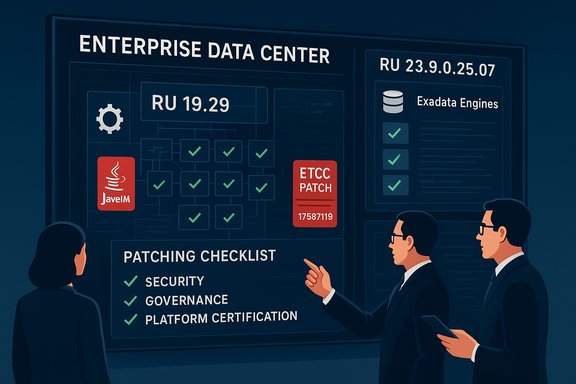
Oracle’s E‑Business Suite (EBS) Release 12.2 has been mapped to Oracle Database Release Update (RU) 19.29 for Linux x86‑64 database homes in the October 2025 ETCC refresh, and the update pairs that database RU with the matching Oracle JavaVM component RU 19.29 — while Exadata receives its own on‑premises RU mapping (RU 23.9.0.25.07) and certification on non‑Linux platforms remains pending until Oracle completes platform‑specific validation.
Oracle E‑Business Suite 12.2 remains a widely used enterprise application suite whose stability depends critically on coordinated database, Java, and middleware patching. Oracle issues quarterly Database Release Updates (RUs) for Oracle Database 19c; EBS teams then certify which RUs are supported for EBS on each platform and publish those mappings through the E‑Business Suite Technology Codelevel Checker (ETCC) and consolidated My Oracle Support (MOS) guidance. ETCC (distributed as Patch 17537119) is the authoritative pre‑patch scanner for EBS environments: it inspects application and database homes and reports missing or recommended patches, mapped to the EBS support matrix.
The October 2025 ETCC refresh is compact in scope but operationally important: it records platform‑specific RU mappings for Linux x86‑64 19c database homes and documents the Exadata on‑premises RU mapping separately. The practical upshot for DBAs and EBS teams is clearer guidance on which RU to use for which platform, and explicit pairing of database RUs with JavaVM component RUs where applicable.
Caveat: when an ETCC record shows a different internal build marker than some public trackers, treat MOS as the authoritative source — MOS contains the definitive patch artifacts and prerequisite matrices that EBS teams must follow.
Adopt RU 19.29 where ETCC certifies it, but do so with the rigor EBS environments require: test, verify, automate the inventory, and keep MOS as the final authoritative source for patch artifacts and prerequisites.
Source: Oracle Blogs https://blogs.oracle.com/ebstech/eb...-release-update-19-29-all-platforms-oct-2025/
 Background / Overview
Oracle E‑Business Suite 12.2 remains a widely used enterprise application suite whose stability depends critically on coordinated database, Java, and middleware patching. Oracle issues quarterly Database Release Updates (RUs) for Oracle Database 19c; EBS teams then certify which RUs are supported for EBS on each platform and publish those mappings through the E‑Business Suite Technology Codelevel Checker (ETCC) and consolidated My Oracle Support (MOS) guidance. ETCC (distributed as Patch 17537119) is the authoritative pre‑patch scanner for EBS environments: it inspects application and database homes and reports missing or recommended patches, mapped to the EBS support matrix.The October 2025 ETCC refresh is compact in scope but operationally important: it records platform‑specific RU mappings for Linux x86‑64 19c database homes and documents the Exadata on‑premises RU mapping separately. The practical upshot for DBAs and EBS teams is clearer guidance on which RU to use for which platform, and explicit pairing of database RUs with JavaVM component RUs where applicable.
What Oracle announced (concise technical summary)
- Oracle EBS 12.2 is now shown by ETCC as certified to run against Database RU 19.29 for Linux x86‑64 database homes. ETCC also lists the matching Oracle JavaVM component RU 19.29 for those database homes.
- On‑premises Exadata database homes receive a separate ETCC entry, recommending RU 23.9.0.25.07 as the Exadata baseline for EBS 12.2 on engineered systems.
- ETCC explicitly marks certification for non‑Linux platforms as pending; Oracle’s practice is to certify on one platform first (commonly Linux) and expand coverage after validation. Do not apply a RU to a platform unless ETCC/MOS explicitly shows certification for that platform.
- The ETCC refresh was distributed as part of the October 2025 update cycle; public patch records indicate the RU family was released in October 2025 and ETCC ties the mapping to that RU family. Administrators must verify the exact MOS patch number and build string before download and application because build suffixes recorded across public trackers and ETCC notes can differ.
Why this matters: security, stability, and compliance
Database RUs are not mere feature packs — they bundle security fixes, regression fixes, and operational updates that influence EBS runtime behavior (SQL optimizer fixes, OJVM updates, drivers, diagnostic agents). The October 2025 CPU (Critical Patch Update) cycle contained several important database‑level fixes; mapping the RU into the EBS matrix via ETCC helps EBS teams validate whether the security and stability fixes are compatible with their application stack. Staying current with certified RUs is both a security imperative and an operational requirement for supported environments.Technical verification and build‑string caveats
One subtle but important detail in the October 2025 mapping is build string variance. Public patch registries and community patch catalogs show RU 19.29 with different build suffixes (for example, a commonly indexed build string is 19.29.0.0.251021, while the ETCC/announcement references a variant formatted like 19.29.0.0.250715‑Oct2025). Functionally this is the same RU family (19.29), but the exact MOS patch number and build string you download must match the Oracle Home and prerequisites you intend to patch. Always verify the MOS patch page for your target Oracle Home before download and installation; do not assume that differing build suffixes are interchangeable.Caveat: when an ETCC record shows a different internal build marker than some public trackers, treat MOS as the authoritative source — MOS contains the definitive patch artifacts and prerequisite matrices that EBS teams must follow.
Operational risks and common failure modes
Applying database RUs in an EBS context is a multi‑layer activity; the most common and serious failure modes are well known in field practice:- Applying the wrong platform RU — installing a Linux x86‑64 RU on AIX, Solaris, z/Architecture, Windows, or an Exadata system without explicit certification can leave you in an unsupported and unstable state. ETCC flags platform scope to prevent this, and those flags must be heeded.
- Mismatched JavaVM component — ETCC pairs JavaVM RUs with Database RUs because the embedded database Java runtime (OJVM) and related components require parity; skipping the JavaVM RU when ETCC lists it can cause JVM errors inside the database and runtime failures for Java‑dependent PL/SQL or agents.
- OPatch / patch tool incompatibility — new RUs often require specific OPatch (or OPatch alternatives) versions and an exact patching sequence. Using an incorrect patching tool or sequence causes failed installs, partial patch states, and long recoveries.
- Insufficient regression testing — an RU fixes bugs but can alter behavior; inadequate test coverage (missing batch jobs, concurrent programs, third‑party integrations, JVM‑driven tasks) leads to production breakage after a patch window.
- Rollback complexity — rolling back an RU, particularly those that change OJVM libraries, listeners, or initialization parameters, may not be trivial. Verified backups and documented rollback procedures are essential.
Actionable checklist: how to adopt RU 19.29 for EBS 12.2 (practical step‑by‑step)
- Download the latest ETCC (Patch 17537119) from My Oracle Support and extract it to a secure tools directory. Run ETCC against each EBS database and application home to capture the exact recommendations for your environment.
- Confirm the exact RU and JavaVM patch numbers and build strings on MOS. Do not rely on third‑party patch indexes alone — MOS is authoritative. If build strings differ, treat the MOS artifact as the source of truth.
- Verify the target Oracle Home’s platform and ensure ETCC shows certification for that platform. If ETCC flags certification as pending for your OS or hardware, postpone RU application until Oracle announces support.
- Confirm patch tool compatibility: verify OPatch (or the platform‑specific patcher) version requirements for the RU and update the tool before attempting the RU application. Run pre‑patch tool checks and read the MOS readme for sequencing steps.
- Prepare a representative non‑production clone of production (schema, custom code, integrations) and apply RU 19.29 and the paired JavaVM RU there first. Execute smoke tests, full regression for batch jobs, concurrent programs, and integration endpoints. Validate JVM‑dependent features explicitly.
- Re‑run ETCC after the patch on the test instance to ensure ETCC no longer flags the prior recommendations. Use ETCC output as post‑patch validation.
- Maintain tested rollback steps and verified backups. Practice the rollback on the test clone so you know the operational impact and time to restore before attempting production changes.
- For cloud or managed database services (Oracle Cloud Database Service, Exadata Database Service), follow the specific cloud patching guides — do not treat managed cloud DBs as plain VM hosts. Oracle‑managed patching or service bundles may differ from on‑prem procedures.
- If anything in the ETCC output or MOS readme is unclear, open a My Oracle Support Service Request referencing the ETCC output and exact patch numbers; MOS is the final arbiter on prerequisites and conflict resolution.
Cloud and managed database considerations
EBS customers running on Oracle Cloud Infrastructure (OCI) or using Oracle’s managed database services must treat RU adoption differently. Managed services often enumerate their own recommended RU baselines and can apply service‑specific bundles; cloud customers should follow the managed service documentation rather than applying patches as if on a raw VM. For Exadata Database Service and Oracle Base Database Service customers, consult the service‑specific installation guides to confirm whether Oracle will manage the RU patching as part of the maintenance window or whether a customer‑initiated RU application is required. ETCC and MOS remain authoritative for EBS‑on‑cloud customers, but the operational playbook differs and must be followed.Strengths in Oracle’s October 2025 approach
- Platform‑aware mapping — separating Exadata and Linux x86‑64 RUs reduces misconfiguration risk. EBS teams no longer need to guess whether a given RU is appropriate for an engineered system vs. a commodity Linux host.
- JavaVM parity enforced — ETCC’s explicit pairing of JavaVM component RUs with database RUs addresses a frequent root cause of runtime JVM errors. Making JavaVM updates visible in ETCC forces teams to treat OJVM parity as part of the critical path.
- Small, targeted updates — the October refresh was deliberately narrow and operationally focused, reducing churn for administrators while delivering the required RU mappings. This conservative approach lowers the operational blast radius compared with sweeping matrix changes.
Weaknesses and gaps to watch
- Build string inconsistency — varying build suffixes across public trackers and ETCC notes can confuse downloads and planning; administrators must always verify MOS patch artifacts to avoid mistaken downloads.
- Delayed cross‑platform certification — Oracle’s practice of certifying on Linux first and expanding later leaves heterogeneous environments waiting for explicit updates. Cross‑platform shops must either delay RU adoption or manage disparate patch levels across platforms.
- Tooling & process complexity — even with ETCC, patching remains a multi‑step process (OPatch, JavaVM pairing, middleware checks, testing, rollback). Organizations with numerous Oracle homes face a significant operational burden to coordinate consistent application across environments.
Practical governance and testing recommendations
- Automate and date‑stamp ETCC runs as part of the pre‑maintenance checklist. Keep ETCC output in the change record to demonstrate what Oracle recommended at the time of the maintenance window.
- Put JavaVM parity on the critical path for any database RU adoption where ETCC lists a JavaVM RU; design smoke tests to include JVM‑dependent stored procedures, listeners, and diagnostic flows.
- Use a staged approach to patching:
- Unit tests and package smoke tests
- Full functional regression in a clone of production
- Pre‑production soak (multi‑day)
- Production cutover with rollback rehearsed and validated
- Where Exadata is in use, treat it as a separate engineering track; track Exadata RU bulletins independently and follow Exadata-specific instructions.
When to escalate to My Oracle Support
- If ETCC output shows a mismatch between the RU number and the MOS patch artifacts (e.g., differing build strings), open an MOS SR and reference ETCC output plus the MOS patch numbers. MOS will confirm the correct download and prerequisites.
- If patching fails due to OPatch/tool incompatibility or yields partial installs, gather OPatch logs and the ETCC output and open an SR immediately; failed RU installs often require vendor guidance to restore a consistent state.
- If a production regression is traced to an RU change and rollback is complex, escalate to MOS with detailed test evidence and the ETCC reports for both pre‑ and post‑patch states.
Bottom line — what EBS 12.2 teams should do this quarter
Treat the October 2025 ETCC refresh as an operational inventory update: it simplifies one piece of the quarterly patch planning by explicitly mapping RU 19.29 (Linux x86‑64) and Exadata RU 23.9 to EBS 12.2, and by calling out the JavaVM pairing that must be applied in tandem. However, the update also reinforces long‑standing patch discipline: verify MOS artifacts, respect platform certification boundaries, update patching tools, test comprehensively, and keep rollback plans ready. The safest, most auditable path to adopt RU 19.29 is:- Run ETCC now and save the dated output.
- Validate exact MOS patch numbers and build strings.
- Test RU + JavaVM in a non‑production clone and re‑run ETCC post‑patch.
- Use MOS for unresolved issues and for final go/no‑go confirmation.
Final assessment
The October 2025 ETCC mapping and the EBS team’s announcement represent practical progress: platform‑specific RU mappings and explicit JavaVM pairing remove ambiguity and help EBS operations teams make safer patch decisions. At the same time, build string inconsistencies and the usual patching complexity mean this is not a trivial lift. Organizations should treat the ETCC output as an operational mandate — not merely a suggestion — and build change windows that include full regression, a clear rollback plan, and MOS support contact points.Adopt RU 19.29 where ETCC certifies it, but do so with the rigor EBS environments require: test, verify, automate the inventory, and keep MOS as the final authoritative source for patch artifacts and prerequisites.
Source: Oracle Blogs https://blogs.oracle.com/ebstech/eb...-release-update-19-29-all-platforms-oct-2025/
