

Oracle’s mass layoffs are a reminder that the biggest risk in enterprise software is not just code, it’s continuity. When a vendor trims customer success, implementation, cloud operations, and engineering teams at once, the fallout can show up far from the balance sheet: in delayed go-lives, brittle integrations, slower escalations, and more work pushed back onto customer IT staff. That is why Oracle’s reported cuts matter so much to CIOs, UC leaders, and productivity software buyers who depend on the company’s platforms to keep daily operations moving.
Oracle has long sold itself as a company that can run the plumbing of modern enterprise technology. Its databases, SaaS applications, cloud infrastructure, and communications-adjacent products sit underneath everything from finance systems to contact center workflows. That position makes headcount reductions especially consequential because Oracle is not just a software licensor; it is also a support organization, an implementation organization, and a cloud operations organization.
The scale of the latest cuts is what turned a routine restructuring story into a strategic issue. Reports indicate Oracle began issuing termination notices on March 31, 2026, and analysts at TD Cowen estimated as many as 30,000 jobs could be affected, or roughly 18% of the company’s global workforce. Oracle’s own most recent SEC filing, meanwhile, says the company employed approximately 162,000 full-time employees as of May 31, 2025.
That combination of scale and timing matters. Oracle has been in a capital-intensive race to expand its cloud and AI infrastructure, while also managing a restructuring program that its March 2026 10-Q says could total up to $2.1 billion. The filing says those costs will be recorded as incurred through the end of the plan, and that gives the layoff story a financial frame that is hard to ignore.
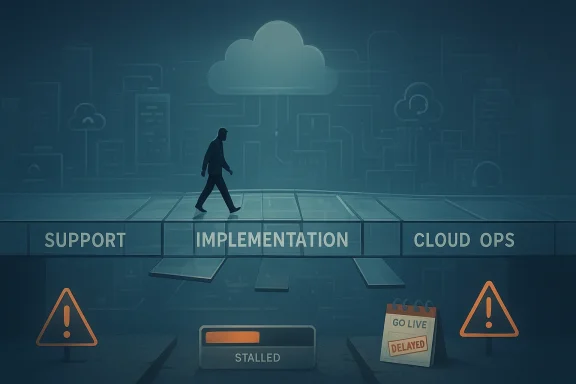
What makes this different from a generic tech layoff is the nature of the affected work. The concern is not only how many people left, but which functions absorbed the blow. Customer-facing groups, cloud support teams, implementation teams, and engineering teams are the connective tissue between Oracle’s products and the organizations that rely on them. When those layers thin out, the gap is often filled by the customer’s own staff, partners, or waiting time.
In fiscal 2025, Oracle continued to emphasize cloud growth and infrastructure expansion. The company’s investor materials for fiscal 2026 pointed to strong demand, while also signaling a much larger financial commitment to capacity buildout. That was an early clue that Oracle was willing to sacrifice organizational breadth to preserve runway for the infrastructure war it believes it must win.
By March 2026, that strategy had become more visible in Oracle’s filings. The company’s Q3 fiscal 2026 results said it had been restructuring product development teams into smaller, more agile groups, and its 10-Q disclosed a major restructuring plan. Taken together, those disclosures suggest a company trying to make itself leaner in the middle of a costly platform transition.
At the same time, outside analysts have cautioned against reading every AI-era layoff as proof of actual AI replacement. Forrester’s January 2026 forecast says too many companies are confusing financially driven layoffs with AI-driven job displacement, and it argues that more than half of layoffs attributed to AI will be reversed when firms discover how hard it is to replace human work at scale. That distinction matters here, because Oracle’s cuts are occurring amid spending pressure as much as, or more than, automation maturity.
The result is a story that sits at the intersection of finance, labor, and enterprise operations. Oracle is not simply shrinking. It is reallocating scarce resources toward infrastructure that it believes will define its next decade, and that choice will be felt by customers long before it is fully understood by investors.
The practical issue is service depth. If a customer success manager disappears, the customer may still have a ticketing portal. If an implementation engineer disappears, the customer may still have documentation. But if multiple layers go missing at once, the organization loses the human path through the vendor ecosystem, and that path often matters more than the software brochure suggests.
Oracle buyers also tend to operate in highly integrated environments. UCaaS, CRM, contact center, identity, ERP, and data platforms are usually woven together through APIs, SBCs, identity providers, middleware, and cloud networking layers. When vendor support capacity thins out, even a small integration issue can become a business interruption because the fix depends on cross-team coordination.
That is why reductions in customer success and cloud operations can matter as much as reductions in engineering. Buyers do not merely purchase software; they purchase responsiveness, roadmapping confidence, and the ability to translate technical problems into resolved work.
Oracle’s customers in productivity software, communications, and cloud infrastructure are particularly exposed because these are domains where uptime and coordination matter more than novelty. A delayed answer about an integration issue can cascade into a failed deployment, a missed compliance deadline, or a customer-facing outage.
That is why the workforce reductions should be read as part of a broader balance-sheet strategy. When a company commits to large infrastructure outlays, it often looks for cost offsets in labor because labor is the most immediate lever. The unfortunate trade-off is that the people being cut are often those who preserve service quality during the transition.
Oracle’s March 2026 10-Q is especially relevant because it explicitly ties restructuring to a fiscal 2026 plan with up to $2.1 billion in estimated costs. That signals the cuts are not a small adjustment. They are part of a deliberate companywide reconfiguration.
That creates several knock-on effects:
Oracle’s situation is also a reminder that “AI spending” is often a shorthand for a much bigger capital story. Some layoffs may be justified as reorganization, some as automation, and some as expense management, but the combined effect is the same: fewer humans available to absorb complexity while the company chases a more infrastructure-heavy future.
Forrester’s January 2026 forecast is a useful reality check. The firm says most organizations are still not ready to replace human roles at scale with vetted AI systems, and it warns that many AI-attributed layoffs will be reversed as the operational difficulties become clear. In that sense, Oracle’s cuts fit a broader pattern of AI-washing—the tendency to explain financially motivated reductions with a futuristic automation story.
That does not mean Oracle is not automating anything. It almost certainly is. Vendors across the industry are using AI-assisted support, code generation, monitoring, and workflow tools to reduce the amount of routine labor they need. But automation usually removes pieces of a job first, not the entire job, and that nuance is exactly what gets lost in breathless layoff headlines.
If Oracle is trimming people under the assumption that AI will absorb their work, customers should ask a simple question: which exact workflows have been proven to run without those people? If the answer is vague, then the layoffs are not automation proof. They are faith.
If those teams are thinned out, the impact will not be evenly distributed. Large strategic accounts may continue to receive attention, while smaller or mid-market customers experience slower response times, more self-service, and more friction in getting issues escalated. That is a common pattern in vendor restructurings, and it can quietly change the economics of doing business with a platform.
Oracle’s own investor disclosures reinforce why these teams matter. The company repeatedly emphasizes cloud growth, infrastructure management, and the complexity of delivering large-scale services. But delivery at scale is not just about data centers. It is also about people who understand deployments, migrations, renewals, and problem resolution.
When you reduce the staff supporting that ecosystem, the consequences are subtle but real:
Oracle’s cloud infrastructure teams are equally important because OCI deployments are rarely isolated. They often sit alongside identity services, network controls, observability tools, and communications infrastructure. A shrinkage in experienced support staff can make that environment more brittle, especially for customers already balancing hybrid architectures.
When customer success is cut too deeply, vendors can still book revenue in the short term, but they begin to erode the quality of the installed base. That is a risky trade in productivity software, where adoption, configuration, and change management are often more important than the license itself.
This is especially true for firms running NetSuite, cloud communications systems, or productivity workflows that have been stitched together over time by a small internal IT staff. The more complex the integration, the more a vendor’s human support matters. A large bank may have the staff to compensate; a growing logistics company or regional healthcare network may not.
There is also a perception issue. Mid-market buyers tend to view vendor stability as a proxy for product maturity. If a company is seen as retrenching, those buyers may hesitate to expand their footprint, even if the underlying technology remains solid. That hesitation can be more damaging than a single delayed ticket.
That dynamic creates an uneven market. Enterprise buyers may negotiate around it. Mid-market buyers may simply live with it, which means the vendor slowly absorbs more trust risk than the quarterly numbers suggest.
Oracle has spent years trying to compete on cloud credibility and software breadth. But credibility in the mid-market is built less on marketing and more on whether the phone gets answered when a deployment breaks. If the support layer is hollowed out, that credibility becomes harder to defend.
That opening is not limited to product features. Enterprise software competition often turns on delivery confidence. If Oracle customers begin to experience slower response times or reduced guidance, procurement teams may give more weight to alternative platforms during renewals, expansions, or modernization projects. The software may still be good, but the buying experience becomes easier to challenge.
For competitors, this is a chance to frame themselves as more stable, more customer-centric, and more operationally responsive. That does not require a better database or a better ERP story. It only requires being easier to work with when a customer’s stack is under pressure.
That means Oracle’s rivals do not need to prove Oracle is failing. They only need to prove they are more predictable. In enterprise software, predictability is a feature.
The first step is to identify where Oracle is truly indispensable. A cloud contract is one thing; an identity integration, a contact center dependency, or an SBC-related workflow is another. The deeper Oracle sits in business operations, the more important it becomes to document fallback plans and escalation routes.
The second step is to pressure-test your relationship with the vendor. You should not accept broad assurances about “AI-enhanced support” without asking how it changes response times, escalation ownership, and named contact continuity. If the answer is marketing language, keep asking.
Organizations in the middle of migrations should be especially careful. A layoff-driven support gap can turn a manageable project into a delayed one, and project slippage is often far more expensive than an incremental contract concession.
Forrester has been explicit about this pattern. Its 2026 forecasts argue that AI’s job impact will be real but modest through 2030, and that many layoffs framed as AI-driven will later be unwound when companies discover the complexity of replacing human roles. That is an important warning for both vendors and buyers because it suggests the current wave of layoffs may be more cyclical than transformational.
Oracle’s case also reflects a broader shift in enterprise tech economics. Capital is moving toward data centers, GPUs, and infrastructure commitments, while human support layers are treated as flexible costs. That may improve short-term financial optics, but it can create long-term service fragility if too much domain knowledge leaves at once.
The opportunity is to transform restructuring into operational clarity rather than operational decline. If Oracle uses automation to absorb repetitive support tasks while protecting expert staffing for high-value customers, it could improve efficiency without sacrificing trust. That would be the best-case outcome, even if it is difficult to execute.
A second concern is strategic confusion. If Oracle’s layoffs are presented as AI-driven when they are largely financial, customer trust could suffer because buyers will not appreciate being told automation solved problems that automation has not actually solved. That kind of mismatch tends to linger.
Watch the next earnings cycle, but also watch the operational signals. If customers start reporting slower escalations, less consistent account coverage, or more brittle deployment support, the effect of the layoffs will be more important than any press release about AI efficiency. That is where the story will become visible.
Source: UC Today How Oracle’s 30,000 Layoffs Could Impact Enterprise Productivity Software - UC Today
 Overview
Oracle has long sold itself as a company that can run the plumbing of modern enterprise technology. Its databases, SaaS applications, cloud infrastructure, and communications-adjacent products sit underneath everything from finance systems to contact center workflows. That position makes headcount reductions especially consequential because Oracle is not just a software licensor; it is also a support organization, an implementation organization, and a cloud operations organization.The scale of the latest cuts is what turned a routine restructuring story into a strategic issue. Reports indicate Oracle began issuing termination notices on March 31, 2026, and analysts at TD Cowen estimated as many as 30,000 jobs could be affected, or roughly 18% of the company’s global workforce. Oracle’s own most recent SEC filing, meanwhile, says the company employed approximately 162,000 full-time employees as of May 31, 2025.
That combination of scale and timing matters. Oracle has been in a capital-intensive race to expand its cloud and AI infrastructure, while also managing a restructuring program that its March 2026 10-Q says could total up to $2.1 billion. The filing says those costs will be recorded as incurred through the end of the plan, and that gives the layoff story a financial frame that is hard to ignore.
What makes this different from a generic tech layoff is the nature of the affected work. The concern is not only how many people left, but which functions absorbed the blow. Customer-facing groups, cloud support teams, implementation teams, and engineering teams are the connective tissue between Oracle’s products and the organizations that rely on them. When those layers thin out, the gap is often filled by the customer’s own staff, partners, or waiting time.
Background
Oracle’s modern business is built on a paradox. The company remains one of the most important enterprise software vendors in the world, yet much of its growth narrative now depends on massive cloud expansion and AI infrastructure spending. That creates a tension between near-term cost discipline and long-term platform ambition, and it is a tension that often shows up first in people costs.In fiscal 2025, Oracle continued to emphasize cloud growth and infrastructure expansion. The company’s investor materials for fiscal 2026 pointed to strong demand, while also signaling a much larger financial commitment to capacity buildout. That was an early clue that Oracle was willing to sacrifice organizational breadth to preserve runway for the infrastructure war it believes it must win.
By March 2026, that strategy had become more visible in Oracle’s filings. The company’s Q3 fiscal 2026 results said it had been restructuring product development teams into smaller, more agile groups, and its 10-Q disclosed a major restructuring plan. Taken together, those disclosures suggest a company trying to make itself leaner in the middle of a costly platform transition.
At the same time, outside analysts have cautioned against reading every AI-era layoff as proof of actual AI replacement. Forrester’s January 2026 forecast says too many companies are confusing financially driven layoffs with AI-driven job displacement, and it argues that more than half of layoffs attributed to AI will be reversed when firms discover how hard it is to replace human work at scale. That distinction matters here, because Oracle’s cuts are occurring amid spending pressure as much as, or more than, automation maturity.
The result is a story that sits at the intersection of finance, labor, and enterprise operations. Oracle is not simply shrinking. It is reallocating scarce resources toward infrastructure that it believes will define its next decade, and that choice will be felt by customers long before it is fully understood by investors.
Why These Layoffs Matter to Enterprise Buyers
For enterprise buyers, layoffs at a software vendor are not abstract. They alter the vendor’s ability to deliver implementations, maintain release cadence, respond to incidents, and support complex integrations. That is especially true when the vendor supplies business-critical platforms such as Oracle Cloud Infrastructure, NetSuite, and communications-related workloads.The practical issue is service depth. If a customer success manager disappears, the customer may still have a ticketing portal. If an implementation engineer disappears, the customer may still have documentation. But if multiple layers go missing at once, the organization loses the human path through the vendor ecosystem, and that path often matters more than the software brochure suggests.
Oracle buyers also tend to operate in highly integrated environments. UCaaS, CRM, contact center, identity, ERP, and data platforms are usually woven together through APIs, SBCs, identity providers, middleware, and cloud networking layers. When vendor support capacity thins out, even a small integration issue can become a business interruption because the fix depends on cross-team coordination.
The support chain is the product
One of the least appreciated truths in enterprise software is that the support chain is part of the product. A feature only matters if the vendor can deploy it, explain it, troubleshoot it, and keep it functioning through the next incident.That is why reductions in customer success and cloud operations can matter as much as reductions in engineering. Buyers do not merely purchase software; they purchase responsiveness, roadmapping confidence, and the ability to translate technical problems into resolved work.
- Fewer support staff can mean longer escalation cycles.
- Smaller implementation teams can slow go-lives.
- Reduced product-facing staffing can create roadmap uncertainty.
- Less partner coordination can increase customer-side labor.
- More automation can help, but only for repeatable tasks.
Oracle’s customers in productivity software, communications, and cloud infrastructure are particularly exposed because these are domains where uptime and coordination matter more than novelty. A delayed answer about an integration issue can cascade into a failed deployment, a missed compliance deadline, or a customer-facing outage.
Financial Pressure Behind the Headcount Cuts
The financial backdrop helps explain why the layoffs are so large. Oracle reported a 95% jump in quarterly net income in one recent period, but that does not tell the whole story. The company has also taken on significant debt to fund data center construction, and its growth strategy requires immense capital spending before the payoff fully materializes.That is why the workforce reductions should be read as part of a broader balance-sheet strategy. When a company commits to large infrastructure outlays, it often looks for cost offsets in labor because labor is the most immediate lever. The unfortunate trade-off is that the people being cut are often those who preserve service quality during the transition.
Oracle’s March 2026 10-Q is especially relevant because it explicitly ties restructuring to a fiscal 2026 plan with up to $2.1 billion in estimated costs. That signals the cuts are not a small adjustment. They are part of a deliberate companywide reconfiguration.
Debt, capex, and operating leverage
A cloud and AI buildout is not funded like a normal software refresh. It is funded through a combination of operating cash, debt, and investor confidence, which means every headcount decision becomes part of a capital allocation story.That creates several knock-on effects:
- Sales and support staffing may be cut to protect margins.
- Implementation and success teams may shrink while demand stays high.
- Customers may see more reliance on self-service tools.
- Partners may absorb more of the delivery burden.
- Internal teams may be forced to prioritize strategic accounts over everyone else.
Oracle’s situation is also a reminder that “AI spending” is often a shorthand for a much bigger capital story. Some layoffs may be justified as reorganization, some as automation, and some as expense management, but the combined effect is the same: fewer humans available to absorb complexity while the company chases a more infrastructure-heavy future.
AI Hype Versus Actual Automation
The easiest narrative is that AI is replacing Oracle workers. The more careful reading is that AI may be helping Oracle justify or accelerate a financial restructuring, but that is not the same thing as a proven machine-for-human substitution. That distinction matters because customers can be sold a story about automation before the automation is actually ready.Forrester’s January 2026 forecast is a useful reality check. The firm says most organizations are still not ready to replace human roles at scale with vetted AI systems, and it warns that many AI-attributed layoffs will be reversed as the operational difficulties become clear. In that sense, Oracle’s cuts fit a broader pattern of AI-washing—the tendency to explain financially motivated reductions with a futuristic automation story.
That does not mean Oracle is not automating anything. It almost certainly is. Vendors across the industry are using AI-assisted support, code generation, monitoring, and workflow tools to reduce the amount of routine labor they need. But automation usually removes pieces of a job first, not the entire job, and that nuance is exactly what gets lost in breathless layoff headlines.
What AI can and cannot do here
AI is best at repetitive, well-structured tasks with strong input signals. It is much weaker at handling exceptions, large customer escalations, and multi-system troubleshooting, especially when environments differ by region, contract, or deployment model.- AI can triage tickets.
- AI can draft responses.
- AI can suggest root causes.
- AI can summarize logs.
- AI cannot reliably own accountability.
If Oracle is trimming people under the assumption that AI will absorb their work, customers should ask a simple question: which exact workflows have been proven to run without those people? If the answer is vague, then the layoffs are not automation proof. They are faith.
Which Oracle Functions Are Most Exposed
The most concerning aspect of the cuts is not that they happened, but that they reportedly reached functions closest to customers. Reports and employee posts point to reductions in customer success, cloud operations, implementation, and engineering-adjacent teams, including areas tied to NetSuite and SaaS operations. Those are precisely the groups that enterprise buyers lean on when systems get complicated.If those teams are thinned out, the impact will not be evenly distributed. Large strategic accounts may continue to receive attention, while smaller or mid-market customers experience slower response times, more self-service, and more friction in getting issues escalated. That is a common pattern in vendor restructurings, and it can quietly change the economics of doing business with a platform.
Oracle’s own investor disclosures reinforce why these teams matter. The company repeatedly emphasizes cloud growth, infrastructure management, and the complexity of delivering large-scale services. But delivery at scale is not just about data centers. It is also about people who understand deployments, migrations, renewals, and problem resolution.
NetSuite, SaaS, and cloud operations
NetSuite is particularly sensitive because it sits in the operational core of many mid-market and enterprise organizations. It is often connected to finance, HR, procurement, customer systems, and communications workflows.When you reduce the staff supporting that ecosystem, the consequences are subtle but real:
- patch coordination gets slower;
- implementation guidance becomes less hands-on;
- escalating a defect may take longer;
- post-launch tuning becomes harder;
- integration troubleshooting can shift to the customer side.
Oracle’s cloud infrastructure teams are equally important because OCI deployments are rarely isolated. They often sit alongside identity services, network controls, observability tools, and communications infrastructure. A shrinkage in experienced support staff can make that environment more brittle, especially for customers already balancing hybrid architectures.
Customer success is not optional
Customer success is frequently treated as a cost center, but in enterprise software it performs a strategic function. It helps turn a sale into a successful deployment, and a successful deployment into renewal.When customer success is cut too deeply, vendors can still book revenue in the short term, but they begin to erode the quality of the installed base. That is a risky trade in productivity software, where adoption, configuration, and change management are often more important than the license itself.
The Consumer and Mid-Market Angle
The headlines tend to focus on large enterprise buyers, but the mid-market consequences may be just as significant. Companies using Oracle tools in leaner IT environments often depend even more on vendor guidance because they do not have sprawling internal teams to absorb disruption. When a vendor reduces support, those customers feel it faster.This is especially true for firms running NetSuite, cloud communications systems, or productivity workflows that have been stitched together over time by a small internal IT staff. The more complex the integration, the more a vendor’s human support matters. A large bank may have the staff to compensate; a growing logistics company or regional healthcare network may not.
There is also a perception issue. Mid-market buyers tend to view vendor stability as a proxy for product maturity. If a company is seen as retrenching, those buyers may hesitate to expand their footprint, even if the underlying technology remains solid. That hesitation can be more damaging than a single delayed ticket.
Why smaller teams feel layoffs first
Smaller IT organizations typically rely on vendor success teams for:- implementation playbooks;
- release planning;
- migration support;
- escalation paths;
- training and adoption guidance.
That dynamic creates an uneven market. Enterprise buyers may negotiate around it. Mid-market buyers may simply live with it, which means the vendor slowly absorbs more trust risk than the quarterly numbers suggest.
Oracle has spent years trying to compete on cloud credibility and software breadth. But credibility in the mid-market is built less on marketing and more on whether the phone gets answered when a deployment breaks. If the support layer is hollowed out, that credibility becomes harder to defend.
Competitive Implications for Oracle and Rivals
The competitive impact of the layoffs could be significant because Oracle is not the only vendor selling enterprise productivity and cloud software. Microsoft, SAP, Salesforce, Workday, ServiceNow, and a wide ecosystem of specialist providers all compete for the same customer budgets and implementation mindshare. If Oracle’s support capacity weakens, rivals may gain an opening.That opening is not limited to product features. Enterprise software competition often turns on delivery confidence. If Oracle customers begin to experience slower response times or reduced guidance, procurement teams may give more weight to alternative platforms during renewals, expansions, or modernization projects. The software may still be good, but the buying experience becomes easier to challenge.
For competitors, this is a chance to frame themselves as more stable, more customer-centric, and more operationally responsive. That does not require a better database or a better ERP story. It only requires being easier to work with when a customer’s stack is under pressure.
The margin-growth trade-off
Oracle appears to be betting that better margins and heavier infrastructure investment will ultimately strengthen its competitive position. That is a valid strategic idea, but it comes with a near-term service penalty if too much organizational memory is lost.- Rivals can pitch lower-friction migrations.
- Partners can exploit gaps in Oracle staffing.
- Customers can renegotiate around support concerns.
- Procurement can use the layoffs as leverage.
- Analysts can question service quality assumptions.
Why this matters in productivity software
Productivity software is not won only by features. It is won by adoption, reliability, and the ability to fit into daily work. In that market, vendor instability can be enough to shift buying behavior even if the technology stack itself remains strong.That means Oracle’s rivals do not need to prove Oracle is failing. They only need to prove they are more predictable. In enterprise software, predictability is a feature.
What IT Leaders Should Do Now
If Oracle sits in your critical path, this is a moment for active risk management rather than passive observation. Even if your deployment is healthy today, vendor staffing changes can affect the next quarter’s support quality, and it is better to prepare before service levels deteriorate.The first step is to identify where Oracle is truly indispensable. A cloud contract is one thing; an identity integration, a contact center dependency, or an SBC-related workflow is another. The deeper Oracle sits in business operations, the more important it becomes to document fallback plans and escalation routes.
The second step is to pressure-test your relationship with the vendor. You should not accept broad assurances about “AI-enhanced support” without asking how it changes response times, escalation ownership, and named contact continuity. If the answer is marketing language, keep asking.
A practical response plan
- Review every active Oracle project and flag any milestone that depends on named Oracle staff.
- Ask for written confirmation of who owns implementation, support, and escalation.
- Revalidate service-level assumptions against your current business cycle.
- Document internal workarounds for outages, configuration changes, and release issues.
- Check whether any Oracle-dependent systems need extra monitoring this quarter.
- Reassess whether a partner, SI, or internal team should absorb more support responsibility.
Contracts and renewal leverage
Buyers with upcoming renewals have leverage right now. The possibility of weakened support can justify tighter SLAs, more explicit escalation commitments, or additional exit rights if service quality drops. Even if Oracle resists, the negotiation itself creates a paper trail that can help later.Organizations in the middle of migrations should be especially careful. A layoff-driven support gap can turn a manageable project into a delayed one, and project slippage is often far more expensive than an incremental contract concession.
How Oracle’s Layoffs Fit the Wider Tech Pattern
Oracle is not an isolated case. The tech industry has spent several years blending AI ambition with workforce reductions, and the narrative often oversimplifies what is happening. In many cases, firms are not replacing humans with AI so much as using AI as a justification for reallocating capital toward infrastructure, platform bets, or margin protection.Forrester has been explicit about this pattern. Its 2026 forecasts argue that AI’s job impact will be real but modest through 2030, and that many layoffs framed as AI-driven will later be unwound when companies discover the complexity of replacing human roles. That is an important warning for both vendors and buyers because it suggests the current wave of layoffs may be more cyclical than transformational.
Oracle’s case also reflects a broader shift in enterprise tech economics. Capital is moving toward data centers, GPUs, and infrastructure commitments, while human support layers are treated as flexible costs. That may improve short-term financial optics, but it can create long-term service fragility if too much domain knowledge leaves at once.
The market lesson
The market often rewards companies for cutting costs and promising AI scale. But enterprise customers live with the operational consequences. That means the market’s excitement and the buyer’s reality can diverge sharply.- Investors may like margin expansion.
- Customers may dislike slower support.
- Analysts may focus on strategy.
- IT teams focus on outages.
- Procurement teams focus on renewal risk.
Strengths and Opportunities
Oracle still has significant strengths that should not be ignored. The company has a large installed base, deep enterprise relationships, and a cloud and database portfolio that remains central to many organizations. If it can preserve service quality while restructuring, the layoffs could ultimately make Oracle leaner, faster, and more financially disciplined.The opportunity is to transform restructuring into operational clarity rather than operational decline. If Oracle uses automation to absorb repetitive support tasks while protecting expert staffing for high-value customers, it could improve efficiency without sacrificing trust. That would be the best-case outcome, even if it is difficult to execute.
- Oracle retains a massive enterprise footprint.
- The company has strong recurring revenue characteristics.
- Infrastructure demand remains real across the market.
- AI tools can improve some support workflows.
- A leaner operating model could reduce internal friction.
- Competitors may still struggle to match Oracle’s scale.
- Customers may accept change if service remains stable.
Risks and Concerns
The risks are equally clear. The biggest concern is that Oracle may have cut into the very layers that keep enterprise systems stable during change. If support and implementation teams shrink too much, customers may see slower responses, weaker escalation paths, and more reliance on self-service at precisely the moment they need expert help.A second concern is strategic confusion. If Oracle’s layoffs are presented as AI-driven when they are largely financial, customer trust could suffer because buyers will not appreciate being told automation solved problems that automation has not actually solved. That kind of mismatch tends to linger.
- Support response times may worsen.
- Implementation timelines may slip.
- Customer success coverage may thin out.
- Institutional knowledge may walk out the door.
- AI claims may outpace actual automation maturity.
- Mid-market customers may feel the strain first.
- Rival vendors may use the disruption as a sales wedge.
Looking Ahead
The next few months will tell us whether Oracle’s restructuring is a temporary shock or a lasting change in service quality. The key question is not whether the company can survive the layoff cycle; it almost certainly can. The real question is whether Oracle can maintain the trust of the enterprises that depend on it while simultaneously reengineering its cost base.Watch the next earnings cycle, but also watch the operational signals. If customers start reporting slower escalations, less consistent account coverage, or more brittle deployment support, the effect of the layoffs will be more important than any press release about AI efficiency. That is where the story will become visible.
- Customer service response times.
- Renewal language and contract amendments.
- Product release support coverage.
- Partner ecosystem load-sharing.
- Executive commentary on restructuring progress.
Source: UC Today How Oracle’s 30,000 Layoffs Could Impact Enterprise Productivity Software - UC Today
Last edited:
