

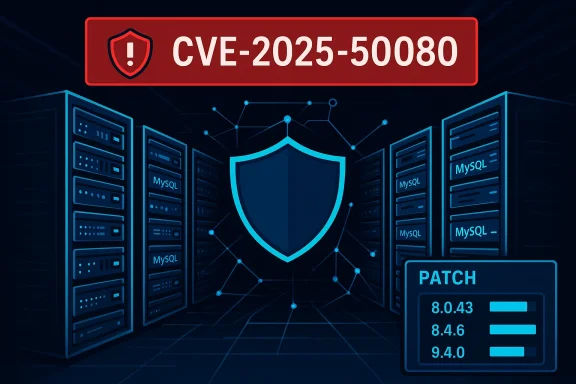
A newly disclosed denial‑of‑service vulnerability in Oracle’s MySQL Server — tracked as CVE‑2025‑50080 — affects a broad range of MySQL releases and can cause sustained or persistent loss of availability by triggering hangs or repeated crashes in the server’s stored‑procedure handling code. The flaw was enumerated in Oracle’s July 2025 Critical Patch Update and public vulnerability databases shortly thereafter; vendors and distribution maintainers pushed fixes in follow‑up packages and advisories. Operators running MySQL Server versions up through the 8.0.42, 8.4.5 and 9.3.0 series should treat this as an operationally significant availability risk, prioritize patching, and apply immediate compensating controls where patching is not yet possible.
CVE‑2025‑50080 is described as a vulnerability in the Server: Stored Procedure component of Oracle MySQL. Public trackers consistently record the affected ranges as MySQL Server 8.0.0 through 8.0.42, 8.4.0 through 8.4.5 and 9.0.0 through 9.3.0. Successful exploitation allows a high‑privileged attacker with network access to cause a hang or repeatedly crash the server — effectively a complete denial of service (DoS) on affected components. The official scoring used by multiple trackers lists the CVSS v3.1 base score around 4.9 with the primary impact being Availability.
Several independent vulnerability aggregators and vendor advisories catalog this issue and indicate that fixes were shipped in the vendor patch cycle; downstream distributions have issued their own package updates. Debian and a number of Linux vendors mark the issue as fixed in their packaged MySQL updates (for example, MySQL 8.0 packages moved to 8.0.43 in fixed trees). Enterprise watchers such as CISA included the issue in vulnerability summary bulletins, underscoring the operational relevance for administrators.
Public trackers and Rapid7 list practical upgrade targets introduced by the vendor and downstream packagers — namely MySQL 8.0.43 and corresponding 8.4/9.4 series updates in vendor package naming schemes. Distribution maintainers produced their own advisories and backports, so operators should consult their platform’s package repository for the exact vendor‑supplied fixed package names and versions.
Source: MSRC Security Update Guide - Microsoft Security Response Center
 Background / Overview
CVE‑2025‑50080 is described as a vulnerability in the Server: Stored Procedure component of Oracle MySQL. Public trackers consistently record the affected ranges as MySQL Server 8.0.0 through 8.0.42, 8.4.0 through 8.4.5 and 9.0.0 through 9.3.0. Successful exploitation allows a high‑privileged attacker with network access to cause a hang or repeatedly crash the server — effectively a complete denial of service (DoS) on affected components. The official scoring used by multiple trackers lists the CVSS v3.1 base score around 4.9 with the primary impact being Availability.Several independent vulnerability aggregators and vendor advisories catalog this issue and indicate that fixes were shipped in the vendor patch cycle; downstream distributions have issued their own package updates. Debian and a number of Linux vendors mark the issue as fixed in their packaged MySQL updates (for example, MySQL 8.0 packages moved to 8.0.43 in fixed trees). Enterprise watchers such as CISA included the issue in vulnerability summary bulletins, underscoring the operational relevance for administrators.
What the vulnerability actually does
Technical cause (high level)
Public records characterize the root cause as an instance of uncontrolled resource consumption (CWE‑400) in the stored‑procedure handling paths. In plain terms, certain stored procedure inputs or invocation sequences can cause the server to consume resources in a way that leads to a hang or repeated crash. The effect is availability loss rather than disclosure or integrity compromise. Multiple vulnerability trackers list the weakness class as uncontrolled resource exhaustion, which maps to repeated crash/hang vectors rather than arbitrary memory corruption or direct data exposure.Attack prerequisites and complexity
- Attack vector: Network — the vulnerable code can be reached via networked MySQL protocol interactions.
- Privileges required: High — the attacker needs elevated database privileges (for example, the ability to create or invoke stored procedures) to trigger the condition.
- Complexity: Low for causing DoS (i.e., a hang or crash is straightforward once the attacker has the necessary privileges), but exploitation for anything beyond DoS would depend on additional factors and is not described as trivial in public advisories.
Impact profile
- Confidentiality: None reported — there is no public indication that credentials, schema data, or row contents are disclosed by this bug.
- Integrity: None reported — the vulnerability is not described as allowing arbitrary modification of data.
- Availability: High — total loss of service for the MySQL process is the principal impact (hang or crash, repeatedly reproducible).
Timeline and vendor response
Oracle included CVE‑2025‑50080 in its July 2025 Critical Patch Update, recording the vulnerability alongside several other MySQL issues affecting stored procedures, the optimizer, InnoDB and other internal components. Vendors and distributions subsequently published fixes and distribution package updates; for example, Debian tracked fixes that moved MySQL 8.0 packaging to 8.0.43 in response to the July updates. Third‑party vulnerability databases and scanning services flagged the fixed package versions (and the recommended vendor upgrades).Public trackers and Rapid7 list practical upgrade targets introduced by the vendor and downstream packagers — namely MySQL 8.0.43 and corresponding 8.4/9.4 series updates in vendor package naming schemes. Distribution maintainers produced their own advisories and backports, so operators should consult their platform’s package repository for the exact vendor‑supplied fixed package names and versions.
Cross‑checks and corroboration
Key claims about affected versions, attack vector, and scoring are corroborated across multiple independent sources:- The NVD entry and aggregator sites summarize the same affected version ranges and CVSS vector (network attack vector, high privileges required, availability impact).
- Oracle’s own CPU risk matrix lists CVE‑2025‑50080 as a stored‑procedure vulnerability with availability impact and the same affected ranges.
- Distribution trackers (Debian, Oracle Linux, Ubuntu downstream pages) show that vendor fixes were incorporated into OS packages and list the corrected package versions.
Exploitation and public proof‑of‑concept status
At disclosure and in follow‑on months there were no widely‑reported, reliable public proofs‑of‑concept for privilege‑escalating attacks tied to CVE‑2025‑50080; the primary weaponization observed in public records is DoS (server crashes/hangs). Threat feeds and EPS scores for this CVE have been low compared with actively exploited vulnerabilities, reflecting both the privilege requirement and the more limited impact scope (availability only). That said, the presence of a reproducible crash in a widely deployed database engine makes opportunistic nuisance scanning and automated DoS probes plausible for service‑facing installations. Administrators should therefore act quickly even if there is no public working exploit beyond crash triggers.Risk assessment for different deployment models
On‑premises MySQL servers
These are directly exposed to the vulnerability if they run impacted MySQL versions and allow administrative‑level network access. Risk increases when:- administrative accounts are accessible from public networks;
- stored procedure execution rights are granted too broadly;
- failover/restart procedures are manual or slow.
Cloud managed databases (DBaaS)
Managed database vendors often apply vendor patches on behalf of customers, but schedules vary and many providers require customers to choose major version upgrades or apply rolling maintenance windows. For managed instances, customers must:- confirm the provider’s patch status for the specific instance version;
- follow provider guidance for planned restarts and failover testing;
- if a provider has not applied the fix, apply compensating network controls or consider temporary migration to patched versions.
Containers and immutable images
Images that contain old MySQL packages or statically bundled MySQL binaries remain vulnerable until rebuilt and redeployed. Scanning images, rebuilding from patched bases, and updating Kubernetes manifests/Helm charts are essential steps to avoid redeploying vulnerable artifacts.Immediate actions — a prioritized checklist
Below is an operational playbook you can follow now. Apply items in order of priority based on your environment’s exposure and change windows.- Patch first: Identify hosts running affected MySQL versions and schedule updates to vendor‑supplied fixed packages (for many distributions this is MySQL 8.0.43 / 8.4.6 / 9.4.0 or the distribution equivalent). If you use packaged OS distributions, install the vendor security update from your distribution channel.
- Limit network exposure: Restrict access to MySQL management ports (default TCP 3306) using firewalls, host‑based ACLs, or cloud security groups. Make administrative ports reachable only from known management subnets.
- Review and tighten privileges: Audit which accounts can create or execute stored procedures and reduce that set to the minimum required. Revoke unnecessary administrative privileges on production instances.
- Staging validation: Test the vendor patch in a staging environment under representative load and stored procedure workloads before rolling to production. Monitor for regressions in performance and replication behavior.
- Rebuild container images: If MySQL is deployed in containers or bundled in images, rebuild images from patched base images and redeploy. Do not rely solely on host updates when the binary is packaged inside an immutable image.
- Monitoring and alerting: Add alerts for repeated mysqld crashes, core dumps, or persistent “Aborted connection” errors. Watch for frequent restarts or long stop/start cycles; these are indicators of exploitation or repeated crash triggers.
- Compensating controls if you cannot patch immediately: Use strict network segmentation and an allowlist for admin traffic, reduce stored‑procedure privilege breadth, and schedule maintenance windows for safe patch application.
How to verify vulnerability status and successful remediation
- Confirm server version: Connect to the MySQL instance and run SHOW VARIABLES LIKE 'version'; or run mysql --version on the host; the server should report a vendor‑supplied fixed build (for example, 8.0.43 or later for the 8.0 stream where the vendor indicated fixes were applied).
- Check packaging metadata: On OS packages, verify the installed package version (rpm -q mysql-server or dpkg -l mysql-server) and match it against your distribution’s advisory for the fix.
- Observe service health: After patching, watch for absence of the prior crash signatures (no new core dumps, no repeated mysqld restarts, stable uptime under representative workloads).
- Audit logs: Review MySQL error logs for crash stack traces and for the stored‑procedure invocation patterns that preceded earlier crashes; compare before/after patch behavior.
Detection and forensics guidance
Operators investigating potential exploitation or repeated crash events should collect the following artifacts:- MySQL error and general logs, including timestamps of crashes and the last client connections before each crash.
- mysqld core dumps and any server stack traces. These can be used to correlate vendor advisory crash signatures with your instance behavior.
- Network logs showing which user accounts or client IPs invoked stored procedures prior to crash events.
- System metrics around memory, file descriptors, and process restarts to determine whether the crash pattern matches resource exhaustion or targeted stored‑procedure invocation sequences.
Strengths and caveats in the vendor response
Strengths:- Oracle published the issue in its CPU and included MySQL in its July 2025 advisory matrix; downstream distributions and major package providers followed up with fixed builds. This allowed rapid distribution through normal OS package channels.
- The public write‑ups and trackers agree on the core facts (affected ranges, availability impact, privileges required), which simplifies triage for operations teams.
- The vulnerability requires high privileges to weaponize for DoS, which mitigates the risk where administrative accounts are segmented and not network‑reachable; however, in many real environments admin access is misconfigured or reachable, increasing real‑world exposure.
- There are no reliable per‑instance workarounds that fully restore availability without upgrading the code in most cases. Distribution maintainers and upstream advisories emphasize patching as the definitive mitigation; network and privilege restrictions are compensating controls only.
- Because images and containers can embed vulnerable binaries, OS‑level updates alone will not remediate systems where the server binary is packaged inside an image — a rebuild is required. This supply‑chain nuance is a recurring operational stumbling block.
Practical detection signatures and queries
- Watch for repeated mysqld restarts in systemd/journald logs or for core dumps in the data directory. Alert on more than N restarts in M minutes to capture repeated crash attempts.
- Inspect MySQL error log entries that occur immediately before a crash; match these to vendor advisory crash descriptions or to stack traces published in vendor patch notes if available.
- Audit stored procedure creation and invocation events; if your logging shows the same admin user or external IP invoking stored procedures shortly before crashes, that activity should be treated as suspicious.
Longer‑term lessons and hardening
- Inventory and least privilege: Regularly audit who can define and run stored procedures and narrow that group. Enforce least privilege for database users and service accounts.
- Immutable images discipline: Ensure CI pipelines rebuild images when base OS or database binaries change and fail builds if vulnerable package versions are present.
- Patch discipline and testing: Maintain a fast, tested path from patch notification to staging validation to production rollout, including automated compatibility checks for replication and backups.
- Defense in depth: Combine network segmentation, strong credential controls, multi‑factor authentication for admin access, and host‑level process supervision to reduce both the chance and the impact of successful attacks.
Conclusion
CVE‑2025‑50080 is not an apocalypse‑level bug — it is a targeted availability issue with clear operational implications. The combination of a widely used database engine, a reproducible crash path, and the privilege‑required attack vector places this squarely in the “patch quickly, but also reduce exposure” category. Administrators should prioritize applying vendor and distribution patches, rebuild any container images that embed outdated MySQL binaries, restrict administrative network access, and tighten stored‑procedure privileges. If immediate patching is impossible, implement strict network controls and monitoring to limit the exploitation window. Multiple independent sources and vendor advisories confirm the affected versions, the availability impact, and the recommended remediation path; use your platform’s updated package and orchestration tooling to bring instances to the patched stream without delay.Source: MSRC Security Update Guide - Microsoft Security Response Center
