

Orange Business has renewed its Kubernetes on Microsoft Azure specialization, reaffirming the company's validated ability to design, deploy, and operate production Kubernetes workloads on Azure and positioning its teams squarely inside Microsoft’s Digital & App Innovation and Data & AI solution areas. This is more than a marketing milestone: the specialization is a Microsoft-verified credential that combines revenue-backed customer experience, staff certifications, and an independent audit — a formal signal that Orange Business meets the specific performance, skilling, and compliance gates Microsoft requires for partners working with Azure Kubernetes Service (AKS).
Kubernetes has become the default orchestration framework for containerized applications, and cloud providers have responded with managed Kubernetes services that try to remove operational friction. Microsoft’s managed Kubernetes offering, Azure Kubernetes Service (AKS), bundles a managed control plane, optional automation features, and a set of integrated security and monitoring services that allow customers to run scale-critical workloads in Azure with Microsoft’s operational SLAs and tooling. AKS has evolved into a multi-tier platform with features such as AKS Automatic (a more hands-off mode), node pool management, integrated networking (Azure CNI and Cilium), and first-class monitoring and security integrations. On the partner side, Microsoft offers the Kubernetes on Microsoft Azure specialization to Solution Partners who can demonstrate measurable Azure consumption in container services, maintain required role-based certifications across their staff, and pass a third-party audit validating delivery processes and operational practices. The published requirements include an aggregated Azure Consumed Revenue (ACR) threshold (for AKS/ARO) and at least three certified individuals across key Azure roles, plus a remote audit of processes. These gates are intended to ensure partners aren’t just experimenting, but actively operating production-grade Kubernetes environments for multiple customers.
That said, the specialization is the beginning of the conversation, not the end. Effective projects still require architectural clarity, contractual SLAs, operational playbooks, and — particularly now, with AI and scale-hungry workloads — explicit cost governance. Customers should pair the specialization with a focused due diligence checklist: lineup of runbooks, demonstrable FinOps outcomes, security posture evidence, identity and supply-chain controls, and clear migration or portability strategies where they matter.
Cloud. Containers. Results. The promise is real when the partner combines verified technical chops with tight engineering governance and measurable FinOps discipline — and that is the practical yardstick organizations should use when they evaluate any partner claiming Kubernetes mastery on Azure.
Source: Orange Business Kubernetes on Azure specialization celebration
 Background
Kubernetes has become the default orchestration framework for containerized applications, and cloud providers have responded with managed Kubernetes services that try to remove operational friction. Microsoft’s managed Kubernetes offering, Azure Kubernetes Service (AKS), bundles a managed control plane, optional automation features, and a set of integrated security and monitoring services that allow customers to run scale-critical workloads in Azure with Microsoft’s operational SLAs and tooling. AKS has evolved into a multi-tier platform with features such as AKS Automatic (a more hands-off mode), node pool management, integrated networking (Azure CNI and Cilium), and first-class monitoring and security integrations. On the partner side, Microsoft offers the Kubernetes on Microsoft Azure specialization to Solution Partners who can demonstrate measurable Azure consumption in container services, maintain required role-based certifications across their staff, and pass a third-party audit validating delivery processes and operational practices. The published requirements include an aggregated Azure Consumed Revenue (ACR) threshold (for AKS/ARO) and at least three certified individuals across key Azure roles, plus a remote audit of processes. These gates are intended to ensure partners aren’t just experimenting, but actively operating production-grade Kubernetes environments for multiple customers. What the specialization actually signals
Verified operational experience, not a guarantee
Earning or renewing the Kubernetes specialization verifies that a partner has demonstrated production deployments, measurable Azure consumption tied to Kubernetes services, and that people on the team hold specific Azure certifications. It’s a formal checklist validated by Microsoft and a third-party auditor — helpful for procurement and risk reduction. However, the specialization is a verification of capabilities and process, not a warranty on outcomes. Organizations should treat the specialization as evidence of competence, not as a substitute for due diligence on project fit, SLAs, and architecture.Market-facing benefits
For customers, working with a specialized partner typically brings:- Prioritized go-to-market support and co-sell opportunities with Microsoft, which can lower procurement friction and accelerate engagements.
- Access to Microsoft-funded workshops, technical enablement, and possibly Azure credits or engagement funding through specific partner programs.
- Confidence that the partner met revenue, certification, and audit requirements designed specifically for AKS and container workloads.
Why Orange Business’s renewal matters to enterprise customers
Orange Business is a global managed services and systems integrator with a significant footprint across connectivity, cloud, and cybersecurity services. The company’s positioning — combining network reach with cloud-native engineering, FinOps practice, and managed services — aligns with what many enterprises need when they take a hybrid or multi-cloud path for container workloads. Orange Business specifically highlighted their tie-in with Digital & App Innovation and Data & AI—two Microsoft solution areas where Kubernetes is often used to host modern application stacks and AI inference pipelines. That combination matters for customers that want to move beyond lift-and-shift and into scalable microservices, cloud-native data pipelines, or AI-serving architectures. Orange Business also emphasizes FinOps and cost optimization as part of the offer. With containerized workloads, costs can be counterintuitive: short-lived spikes, inefficient images, or cluster misconfiguration can produce surprising bills. A partner that couples AKS technical expertise with FinOps practices across the CI/CD pipeline and runtime governance helps organizations reclaim cloud budget and align cloud spend with business outcomes. Independent industry analysis shows FinOps practices can often capture 10–20% (or more) of avoidable cloud spend when applied systematically.Technical implications for customers choosing a specialized partner
Core AKS advantages to expect from a specialized partner
A partner with a verified Kubernetes specialization should be able to deliver the following AKS capabilities and best practices:- Managed control plane and operational SLAs that remove the need to run Kubernetes control plane servers yourself.
- Modern identity integrations such as Azure AD Workload Identity (the recommended approach for pod-to-Azure authentication) to eliminate secret sprawl and leverage federated identities for pods.
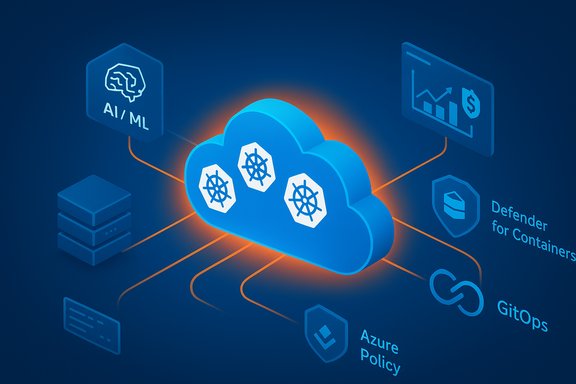
- Integrated security posture and threat protection using Microsoft Defender for Containers / Defender for Cloud, together with Azure Policy guardrails to enforce baseline configurations and compliance.
- Observability based on Azure Monitor Container insights and integrated logging/metrics pipelines to support live diagnostics and performance tuning.
- Modern automation patterns such as GitOps (Flux/Argo), IaC (Bicep/ARM/Terraform), and CI/CD pipelines. These are the operational patterns that turn an AKS deployment into a robust delivery platform for microservices and data workloads.
What a specialization implies for security and compliance
Specialized partners must show repeatable processes, which often translates to:- Use of Azure Policy and Kubernetes admission controls to prevent insecure pod specs and network exposures.
- A documented approach for secrets and identity (workload identity rather than long-lived secrets).
- Integration with Defender for Containers for runtime detection and supply-chain scanning, plus ongoing vulnerability management for images and node OS.
Strengths: Where specialization adds clear value
- Reduced procurement risk: Microsoft validation, combined with an independent audit, shortens the checklist procurement teams use to qualify partners. The program requirement for measurable AKS/ARO consumption from multiple customers means the partner has real-running environments, not only training labs.
- Faster time-to-value: Specialized partners usually bring pre-built operational blueprints and deployment templates that accelerate cluster provisioning, CI/CD integration, and observability on AKS, which cuts project timelines. Many partners maintain templated "landing zones" and GitOps patterns to standardize deployments.
- Integrated cloud + network + security: Large telco-plus-managed-service providers like Orange Business can bundle connectivity and managed security with AKS operations, which can be attractive for global or hybrid customers that need managed WAN, SASE, and consistent security controls.
- FinOps-aware operations: When cost governance is embedded into deployment pipelines and operational playbooks, customers capture savings faster and reduce cloud waste — a practical benefit that moves AKS from a technical win to a financial one. Industry studies and consulting reports indicate systematic FinOps programs often reveal double-digit percent savings on cloud spend.
Risks and caveats customers must watch for
1. Specialization is a competency gate, not an SLA
The specialization demonstrates competence and repeatable processes, but it is not a performance SLA for any single project. Customers should still negotiate explicit service levels, incident response metrics, and operational runbooks in contracts to ensure the partner’s delivery promises match day-two reality.2. Vendor and architectural lock-in
AKS provides tight integrations to Azure services (Key Vault, Cosmos DB, Managed Identity, NAT Gateway, Azure CNI). While these integrations accelerate development and operations on Azure, they can increase migration complexity if an organization later decides to leave Azure or adopt a multi-cloud control plane. Design for portability where it matters: separate application logic from cloud-specific services, and keep IaC templates and GitOps flows cloud-agnostic where feasible.3. Cost surprises from misconfiguration and AI-era workloads
Container platforms can mask underlying compute consumption. Unbounded autoscaling, large inference models, or inefficient container images can result in outsized bills. The combination of rapidly growing AI workloads and elastic infrastructure has made FinOps more than a nice-to-have; today it’s a core governance practice — partners must demonstrate concrete cost governance controls, not only stated FinOps advisory.4. Security drift and supply-chain risk
Kubernetes ecosystems are complex, and supply-chain risks—from unvetted images to compromised Helm charts—remain real. Customers should insist on documented supply-chain controls: trusted registries (e.g., Azure Container Registry with content trust), image signing, SBOM generation, and vulnerability scanning integrated into both build and runtime. Defender for Containers helps at runtime, but secure CI/CD and image provenance are first-line defenses.5. Human and organizational factors
A certified team is a positive indicator, but real-world projects succeed or fail on organizational buy-in, shared ownership, and change management. Shifting to cloud-native operations often requires retooling teams, retraining developers in cloud-native debugging and testing, and aligning finance and engineering around FinOps practices.Practical checklist: What customers should validate when engaging a specialized partner
- Proof of specialization and scope of the audit — request the partner’s public announcement and ask which regions and service areas were audited.
- Sample runbooks and SLOs — review specific evergreen runbooks for upgrades, disaster recovery, and incident response for AKS clusters.
- IaC and GitOps artifacts — require partners to commit to delivering IaC (Bicep/ARM/Terraform) and GitOps pipelines (Flux/Argo) under version control.
- FinOps controls — validate tagging strategy, automated rightsizing, budget alerts, and demonstrable historical cost savings from prior projects.
- Security posture — ensure Defender for Containers / Defender for Cloud is part of the baseline, plus image scanning in CI and Azure Policy enforcement for clusters.
- Identity approach — confirm use of Workload Identity or approved managed identity patterns rather than long-lived credentials in pods.
- Portability commitments — if multi-cloud or future migration is a concern, require architectural artefacts and escape plans that avoid unnecessary lock-in.
Technical best practices a specialization should reflect
- Treat clusters as cattle, not pets: automate upgrades, node pool lifecycle, and replace nodes frequently. AKS Automatic and managed system node pools reduce human maintenance overhead where appropriate.
- Enforce guardrails with Azure Policy and admission webhooks: prevent risky pod specs, unnecessary hostPath mounts, and ensure network policies are applied.
- Use Workload Identity for pod authentication to Azure services: avoids secrets-on-disk, scales better than legacy approaches, and supports both Linux and Windows workloads.
- Integrate Defender for Containers for runtime threat detection and continuous posture assessment; pair it with image scanning in CI to shift left on security.
- Make FinOps a CI/CD concern: include tagging, budget checks, and right-sizing recommendations as part of pull request templates and automated merge checks. Industry reports show automation-first FinOps captures measurable savings quickly.
What customers should expect from Orange Business specifically
Orange Business frames its Kubernetes specialization as part of an end-to-end portfolio that includes cloud adoption, FinOps, managed AKS services, and combined network/security offerings. For customers that require global reach and integrated connectivity (WAN, SASE), Orange Business’s combination of telco-grade infrastructure and Azure engineering can reduce the number of vendors in large programs and simplify contractual and operational interfaces. The renewal of the Kubernetes specialization signals that Orange Business continues to meet Microsoft’s consumption, certification, and audit requirements for AKS work across its regionally distributed teams. However, customers should still request concrete examples and references: which AKS workloads the partner runs in production, the scale (cluster counts, node counts, core usage), and the documented cost savings or performance improvements achieved for existing customers.Conclusion
Microsoft’s Kubernetes on Microsoft Azure specialization is a meaningful badge for partners and a practical procurement filter for customers. Orange Business’s renewal of this specialization signals continued investment in AKS skills, integrations with Microsoft’s solution areas (Digital & App Innovation and Data & AI), and capabilities that combine cloud orchestration with connectivity and FinOps practices. For enterprises seeking a partner to run production Kubernetes on Azure, a specialized partner reduces one element of delivery risk — validated process, certified staff, and real customer consumption.That said, the specialization is the beginning of the conversation, not the end. Effective projects still require architectural clarity, contractual SLAs, operational playbooks, and — particularly now, with AI and scale-hungry workloads — explicit cost governance. Customers should pair the specialization with a focused due diligence checklist: lineup of runbooks, demonstrable FinOps outcomes, security posture evidence, identity and supply-chain controls, and clear migration or portability strategies where they matter.
Cloud. Containers. Results. The promise is real when the partner combines verified technical chops with tight engineering governance and measurable FinOps discipline — and that is the practical yardstick organizations should use when they evaluate any partner claiming Kubernetes mastery on Azure.
Source: Orange Business Kubernetes on Azure specialization celebration
