

Other World Computing (OWC) has pushed the limits of portable RAID storage again, announcing a ThunderBlade X12 expansion that doubles the device’s maximum capacity to 192TB while retaining Thunderbolt 5 performance and SoftRAID-based RAID flexibility—an audacious move that aims to put multi-terabyte production workflows into a single palm-sized shuttle drive.
OWC’s ThunderBlade family has been targeted squarely at location-based production professionals—DITs, cinematographers, and post houses that need high sustained write speeds, portability, and reliable RAID protection during on-set ingest and editing. The ThunderBlade X12 originally shipped as a 12-bay M.2 NVMe shuttle with capacities up to 96TB, blazing sequential performance, and OWC’s SoftRAID software for RAID 0/1/4/5/10 and JBOD configurations. Recent company announcements and press coverage confirm a planned expansion to accept larger NVMe modules—twelve 16TB M.2 modules—for a new 192TB top capacity. The upshot: for workflows that can chew through terabytes per day—8K RAW, multi-camera capture, VFX dailies—there is now a claim that a single ThunderBlade X12 can hold an entire production’s raw footage in one portable RAID box, with peak bandwidth figures that remain competitive with internal workstation storage.
In short: the expanded ThunderBlade X12 is a compelling tool for high-end production teams who need consolidated, portable throughput more than the cheapest storage-per-terabyte. When used with thoughtful workflow design—active monitoring, immediate duplication, and validated host platforms—it can materially simplify complex production workflows. The model is not a universal fit, but for its target audience it represents a notable step forward in what a portable RAID shuttle can offer.
Conclusion
The ThunderBlade X12’s move to 192TB underscores a clear industry trend: creators demand ever-larger, ever-faster portable storage that doesn’t force a return to racks and crates on every job. OWC’s announcement demonstrates both how far external storage engineering has come and the practical trade-offs teams must weigh—thermal engineering, drive supply, host compatibility, and backup discipline. For production environments where speed and consolidation are mission-critical, the ThunderBlade X12 192TB is a noteworthy option to evaluate; its real impact will be determined by availability, price, and how it performs under sustained, real-world production stress.
Source: TechPowerUp OWC Announces ThunderBlade X12 Expansion Delivering up to 192TB of Thunderbolt 5 RAID Storage | TechPowerUp}
 Background / Overview
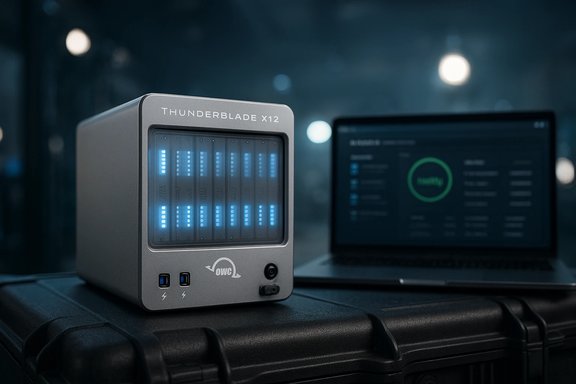
OWC’s ThunderBlade family has been targeted squarely at location-based production professionals—DITs, cinematographers, and post houses that need high sustained write speeds, portability, and reliable RAID protection during on-set ingest and editing. The ThunderBlade X12 originally shipped as a 12-bay M.2 NVMe shuttle with capacities up to 96TB, blazing sequential performance, and OWC’s SoftRAID software for RAID 0/1/4/5/10 and JBOD configurations. Recent company announcements and press coverage confirm a planned expansion to accept larger NVMe modules—twelve 16TB M.2 modules—for a new 192TB top capacity. The upshot: for workflows that can chew through terabytes per day—8K RAW, multi-camera capture, VFX dailies—there is now a claim that a single ThunderBlade X12 can hold an entire production’s raw footage in one portable RAID box, with peak bandwidth figures that remain competitive with internal workstation storage. What OWC is claiming: headline specs and features
- Capacity: Up to 192TB using twelve 16TB NVMe M.2 SSDs (previous max 96TB using 12×8TB).
- Performance: Up to 6,600 MB/s peak and ~5,990 MB/s sustained writes across the volume—figures tied to Thunderbolt 5 connectivity.
- Interface: Dual Thunderbolt 5 (USB-C) ports with daisy-chaining support and the standard TB5 bandwidth/boost modes.
- Software: Ships with SoftRAID (Standard/Premium tiers) for RAID configuration and monitoring across macOS and Windows. SoftRAID supports RAID 0/1/4/5/1+0 volumes and provides drive-health monitoring and proactive alerts.
- Form factor / build: Fanless, all-aluminum shuttle chassis designed for quiet operation, with a locking power connector, non-skid feet, and a ballistic hard case for transport.
Why the jump to 192TB matters for production workflows
For on-location production, two constraints dominate: how fast media can be offloaded, and where the offloaded media lives until cataloging and backup complete. The ThunderBlade X12’s combination of:- high sustained write throughput to avoid dropped frames during multi-card offload,
- RAID-level data protection to guard against single-device failure during transport, and
- a small, rugged shuttle form factor for easy movement on- and off-set
Technical deep dive: how this fits with Thunderbolt 5 and real-world throughput
Thunderbolt 5’s key advance is a step-change in link bandwidth: the baseline TB5 mode provides 80 Gbps bi-directional bandwidth (roughly 10 GB/s aggregate), with an additional Bandwidth Boost mode that can push up to 120 Gbps uni‑directionally for display-heavy use cases. That headroom is what lets OWC credibly claim multi-gigabyte-per-second throughput over a single USB-C cable. Against that raw link:- OWC’s claimed 6.6 GB/s peak (6,600 MB/s) and ~6.0 GB/s sustained writes are well beneath the TB5 theoretical maximum—leaving a margin for protocol overhead, CPU, and host-side bus contention. That headroom makes the claim plausible on hosts with full TB5 support and adequate PCIe backhaul.
- Real-world sustained throughput depends heavily on host implementation (e.g., whether the host’s TB5 controller has full PCIe lanes allocated, whether the OS and drivers support NVMe-over-Thunderbolt without bottlenecking) and on whether any other devices are daisy-chained. Expect top numbers with direct TB5 connections to modern workstations or Apple silicon/Mac devices with TB5 ports; older TB4 or USB4 hosts may not reach the same ceilings.
How OWC gets to 192TB — practical realities
OWC’s 192TB figure is produced by equipping the X12 with 12 × 16TB M.2 NVMe modules, a straightforward arithmetic move that doubles the prior 12 × 8TB ceiling. OWC and multiple press outlets describe the device accepting twelve 16TB modules to reach the sum capacity. A practical note: high-capacity M.2 NVMe modules in the 12–16TB range are more commonly encountered as enterprise-class parts (or as OEM/merchant‑market modules) rather than mainstream consumer SKUs. The supply, endurance, and price of 16TB M.2 modules will therefore materially influence the availability and final cost of a fully populated 192TB ThunderBlade X12. Historically, the largest widely publicized server SSD capacities have appeared first in U.2 / U.3 or 2.5" form factors (e.g., 15.36TB / 30.72TB classes in enterprise product lines), and industry roadmaps show capacity rising, but channel availability lags initial product announcements. This makes the 192TB variant plausible technically, but subject to drive-supply realities.SoftRAID, cross-platform access and RAID choices
SoftRAID is the management layer that makes the ThunderBlade X12 function as more than just a container of NVMe modules. The product bundle and OWC documentation highlight:- SoftRAID volume creation and monitoring, with advanced parity RAID options (RAID 4/5) and predictive monitoring tools, available across macOS and Windows. SoftRAID Premium exposes monitoring, rebuild management, and proactive alerts—useful on remote shoots where immediate attention to drive health pays dividends.
- SoftRAID’s cross-platform support means volumes can be configured for macOS or Windows workflows; SoftRAID also provides tools for converting and accessing volumes between OSes (with caveats on APFS and special formats).
- RAID level matters: producers will trade capacity for redundancy (e.g., RAID 5 vs RAID 1+0). For portable shuttle drives that are subject to one-off transport exposure, many DITs prefer RAID 1+0 (mirrored and striped) or RAID 5 with robust monitoring and off-site replication strategies. SoftRAID makes those choices configurable but cannot replace a proper 3-2-1 backup strategy.
Strengths: where ThunderBlade X12 192TB could genuinely shine
- Consolidation of media: One rugged box holding a full shoot reduces cable and logistics overhead compared with many smaller SSDs or HDDs. This reduces the number of swap cycles and simplifies ingest workflows.
- Sustained throughput: The combination of many NVMe modules and TB5 bandwidth makes truly high sustained ingest and editorial playback possible on a single external device, accelerating DIT and editorial productivity.
- Enterprise-style monitoring in a portable device: SoftRAID’s monitoring and OWC’s hardware diagnostics can catch failing media early—critical when a drive is in transit.
- Compatibility with modern TB5 hosts: On validated TB5 platforms the X12 can behave like very high-end external storage without the footprint or power draw of rack-mounted arrays.
Risks and caveats — what buyers must consider
- Thermals and endurance in a fanless shuttle: The X12’s fanless aluminum design is marketed as silent and rugged, but packing twelve high-capacity NVMe modules in a compact case raises thermal design questions under sustained max-write workloads. If all drives sustain heavy writes for long periods (as in large-scale offloads or multi-hour workplaces), SSD temperatures and controller throttling behavior are determinants of real throughput and drive longevity. The product claims passive dissipation, but teams planning constant heavy throughput should evaluate thermal behavior under realistic conditions and keep an eye on SoftRAID temperature monitoring.
- Drive availability and price: Twelve enterprise- or OEM-grade 16TB M.2 NVMe modules will be expensive and may be constrained in supply. OWC’s press mentions the 192TB configuration will be available in 2026, and pricing for the new top-end SKU was not listed at announcement time—expect a significant premium relative to the 96TB or smaller SKUs. Budget models and procurement windows should factor in lead times and component costs.
- Host and OS bottlenecks: Thunderbolt 5 provides the link bandwidth, but the host’s internal PCIe lanes, CPU, and driver stack must support full throughput. Not all TB5-capable laptops or workstations will deliver the same sustained performance; TB4, USB4 or older controllers will reduce capability. Validate the host machine before committing to the X12 as a primary editorial source.
- Single-enclosure failure risk: A single-shuttle approach trades convenience for consolidation risk; a single catastrophic loss (theft, accident) of a 192TB shuttle would be severe. On-set workflows should still follow robust backup and replication practices—replicate to a second device or cloud when possible. SoftRAID helps but is not a replacement for off-site backup.
- Inconsistent published materials: Some official OWC pages still display the ThunderBlade X12 as supporting up to 96TB (12×8TB) in product copy, while the announcement/press materials and coverage discuss the new 192TB expansion (12×16TB). This discrepancy likely reflects a staged rollout—product page updates are sometimes lagged, and SKUs may be introduced incrementally. Buyers should confirm SKU and exact specs at purchase and consider asking OWC for clarification if documentation mismatch is material to procurement.
Deployment guidance: practical checklist for buying teams
- Confirm host capability: verify the workstation/laptop supports Thunderbolt 5 and has adequate PCIe backhaul to avoid internal bus bottlenecks.
- Clarify the SKU and included drives: ask whether the 192TB SKU ships populated with 16TB modules, or whether it’s a populated vs. empty enclosure option. Pricing and warranty differ.
- Plan redundancy: never rely on a single device as the only copy of shoot material. Implement at least one immediate duplication step (mirrored ingest to another device or cloud replication).
- Test sustained writes and thermal behavior: run a representative ingest test at your facility to validate sustained throughput, temperature curves, and SoftRAID rebuild behavior under load.
- Budget for OWC SoftRAID Premium if proactive monitoring and enterprise support are required; factor in multi-year subscription costs.
Pricing, availability and timing
OWC’s official materials and the press announce the 192TB expansion with an availability window in 2026, but at publication the 192TB price had not been posted. Independent coverage lists current 12TB–96TB pricing as context (e.g., 12TB starting around $3,299 and 96TB around $15,499 for existing SKUs), implying the 192TB SKU will command a materially higher price once populated with high-density enterprise M.2 parts. Expect final pricing and channel availability to be announced closer to general availability.Business and creative impact: who benefits most?
- Large-scale film production houses and post facilities that produce multi-terabyte daily footage stand to reduce logistic complexity by consolidating on fewer devices.
- On-set DITs who need fast, single-step ingest and immediate editing/playback capability.
- VFX and stereo/VR teams that prefer high-speed, low-latency external pools for collaborative editing.
- Small to mid-size studios that value an external shuttle that blends high capacity and high throughput without full rack infrastructure.
Final assessment
OWC’s expansion of the ThunderBlade X12 to a claimed 192TB is a bold, pragmatic response to the relentless growth of on-set media sizes and the need for portable, high-throughput RAID solutions. The technical ingredients—many NVMe blades paired with Thunderbolt 5—are sound on paper: TB5 provides the link bandwidth, NVMe offers the raw media speed, and SoftRAID supplies software-level RAID and monitoring. Multiple outlets and OWC’s press materials corroborate the headline claims, and the numbers sit comfortably inside TB5’s theoretical envelope. However, the real-world value of the 192TB SKU depends on several practical variables: the availability and endurance of 16TB M.2 NVMe modules, thermal performance in a fanless shuttle under sustained workloads, host-side implementation of Thunderbolt 5 and PCIe lanes, and the device’s final price once fully populated. Buyers should treat the 192TB announcement as an important new option that requires site-specific validation—run ingest/thermal tests, confirm host compatibility, and maintain conservative backup discipline. SoftRAID’s monitoring and OWC’s pro-support add operational value, but they do not eliminate the need for multiple copies.In short: the expanded ThunderBlade X12 is a compelling tool for high-end production teams who need consolidated, portable throughput more than the cheapest storage-per-terabyte. When used with thoughtful workflow design—active monitoring, immediate duplication, and validated host platforms—it can materially simplify complex production workflows. The model is not a universal fit, but for its target audience it represents a notable step forward in what a portable RAID shuttle can offer.
Conclusion
The ThunderBlade X12’s move to 192TB underscores a clear industry trend: creators demand ever-larger, ever-faster portable storage that doesn’t force a return to racks and crates on every job. OWC’s announcement demonstrates both how far external storage engineering has come and the practical trade-offs teams must weigh—thermal engineering, drive supply, host compatibility, and backup discipline. For production environments where speed and consolidation are mission-critical, the ThunderBlade X12 192TB is a noteworthy option to evaluate; its real impact will be determined by availability, price, and how it performs under sustained, real-world production stress.
Source: TechPowerUp OWC Announces ThunderBlade X12 Expansion Delivering up to 192TB of Thunderbolt 5 RAID Storage | TechPowerUp}
