

Oxfordshire County Council has moved from pilot to full rollout with Microsoft Copilot, claiming major time savings, a £3.3m net present value identified in its proof of concept, and a programme of engagement and governance designed to make AI adoption practical, safe and organisation‑wide.
Oxfordshire’s programme is a high‑profile example of a local government body treating generative AI as a strategic, enterprise change programme rather than an isolated IT project. The council reports that it gave Copilot Chat to every member of its 5,000‑plus workforce and provisioned Microsoft 365 Copilot to roughly 4,500 office and knowledge workers after a 2024 pilot involving 500 staff. Those pilot results — including headline figures such as 25,200 hours saved for managers and practitioners and an identified £3.3 million net present value — were central to the decision to scale. The rollout pairs behaviour‑change work (training, champions, gamified learning) with a technical and governance uplift — including an enterprise licensing move to Microsoft E5, adoption of Microsoft Purview and Data Loss Prevention controls, and a stated intent to keep data inside Microsoft tenancy boundaries rather than exposing it to external public models. These are explicit design choices intended to balance adoption with risk mitigation.
The headline metrics are compelling but vendor‑reported; they should be evaluated and audited before acting as the central justification for heavy licence investments elsewhere. For councils and public services embarking on their own journeys, the practical takeaways are clear: start small, measure rigorously, pair excitement with guardrails, and invest in the people and governance that make AI safe, useful and sustainable.
Source: Microsoft Oxfordshire County Council breaks down silos with Microsoft Copilot | Microsoft Customer Stories
 Background / Overview
Oxfordshire’s programme is a high‑profile example of a local government body treating generative AI as a strategic, enterprise change programme rather than an isolated IT project. The council reports that it gave Copilot Chat to every member of its 5,000‑plus workforce and provisioned Microsoft 365 Copilot to roughly 4,500 office and knowledge workers after a 2024 pilot involving 500 staff. Those pilot results — including headline figures such as 25,200 hours saved for managers and practitioners and an identified £3.3 million net present value — were central to the decision to scale. The rollout pairs behaviour‑change work (training, champions, gamified learning) with a technical and governance uplift — including an enterprise licensing move to Microsoft E5, adoption of Microsoft Purview and Data Loss Prevention controls, and a stated intent to keep data inside Microsoft tenancy boundaries rather than exposing it to external public models. These are explicit design choices intended to balance adoption with risk mitigation. Why this matters: context from other UK public‑sector pilots
Oxfordshire’s narrative fits into a broader wave of UK public‑sector Copilot pilots and rollouts that report measurable productivity gains while wrestling with governance and safety questions. Other councils and NHS organisations have reported time savings and efficiency gains from embedding Copilot into everyday apps such as Teams, Outlook and Word — but those reports come with caveats about measurement methodology and the need for human‑in‑the‑loop validation. Examples from Buckinghamshire Council and major NHS trials illustrate similar patterns: promising time‑saving figures, strong emphasis on governance and training, and staged rollouts rather than immediate enterprise enablement.The rollout: structure, scale and key components
Pilot design and persona approach
Oxfordshire’s pilot deliberately sampled employee personas (knowledge worker, management, business support) rather than only by department. This approach attempts to capture common task types and skill profiles across the organisation so that use cases and training are transferable across services. The pilot identified ten priority use cases by asking staff to nominate the “high‑volume, high‑intensity, low‑efficiency” tasks in their everyday work.Licensing and security posture
The council’s technical response included upgrading licensing from E3 to E5 to unlock advanced security and compliance features such as Microsoft Purview and enterprise DLP. Alongside that licensing change, Oxfordshire emphasised tenant‑boundary controls (for example, disabling unauthorised external AI tools and restricting web grounding) to reduce the risk of data leakage or inadvertent training of third‑party models. Those admin controls are standard good practice for public‑sector tenants adopting Copilot at scale.Governance and Centre of Excellence thinking
The rollout incorporated a governance framework (a Centre of Excellence style model), mandatory training for pilot participants, and user agreements that set expectations for safe Copilot use. The programme tied access to both technical controls and cultural interventions — training, champions, and ongoing measurement — to ensure the technology was embedded rather than merely available.Engagement, training and culture: The Hangar, Flight School and Ambassadors
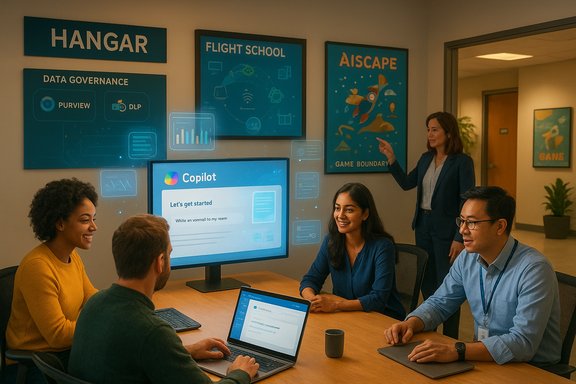
A recurring theme in successful Copilot adoption is that people and behavioural design matter as much as the code. Oxfordshire leaned hard into engagement to drive uptake and reduce anxiety.- The Hangar: a Teams channel used as a persistent community resource for tips, examples and troubleshooting.
- The Flight School: a structured communications and training calendar to surface practical learning opportunities.
- Copilot Ambassadors: local champions across services who demonstrate use cases and make the technology feel relevant to specific teams. One ambassador, Maggie Wang, is quoted as using Copilot daily across brainstorming, research and code debugging — a vivid example of how embedding Copilot inside familiar apps reduces friction.
Gamified onboarding: AIscape rooms and hackathons
Oxfordshire used two creative, engagement‑first approaches:- AIscape rooms — gamified escape‑room experiences deployed across council buildings to introduce AI concepts and build "prompt literacy" in a low‑pressure, team‑based format.
- A Copilot Hackathon — a one‑day, Microsoft‑supported build event where 80+ participants formed 11 cross‑functional teams to prototype agent use cases and present them in a "Dragons’ Den" style. The hackathon was explicitly positioned to create “see it to believe it” moments and to seed reuseable agents across services.
Reported outcomes: numbers, benefits and caveats
Oxfordshire reports several headline outcomes from its pilot and early rollout:- 25,200 hours saved for managers and practitioners by reducing time spent writing supervision notes (pilot).
- 30,000 hours saved annually for managers through automated meeting notes and follow‑ups.
- 8,000 hours saved annually in hiring processes (job descriptions, interview structures, offer letters).
- A pilot‑identified net present value of approximately £3.3 million.
- After six months, the council reported Copilot had enabled the release of about 174,000 hours, equating to ~£2.2 million in officer capacity if fully realised.
Technical integration: how Copilot fits into council systems
Microsoft 365 Copilot operates as an add‑on to an existing Microsoft 365 tenancy and can reason over work data surfaced through Microsoft Graph (Exchange, SharePoint, OneDrive, Teams) when tenant policies permit. Key technical control levers for councils include:- Tenant grounding vs web grounding — deciding whether Copilot may use public web data as context.
- File upload and scope controls — limiting which repositories Copilot may index.
- Retention and audit logs for Copilot chat history — important for traceability and compliance.
- Identity hardening — conditional access, risk‑based policies and Privileged Identity Management (PIM) via Entra ID P2 or equivalent — to prevent unauthorized access to privileged data.
Strengths: what Oxfordshire did well
- Holistic change model: treating Copilot as an organisational change programme that combines training, governance and technical hardening.
- Broad, inclusive pilot: using personas helped surface cross‑service use cases and build reuseable templates.
- Engagement focus: The Hangar, Flight School, ambassadors, AIscape rooms and hackathons created momentum and addressed adoption friction in a pragmatic way.
- Security posture: conscious licensing and Purview/DLP investment signalled a commitment to embedding Copilot within an auditable enterprise boundary rather than as an ad hoc consumer tool.
Risks, gaps and unresolved questions
- Measurement fidelity and persistence
- Many public‑sector Copilot pilots rely on self‑reported time savings and modelling to create headline metrics. Self‑reporting is a pragmatic first step but can overstate persistent net gains. Longitudinal measurement, representative audits and comparative cohorts are needed to determine whether time saved becomes sustained productivity or is reabsorbed into other work. Oxfordshire’s promising numbers are vendor‑reported and should be validated with independent measurement if they are to underpin major budgeting decisions.
- Hallucinations and domain risk
- Generative models can produce confident but incorrect answers (hallucinations). For frontline services — social care case notes, procurement guidance or legal summaries — errors can have reputational, operational and legal consequences. The council’s emphasis on a “human in the loop” is right; institutionalising mandatory validation steps for externally facing or decision‑critical outputs is essential.
- Data governance and configuration drift
- Tenant misconfiguration, over‑permissive web grounding or inconsistent label application can leak sensitive data. The technical levers exist to mitigate these risks, but they require continuous operational discipline, audits and role‑based admin separation to ensure they remain effective in a live environment. Oxfordshire’s E5 and Purview investments reduce risk but are not a silver bullet.
- Workforce and labour impacts
- While Copilot aims to reduce routine burdens, it also shifts how work is done. Clear policies are needed to manage expectations about productivity gains, role redesign, training budgets, and any downstream effects on FTE planning. Transparent communication and upskilling pathways help avoid the perception that AI equals job cuts.
- Vendor reliance and long‑term costs
- Deep integration with the Microsoft 365 ecosystem delivers low friction and high functionality, but it also creates commercial dependency. Counters to vendor lock‑in include clear exit planning, portability strategies for data and templates, and continuous procurement review of total cost of ownership. Several UK public bodies adopting Copilot have explicitly modelled multi‑year TCO and governance as part of their rollout.
Practical recommendations for other councils and public bodies
- Start with personas and a tight set of measurable use cases.
- Run an instrumented pilot with a control cohort and pre/post metrics (time on task, draft cycles, error rates).
- Pair any technical enablement with:
- Mandatory, role‑specific training.
- A champions network.
- A simple “Copilot playbook” (approved prompts, redaction rules, verification workflow).
- Harden identity and tenant controls before broad enablement (conditional access, PIM, sensitivity labels).
- Publish a measurement cadence and an audit plan to validate vendor‑reported gains.
- Build reuseable Copilot agents in a staged manner and require human sign‑off for externally shared outputs.
How to evaluate reported savings: a short checklist
- Are the savings self‑reported or instrumented? (Self‑reporting biases are common.
- What baseline was used and is there a control group?
- Were savings measured as reclaimed time or as net organisational productivity?
- Are the reported savings persistent across six to 12 months?
- Were qualitative impacts (accessibility gains, employee well‑being) captured alongside quantitative metrics?
Final analysis: measured optimism with governance teeth
Oxfordshire County Council’s Copilot rollout is notable for its scale, creativity in engagement and explicit linkage of adoption to governance and security controls. The council demonstrated a pragmatic mix of enthusiasm and caution: gamified training and ambassadors to drive usage, coupled with licensing and Purview investments to mitigate risk. Those twin pillars—people and platform—are what transform a technology pilot into an operational capability. However, the most load‑bearing claims in Oxfordshire’s story (tens of thousands of hours saved, six‑month releases of 174,000 hours, and multi‑million‑pound valuations) are derived from vendor‑published case material. That does not make them false — many public‑sector pilots do report material task‑level improvements — but these outcomes should be validated through independent measurement and transparent methodology if they are to justify long‑term budget decisions. Comparable public‑sector pilots (for example in other councils and large NHS programmes) show similar directional benefits while also demonstrating the need for cautious, audited scale‑ups. Public bodies considering Copilot would do well to replicate Oxfordshire’s combined focus on:- building excitement and practical skill through champions and gamified learning,
- enforcing technical tenant boundaries and identity hardening,
- and establishing clear human oversight and auditability for Copilot outputs.
Conclusion
Oxfordshire’s Copilot programme is an instructive case study in converting AI curiosity into operational practice: rapid experimentation, inclusive pilots, imaginative engagement and explicit governance. The council’s blend of cultural programmes (The Hangar, Flight School, AIscape rooms, ambassadors) and technical hardening (E5 licensing, Purview, DLP) reflect a mature approach to enterprise AI adoption.The headline metrics are compelling but vendor‑reported; they should be evaluated and audited before acting as the central justification for heavy licence investments elsewhere. For councils and public services embarking on their own journeys, the practical takeaways are clear: start small, measure rigorously, pair excitement with guardrails, and invest in the people and governance that make AI safe, useful and sustainable.
Source: Microsoft Oxfordshire County Council breaks down silos with Microsoft Copilot | Microsoft Customer Stories
