

Dominic Redmond’s tenure as group CIO at PageGroup is a study in pragmatic digital transformation: a steady pivot from isolated tooling to an integrated, data-first technology stack that powers candidate and client engagement, automates high-volume operational workflows, and puts productivity for revenue-generating recruiters at the centre of IT strategy. The interview with Redmond sketches an IT leader who has blended large-scale programme delivery with an emphasis on people, culture and practical automation — and who has chosen a commercial integration platform to glue together Salesforce, Microsoft services, NetSuite, ServiceNow and numerous specialist systems to deliver a single operational story for a global recruiter. The practical results Redmond cites — integration-led automation, consolidated reporting, and major CV processing throughput — are credible and broadly consistent with vendor- and partner-published case material, but they also expose the usual trade-offs of scale: governance, vendor dependency, and the privacy and security pressure of orchestrating huge volumes of personally identifiable data. The rest of this feature drills into the technical bedrock and organisational choices behind PageGroup’s approach, validates key claims with independent sources, highlights strengths and risks, and offers concrete guardrails for any professional services firm pursuing the same path.
PageGroup (the parent of the Michael Page brand) is a major FTSE recruiter operating across dozens of markets and thousands of recruiting consultants. Technology is an intrinsic part of how the business creates and delivers value: candidate acquisition, CV processing, client engagement and recruiter productivity are all mediated by software platforms and integrations. Dominic Redmond joined PageGroup in 2016, ran global applications and digital programmes, and moved into the group CIO role in the early 2020s. His remit is intentionally broad: lift business performance through technology and data, while maintaining operational resilience for mission-critical systems and building a foundation for automation and AI-enabled productivity. Redmond’s public remarks emphasize cross-functional collaboration, a services mindset inside IT, and the deliberate replacement of twig-like point solutions with a joined-up enterprise architecture.
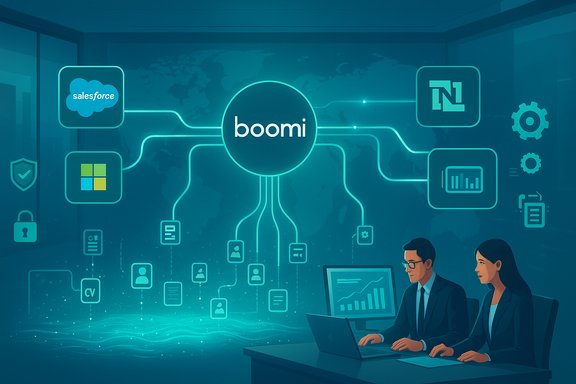
A key architectural decision under Redmond’s leadership has been to standardise around a small set of enterprise platforms (Salesforce, Microsoft, NetSuite, ServiceNow) and use an integration platform (Boomi) as the connective tissue that moves and orchestrates data across the estate. This approach supports a data lake and analytics layer that underpin operational reporting and candidate-to-client workflows — the “funnel” Redmond describes where digital and human interactions progressively move candidates toward placement.
This is not academic: PageGroup has publicly described the practical business outcomes of that architecture — using integration to move CVs, automate onboarding, payroll and supplier payments, and supply a single view of operational performance to recruiters and back-office teams. The vendor case materials corroborate those general claims and document large-scale throughput in candidate processing.
The cultural strategy underpins several technical imperatives:
PageGroup’s story under Dominic Redmond shows how a recruitment business can move from fragmented tooling to a managed, data-enabled enterprise architecture that supports both recruiter productivity and customer-facing digital experiences. The architectural choices are sensible and validated by third-party vendor material; the next stage of value — and risk — will come from how governance, resilience and AI assurance scale alongside that integration plane. With the right guardrails, the payoff will be measurable: faster placements, fewer manual hand-offs, and a data foundation to power personalised candidate experiences at global scale.
Source: Computer Weekly Interview: Dominic Redmond, group CIO, PageGroup | Computer Weekly
 Background / Overview
PageGroup (the parent of the Michael Page brand) is a major FTSE recruiter operating across dozens of markets and thousands of recruiting consultants. Technology is an intrinsic part of how the business creates and delivers value: candidate acquisition, CV processing, client engagement and recruiter productivity are all mediated by software platforms and integrations. Dominic Redmond joined PageGroup in 2016, ran global applications and digital programmes, and moved into the group CIO role in the early 2020s. His remit is intentionally broad: lift business performance through technology and data, while maintaining operational resilience for mission-critical systems and building a foundation for automation and AI-enabled productivity. Redmond’s public remarks emphasize cross-functional collaboration, a services mindset inside IT, and the deliberate replacement of twig-like point solutions with a joined-up enterprise architecture.A key architectural decision under Redmond’s leadership has been to standardise around a small set of enterprise platforms (Salesforce, Microsoft, NetSuite, ServiceNow) and use an integration platform (Boomi) as the connective tissue that moves and orchestrates data across the estate. This approach supports a data lake and analytics layer that underpin operational reporting and candidate-to-client workflows — the “funnel” Redmond describes where digital and human interactions progressively move candidates toward placement.
Why integration-first architecture matters for recruitment
The problem recruitment firms face
Large recruitment firms are built on high-volume, people-centric workflows: candidate discovery and relationship management, CV ingestion and parsing, matching against role profiles, compliance checks, onboarding and payroll. Each step can be serviced by specialist tools (job boards, ATS modules, payroll engines, CRM, finance), but when those tools are stitched together ad hoc they create:- Data silos that erode visibility and make analytics expensive
- Manual hand-offs that slow time-to-placement and introduce error
- Operational duplication and escalating licence costs as the estate fragments
PageGroup’s chosen pattern
Redmond’s team has pursued an integration-first pattern: consolidate key platforms for CRM, ERP and service management, and use an iPaaS (integration platform as a service) to orchestrate and transform data flows. That iPaaS then feeds a central analytics layer (a data lake) that supports KPI reporting, operational dashboards and downstream automation or agentic AI services. This is the classical modern enterprise stack: platforms + integration plane + governed data lake + analytics/AI.This is not academic: PageGroup has publicly described the practical business outcomes of that architecture — using integration to move CVs, automate onboarding, payroll and supplier payments, and supply a single view of operational performance to recruiters and back-office teams. The vendor case materials corroborate those general claims and document large-scale throughput in candidate processing.
The technology stack — platforms and the integration layer
Core platforms named by Redmond
Redmond’s interview identifies a compact set of enterprise platforms that make up PageGroup’s backbone:- Salesforce — CRM and candidate/client engagement workflows
- Microsoft — productivity and platform services (Office 365 / Entra / Azure services)
- NetSuite — finance and ERP systems
- ServiceNow — ITSM and service workflows
Boomi as the connective tissue
PageGroup’s pragmatic choice for that layer has been Boomi, a widely used iPaaS. According to Boomi’s published case material, the vendor’s platform underpins many of PageGroup’s integrations and is credited with enabling the company to move from a handful of integrations in 2016 to dozens or hundreds today, while supporting high-volume operations that include CV ingest, onboarding and supplier payments. Boomi’s case page indicates PageGroup processes in the order of millions of CVs per month using the integration layer, and cites the platform as the mechanism used to create the company’s data lake that began with finance data from NetSuite but expanded to operational metrics and performance data. Practical takeaways from that choice:- An iPaaS reduces bespoke connector development and shortens time-to-value for cross-system workflows.
- A mature iPaaS can perform lightweight orchestration and data transformation in-flight, reducing the need for separate ETL pipelines.
- Having a single integration plane increases visibility and makes governance and observability more tractable — if governance is implemented.
Verifying the numbers and claims: what we can confirm and what needs caution
The interview makes several concrete claims worth validating:- PageGroup uses Boomi to integrate a very large number of applications and to process high volumes of CVs monthly.
- The firm created a data lake that started with finance data (NetSuite) and expanded to operational metrics and KPIs.
- The integration estate supports a wide variety of day-to-day operations, including onboarding, paying suppliers and expense management.
- The interview references more than 150 applications integrated via Boomi. Boomi’s published case material cites different counts in different places (examples include “50+ apps,” “100+ integrations,” and reported CV-processing volumes reaching 1–1.5 million+ CVs monthly). These discrepancies are not uncommon in marketing and press materials where integration counts can be framed as “application endpoints,” “integration processes,” or “system connectors,” depending on definition. The meaningful signal is consistent: PageGroup operates a large, growing integration estate that supports millions of CVs per month. The exact number of connected endpoints is less important than the demonstrated scale and the presence of a central integration plane, but the precise “150+” figure should be treated as an internal metric that requires confirmation if it underpins procurement or compliance decisions.
What PageGroup has done well — strengths and strategic merits
- Focus on business-facing outcomes, not technology for its own sake
- Redmond’s framing — use technology to make recruiter work more effective, not to replace people — is a well-calibrated message for professional services where human judgement and relationships remain differentiators.
- Aligning IT KPIs with recruiter productivity and placement rates keeps technology investments grounded in revenue outcomes.
- Consolidation around a small set of enterprise systems
- Choosing proven SaaS platforms for CRM, finance and service management reduces the cost of custom development and leverages vendor roadmaps.
- This creates an architecture where improvements in the platforms (e.g., Salesforce features or ServiceNow automations) can be adopted incrementally.
- a robust integration plane
- The decision to centralise integrations in a mature iPaaS (Boomi) gives PageGroup the flexibility to onboard new applications quickly and to standardise data transformations, which are essential at its scale.
- The iPaaS-led path also lowers the friction for adding analytics and automation on top of the existing estate.
- Data-first approach and iterative expansion of the data lake
- Starting the data lake with finance data and growing to operational KPIs demonstrates an incremental, pragmatic approach to data engineering — a pattern that usually yields better governance and trust than attempting a big-bang enterprise data warehouse.
- Cultural and organisational emphasis
- Redmond’s focus on cohesion, cross-functional collaboration and team wellbeing reduces the common delivery friction that plagues large transformation efforts. Technology delivery in a matrixed business requires deliberate people work alongside systems work.
Risks and blind spots — where governance and resilience must be stronger
Any organisation that centralises operational control and integrates hundreds of systems also concentrates risk. Key areas to scrutinise:- Data protection and candidate privacy
- Processing millions of CVs monthly means handling vast amounts of personal data across jurisdictions (EU/UK, APAC, Americas). That demands a rigorous privacy-by-design posture: data minimisation, field-level masking, robust consent records, and cross-border transfer controls. Vendor claims about functionality are not a substitute for contractual and audit evidence of compliance with GDPR, local privacy laws, and sector rules.
- Vendor concentration and dependency
- An architected dependency on a single iPaaS for most systemic integrations improves efficiency but raises vendor-risk. Outages, pricing changes, or contractual disputes with the iPaaS provider can have outsized impact without clear resilience strategies and exit planning.
- Operational observability and incident response
- With hundreds of integrations and high-volume flows, detecting degradation and triaging root causes require enterprise-grade observability: tracing across integrations, synthetic transactions, and end-to-end SLAs for critical workflows (e.g., CV ingestion, payroll feeds).
- The organisation must build runbooks and recovery playbooks for the most critical integration flows.
- Automation and AI risks
- As PageGroup layers automation and AI on top of integrated data, governance must ensure model grounding, prompt safety, drift detection, and explainability. Candidate-facing automation in recruitment raises reputational and legal risks if outputs malfunction or unfairly filter candidates.
- Data quality and semantic consistency
- Integration does not equal quality. Harmonising data models across CRM, ATS, finance and HR systems — and tracking lineage — is essential so analytics and downstream agents can make safe, auditable decisions.
- Over-reliance on “platform magic”
- iPaaS products can justify many use cases, but complex orchestration that mixes human approvals, long-running transactions and multi-step rollbacks may still require bespoke workflow logic or transactional design that lives outside simple point-to-point integrations.
Practical recommendations — guardrails for scale
- Strengthen identity, access and least-privilege controls
- Enforce fine-grained, role-based access across integrations.
- Use short-lived credentials and managed identities for connectors; rotate and audit service accounts.
- Implement field-level governance and PII minimisation
- Classify data fields at ingestion time, mask or tokenise PII where business does not require full fidelity, and maintain a consent ledger for candidate records that persists across flows.
- Build an integration SLO catalogue and runbook library
- Prioritise critical end-to-end flows (e.g., CV ingest → ATS → recruiter UI → placement record → payroll) and define SLOs, monitoring, and recovery runbooks for them.
- Simulate failovers and practice incident response with tabletop exercises for the most important flows.
- Negotiate strong vendor SLAs and portability clauses
- Ensure vendors provide contractual artefacts: outage history, RTO/RPO commitments, export formats and a defined exit path for connectors and data.
- Store canonical schema and semantic metadata outside the vendor tool so migrating connectors does not require full rework.
- Invest in data lineage, cataloguing and model governance
- Use a central data catalog and enforce lineage so analytics and AI initiatives can trace back to authoritative sources.
- Establish model governance with periodic reviews, drift detection and human-in-loop thresholds for candidate-facing automation.
- Run focused AI pilots with human oversight
- Start with read-only assistive agents and QA pipelines before enabling any write actions or automated candidate screening decisions.
- Maintain a blended delivery approach
- Keep a small centre of excellence for integration patterns and platform governance, while enabling product-aligned teams to own feature delivery and user adoption.
The cultural factor: why Redmond’s emphasis on people matters
Technical architecture alone doesn’t deliver outcomes — organisational alignment does. Redmond’s interview repeatedly emphasises building a cohesive IT culture that supports cross-functional work: infrastructure, security, architecture and application teams working together with vendors. That emphasis is strategically sound: enterprise integration projects fail not because of middleware limits, but because teams fail to agree on interfaces, ownership or escalation procedures.The cultural strategy underpins several technical imperatives:
- Faster onboarding of new systems when product teams and ops teams share responsibilities
- Better security outcomes when Infosec is a stakeholder in design rather than an afterthought
- Higher adoption rates when the end-user experience (recruiters, consultants) is considered in delivery cycles
How to judge success: KPIs and measures for the next phase
If PageGroup is positioned to scale automation and AI, its CIO office should adopt measurable goals that make the business impact explicit:- Business-facing KPIs
- Time-to-placement (by discipline/market)
- Consultant productivity (placements per recruiter per period)
- Candidate NPS or engagement lift for digital channels
- Operational KPIs for the integration estate
- Mean time to detect and recover for critical integration flows
- Integration success rate (percentage of successful end-to-end transactions)
- Data freshness SLAs for analytics/ML use-cases
- Governance and compliance KPIs
- Percentage of candidate records with complete consent records
- Audit completeness for cross-border transfers and PII access logs
- AI assurance metrics
- Error rates and false positives in automated candidate matching
- Frequency of human override for agentic decisions
- Drift indicators / model retraining cadence
Final assessment — pragmatic architecture, but governance must scale with volume
Dominic Redmond’s description of PageGroup’s technology journey is a textbook example of modern enterprise transformation in a people-centric business: pick durable platforms, centralise integration, build a governed data plane, and use automation to free human judgement for high-value work. Independent materials by the integration vendor corroborate the central architecture and scale claims — Boomi’s published case materials document PageGroup’s use of the platform to integrate dozens (and in vendor language, potentially 50–100+) of systems and to process millions of CVs per month; that aligns with Redmond’s emphasis on high-volume CV processing and data consolidation. That progress is meaningful: when an enterprise replaces brittle point solutions with a controlled integration fabric, the payoff in analytics, automation, and user productivity can be substantial. But the same decisions that unlock scale also create concentrated surface area for risk. For PageGroup, the immediate priorities are clear: tighten data governance for candidate PII, formalise vendor resilience and exit plans for the integration plane, and build robust observability and incident response around the most critical end-to-end flows. Doing so will turn the architecture from a tactical integration win into a durable, trustworthy platform for the next wave of automation and AI-enabled experiences.Action checklist for IT leaders in recruitment and professional services
- Map your critical end-to-end flows and classify them by business impact.
- Build an integration SLO catalogue and instrument synthetic monitoring for transaction-level visibility.
- Treat PII and consent as first-class citizens in the data model; implement masking and tokenisation where full fidelity is not required.
- Negotiate vendor SLAs, export rights and exit assistance for your iPaaS and major platform contracts.
- Pilot AI/automation in read-only or assistive modes with human-in-loop gating and explicit rollback paths.
- Invest in a data catalog and lineage tooling before aggressively scaling agentic AI or modelled decisioning.
- Develop cross-functional runbooks and conduct regular incident simulations for the integration plane.
PageGroup’s story under Dominic Redmond shows how a recruitment business can move from fragmented tooling to a managed, data-enabled enterprise architecture that supports both recruiter productivity and customer-facing digital experiences. The architectural choices are sensible and validated by third-party vendor material; the next stage of value — and risk — will come from how governance, resilience and AI assurance scale alongside that integration plane. With the right guardrails, the payoff will be measurable: faster placements, fewer manual hand-offs, and a data foundation to power personalised candidate experiences at global scale.
Source: Computer Weekly Interview: Dominic Redmond, group CIO, PageGroup | Computer Weekly
