

Fiserv’s new, expanded partnership with Microsoft signals a decisive push to embed generative AI across a major payments and fintech platform — combining Microsoft 365 Copilot for knowledge workers, deeper use of Microsoft Foundry for AI application development, and existing investments in GitHub Copilot for engineering productivity. The announcement frames the agreement as a productivity and product-innovation accelerator that will touch developer toolchains, client-facing systems, fraud and risk workflows, and internal operations — but it also raises important questions about data governance, vendor concentration, regulatory risk, and the practical limits of large-scale Copilot rollouts in regulated industries.
Fiserv is a Fortune 500 payments and financial-technology company that provides account processing, card issuer services, payments, merchant acquiring, Clover point-of-sale systems, and a range of fintech platforms used by banks, merchants, and partners worldwide. Over recent years Fiserv has built and acquired scale in payments and developer tooling, and has publicly invested in machine learning and AI across fraud detection, authorization decisioning, personalization, and client servicing. The company announced on January 8, 2026 that it will deploy Microsoft 365 Copilot across its global workforce and expand its use of Microsoft Foundry (the Azure-hosted AI application platform) to build, customize, deploy, and manage AI applications at scale. At the same time Fiserv reiterated deployments it has already made: it has been using Microsoft Foundry and GitHub Copilot, and stated it has processed "more than 100 billion tokens" in Foundry and rolled GitHub Copilot out to over 8,000 software engineers. Those figures are presented in the company’s announcement and echoed by multiple outlets that republished the release. These metrics illustrate the scope of Fiserv’s AI experiments to date, though they should be judged as company-reported operational statistics rather than independently audited measurements.
Conclusion
The expanded Fiserv–Microsoft collaboration is a textbook example of enterprise AI stacking: apply Copilot to people, Foundry to applications, and Copilot for code to developers. The combination promises quicker product cycles and smarter client experiences in payments and banking. Yet the real test will not be platform adoption counts or token totals — it will be whether these capabilities measurably reduce fraud, improve authorization rates, lower handling times, and do so while preserving compliance, privacy, and system resilience. Fiserv’s public commitments and prior AI investments set a promising stage; the coming months and case-study disclosures will reveal whether the company can realize those promises while managing the amplified operational and regulatory responsibilities that come with agentic AI in financial services.
Source: Brand Spur Fiserv Collaborates With Microsoft To Accelerate AI-Driven Innovation - Brand Spur
 Background
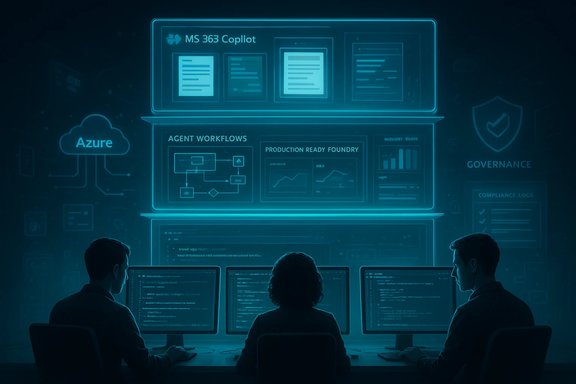
Fiserv is a Fortune 500 payments and financial-technology company that provides account processing, card issuer services, payments, merchant acquiring, Clover point-of-sale systems, and a range of fintech platforms used by banks, merchants, and partners worldwide. Over recent years Fiserv has built and acquired scale in payments and developer tooling, and has publicly invested in machine learning and AI across fraud detection, authorization decisioning, personalization, and client servicing. The company announced on January 8, 2026 that it will deploy Microsoft 365 Copilot across its global workforce and expand its use of Microsoft Foundry (the Azure-hosted AI application platform) to build, customize, deploy, and manage AI applications at scale. At the same time Fiserv reiterated deployments it has already made: it has been using Microsoft Foundry and GitHub Copilot, and stated it has processed "more than 100 billion tokens" in Foundry and rolled GitHub Copilot out to over 8,000 software engineers. Those figures are presented in the company’s announcement and echoed by multiple outlets that republished the release. These metrics illustrate the scope of Fiserv’s AI experiments to date, though they should be judged as company-reported operational statistics rather than independently audited measurements. What Fiserv is doing — the deal in plain terms
- Fiserv will roll out Microsoft 365 Copilot to its global employee base as a productivity and knowledge-work augmentation tool.
- The company is expanding its use of Microsoft Foundry (Azure AI Foundry) to develop, customize, deploy, and monitor AI agents and applications used internally and in client solutions.
- Fiserv will continue scaling GitHub Copilot for its engineering teams and tie Foundry-powered services into its developer gateway and product experiences.
- Fiserv frames this as moving from intelligent automation to agentic intelligence — a shift toward autonomous or semi-autonomous agent behaviors that can perform multistep tasks in business workflows.
Microsoft Foundry explained — what Fiserv is buying into
Microsoft Foundry (branded on Azure pages as Azure AI Foundry or Microsoft Foundry across Microsoft’s materials) is an end-to-end platform intended to give enterprises a production environment for building, orchestrating, and managing AI agents and applications. Key platform capabilities include:- Model selection and management: access to multiple foundation and task models, plus model evaluation and monitoring.
- Multi-agent orchestration: tools that let developers compose and orchestrate specialized agents that collaborate to perform complex workflows.
- Customization options: retrieval-augmented generation (RAG), fine-tuning and distillation workflows, and memory/knowledge integration (Foundry IQ / Azure AI Search).
- Security and governance controls: evaluation APIs, safeguards, and controls for resource, privacy, and compliance settings.
- Integration channels: publishable agents for Microsoft 365, Teams, BizChat, and containerized deployments for portability and edge scenarios.
Microsoft 365 Copilot — productivity uplift for knowledge workers
Microsoft 365 Copilot integrates generative AI capabilities into Office applications, Teams, Outlook, and a central Copilot app — offering features such as summarization, drafting, data analysis, and an agent/automation model called Agents or Copilot agents. Microsoft emphasizes enterprise-grade security, claiming data ownership remains with customers and that prompts, inputs, and responses are not used to train base models when the customer uses enterprise Copilot offerings under their commercial agreements. Microsoft also promotes governance and permission inheritance from Microsoft 365 to control access to content. For Fiserv, Microsoft 365 Copilot promises several immediate use cases:- Faster meeting summarization and action-item capture across large client programs.
- Automated drafting of client communications, RFP responses, and compliance-related documentation.
- Rapid data analysis in Excel and OneDrive/SharePoint knowledge discovery to speed decision-making.
These are realistic productivity gains when Copilot is integrated, but effective outcomes depend heavily on integration architecture, data connectors, and user training.
GitHub Copilot at scale — engineering productivity and the "8,000 engineers" claim
GitHub Copilot is an AI pair-programmer service that provides code suggestions and automation inside IDEs. GitHub states that Copilot Business and Enterprise do not use Copilot-enterprise data to train GitHub models, and offers duplication filters and vulnerability scanning to reduce risk of unsafe or overly permissive suggestions. For large engineering teams, Copilot can materially reduce routine coding tasks and speed prototyping, but integrating it at scale requires policy, guardrails, and observable CI/CD checks. Fiserv reports that it has deployed GitHub Copilot to more than 8,000 engineers. Multiple media outlets repeated this figure from the company announcement. If accurate, that scale suggests Fiserv treats Copilot as a standard part of developer tooling — and is seeing measurable productivity gains — but the exact metrics (for example, percent reduction in task time or defect rates) were not disclosed in the release and remain company-specific claims. Independent validation would be necessary to quantify the ROI.The “100 billion tokens” claim — scale, and why it matters (with caution)
Fiserv stated that it has processed more than 100 billion tokens in Microsoft Foundry. Token counts are a standard way of measuring the volume of inputs and outputs handled by language models and are often used internally to approximate compute and usage. Processing 100 billion tokens indicates substantive experimentation and likely significant production usage across multiple use cases (e.g., client servicing workflows, product enhancements, developer gateways). A cautionary note: token-count disclosures from vendors are useful directional signals but are not a direct measure of business impact. Token volume does not reveal:- How many tokens were generated versus ingested,
- The context/resolution (short chat prompts vs. long document embeddings),
- Cost-per-token or inference cost, or
- Business outcomes associated with that usage.
Security, compliance, and responsible AI — enterprise concerns
Both Microsoft and GitHub publicly emphasize enterprise-grade security, data governance, and non-training commitments for enterprise Copilot offerings. Microsoft's Copilot materials highlight that prompts and responses are not used to train base models under commercial agreements and that Copilot honors Microsoft 365 permissions, sensitivity labels, and retention policies. GitHub Copilot’s enterprise documentation offers duplication filters and compliance features. These protections matter heavily for financial services, which must comply with rules on data residency, recordkeeping, model explainability, and auditability. That said, practical deployment at Fiserv scale will confront several operational challenges:- Data residency and cross-border flows: Financial institutions and merchants operate across jurisdictions with competing rules. Platform-level assurances must be coupled with architecture-level controls (regional deployments, edge containers, or on-prem capabilities).
- Model governance and explainability: Agentic behaviors and RAG systems must provide auditable trails for decisions that impact fraud attribution, risk scoring, or onboarding.
- Privileged access and least privilege enforcement: Copilot agents integrated into internal systems must be tightly constrained to avoid excessive access to customer PII or transaction systems.
- Regulatory scrutiny: Financial regulators are intensifying focus on AI risk management; any systemic error, bias, or misuse can attract supervisory and legal consequences.
Business implications for merchants, banks, and Fiserv’s clients
If executed well, the partnership could yield several client-facing improvements:- Faster time-to-value for customized fintech solutions: Foundry’s templates and agent workflows could accelerate bespoke solutions for merchant decisioning, dynamic authentication flows, and dispute resolution.
- Improved client servicing: Copilot-augmented agents could reduce response times for inquiries, streamline case triage, and surface relevant documents automatically.
- Smarter merchant decisioning: Generative models combined with existing ML could supply richer context for authorization decisions, potentially increasing authorization rates while managing fraud risk.
- Developer velocity for partners: Standardized developer gateway integrations and Copilot-driven coding could speed partner integrations and reduce cost-to-serve.
Risks and trade-offs — what to watch
- Vendor concentration and lock-in. Heavy reliance on Microsoft’s Copilot + Foundry + Azure stack amplifies vendor risk. Migration away from a deeply integrated stack is non-trivial and costly, especially when integrated with identity, data, and developer pipelines.
- Model reliability and hallucinations. Generative models can produce plausible-sounding but incorrect outputs. In financial contexts, erroneous guidance could lead to regulatory exposure or client harm unless outputs are validated.
- Regulatory and legal exposure. Regulators may demand model documentation, fairness audits, and incident reporting. Fiserv’s customers — banks and merchants — may require contractual protections and audit rights.
- Operational complexity and cost. Foundry’s capabilities reduce friction but do not eliminate the need for specialized AI ops, MLOps, and platform engineers. Operating agents at scale generates ongoing cloud and monitoring costs that must be justified by measurable outcomes.
- Data governance and privacy. Ensuring appropriate data minimization, retention, and encryption across flows that include Copilot interactions requires robust design and monitoring.
- Human-in-the-loop requirements. Many decisioning scenarios (fraud holds, chargeback adjudication) will still need human oversight. Balancing autonomy with control is a delicate engineering and policy problem.
Technical and organizational readiness — practical considerations for rollout
Successful enterprise AI rollouts hinge on four interlocking domains:- People: training, change management, and new roles (AI product managers, MLOps engineers, AIOps).
- Processes: integration of model evaluation into release cycles, incident response, and audit reporting.
- Platforms: secure data pipelines, observability/monitoring for model drift, and cost governance.
- Policies: data classification, acceptable use, and escalation procedures for risky outputs.
How to measure success — KPIs that matter
Organizational leaders must tie AI investments to measurable outcomes. Suggested KPIs include:- Productivity and time savings (hours saved per employee per month, number of draft cycles reduced).
- Developer velocity (time-to-merge, defect rates, mean time to resolve regressions).
- Business outcomes (increase in authorization rate, reduction in fraud losses, lower dispute resolution times).
- Compliance metrics (auditable logs, time-to-produce model documentation, number of escalated incidents).
- Cost controls (inference cost per transaction, cloud spend as a percent of revenue for AI services).
Competitive and market context
Microsoft’s approach — bundling Copilot productivity tools with a Foundry platform for model management and GitHub for developer tooling — is designed to create an end-to-end enterprise AI stack. Major cloud competitors are pursuing comparable strategies with their own model ecosystems and tooling, but Microsoft’s deep integration with Office apps, enterprise identity, and developer tooling gives it a unique advantage in the workplace productivity and enterprise developer segments. For Fiserv, choosing Microsoft’s stack aligns with many banks and merchants who already rely on Microsoft 365 and Azure, enabling faster integration but also concentrating strategic risk with one cloud provider.Recommendations and watchpoints for CIOs and security leaders
- Treat Copilot and Foundry rollouts as platform programs, not product pilots. Invest in MLOps, compliance automation, and thorough integration tests before exposing AI-driven agents to real money flows.
- Insist on contractual controls around data handling, model use, and audit rights — particularly for customer PII and transaction data.
- Implement staged, observable rollouts with human-in-the-loop fail-safes for decisioning that affect customers or merchants.
- Require measurable pilot success criteria before scaling: e.g., a validated X% improvement in authorization rates or Y% reduction in average handle time for client servicing.
- Build a centralized AI governance council to oversee agent behaviors, acceptable use cases, and cross-border data flows.
- Maintain multi-cloud portability for critical components where practical, or at minimum, define exit strategies and data-backup processes to limit lock-in.
Bottom line — opportunity balanced with caution
Fiserv’s collaboration with Microsoft is a clear bet that generative AI — when combined with enterprise productivity tools and a governed development platform — will accelerate product innovation and improve operational productivity in payments and fintech. The announcement demonstrates scale and ambition: Microsoft 365 Copilot for knowledge work, Foundry for AI productization, and GitHub Copilot for engineering velocity together form a coherent platform strategy. At the same time, the initiative carries non-trivial operational, regulatory, and vendor-concentration risks. Public metrics such as “100 billion tokens” and widespread Copilot rollouts signal serious investment, but measurable business outcomes, robust governance, and documented regulatory readiness will determine whether the partnership delivers sustained value. The next steps to watch are concrete client case studies, measurable KPIs tied to revenue or risk reduction, and the disclosure of governance processes that show how Fiserv will keep agentic intelligence safe, explainable, and auditable in a highly regulated marketplace. In short, the Fiserv–Microsoft alignment represents one of the larger enterprise AI plays within fintech to date: it offers substantial upside for acceleration and product differentiation, provided that execution focuses equally on controls, observability, and outcome-based measurement rather than on headline-scale platform metrics alone.Conclusion
The expanded Fiserv–Microsoft collaboration is a textbook example of enterprise AI stacking: apply Copilot to people, Foundry to applications, and Copilot for code to developers. The combination promises quicker product cycles and smarter client experiences in payments and banking. Yet the real test will not be platform adoption counts or token totals — it will be whether these capabilities measurably reduce fraud, improve authorization rates, lower handling times, and do so while preserving compliance, privacy, and system resilience. Fiserv’s public commitments and prior AI investments set a promising stage; the coming months and case-study disclosures will reveal whether the company can realize those promises while managing the amplified operational and regulatory responsibilities that come with agentic AI in financial services.
Source: Brand Spur Fiserv Collaborates With Microsoft To Accelerate AI-Driven Innovation - Brand Spur
