

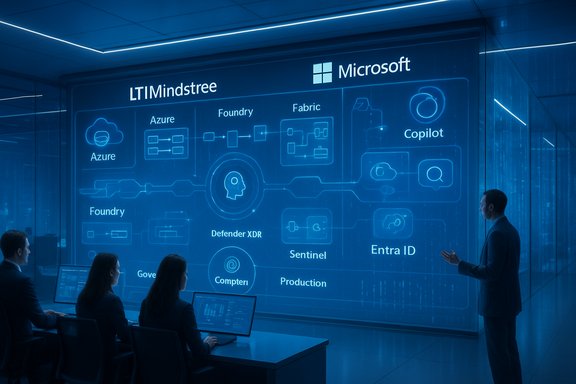
LTIMindtree has expanded its global collaboration with Microsoft to accelerate enterprise adoption of Microsoft Azure and drive AI-powered business transformation, positioning itself as a deeper systems integrator for Azure, Microsoft Foundry, Microsoft 365 Copilot, and Microsoft Fabric while simultaneously adopting a full Microsoft security stack across its own environment.
LTIMindtree is a global technology consulting and digital solutions company that has steadily broadened its hyperscaler partnerships and GenAI credentials over recent years. The company holds multiple Microsoft solution partner designations and has been publicly positioning itself as an AI-first integrator, launching internal AI programs and Centers of Excellence to accelerate enterprise-scale deployments. Microsoft, meanwhile, has evolved its enterprise AI portfolio under the Microsoft Foundry umbrella — a unified platform for models, tools, agents and AI governance — and continues to push Microsoft 365 Copilot and Fabric as primary channels for embedding AI in workplace productivity and data-led analytics.
This announcement is not a one-off product tie-up: it extends an existing 360-degree relationship between the two firms and explicitly anchors LTIMindtree as a partner focused on industrializing AI and cloud adoption using Microsoft technologies. The move is intended to help customers transition from pilots to production, improve time‑to‑value, and strengthen security and governance for hybrid and multi-cloud estates.
Taken together, these components form an integrated stack for enterprises that want to blend data, models, and user‑facing experiences under a common governance and operational model.
These are tangible operational moves: adopting Microsoft Defender XDR and Sentinel provides integrated XDR and SIEM capabilities, while Intune, Windows Autopatch and Entra ID form the endpoint management and identity control plane. The stated internal adoption of Copilot and Security Copilot is consistent with the typical GSI playbook of “eat your own dog food” to develop accelerators and prescriptive blueprints for customers.
Competitors in the Microsoft ecosystem (and beyond) include the large system integrators that have also announced expanded AI partnerships and integrations, creating a crowded but opportunity-rich marketplace. The net effect: enterprises have more choices, but the outcome depends heavily on how well a partner balances platform expertise with industry context and operational rigor.
Long-term, repeated use of Foundry and Fabric could reshape enterprise architecture patterns: data lakes and model endpoints will become core infrastructure in the same way databases and data warehouses did a decade ago. This raises architectural and governance imperatives that will determine which organizations harvest sustained business value.
Success, however, will depend on disciplined governance, realistic costing, talent readiness and an exit-conscious architecture that protects data and preserves strategic optionality. Enterprises that combine the speed of a GSI‑led implementation with their own governance, portability and measurement discipline will extract the most durable advantage from this type of hyperscaler‑partner engagement.
Source: The Financial Express https://www.financialexpress.com/bu...azure-adoption-and-ai-transformation/4049258/
 Background
LTIMindtree is a global technology consulting and digital solutions company that has steadily broadened its hyperscaler partnerships and GenAI credentials over recent years. The company holds multiple Microsoft solution partner designations and has been publicly positioning itself as an AI-first integrator, launching internal AI programs and Centers of Excellence to accelerate enterprise-scale deployments. Microsoft, meanwhile, has evolved its enterprise AI portfolio under the Microsoft Foundry umbrella — a unified platform for models, tools, agents and AI governance — and continues to push Microsoft 365 Copilot and Fabric as primary channels for embedding AI in workplace productivity and data-led analytics.This announcement is not a one-off product tie-up: it extends an existing 360-degree relationship between the two firms and explicitly anchors LTIMindtree as a partner focused on industrializing AI and cloud adoption using Microsoft technologies. The move is intended to help customers transition from pilots to production, improve time‑to‑value, and strengthen security and governance for hybrid and multi-cloud estates.
What LTIMindtree and Microsoft are promising
- Accelerated Azure adoption programs that combine migration, modernization, and industry-specific cloud blueprints.
- Deployment and operationalization of AI-powered solutions using Azure OpenAI models within Microsoft Foundry, plus workplace AI via Microsoft 365 Copilot and enterprise data orchestration with Microsoft Fabric.
- Security hardening across hybrid and multi-cloud environments through the adoption of Microsoft’s security stack — Microsoft Defender XDR, Microsoft Sentinel, Intune, Windows Autopatch, and Entra ID — alongside automation for threat detection and response.
- Internal adoption of Microsoft Copilot to accelerate employee productivity and use those lessons to guide customer implementations.
- A Global System Integrator (GSI)-level engagement model to deliver faster time-to-value, industry-specific solutions, and “move from pilots to productivity” at scale.
Microsoft Foundry, Azure OpenAI, Copilot and Fabric — a quick technical orientation
Microsoft Foundry
Microsoft Foundry is the company’s unified enterprise AI platform that brings together models, agents, and tools with governance, deployment options, and developer-facing SDKs. Foundry Tools (formerly Azure Cognitive Services / Azure AI Services) provide out‑of‑the‑box capabilities for vision, language, document intelligence and agent orchestration. Foundry also exposes a model router, AI Gateway and knowledge/agent services to simplify model choice, governance and deployment at scale.Azure OpenAI in Foundry
Azure OpenAI services (integrated into the Foundry experience) enable enterprises to use OpenAI models under Microsoft’s governance, controls, and regional deployment options. This is essential for regulated industries or businesses requiring data residency and enterprise-grade compliance.Microsoft 365 Copilot and Copilot Studio
Microsoft 365 Copilot is the workplace AI that augments Word, Excel, Outlook, Teams and other Microsoft 365 apps with generative capabilities. Copilot Studio and Declarative Agents extend Copilot to create tailored assistants that act on company data and workflows.Microsoft Fabric
Fabric is Microsoft’s integrated data platform designed to unify data engineering, data science, and BI with OneLake. Fabric simplifies building analytics pipelines and powering Copilot and agents with a single data plane.Taken together, these components form an integrated stack for enterprises that want to blend data, models, and user‑facing experiences under a common governance and operational model.
What LTIMindtree has implemented internally
LTIMindtree states it has adopted the full Microsoft security stack — Microsoft Defender XDR, Sentinel, Intune, Windows Autopatch, and Entra ID — across multiple endpoints to secure hybrid and multi-cloud environments and to support automated threat response. The firm has also rolled out Microsoft 365 Copilot internally to accelerate workflows and improve productivity.These are tangible operational moves: adopting Microsoft Defender XDR and Sentinel provides integrated XDR and SIEM capabilities, while Intune, Windows Autopatch and Entra ID form the endpoint management and identity control plane. The stated internal adoption of Copilot and Security Copilot is consistent with the typical GSI playbook of “eat your own dog food” to develop accelerators and prescriptive blueprints for customers.
Why this matters: The strategic case for enterprises
- Faster conversion from pilot to production
- Building propositions around a single hyperscaler stack and a systems integrator that has embedded the toolset internally reduces the unknowns in deploying generative AI at scale.
- Microsoft Foundry and Fabric are designed to shorten engineering cycles for agents, retrieval-augmented generation, and analytics-driven Copilots.
- End-to-end operational model
- The combination of migration, security, governance, data platform, and workplace Copilot creates a credible pathway for end‑to‑end transformation rather than fragmented PoCs.
- Reduced integration friction
- Pre-existing integrations, reference architectures, and validated runbooks from a partner who already uses the stack internally can materially reduce time-to-value.
- Security and compliance baked in
- Integrating Defender XDR, Sentinel and Entra ID at the outset addresses core enterprise concerns: detection, SIEM, identity governance, and endpoint management.
- Commercial leverage
- A strategic GSI partnership often yields consolidated procurement and programmatic consumption commitments that can be used to negotiate better pricing, capacity, or managed service structures.
Strengths and notable positives
- End‑to‑end capability: LTIMindtree is combining consulting, migration, data platform engineering, and application modernization expertise with Microsoft’s rapidly maturing enterprise AI portfolio. This full-stack capability helps customers bridge the gap between experimentation and production.
- Operational credibility: LTIMindtree’s internal adoption of Copilot and the Microsoft security stack demonstrates practical operational experience rather than theoretical capability.
- Microsoft Foundry maturity: Foundry’s unified model/tool/agent approach and features such as model routing, AI Gateway and knowledge bases materially simplify enterprise concerns around governance and vendor choice.
- Industry specificity: LTIMindtree’s pitch emphasizes sector-specific programs — a commercial differentiator when buyers demand domain expertise alongside technical delivery.
- Market momentum: LTIMindtree’s growing deal pipeline and recent large contract wins increase the likelihood that it can scale teams, IP and delivery frameworks to support enterprise rollouts.
Risks, gaps and where to be cautious
- Vendor concentration and lock-in: Deep reliance on a single hyperscaler’s stack accelerates time-to-value but also increases vendor lock-in risk for data, tooling, and model access. Enterprises should quantify the cost and effort to pivot or multi-cloud enable critical components.
- Data governance and model risk: Deploying generative AI against enterprise data introduces risks — hallucinations, IP leakage, and regulatory exposure. The promises of Foundry and Copilot are real, but outcomes depend on careful prompt engineering, robust retrieval grounding, and strict access controls.
- Cost and consumption surprises: AI workloads can be unpredictable from a consumption perspective. Without firm consumption governance and FinOps for AI, organizations can see large, unexpected bills.
- Talent and skills gaps: Moving from PoC to production requires scarce engineering skills in model ops, prompt engineering, security for AI, and SRE for agentic systems. GSIs can provide those skills but long-term success depends on internal capability transfer.
- Third‑party model risk: Foundry supports multiple models and vendors — beneficial for choice, but it complicates governance when different models have different licensing, provenance and compliance characteristics.
- Regulatory and data residency complexity: For regulated industries or multi-jurisdictional enterprises, hosting models and data requires careful region-specific planning. Microsoft provides options but legal and compliance approvals remain essential.
- Overpromising productivity gains: Vendor and partner ROI claims often reflect best‑case scenarios. These should be validated with controlled pilots and measurable SLOs, not accepted as default.
Market context: GSIs, competition and hyperscaler dynamics
Large GSIs and consultancies are deepening cloud partner relationships across Microsoft, AWS and Google Cloud. Microsoft’s Foundry strategy is explicitly designed to create a platform that GSIs can build on — enabling standardized offerings rather than bespoke model engineering for every customer.Competitors in the Microsoft ecosystem (and beyond) include the large system integrators that have also announced expanded AI partnerships and integrations, creating a crowded but opportunity-rich marketplace. The net effect: enterprises have more choices, but the outcome depends heavily on how well a partner balances platform expertise with industry context and operational rigor.
Practical guidance — checklist for enterprise IT leaders
- Technical due diligence
- Inventory critical data and determine what can safely be used for model training or inference.
- Validate regional deployment options and data residency — ensure Foundry/region choices meet legal and compliance needs.
- Define model governance: who approves model selection, how models are monitored, and what guardrails exist for hallucinations and drift.
- Commercial and contractual
- Confirm consumption pricing models and request cost‑caps or alerts for runaway usage.
- Negotiate clear SLAs and SLOs for availability, latency (for real‑time agents), and runtime behavior.
- Embed exit clauses and data portability commitments to reduce lock-in.
- Security and operations
- Require proof of endpoint and identity hardening — Entra ID for identity, Intune for device posture, Defender XDR and Sentinel for detection and response.
- Mandate integration with your existing SIEM/SOC procedures and incident playbooks.
- Build a FinOps and AIOps charter to manage spending and model lifecycle automation.
- People and change
- Establish a Center of Excellence that includes security, data engineering, legal, and business stakeholders.
- Prioritize internal change management: training for Copilot use, governance for agentic workflows, and documentation of how AI augments roles.
- Start small, measure impact, and scale based on quantifiable KPIs (time saved, task automation rate, accuracy metrics).
How to get value without becoming captive
- Design for polyglot AI: Use abstraction layers so that model endpoints and vector stores can be swapped if strategic needs change.
- Treat the cloud provider as a platform rather than a partner — contract for capabilities, but own the orchestration and data pipelines where feasible.
- Use hybrid patterns: Keep the most sensitive inference on-prem or in a controlled private cloud while using managed services for less-sensitive workloads.
- Apply staged rollout: pilot across a critical business function, iterate on safety/accuracy, then expand with automated guardrails.
Short-term and long-term implications
Short-term, the alliance is likely to accelerate sales cycles for Azure-hosted AI engagements where LTIMindtree can demonstrate prescriptive outcomes and vendor-validated accelerators. For Microsoft, strengthened GSI relationships help the company drive larger consumption commitments and more rapid enterprise adoption of Foundry, Fabric and Copilot.Long-term, repeated use of Foundry and Fabric could reshape enterprise architecture patterns: data lakes and model endpoints will become core infrastructure in the same way databases and data warehouses did a decade ago. This raises architectural and governance imperatives that will determine which organizations harvest sustained business value.
Critical caveats and unverifiable claims
- Company statements regarding internal productivity gains, percentage improvements, and specific customer outcomes are vendor-provided figures and should be validated with direct customer references or proof-of-value programs. These claims are plausible but not independently audited in the public domain.
- Market reaction claims — for example, short-term share-price moves attributed to the announcement — can be reported differently across exchanges and news outlets. Any specific intraday percentage moves should be verified against the exchange-level trade data for the stated date before treating them as definitive.
Bottom line: What enterprises should take from this
LTIMindtree’s expanded collaboration with Microsoft packages a pragmatic, production-first pathway for enterprises that want to adopt Azure, Microsoft Foundry, Copilot and Fabric with security and governance pre-integrated. The partnership offers a strong proposition for customers prioritizing speed, prescriptive industry playbooks, and unified Microsoft tooling.Success, however, will depend on disciplined governance, realistic costing, talent readiness and an exit-conscious architecture that protects data and preserves strategic optionality. Enterprises that combine the speed of a GSI‑led implementation with their own governance, portability and measurement discipline will extract the most durable advantage from this type of hyperscaler‑partner engagement.
Practical next steps for technology leaders evaluating this offering
- Ask for a short, measurable pilot tied to a real business KPI (e.g., reduce processing time for X by Y%).
- Insist on joint runbooks that demonstrate how LTIMindtree will manage security incidents, data residency requests, and model updates.
- Require transparency on consumption and cost forecasting for Foundry, Fabric, and Azure OpenAI usage.
- Confirm skills-transfer objectives and the timeline for building internal capability alongside managed services.
- Build a risk register focused on model safety, data privacy, and regulatory compliance and require mitigation plans as part of the contract.
Source: The Financial Express https://www.financialexpress.com/bu...azure-adoption-and-ai-transformation/4049258/
