

For generations Pakistan’s schools have treated education as a ticket to a job: age‑gated classes, standardized curricula, and high‑stakes exams that reward memorization over invention. A recent feature in Business Recorder argues that this model is not only outdated in the era of abundant digital tools and generative AI, it is actively harmful to national development—and lays out a practical, four‑stage blueprint for remaking classrooms, universities, and public policy so they prepare students to build rather than recite.
The industrial‑era school design assumed scarcity: scarce books, scarce laboratory access, scarce expert time. That model produced reliable clerks and supervisors for a centralized bureaucracy, but it also baked in perverse incentives: memorize to pass, pass to secure employment. The Business Recorder piece reframes the problem succinctly—Pakistan’s current system suppresses curiosity and practical problem solving at precisely the moment when global economies reward creative, multidisciplinary problem solvers.
This mismatch matters because the tools that enable creation—cloud simulation platforms, offline learning servers, low‑cost maker hardware, and generative AI copilots—are now widely available. But availability alone does not equal access or impact. Without intentional curriculum redesign, teacher training, transparency in procurement, and infrastructure investments, these tools risk reinforcing privilege rather than closing gaps. The article positions reform across classrooms, universities, and policy as a single, integrated program of change.
But the plan also faces real hazards:
Policy must move from shouting slogans about digitalization to disciplined public‑goods delivery: local caching and offline platforms where broadband is scarce, solar solutions for electricity reliability, subsidized teacher devices, and open‑data dashboards that let citizens verify outcomes. The alternative is inertia: an education system that preserves privilege by disguising it as reform.
The doors to a new system are open. The imperative now is to step through with clear metrics, robust governance, and a relentless focus on equity—so every child in Faisalabad, Quetta, Chitral, and Tharparkar can be more than an applicant‑in‑waiting and become a builder, thinker, and innovator.
Source: Business Recorder Reimagining education in the age of AI—IV
 Background: why the old industrial model fails the AI era
The industrial‑era school design assumed scarcity: scarce books, scarce laboratory access, scarce expert time. That model produced reliable clerks and supervisors for a centralized bureaucracy, but it also baked in perverse incentives: memorize to pass, pass to secure employment. The Business Recorder piece reframes the problem succinctly—Pakistan’s current system suppresses curiosity and practical problem solving at precisely the moment when global economies reward creative, multidisciplinary problem solvers.This mismatch matters because the tools that enable creation—cloud simulation platforms, offline learning servers, low‑cost maker hardware, and generative AI copilots—are now widely available. But availability alone does not equal access or impact. Without intentional curriculum redesign, teacher training, transparency in procurement, and infrastructure investments, these tools risk reinforcing privilege rather than closing gaps. The article positions reform across classrooms, universities, and policy as a single, integrated program of change.
Overview of the proposed shift: toolkit, stages, and national strategy
The Business Recorder recommendation can be summarized in three core moves:- Pivot from rote instruction to immersive, project‑driven learning powered by simulations, AR/VR, and AI tutors.
- Reconfigure assessment and credentials to reward verified projects, portfolios, and competency demonstrations, not just exam scores.
- Treat connectivity and electricity as foundational public goods for education, while making learning platforms offline‑first and multilingual.
The new educational toolkit — what works, now
Today’s edtech stack is mature enough to deliver the kinds of experiences the article describes. A quick verification of major components shows they are proven, accessible, and already used in classrooms worldwide.- PhET interactive simulations provide research‑based digital labs for physics, chemistry, and math and have an extensive history of classroom use and multilingual availability. These sims let learners manipulate parameters and observe outcomes—exactly the kind of exploration the four‑stage model prioritizes.
- Virtual lab platforms such as Labster offer immersive lab simulations that integrate with institutional LMS tools and report strong engagement and learning metrics in higher‑education pilots. They are particularly useful where physical labs are expensive or unsafe at scale.
- Offline‑first learning platforms like Kolibri (Learning Equality) are explicitly designed for low‑connectivity environments. Kolibri installations run on small local servers and ship with curriculum content that syncs when connectivity is available—making them a practical bridge in rural or off‑grid areas.
- AR/VR and mixed‑reality tools (Merge EDU, Microsoft HoloLens 2, zSpace, ClassVR) provide spatial, tactile understanding of complex concepts. Peer‑reviewed studies and university pilots show measurable learning gains in applied domains—especially medical and STEM training—though cost and logistics remain obstacles for broad deployment.
- Low‑cost hardware (Raspberry Pi, Arduino, inexpensive tablets) and maker toolchains (Tinkercad, Scratch, Raspberry Pi OS learning images) reliably support hands‑on projects from sensor builds to basic robotics and local model training. These platforms are low‑risk, high‑value entry points to computational thinking and practical problem solving.
Verifying the policy levers the article recommends
The Business Recorder calls for legal and governance anchors: proactive disclosure under Pakistan’s Right of Access to Information Act (2017), a National AI‑in‑Education Strategy, and dashboards that publish school budgets, enrollments and learning outcomes. Those legal levers are real and usable.- Pakistan’s Right of Access to Information Act (2017) is an established statute intended to guarantee citizen access to public records and to support proactive disclosure—making it a credible tool to improve procurement transparency and reduce ghost appointments if enforced.
- UNESCO’s AI Competency Frameworks for students and teachers (published in 2024) provide an internationally recognized structure for integrating ethical AI literacy and human‑centred design into curricula—exactly the kind of standard a national strategy should adopt. The frameworks emphasize human agency, ethics, and a staged progression from understanding to creation. Aligning national curricula to UNESCO guidance would therefore be sensible and defensible.
Fact‑check: connectivity, device access, and the digital divide
The Business Recorder piece argues that mobile‑first design is essential and implies a very high smartphone/internet penetration. This is the kind of claim that must be measured carefully.- National telecom reporting and market summaries for 2024–early‑2025 show mobile broadband (3G/4G) penetration in the ~55–60% range, and total internet users in the mid‑40% of the population—substantially lower than the 80+ percent implied by blanket smartphone claims. Mobile network coverage (voice) reaches a larger share of the population than mobile broadband, and many Pakistanis hold multiple SIMs, which inflates connection counts relative to unique users. Policy should therefore plan from conservative baselines (roughly half the population with reliable mobile broadband) and prioritize offline‑first delivery and device programs rather than assuming universal always‑online access.
A critical appraisal of the four‑stage classroom model
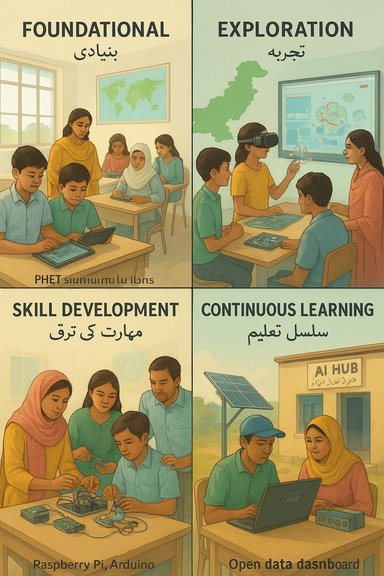
The four stages the article proposes are pedagogically coherent and align with global best practice: build strong multimodal foundations, enable exploratory simulation, support skill‑rich project work, then institutionalize continuous learning and micro‑credentials. Each stage has clear benefits—and predictable implementation risks.Stage 1: Foundational knowledge (immersive visual learning)
Strengths:- Moves early schooling away from passive memorization toward multi‑sensory understanding.
- Leverages low‑cost AR, animations, and 3D models to improve retention and scaffold later abstraction.
- Without teacher facilitation, multimedia can become passive entertainment. Teachers must be trained to orchestrate guided inquiry and formative assessment. Cost of high‑end mixed reality (HoloLens 2) remains prohibitive for broad rollouts; lower‑cost AR (Merge Cube/phone‑based AR) scales more easily.
Stage 2: Exploration & simulation
Strengths:- Simulations enable safe failure and iterative experimentation—core to scientific reasoning.
- PhET and Labster show strong engagement and measurable gains when integrated with instruction.
- Licensing costs and LMS integration issues can create vendor lock‑in for cash‑strapped districts.
- Simulations must be carefully mapped to curricular outcomes and assessment rubrics, or they become extracurricular novelty.
Stage 3: Skill development (project‑based learning)
Strengths:- Produces observable artifacts—code, prototypes, portfolios—that can be verified, shared, and credited.
- Prepares students with workplace‑relevant competencies (digital fluency, prompt craft, basic data literacy).
- Assessment and credentialing frameworks must evolve to recognize verified projects; otherwise, employers and universities will discount portfolio evidence.
- Equity risk: school and home access to tools will determine who can complete projects. Device subsidy and community hubs are essential complements.
Stage 4: Continuous learning
Strengths:- Ties secondary schooling to lifelong micro‑credentials and global learning platforms.
- Aligns with employer demand for demonstrable competencies rather than degree names alone.
- Quality assurance for micro‑credentials must be robust; otherwise the system invites credential inflation and vendor fragmentation.
Universities: from gatekeepers to enablers
The article’s recommendation that universities accredit verified pre‑college portfolios and provide bridge competency programs reflects a global shift in higher education. Institutions are already piloting flexible admissions and micro‑credential recognition, and UNESCO and other international partners recommend competency‑based pathways for inclusion and workforce alignment. Aligning Pakistani universities to such models would:- Expand access for talented youth who lack exam coaching but demonstrate verified project mastery.
- Accelerate research and industry collaboration on local problems (agriculture, water management, telemedicine).
- Reduce reliance on high‑stakes gateways that fuel corruption and elite capture.
Governance, privacy, and vendor risk — policy guardrails
A program that places AI and cloud tools at the center of learning must be coupled with contractual and operational standards:- Data protection: contracts should restrict vendors from using student inputs to further train models, mandate data deletion windows, and require local data residency where appropriate.
- Auditability: institutional access logs, RAG provenance, and reproducible assessment trails are essential for accountability.
- Procurement transparency: proactive disclosure under RTI frameworks can reduce corruption and ensure social auditability.
Practical pilots and a 2025–2030 roadmap
The Business Recorder calls for an actionable staging plan: digitize public schools by 2027, pilot 100 immersive learning labs by 2026, mandate AI literacy from Grade 6, and scale community AI hubs. Translating that into operational steps:- Launch 200 community AI hubs (solar‑powered Raspberry Pi + Kolibri or local caches) in priority union councils within 12 months.
- Pilot 100 immersive labs (mix of low‑cost AR and a limited number of higher‑end HoloLens sites for medical/engineering faculties) with standardized evaluation metrics in years 1–2.
- Institute a teacher re‑skilling program: short, modular certifications in AI literacy, formative assessment with AI, and project facilitation—paired with protected redesign time.
- Build an open‑data dashboard (district, provincial, federal) that publishes enrollment, budget flows, procurement awards, and verified learning outcomes under RTI rules.
- Design and trial a portfolio accreditation standard (digital portfolio schema, verification protocol, district vetting) that universities can accept for admissions or credit transfer.
Costs, partnerships, and funding models
Transforming education at scale requires re‑allocating resources from one‑off visibility projects to enduring human capital investments. Practical financing approaches include:- Device subsidy programs with transparent distribution apps and social audits; prioritize teacher devices to amplify impact.
- Public‑private co‑investments: vendors supply non‑training, audit‑friendly versions of AI assistants to government education pilots on fixed contracts.
- Local assembly incentives: subsidies or tax relief to domestic tech assemblers who supply low‑cost tablets and create local jobs.
- Donor and multilateral funding for initial pilots (community hubs and teacher training) with matched provincial commitments.
Strengths, risks, and an honest verdict
The Business Recorder prescription has many strengths: it is pedagogically grounded, practical, and aligned with international frameworks and existing technologies. It reframes education as an engine of national problem‑solving rather than a queue for employment and it centers equity via offline‑first design and public transparency.But the plan also faces real hazards:
- Infrastructure and device gaps remain large; market counts of SIMs and cell sites overstate unique internet users and risk creating illusions about immediate reach. Policy must plan for roughly half the population with reliable mobile broadband as a conservative baseline.
- Procurement and vendor governance are underdeveloped in many public agencies; without enforceable contract standards the state risks losing control of curricula, student data, and audit trails.
- Teacher capacity is the single most important human constraint. Rolling out devices without a scalable teacher professional learning program will convert hardware into expensive paperweights.
Quick, high‑impact pilots that scale
- Community AI Hubs: solar‑powered Kolibri + Raspberry Pi hubs in union councils to provide offline courseware, maker tools, and project upload points. These hubs can be run from existing public buildings (mosques, post offices) and staffed by local educators or volunteers.
- Maker‑Week: a national campaign where Grade 9 classes deliver community projects (water sensors, smog monitors) and publish verified portfolios to district portals—tested in one province, then scaled. This creates fast feedback loops between schools, districts, and universities.
- Teacher Micro‑certifications: short, stackable modules on prompt engineering, hallucination checks, and project assessment that confer stipends and protected time on completion.
Conclusion: a pragmatic call to build, not memorize
The Business Recorder’s argument is an urgent, practical manifesto: AI and immersive technologies make the old exam‑centric schooling model not merely obsolete but unjust. Pakistan has access to the tools, and the legal frameworks (RTI Act) and international guidance (UNESCO AI competency frameworks) are already in place to support a national transition. The choice is operational, not philosophical. It requires honest diagnostics of current connectivity and device baselines, ironclad procurement and data controls, a major investment in teacher capacity, and a willingness to pilot boldly but measure carefully. If executed with transparency and an equity lens, the four‑stage model can convert classrooms into local innovation labs that produce verified, verifiable contributions—projects that matter to communities and employers, not just examiners.Policy must move from shouting slogans about digitalization to disciplined public‑goods delivery: local caching and offline platforms where broadband is scarce, solar solutions for electricity reliability, subsidized teacher devices, and open‑data dashboards that let citizens verify outcomes. The alternative is inertia: an education system that preserves privilege by disguising it as reform.
The doors to a new system are open. The imperative now is to step through with clear metrics, robust governance, and a relentless focus on equity—so every child in Faisalabad, Quetta, Chitral, and Tharparkar can be more than an applicant‑in‑waiting and become a builder, thinker, and innovator.
Source: Business Recorder Reimagining education in the age of AI—IV
