

Pakistan’s classroom model—age‑gated, exam‑driven and optimized for rote recall—has reached a breaking point; the rise of affordable generative AI, immersive simulations, and offline-first learning platforms makes the old exchange of memory for a job certificate both inefficient and unjust, and now demands a national strategy to convert passive instruction into active, project‑driven creation.
For decades Pakistan’s public education architecture has prioritized standardized curricula and high‑stakes exams that reward memorization. That model suited an era of scarce information and centralized bureaucratic hiring, but it systematically suppresses curiosity, practical problem solving, and the cross‑disciplinary collaborations modern economies require. The recent proliferation of generative AI assistants, cloud simulations and low‑cost hardware reframes learning as an open‑ended, verifiable pipeline of projects and competencies rather than a narrow exam score.
At the same time, digital infrastructure and policy gaps—unequal device access, intermittent electricity, uneven broadband and weak procurement transparency—threaten to convert AI into a privilege rather than an equalizer. Concrete change requires both classroom re‑design and hard public investments in connectivity, teacher training and governance. Recent national and international reporting shows these are solvable but urgent problems for any country attempting rapid digital transformation.
The prescription is compelling because it aligns with global practice: blended learning pilots, offline caching platforms for low‑bandwidth contexts, and enterprise education‑grade AI licensing are already being used to scale personalization. Yet several specific claims (for example, precise device penetration figures and some named pilot programs) require careful verification before being adopted as policy baselines.
Stage 1 — Foundational knowledge (Grades K–5)
Source: Business Recorder Reimagining education in the age of AI—IV
 Background
For decades Pakistan’s public education architecture has prioritized standardized curricula and high‑stakes exams that reward memorization. That model suited an era of scarce information and centralized bureaucratic hiring, but it systematically suppresses curiosity, practical problem solving, and the cross‑disciplinary collaborations modern economies require. The recent proliferation of generative AI assistants, cloud simulations and low‑cost hardware reframes learning as an open‑ended, verifiable pipeline of projects and competencies rather than a narrow exam score.At the same time, digital infrastructure and policy gaps—unequal device access, intermittent electricity, uneven broadband and weak procurement transparency—threaten to convert AI into a privilege rather than an equalizer. Concrete change requires both classroom re‑design and hard public investments in connectivity, teacher training and governance. Recent national and international reporting shows these are solvable but urgent problems for any country attempting rapid digital transformation.
Overview: what the Business Recorder piece proposes
The Business Recorder argument reframes Pakistan’s education agenda into a four‑stage model—Foundational knowledge, Exploration & simulation, Skill development, Continuous learning—centered on immersive tools, low‑cost hardware, AI tutors, and competency‑based recognition of pre‑college innovation portfolios. It calls for a National AI‑in‑Education Strategy, rapid digitization of public schools by 2027, teacher retraining, and the constitutional recognition of internet and electricity as basic rights to avoid a deepening digital divide. The piece positions universities as enablers—not gatekeepers—urging partnerships with industry, farmers and hospitals to orient curricula to real‑world challenges.The prescription is compelling because it aligns with global practice: blended learning pilots, offline caching platforms for low‑bandwidth contexts, and enterprise education‑grade AI licensing are already being used to scale personalization. Yet several specific claims (for example, precise device penetration figures and some named pilot programs) require careful verification before being adopted as policy baselines.
The new educational toolbox — verified, practical, and affordable
The article lists dozens of technologies; many are mature, education‑specific and already proven in low‑resource contexts.- PhET Interactive Simulations: research‑driven physics and chemistry simulations widely used in K–12 and higher education to make invisible phenomena visible. These are free, multilingual and designed for classroom exploration.
- Labster: commercial virtual labs that simulate procedural lab work and safety‑critical tasks for biology, chemistry and healthcare training; integrate with common LMSs.
- Kolibri (Learning Equality): an offline‑first platform that can run on a local server or low‑cost devices and is designed specifically for contexts with unreliable connectivity; installed in hundreds of countries and used for curriculum‑aligned channels. This platform is a proven option for rural and off‑grid deployments.
- Tinkercad, Blender, Unity: low‑barrier tools for 3D design, animation and basic game development that scale from primary school to vocational training.
- Raspberry Pi and low‑cost microcontrollers: reliable building blocks for maker labs, IoT prototypes and hands‑on STEM projects.
- AI tutors and copilots (Khanmigo, Microsoft Copilot, GitHub Copilot): these provide scaffolded tutoring, writing and coding assistance; education‑grade editions offer contractable data protections and classroom features.
Why simulation + AI beats rote for core STEM skills
Simulations let learners run controlled experiments, vary parameters and see causal relationships in real time—this builds scientific reasoning far more effectively than static diagrams. Evidence from education research shows simulation use improves conceptual understanding when integrated into guided inquiry. For large cohorts with few lab resources, virtual labs and guided AI tutors produce measurable improvements in readiness and safety competence when pedagogy is aligned.The Four‑Stage Classroom Model — how to operationalize it in Pakistan
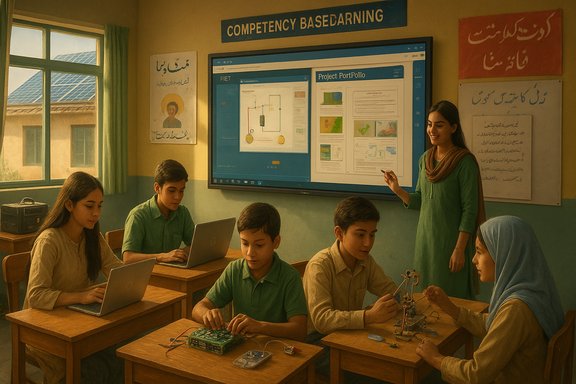
The Business Recorder’s four stages are pragmatic; below is a field‑tested roadmap that maps tools, teacher roles and assessment shifts to each stage.Stage 1 — Foundational knowledge (Grades K–5)
- Replace one‑way lecturing with visual, interactive explainers and multi‑lingual phonics work.
- Deploy offline channels (Kolibri) and lightweight AR/360 tours for history and nature when bandwidth is scarce. Kolibri’s offline architecture has been used to extend structured lessons without constant internet.
- Integrate PhET and Labster mini‑labs into weekly units; assign inquiry prompts that require students to submit short video explanations of their simulated experiments. PhET’s research‑based sims are ideal for guided inquiry at scale.
- Project‑based portfolios: build an IoT smog detector, a low‑cost weather station, or a flood‑alert map. Use Raspberry Pi and Tinkercad for hardware prototyping, GitHub for code hosting, and GitHub Copilot for coding practice under teacher supervision. GitHub’s student programs make Copilot accessible to learners and schools at low or no cost, but institutions should negotiate enterprise safeguards for production deployments.
- Recognize verified micro‑credentials (Coursera/edX/Google Career Certificates) and documented project portfolios as university entry pathways. Universities should implement competency‑based bridge programs that allow students to demonstrate mastery via authenticated projects rather than redundant coursework. This is already a global best practice in portals that accept verified credentials as credit pathways.
Essential skills for every learner in an AI era
The article’s skills list is robust; the following are the non‑negotiable outcomes for a national curriculum aimed at employability and civic readiness:- Digital fluency: efficient typing, file management and cloud collaboration with practical application in real school projects.
- AI literacy: how to prompt, verify outputs, detect hallucinations, and apply ethical guardrails in line with classroom policies.
- Computational thinking: decomposition, pattern recognition and basic data handling.
- Creative media skills: design, animation and accessible storytelling for civic projects.
- Multilingual literacy: strong phonological skills in Urdu and regional languages underpin later English phonics and global participation.
Universities: from gatekeepers to national enablers
Universities must lead by example in three domains:- Curriculum co‑design with industry and communities. Short, applied modules in AI for agriculture, water management, telemedicine and small‑scale manufacturing will have immediate local impact.
- Administrative digitization and transparency. Digitized admissions, grading, procurement and research management increase accountability and can be audited under Pakistan’s Right of Access to Information Act, 2017. The Act is a binding legal instrument that supports proactive disclosure and should be used to enforce transparency in education budgets and procurement.
- Crediting verified pre‑college innovation portfolios. A girl who documents and verifies a local language corpus or a student who prototypes flood sensors should be able to claim entry credit through competency assessments and verifiable digital portfolios.
Bridging the digital divide — infrastructure, devices, and design
The Business Recorder calls for connectivity and electricity as rights; operationally this breaks down to three priority investments:- 24/7 reliable electricity at target schools via hybrid grids and solar microgrids.
- Affordable high‑speed broadband to every union council, district education office and school.
- Subsidized device programs that prioritize teacher devices first—teachers who are confident with tools multiply impact.
Policy imperatives and governance (2025–2030 roadmap)
To convert vision into implementable policy the state must act across six workstreams:- Launch a National AI‑in‑Education Strategy that mandates AI/digital literacy from Grade 6 and defines procurement, privacy, and curriculum standards.
- Digitize every public school and university by 2027 with public dashboards for budgets, enrollments and learning outcomes—use RTI frameworks to require proactive disclosure.
- Compulsory teacher re‑skilling—short, practical modules on prompt design, hallucination checks, and assessment redesign—paired with incentives and protected redesign time.
- Pilot 100 immersive learning labs (mixed reality, virtual labs, offline servers) in transparent, monitored sites by 2026; scale by 2029. Pilots should report disaggregated impact metrics.
- Device subsidy and local assembly partnerships linked to transparent distribution apps and social audits to avoid leakage and favoritism.
- Contract standards for vendors: non‑training clauses for student inputs (when required), retention and deletion guarantees, audit rights, role‑based access, and exportable logs for oversight. Many districts globally now centralize procurement to secure such protections; Pakistan must follow that precedent.
Practical pilots that scale — recommended quick wins
- Community AI labs (solar‑powered Raspberry Pi + Kolibri) in 200 union council centers, serving as offline hubs for local micro‑credentials.
- A nationwide maker‑week program where every Grade 9 class builds a community project (smog sensor, water purifier prototype) and publishes a verified portfolio to a district portal.
- University‑industry accelerators to convert top school portfolios into credit‑bearing bridge programs.
Risks, governance, and the ethics of AI adoption
AI in classrooms is a double‑edged sword. The primary risks are:- Overreliance and deskilling: models can shortcut reasoning if assessments continue to reward finished products over process. Mitigation: process‑based assessment, oral defenses and staged logs.
- Data privacy and vendor lock‑in: poorly drafted contracts expose student data to model training and telemetry; mitigation: standardized public procurement clauses, non‑training agreements and audit rights.
- Equity gaps: premium features and costly hardware risk widening gaps; mitigation: offline‑first architectures, device subsidies and community hubs.
- Hallucinations and correctness: AI outputs are provisional and must be taught as such; mitigation: integrate verification skills into curricula and use citation‑aware tools where possible.
Measuring success — what good looks like
Short‑term measures (1–2 years):- Teacher competency completion rates on AI pedagogy modules.
- Number of schools with offline servers and verified project portfolios.
- Percent of students achieving baseline digital literacy.
- Verified employer hires tracing to school portfolios or micro‑credentials.
- Reduction in unexplained school budget variance through transparent dashboards.
- Improvements in domain‑level learning outcomes (STEM conceptual understanding, literacy rates) validated by independent studies.
- A measurable shift in university admissions toward competency‑based credentials and project portfolios.
- Evidence of inclusive digital participation across gender and geography.
Conclusion — from petitioners to pioneers
The technological and pedagogical tools to transform Pakistani education from an exam‑factory into a national innovation engine exist today. Open, offline‑capable platforms like Kolibri; research‑backed simulation suites like PhET; and practical, low‑cost hardware stacks (Raspberry Pi, Tinkercad prototypes) make active, project‑based learning scalable across rural and urban schools alike. Robust policymaking—grounded in accurate connectivity baselines, the Right of Access to Information Act, and procurement standards—will determine whether AI deepens privilege or democratizes opportunity. Pakistan’s choice is not between tradition and technology; it’s between keeping an unjust, obsolete credentialing system or reorienting education to produce builders, critical thinkers and civic contributors. That reorientation requires clear policy, honest data, teacher‑centred professional learning, and a commitment to equitable access. The gates of the old system are failing—what remains is for policymakers, educators and communities to walk through the new door together, as architects and not petitioners.Source: Business Recorder Reimagining education in the age of AI—IV
