

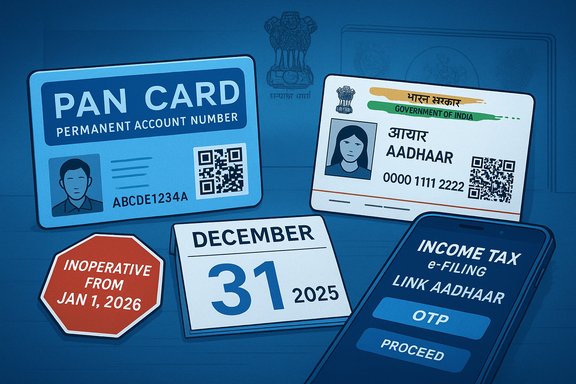
The countdown is real: the government’s targeted rule requiring certain PAN holders to intimate their Aadhaar number ends on December 31, 2025, and any PAN that remains unlinked under that specific rule set will be treated as inoperative from January 1, 2026. This is not a blanket extension for every PAN holder — the April 3, 2025 notifications (Income‑tax (Ninth Amendment) Rules, 2025 and the matching government notification) apply specifically to PANs that were issued on the basis of an Aadhaar Enrolment ID filed before October 1, 2024; those taxpayers must now update the permanent Aadhaar number with the tax authorities by the year‑end or risk service disruption.
India’s PAN–Aadhaar linking exercise has been incremental and legally layered. The central purpose has been to remove duplicate or fraudulent PANs, tighten tax compliance, and ensure one primary identity across tax and government records. The most recent step in that long arc came on April 3, 2025, when the Central Board of Direct Taxes (CBDT) issued two related instruments: an amendment to the Income‑tax Rules (inserting a new Rule 5AA) and a notification prescribing the date by which affected PAN holders must intimate their Aadhaar numbers to the designated Income‑tax Systems authorities. Those documents name December 31, 2025 as the compliance date for the cohort in question. This is distinct from earlier deadlines and operational consequences that affected many taxpayers in 2022–2023: the government’s March–April 2023 rulemaking set out the mechanism for making PANs inoperative for those who failed to intimate Aadhaar earlier, with the practical inoperative status enforced from July 1, 2023 for the general cohort then in scope. The 2025 rule targets a different — narrower — set of PANs (those issued on the basis of an Aadhaar enrolment ID before Oct 1, 2024).
(Helpline reminder: use the Income‑tax e‑filing portal for linking and status checks; if you need Aadhaar assistance, UIDAI’s help channels are the correct starting point — avoid unofficial SMS/links and keep OTPs private.
Source: ET Now Aadhaar-PAN linking deadline: Final call! Only 6 days left to prevent PAN deactivation
 Background and overview
India’s PAN–Aadhaar linking exercise has been incremental and legally layered. The central purpose has been to remove duplicate or fraudulent PANs, tighten tax compliance, and ensure one primary identity across tax and government records. The most recent step in that long arc came on April 3, 2025, when the Central Board of Direct Taxes (CBDT) issued two related instruments: an amendment to the Income‑tax Rules (inserting a new Rule 5AA) and a notification prescribing the date by which affected PAN holders must intimate their Aadhaar numbers to the designated Income‑tax Systems authorities. Those documents name December 31, 2025 as the compliance date for the cohort in question. This is distinct from earlier deadlines and operational consequences that affected many taxpayers in 2022–2023: the government’s March–April 2023 rulemaking set out the mechanism for making PANs inoperative for those who failed to intimate Aadhaar earlier, with the practical inoperative status enforced from July 1, 2023 for the general cohort then in scope. The 2025 rule targets a different — narrower — set of PANs (those issued on the basis of an Aadhaar enrolment ID before Oct 1, 2024). Who exactly is affected?
The narrow but important cohort
- You are affected if your PAN was allotted using an Aadhaar enrolment ID that was part of an Aadhaar application filed prior to October 1, 2024. The CBDT’s April 3, 2025 notifications require these PAN holders to intimate their final Aadhaar number to the designated Income‑tax Systems authorities on or before December 31, 2025.
Who is not automatically in scope
- The 2025 notification does not say that every single PAN holder nationwide has a new, separate deadline. Many taxpayers who were already required to link earlier have either done so or faced deactivation under the 2023 rules. The 2025 rule is remedial and specific to the enrolment‑ID‑issued PANs described above. Tax law exemptions that have existed in earlier linkage rounds — for example, certain residents of specified states (Assam, Jammu & Kashmir, Meghalaya), non‑residents under the Income‑tax Act, very senior citizens, or non‑citizens — remain relevant and should be checked against the Income‑tax FAQ and notifications for exact applicability.
Timeline and how the rules fit together
- March 2022 and March–April 2023: primary linking rules and the mechanism to make PANs inoperative were enacted and applied, with the practical inoperative enforcement from July 1, 2023, for those initially targeted.
- April 3, 2025: CBDT issues Notification No. 25/2025 (Income‑tax (Ninth Amendment) Rules, 2025) and Notification No. 26/2025, inserting Rule 5AA and prescribing December 31, 2025 as the intimation deadline for PANs issued based on Aadhaar Enrolment IDs filed before October 1, 2024.
- January 1, 2026: PANs that remain unlinked under the April 2025 rule are expected to be treated as inoperative from this date — with the same practical consequences already used in 2023 (higher TDS/TCS, suspension of refunds, etc.. Note that the regulations allow the CBDT to specify alternate dates; taxpayers should watch official channels for any late amendments.
What “inoperative” means — immediate consequences
If a PAN is declared inoperative under the rules, the real‑world effects are concrete and immediate:- No refunds under that PAN while it is inoperative; interest on such refunds is not payable for the period of inoperability.
- Higher TDS/TCS: payments to the PAN holder may be subject to higher withholding/collection rates (because the PAN is treated as not furnished).
- Inability to carry out certain financial actions that legally require an operative PAN (some transactions and regulatory filings).
- ITR complications: returns filed with an inoperative PAN may be invalid and could attract compliance consequences.
How to link (or “intimate”) your Aadhaar number to PAN — practical step‑by‑step
The Income‑tax e‑filing portal is the authoritative channel for the process; the portal also documents both pre‑login and post‑login flows. Follow these steps precisely and keep receipts/screen captures at every stage.- Gather prerequisites: your PAN, Aadhaar number, and the mobile number that’s registered against Aadhaar (to receive OTP).
- Visit the Income‑tax e‑filing portal and use the “Link Aadhaar” quick link or the profile → Link Aadhaar option. You can perform the operation either without logging in (pre‑login) or after logging in (post‑login).
- Enter PAN and Aadhaar; validate details. If the portal reports “payment details not found,” follow the on‑screen prompts to pay the required fee through the e‑Pay tax flow (challan type and assessment year will be pre‑selected). Wait 4–5 working days after payment if the portal does not immediately verify the transaction.
- Complete OTP validation on the mobile number shown. Submit the linking request. You will receive an acknowledgment and can check the Link Aadhaar status via the portal.
Fee, late linking and reactivation: what to expect
- The rules enacted in 2022–2023 introduced a structured fee/penalty mechanism for late intimation. The practical late‑link payment historically referenced by the Income‑tax Department has been Rs. 1,000, with the PAN becoming operative again within a prescribed number of days after payment and successful intimation. That mechanism was the one applied for the 2023 inoperative cohort and remains the practical tool to reactivate PANs where permitted.
- The April 2025 notification itself (No. 26/2025) instructs affected taxpayers to intimate Aadhaar by December 31, 2025; however, the notification text does not include explicit new language about fee waivers. Some news reports and commentators have stated that the specific cohort (PANs issued using Aadhaar enrolment IDs before Oct 1, 2024) can complete the linking without payment if done by Dec 31, 2025. That “free linking” assertion appears in several media summaries but is not spelled out in the CBDT notification text itself; because the official notifications do not expressly state a waiver of late‑link fee, the claim should be treated with caution until clarified directly by the CBDT/Income‑tax Department. Taxpayers should not assume a fee waiver unless they see it in an official government order.
If your PAN is already marked inoperative (from 2023 action) — recovery steps
- Pay the prescribed fee (the challan and payment flow is described on the e‑filing portal). Historically Rs. 1,000 has been applied.
- Intimate Aadhaar via the e‑file Link Aadhaar screen and upload/complete any demanded verification.
- The department’s guidance has stated PAN will be made operative again within a specified period (30 days was used in earlier statements). Maintain proof of payment and screenshots while your case is processed. If the e‑filing portal shows payment but the link does not complete, contact the Income‑tax helpdesk and the PAN service provider (NSDL/UTIITSL) as instructed on the portal.
Common failure modes and remedies
- Name/DOB mismatch between PAN and Aadhaar: update the lesser‑used database (PAN or Aadhaar) to match the other. For PAN changes, contact the PAN agent (NSDL/UTIITSL); for Aadhaar changes, use UIDAI portals or local Aadhaar centers. The e‑filing Link Aadhaar FAQ explicitly directs taxpayers to update mismatched records before attempting linkage.
- Aadhaar linked to different PAN / PAN linked to different Aadhaar: this is a data integrity issue that will typically require jurisdictional AO intervention or submission of an AO request via the e‑filing portal. Keep copies of both documents and any enrolment receipts.
- Portal payment/OTP glitches: if you paid the challan but it’s not reflected, wait 4–5 working days per portal guidance; if delays persist, contact the e‑filing helpdesk and retain the bank challan copy.
Security, privacy and fraud risks — what to watch for
- Phishing and fake “linking” services: criminals exploit deadlines by sending SMS/emails that mimic tax or UIDAI messages and ask for OTPs or upfront fees. Never disclose OTPs, authentication passwords, or upload scanned identity proofs to third‑party sites that are not official government portals. Use only the Income‑tax e‑filing portal (income‑tax[.]gov[.]in) or the UIDAI official site for Aadhaar updates.
- Third‑party offers to “do it for you”: many private operators advertise assistance for a fee; if you use them, insist on written receipts and avoid sharing OTPs. Where possible, transact directly through official government services.
- Data‑quality errors and false positives: automated matching between Aadhaar and PAN systems is not infallible. Erroneous inoperability or mis‑linking can cause real harm (blocked refunds, withheld banking operations). Keep documentation and escalate quickly to Income‑tax grievance channels if you encounter unexpected inoperative status.
Practical checklist for the final days (absolute dates)
As of December 26, 2025 (today), you have until December 31, 2025 to complete intimation under the April 2025 notifications if your PAN falls in the enrolment‑ID cohort. The practical checklist:- Confirm whether your PAN was issued using an Aadhaar enrolment ID before Oct 1, 2024. If you’re unsure, attempt a status check on the e‑filing portal (enter PAN + Aadhaar to see Link Aadhaar status).
- If you have not yet linked/intimated, attempt the Link Aadhaar flow immediately. Use pre‑login if needed, but have your Aadhaar‑registered mobile ready for OTP.
- If the portal insists on payment and you have not paid before, be prepared to use the e‑Pay Tax challan (keep scanned copies). Allow the 4–5 working days buffer if the portal needs to reconcile payment.
- If you encounter mismatches, begin correction workflows for PAN (NSDL/UTIITSL) or Aadhaar (UIDAI) immediately. Corrections can take days or weeks.
- Document everything: screenshots of portal messages, challan receipts, OTP acknowledgement, emails to helpdesks. This evidence is vital if an inoperative PAN causes downstream issues.
Critical analysis — benefits, friction points, and risks
The strengths of the policy
- Data hygiene and de‑duplication: forcing intimation of Aadhaar numbers for PANs issued using enrolment IDs helps remove ghost/dubious PANs and aligns PAN records with the biometric identity system. That boosts tax database reliability and can reduce tax leakage.
- Administrative clarity for a specific cohort: the April 2025 notifications narrowly target an identifiable population (enrolment‑ID PANs before Oct 1, 2024), rather than reopening a broad, ambiguous universe of deadlines. That targeted approach is administratively sensible compared with an indiscriminate blanket extension.
The weaknesses and practical risks
- Timing and friction: imposing a hard year‑end deadline with a short public awareness window risks last‑minute system congestion, call‑center overload, and frustrated taxpayers who may face mismatches that realistically cannot be fixed within days. The e‑filing portal’s own guidance about waiting after payment (4–5 working days) underscores how procedural steps can make end‑of‑year compliance brittle.
- Digital‑divide and accessibility: many taxpayers — elderly citizens, rural residents, or those who lack reliable internet access — may struggle to complete online intimation in time. While service centers and biometric authentication options exist, physical access and time constraints create real inequity.
- Ambiguity over fees and waivers: media reports claiming fee waivers for the affected cohort risk confusion. The CBDT notification does not unambiguously adopt a broad fee waiver in its published text; absent a clear, separate government order, taxpayers should prepare for the standard fee/penalty mechanics and not rely on press summaries. This lack of clarity increases compliance risk.
- Fraud exposure: deadlines create fertile ground for fraudsters. A surge in phishing and fraudulent “help” offers during the final days is a predictable hazard — one the government must actively counter with clear, repeated, and verifiable communications.
Practical recommendations for taxpayers and administrators
- For taxpayers:
- Act now: don’t wait for the last hour. Start the e‑filing Link Aadhaar process immediately and document each step.
- If you face a data mismatch, start the correction process (PAN/UIDAI) and also raise an e‑filing grievance so you have time‑stamped proof of action.
- Avoid sharing OTPs or passwords; use official portals only.
- For administrators and policy implementers (analysis):
- Publish a short, unambiguous FAQ and a simple “who is in scope” flowchart on Income‑tax and CBDT channels to reduce misreporting in media.
- Provide rapid escalations and priority lanes for cases where data mismatch prevents timely linkage (for example, temporary relaxation for those who file an AO ticket plus evidence).
- Coordinate with UIDAI and PAN service providers to ensure real‑time reconciliations and reduce the 4–5 day payment reconciliation window where possible.
Final verdict — what readers should take away
The December 31, 2025 deadline in the CBDT’s April 2025 notifications is real and specific: if your PAN was issued on the basis of an Aadhaar enrolment ID filed before October 1, 2024, you must intimate your Aadhaar number by December 31, 2025, or face the inoperative status from January 1, 2026 with the attendant practical consequences that the Income‑tax rules impose for inoperative PANs. The earlier instrument used in 2023 to make PANs inoperative remains the operational precedent for consequences such as withheld refunds and higher TDS. There are helpful online flows to complete intimation via the Income‑tax e‑filing portal, but real‑world frictions (mismatched identity fields, payment and reconciliation timing, and the risk of scams) mean that acting early and documenting every step is essential. Claims that the linking is automatically free for all affected PANs should be treated as unverified unless and until the CBDT or Income‑tax Department publishes explicit waiver language; rely on the official portals for final confirmation. Take the administrative action now, secure your documentation, and if you hit any procedural snag, escalate immediately through the Income‑tax and PAN service provider helpdesks — last‑minute fixes are possible, but only when the taxpayer can show timely effort and retain receipts.(Helpline reminder: use the Income‑tax e‑filing portal for linking and status checks; if you need Aadhaar assistance, UIDAI’s help channels are the correct starting point — avoid unofficial SMS/links and keep OTPs private.
Source: ET Now Aadhaar-PAN linking deadline: Final call! Only 6 days left to prevent PAN deactivation
