

Intel’s new Panther Lake silicon has landed into OEM designs and press rooms, and the early messaging is both familiar and consequential: on identical hardware, Linux is once again outperforming Windows in a wide swath of real-world workloads. That claim—sparked by coverage that points to a Phoronix benchmarking sweep comparing Windows 11 and Ubuntu 25.04 on a Core Ultra (Panther Lake) reference platform—deserves careful unpacking. The chip is a genuine technical leap for Intel, but the software ecosystem and OS-level tuning are the decisive factors that determine which platform extracts the most performance. In this feature I verify the architectures and claims that matter, explain why Linux often pulls ahead on new x86 silicon, highlight the concrete areas where Windows still holds an advantage, and map practical implications for enterprises, developers, and systems architects planning Panther Lake deployments.
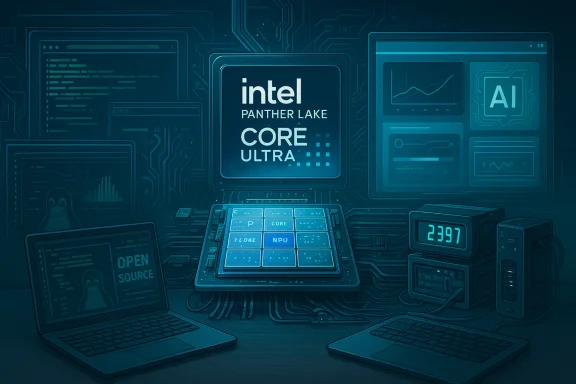
Panther Lake (Intel’s Core Ultra Series 3, also presented under the “Core Ultra 300 / Core Ultra 3” family in vendor materials) represents Intel’s next-generation mobile SoC platform. It continues the tiled, disaggregated approach introduced with Meteor Lake and refined through Lunar Lake. The headline technical characteristics are consistent across vendor briefings and independent coverage:
Taken together, this hardware plus diverging software stacks sets the stage for the cross-platform performance debate: given the same silicon, which OS—Windows 11 or modern Linux—delivers superior throughput, latency, and AI acceleration?
What to verify: exact test harness (number of parallel jobs for compiles), compiler flags, filesystem setup (compression or encryption enabled), and power/TDP settings. Small changes in those variables can swing results meaningfully.
What to verify: whether the tests used the same memory frequency/BIOS settings, and whether Windows used “memory compression” or other Windows-specific kernel features that affect raw bandwidth numbers.
What to verify: block alignment, partitioning, filesystem mount options, TRIM/discard behavior, and whether Windows Defender or other security stacks were scanning I/O during tests—these can bias results.
What to verify: exact NPU workloads used in tests, whether they were quantized (INT8/INT4) or FP16, and which runtime backend (OpenVINO, vendor SDKs, ONNX with plugin) was used.
Panther Lake is not just another chip launch—it’s a stress test for the modern software stack. The winners will be the teams that pair the silicon with a software approach tailored to their actual workloads, and who proactively manage firmware, driver, and OS updates as the platform matures.
Source: WebProNews Intel’s Panther Lake Arrives — And Linux Is Already Beating Windows at Its Own Game
 Background / Overview
Panther Lake (Intel’s Core Ultra Series 3, also presented under the “Core Ultra 300 / Core Ultra 3” family in vendor materials) represents Intel’s next-generation mobile SoC platform. It continues the tiled, disaggregated approach introduced with Meteor Lake and refined through Lunar Lake. The headline technical characteristics are consistent across vendor briefings and independent coverage:- A modern tiled chiplet design combining compute, graphics, and platform tiles.
- A refined hybrid CPU layout: Performance (P) cores, Efficient (E) cores, and an extra low-power E cluster in some SKUs, giving highly heterogeneous core topologies on a single die.
- A new integrated graphics generation branded Xe3 (Arc B-series on some SKUs) with up to a dozen Xe core units in the top X-series parts.
- A fifth‑generation NPU (neural processing unit) aimed at accelerating on-device AI workloads, with vendor TOPS claims substantially higher than prior Intel mobile NPUs.
- First mainstream consumer products built for Intel’s 18A process node, leveraging RibbonFET/GAA and PowerVia backside power to improve performance-per-watt.
Taken together, this hardware plus diverging software stacks sets the stage for the cross-platform performance debate: given the same silicon, which OS—Windows 11 or modern Linux—delivers superior throughput, latency, and AI acceleration?
What the recent coverage claims
Public write-ups circulating around the Panther Lake launch summarize a Phoronix benchmarking campaign that allegedly compared a Panther Lake Core Ultra 200V-series reference platform running Windows 11 against Ubuntu 25.04. The headlines are straightforward:- Linux (Ubuntu 25.04) reportedly outperformed Windows 11 across a majority of CPU, memory, compiler, cryptographic, and many general-purpose workloads—sometimes by double-digit margins.
- Linux showed measurable advantages in compiler and large-scale build tasks (Clang/LLVM, kernel builds).
- Memory and I/O benchmarks reportedly favored Linux’s stack (STREAM/RAMspeed, file system tests with ext4/Btrfs outperforming NTFS in FIO/IOzone runs).
- Windows retained an edge in some browser/JavaScript tests and in scenarios relying on Windows-native graphics drivers—especially in a few gaming-related paths and where Intel’s proprietary driver optimizations for Windows remain stronger.
- NPU-specific tooling and user-space runtimes were said to be more mature on Windows, making Windows a practical choice today for developers who need out-of-box NPU acceleration.
Panther Lake technical primer — what matters for OS performance
Understanding why an OS can extract more performance from the same silicon requires a short explainer of the architectural levers in play.Heterogeneous cores and scheduling
Panther Lake’s mix of P-cores and E-cores (and sometimes a third, very low-power cluster) makes efficient scheduling far more complex than homogeneous multicore chips. A scheduler must decide not only which thread to run, but which class of physical core to place it on, and when to migrate it as workload characteristics change. Intel’s hardware provides telemetry (Thread Director family concepts) to help the OS, but how the scheduler uses those hints and how quickly it can be updated matters a great deal.- Linux benefits from a rapidly iterated kernel and a community that frequently upstreams scheduler improvements. The kernel release family that ships in Ubuntu 25.04 includes scheduler extension hooks (sched_ext) that make it easier to prototype and ship scheduling policies—an advantage on rapidly changing hybrid hardware.
- Windows has invested in hybrid-aware scheduling too, and Microsoft has incorporated Thread Director-aware behavior in Windows 11. But Windows also carries decades of backward-compatibility constraints—driver models, legacy scheduling semantics, and stronger isolation promises—that can slow how quickly scheduler heuristics evolve.
Memory subsystem and I/O stacks
Modern mobile SoCs (and Panther Lake in particular) rely on high-bandwidth, low-latency memory access. Differences in page management (transparent hugepages), allocation strategies, kernel page reclaim behavior, and DMA I/O paths translate to measurable bandwidth and latency differences.- Linux’s memory stack exposes more knobs and has features (hugepages, various tunables) that, when enabled or tuned by distributions or downstream vendors, can yield better sustained memory throughput in scientific, cryptographic, and compiler workloads.
- Windows’ memory manager is designed for broad compatibility and stability across many software scenarios. That often increases general-purpose robustness at the cost of raw throughput in edge cases.
Filesystems and storage drivers
Filesystem choices and their defaults matter. Ext4 and Btrfs, used extensively on Linux workstations and servers, are engineered with different caching, journaling, and sync semantics than NTFS. Linux I/O tools and the maturity of NVMe drivers, combined with less conservative writeback defaults in some distributions, can produce superior sequential and random throughput for specific workloads.GPU and driver stacks
Intel has dramatically increased investment in the open-source Mesa stack for Linux graphics drivers. Mesa’s Vulkan/OpenGL implementations plus the upstreamed kernel graphics driver have closed much of the gap with Windows drivers, but proprietary driver optimizations on Windows still confer advantages in certain shader paths, frame pacing scenarios, or specific gaming workloads where Microsoft’s driver distribution is better matched to a particular OEM/driver combination.NPU/AI toolchains
The NPU is the wild card. Hardware parity alone doesn’t give an OS the ability to use an accelerator productively—user-space tooling, runtime libraries, and driver support determine real-world performance.- Windows benefits from Microsoft’s Copilot+ push and a more mature set of end-user runtimes that integrate NPUs into consumer apps and dev tooling.
- Linux has a narrower but rapidly improving pathway: Intel’s OpenVINO and the upstreamed IVPU kernel plumbing provide the route to NPU acceleration, and in many cases the community and Intel have already upstreamed firmware and driver pieces. However, the user-space ecosystem and third-party framework integration (e.g., ONNX runtime optimizations leveraging the NPU) still lag Windows in out-of-the-box convenience.
Dissecting the reported benchmark results — what’s credible and what to question
Several repeated themes in the coverage deserve higher-resolution scrutiny.Linux wins in compiler, cryptographic, and math workloads
This pattern is nothing new. Historically, Linux distributions used by developers ship with toolchains and I/O paths tuned for developer workloads; low-overhead process launching, aggressive caching, and direct filesystem semantics favor large-scale builds and cryptographic throughput. When multiple independent laboratories (including those specializing in OS-level benchmarks) compare kernel builds and LLVM/Clang workloads, Linux often posts better wall-clock times. This aligns with the reported findings.What to verify: exact test harness (number of parallel jobs for compiles), compiler flags, filesystem setup (compression or encryption enabled), and power/TDP settings. Small changes in those variables can swing results meaningfully.
Memory and STREAM-like tests favor Linux
STREAM, RAMspeed, and similar microbenchmarks target sustained bandwidth and reveal differences in page size usage, prefetch behavior, and NUMA-like cache effects. Linux’s default handling of transparent huge pages and aggressive memory prefetch heuristics can give it measurable advantages on hybrid-core architectures that need more sustained feed to many threads.What to verify: whether the tests used the same memory frequency/BIOS settings, and whether Windows used “memory compression” or other Windows-specific kernel features that affect raw bandwidth numbers.
File I/O: ext4/Btrfs vs NTFS
Ext4 and Btrfs have long been optimized for Linux workloads; NTFS has different journaling semantics oriented to desktop robustness and compatibility. On fast NVMe media, Linux filesystems can demonstrate superior throughput in many synthetic and real-world workloads.What to verify: block alignment, partitioning, filesystem mount options, TRIM/discard behavior, and whether Windows Defender or other security stacks were scanning I/O during tests—these can bias results.
NPU: tooling maturity matters more than raw silicon
The most cautious conclusion is that CPU-based AI inference frameworks (ONNX, PyTorch running on CPU) typically show Linux doing very well due to optimized glibc, libomp, and MKL/oneAPI integrations. But the advantage of the dedicated NPU is not simply measured by benchmark scores; it’s measured by how easy it is to route model graphs to the NPU and the quality of the vendor-run runtime stacks. Windows currently has an edge in practical NPU usage because many consumer-facing runtimes and integrations were demoed on Windows first (Copilot+ experiences), while Linux requires explicit OpenVINO-based enabling and, in some cases, awaiting user-space driver stabilization.What to verify: exact NPU workloads used in tests, whether they were quantized (INT8/INT4) or FP16, and which runtime backend (OpenVINO, vendor SDKs, ONNX with plugin) was used.
Where Windows still holds its ground
The story is not a one-sided rout. Several areas remain Windows strengths:- Application-level optimizations: Many mainstream productivity and creative apps still receive deep Windows-specific shader or AVX/driver tuning that gives them an advantage on Windows binaries.
- Browser JavaScript engines: Windows sometimes outperforms in certain JavaScript microbenchmarks, likely because of more aggressive vendor-level tuning in browser builds targeting the dominant desktop platform.
- NPU ecosystem convenience: The Copilot+ drive and Microsoft’s integration of on-device features create a practical advantage for Windows for users who want NPU-accelerated features without handcrafting runtimes.
- OEM driver distribution: Vendors often ship Windows driver stacks earlier and more aggressively than Linux equivalents; until Linux drivers are fully upstreamed and firmware is widely distributed, Windows can have smoother out-of-box consistency for certain I/O paths (particularly OEM-specific power and sensor firmware).
Why this pattern keeps repeating: structural forces, not one-off bugs
There are systemic reasons Linux often looks faster on bleeding-edge silicon:- Rapid iteration and upstream collaboration: Intel and other vendors have invested heavily in upstreaming Linux kernel patches, Mesa driver changes, and firmware bits. That open approach lets Linux developers iterate quickly on performance fixes that benefit downstream distributions.
- Tunable defaults and special-purpose kernels: Distributions and specialized Linux builds can ship with tuned scheduler, I/O, and malloc configurations that favor developer and server workloads. Windows ships with a one-size-fits-most approach by design.
- Reproducible measurement culture: The Linux benchmarking community has a long tradition of transparent, repeatable reporting (open benchmarking suites, test scripts). That discipline surfaces regressions and drives faster fixes.
- Historical focus: Linux and UNIX derivatives have long been optimized for server and compute tasks; Windows, historically desktop-first, balanced performance with compatibility, UI integration, and legacy behavior.
Enterprise impact: why a 10–20% swing matters at scale
A 10–20% advantage in build throughput, cryptographic throughput, or memory bandwidth is not just an academic curiosity. For organizations with thousands of developer machines or CI servers, time-to-build translates into developer productivity and operational costs. For enterprises deploying Panther Lake into edge devices or AI appliances, the effective performance-per-dollar and software stack readiness will shape platform choices:- Developer workstations: If Linux consistently delivers faster compile and build cycles on Panther Lake hardware, enterprises with Linux-centric development workflows will see direct productivity gains.
- Edge AI appliances: The NPU’s usefulness depends on runtime maturity. If Windows tooling offers simpler NPU leverage today, Windows may be preferable for early commercial AI appliances—unless the organization has resources to invest in Linux/OpenVINO integration.
- Virtualization and container images: Faster filesystems and VM/overlay storage performance on Linux can improve container boot times and image layer operations in CI/CD pipelines.
Roadmap for Intel and Microsoft — what to watch next
Both companies have clear routes to close gaps:- Intel: Continue upstreaming firmware, provide robust OpenVINO and oneAPI support, and collaborate with distribution vendors to distribute firmware and driver packages for consumer systems. Intel’s upstream commit cadence for kernel drivers and firmware is a critical path to Linux parity on NPU and GPU features.
- Microsoft: Targeted scheduler improvements and hybrid-core heuristics for Windows can reduce Linux’s lead in multi-threaded and memory-bound workloads. Windows update channels and OEM driver certification cycles will dictate how quickly those improvements reach consumers.
Practical guidance for IT teams and developers
- If your workloads are primarily compile-heavy, cryptographic, or large-memory scientific workloads, validate Ubuntu 25.04 (or an enterprise Linux build) with your real-world pipeline on Panther Lake hardware before committing to Windows.
- For AI/ML inference where NPU acceleration is a requirement today, test both OpenVINO (Linux) and Microsoft/Intel runtimes (Windows) with your target models. Don’t assume the NPU will “just work” on Linux the way it might on a Windows Copilot+ device—driver and runtime readiness still matters.
- For mixed teams, consider dual-boot or containerized workflows that let developers use Linux toolchains while maintaining Windows for end-user application testing.
- Track firmware/driver updates aggressively. Many of the performance gaps are patched by firmware revisions and OS driver updates in the weeks and months after product launch.
- When procuring Panther Lake laptops at scale, coordinate with OEMs about Linux firmware availability and whether the devices will ship with firmware and driver packages suitable for your chosen distribution.
Final assessment: what this moment really means
Panther Lake is a significant platform release for Intel: better process, improved hybrid cores, a stronger iGPU, and a larger NPU make it a compelling option for ultrabooks, creative laptops, and edge AI appliances. The early performance narrative—that Linux is extracting more from Panther Lake than Windows in many workloads—is credible insofar as it aligns with recurring patterns observed across prior Intel and AMD launches. But the headline should not be reduced to a binary “Linux beats Windows” framing.- Many of the advantages reported for Linux stem from software-side differences: kernel and driver maturity, filesystem and memory defaults, and an open development model that can iterate quickly when new hardware surfaces.
- Windows retains clear advantages in ecosystem convenience, OEM driver packaging, broad application compatibility, and specific user-facing AI experiences that Microsoft has prioritized for Copilot+ PCs.
- The NPU question is the most dynamic: raw silicon capability is only part of the story; usable, production-grade AI acceleration requires a mature tooling stack. Today, Windows often feels more “complete” for end-user Copilot+ experiences, while Linux’s OpenVINO route and upstream kernel commits show that it is catching up fast.
Panther Lake is not just another chip launch—it’s a stress test for the modern software stack. The winners will be the teams that pair the silicon with a software approach tailored to their actual workloads, and who proactively manage firmware, driver, and OS updates as the platform matures.
Source: WebProNews Intel’s Panther Lake Arrives — And Linux Is Already Beating Windows at Its Own Game
