

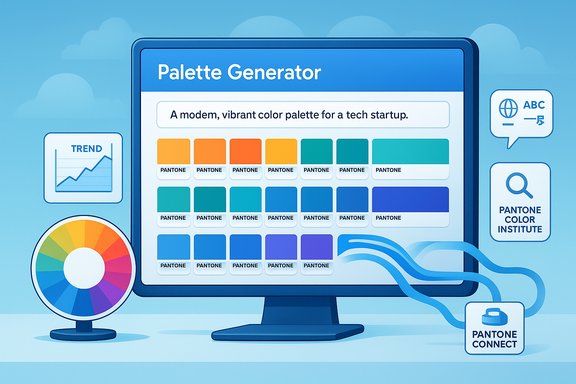
Pantone’s new Palette Generator, launched in beta inside Pantone Connect and built on Microsoft Azure OpenAI, positions color-driven design at the front of a generative-AI era — promising to compress hours of research into seconds while blending Pantone's forecasting expertise with cloud-scale AI tools.
For decades, Pantone has been the shorthand for color consistency and trend forecasting across graphic, fashion, and product design. The company’s Pantone Color Institute has long combined color science with cultural analysis to produce seasonal trend reports and the high-profile Pantone Color of the Year. Microsoft, meanwhile, has been integrating generative AI into productivity and platform services on Azure, expanding capabilities such as retrieval-augmented generation (RAG), agent frameworks, and multimodal AI through offerings like Azure AI Foundry and the Azure OpenAI Service.
The announcement that Pantone and Microsoft are collaborating to bring an AI-driven Palette Generator into Pantone Connect marks a clear industry moment: a legacy physical-and-digital standards brand leaning into conversational AI to reshape early-stage creative workflows. According to the product announcement, the Palette Generator lets users prompt a chat-like assistant to produce color palettes informed by Pantone’s trend research and color psychology, search Pantone’s forecast databases, and export palette assets into existing Pantone Connect workflows.
Beyond RAG, the announcement references “agentic technology.” In practice this means the system likely uses orchestrated agents or microservices — search agents, retrieval agents, and generation agents — to carry out discrete steps in the workflow: fetch relevant trend snippets, compute color relationships, produce design copy/justification, and package assets for export. This multi-agent approach reduces the chance of the model fabricating provenance by tying generation to explicit retrieved evidence from Pantone’s library.
This architecture has clear advantages: elastic compute, managed model deployments, and built-in security and compliance guards from a major cloud provider. It also creates a dependency on Microsoft’s tooling and policies — something organizations must weigh when adopting platform-integrated AI features.
At the same time, the industry has seen frictions between large tool vendors and Pantone’s licensing approach. Designers have reported broken integrations or removed libraries from software platforms in recent years, which made Pantone Connect and other paid solutions necessary to access up-to-date Pantone assets. An AI-enabled Pantone Connect feature could both smooth some of those pain points and complicate vendor relationships, depending on how integrations and export fidelity are handled.
From the cloud-provider angle, major suppliers (Microsoft, Oracle, Google, AWS) are all deepening their AI offerings and courting enterprise partners that can showcase industry-specific use cases. Pantone’s collaboration with Microsoft — leveraging Azure OpenAI and agentic frameworks — is an example of a legacy vertical brand marrying domain expertise with cloud AI muscle. For Microsoft, the win is showcasing Azure’s suitability for specialized, creative, and agent-driven applications.
For Microsoft, the partnership showcases Azure’s ability to host nuanced, domain-specific agentic applications. It’s a case study in how enterprises can embed LLMs into SaaS experiences with search-backed retrieval and multi-step agent workflows. This helps Microsoft position Azure as more than infrastructure — as a platform for industry-specific AI innovation.
For designers and buyers, the Palette Generator promises practical value: faster ideation, trend-aligned concepts, and a closer digital connection to Pantone’s forecasting authority. But the actual benefits will depend on the tool’s fidelity to physical output, export flexibility to third-party design and print pipelines, and transparency around provenance and licensing.
If Pantone addresses these areas with the same rigor it applies to color standards, the Palette Generator could become a meaningful productivity multiplier for designers, helping bridge cultural trend insights and executable color systems. If it falls short on export fidelity or transparency, it risks becoming an attractive ideation toy that still leaves professionals to do the careful work of specification and proofing.
In short, the Palette Generator marks a new chapter for color-driven design: one where human expertise and machine speed must work hand in hand to ensure creativity scales without sacrificing the precision that color-critical workflows demand.
Source: Morningstar https://www.morningstar.com/news/pr...e-to-enhance-creative-exploration-through-ai/
 Background
For decades, Pantone has been the shorthand for color consistency and trend forecasting across graphic, fashion, and product design. The company’s Pantone Color Institute has long combined color science with cultural analysis to produce seasonal trend reports and the high-profile Pantone Color of the Year. Microsoft, meanwhile, has been integrating generative AI into productivity and platform services on Azure, expanding capabilities such as retrieval-augmented generation (RAG), agent frameworks, and multimodal AI through offerings like Azure AI Foundry and the Azure OpenAI Service.The announcement that Pantone and Microsoft are collaborating to bring an AI-driven Palette Generator into Pantone Connect marks a clear industry moment: a legacy physical-and-digital standards brand leaning into conversational AI to reshape early-stage creative workflows. According to the product announcement, the Palette Generator lets users prompt a chat-like assistant to produce color palettes informed by Pantone’s trend research and color psychology, search Pantone’s forecast databases, and export palette assets into existing Pantone Connect workflows.
Overview: What Pantone Palette Generator Does
The Palette Generator is a chat-based tool embedded in Pantone Connect intended to help designers rapidly explore and produce color palettes. Key user-facing capabilities described in the announcement include:- Instant palette creation based on natural-language prompts (for example, “colors that evoke optimism in Gen Z” or “palettes inspired by 1970s fashion editorials”).
- Retrieval of context from Pantone Color Institute content and trend forecasting to ground palette suggestions in Pantone’s proprietary insights.
- The ability to draw from thousands of Pantone colors and to add generated palettes directly into Pantone Connect for download, analysis, and sharing.
- Accessibility during the open beta to all Pantone Connect users, including free (basic) accounts, with plans to expand library coverage over time.
Technical architecture and how the AI works
Retrieval-Augmented Generation (RAG) and agentic components
The Palette Generator is presented as a RAG-enabled assistant: when a user asks for a palette, the system first semantically searches Pantone’s curated content — trend reports, Color Insider posts, forecast docs — and retrieves relevant passages or data. That retrieved material is then used as grounding context for the generative model to produce palette suggestions that are framed by Pantone’s research.Beyond RAG, the announcement references “agentic technology.” In practice this means the system likely uses orchestrated agents or microservices — search agents, retrieval agents, and generation agents — to carry out discrete steps in the workflow: fetch relevant trend snippets, compute color relationships, produce design copy/justification, and package assets for export. This multi-agent approach reduces the chance of the model fabricating provenance by tying generation to explicit retrieved evidence from Pantone’s library.
Microsoft cloud stack and scale tradeoffs
By using Azure OpenAI and Azure AI Foundry, Pantone is relying on Microsoft for model hosting, observability, and agent orchestration. Azure Cosmos DB is mentioned for storing structured assets or indexes, and Azure AI Search (or Cognitive Search capabilities) is used to index Pantone’s trend articles and Color Institute content for semantic queries.This architecture has clear advantages: elastic compute, managed model deployments, and built-in security and compliance guards from a major cloud provider. It also creates a dependency on Microsoft’s tooling and policies — something organizations must weigh when adopting platform-integrated AI features.
Multilanguage and content safeguards
The announcement highlights support for multilanguage use and content safety measures, implying that Pantone and Microsoft implemented content filters, usage logging, and possibly private endpoints or tenant isolation to protect proprietary forecasting research. For designers working globally, multilanguage response capability is a practical plus; for Pantone it is a means to scale trend insights across markets.What this adds to the creative workflow
Speeding the research and inspiration phase
Color research and trend alignment are traditionally time-consuming: teams comb trend reports, mood boards, and physical swatch books, then iterate palettes and proofs with manufacturers. The Palette Generator promises to compress that phase by:- Turning descriptive prompts into ready palettes in seconds.
- Exposing the forecasting rationale that informed each palette so designers can cite a conceptual lineage.
- Allowing generated palettes to immediately import into Pantone Connect for export or collaboration.
Improved accessibility and onboarding
Embedding AI-driven palette generation into Pantone Connect lowers the technical bar for less-experienced designers or clients to start meaningful color conversations. Offering the tool in beta to free users democratizes access to Pantone’s trend reasoning — at least during rollout — and could reduce friction in team onboarding and early-stage ideation.Integrations and downstream workflows
Because generated palettes can be analyzed and exported from Pantone Connect, teams can quickly move from ideation to asset creation for digital or manufacturing purposes. This integration is most valuable when systems downstream (design apps, print workflows, manufacturing color management) can reliably translate Pantone digital values to physical outputs.Strengths and opportunities
- Speed and inspiration at scale. Designers can rapidly iterate on dozens of concept palettes without starting from scratch, which is ideal for brainstorms and client presentations.
- Trend-informed outputs. Tying palette suggestions to Pantone Color Institute research gives outputs a contextual backbone that simple generative color tools lack.
- Seamless workflow integration. Because the Generator sits within Pantone Connect, users don’t need to cobble together separate tools or paste color values manually.
- Accessibility during beta. Opening the beta to basic (free) Pantone Connect users encourages broad feedback and helps Pantone tune the assistant to diverse use cases.
- Enterprise-ready cloud infrastructure. Building on Azure OpenAI, Azure AI Foundry, and Azure Cosmos DB provides scalability, observability, and enterprise controls that many creative SaaS startups can’t match immediately.
Risks, limitations, and practical caveats
While the Palette Generator introduces clear value, several risks and limitations merit attention.Color fidelity and physical reproduction
Pantone’s reputation rests on precise color reproduction across materials and finishes. Generative palettes produced by an LLM are only as useful as their fidelity-to-print. A digital palette that looks good on-screen can translate very differently in print, textiles, or coatings without correct color conversions (LAB, CMYK builds, substrate profiles).- Designers must validate generated collections against physical Pantone guides or vendor proofs before production.
- Any tool that generates palettes should make conversion options transparent (LAB, CMYK, or custom vendor profiles) and quantify confidence in cross-media matches.
Hallucinations and provenance risk
Large language models can invent plausible-sounding rationales or misattribute trend sources. The announcement stresses RAG to ground outputs in Pantone’s forecasting content — a necessary mitigation — but users should still:- Treat the assistant’s narrative explanations as curated suggestions, not authoritative specification documents.
- Request or export the exact retrieved evidence used to generate each palette so creative leads can audit claims.
Proprietary libraries and licensing friction
Pantone’s color libraries are proprietary. The industry has seen tension in recent years around software vendor relationships and licensing; some design tools altered or removed built-in Pantone libraries, pushing users to paid or external workflows. Embedding AI into Pantone Connect may re-raise licensing and interoperability questions:- How will the Palette Generator handle palette export to third-party design tools, particularly where direct Pantone integration is limited or removed?
- Will enterprise customers require additional licensing to use generated Pantone palettes in manufacturing or product lines?
Vendor lock-in and dependence on cloud
Using Azure OpenAI and Microsoft agent frameworks ties Pantone’s AI stack to Microsoft’s platform. For some enterprise customers, this is a feature (proven scale and compliance). For others, it creates dependency and potential concerns over portability, pricing, and data residency.Bias and cultural nuance in trend forecasting
Trend forecasting and color psychology incorporate subjective cultural readings. An AI trained on Pantone’s forecasts will amplify Pantone’s viewpoints and methodology. That can be desirable — but it also means:- Designers should complement Palette Generator outputs with local, cultural, or inclusive research where color meanings vary across regions and communities.
- Organizations should watch for unintended cultural or gendered color assumptions baked into rapid palette suggestions.
Security, IP, and creative ownership
When designers submit prompts that include product details, brand strategy, or proprietary customer information, questions arise about who owns the outputs and how data is used to further train models. Pantone and Microsoft will need clear terms of service and enterprise data controls to reassure clients that creative IP is protected.Industry context: why this matters now
AI-assisted design tools are proliferating, and the market is shaping up in two directions: emergent startups offering point solutions for design ideation, and platform vendors embedding generative capabilities into broad productivity suites. Pantone’s move signals that standards bodies and heritage brands are not only capable of adopting generative AI but also of using it to add tangible value to expert workflows.At the same time, the industry has seen frictions between large tool vendors and Pantone’s licensing approach. Designers have reported broken integrations or removed libraries from software platforms in recent years, which made Pantone Connect and other paid solutions necessary to access up-to-date Pantone assets. An AI-enabled Pantone Connect feature could both smooth some of those pain points and complicate vendor relationships, depending on how integrations and export fidelity are handled.
From the cloud-provider angle, major suppliers (Microsoft, Oracle, Google, AWS) are all deepening their AI offerings and courting enterprise partners that can showcase industry-specific use cases. Pantone’s collaboration with Microsoft — leveraging Azure OpenAI and agentic frameworks — is an example of a legacy vertical brand marrying domain expertise with cloud AI muscle. For Microsoft, the win is showcasing Azure’s suitability for specialized, creative, and agent-driven applications.
Practical guidance for designers and teams
- Use the Palette Generator for ideation and mood boards, not final specifications. Treat AI-generated palettes as starting points that require validation against physical swatches and printer profiles.
- Request the underlying trend snippets or forecasting rationale the assistant used. Keep a log for client approvals and to trace design decisions.
- Export early and test on target substrates. When possible, use LAB values or vendor-specific color builds when moving to production.
- Check licensing and export compatibility. Confirm whether generated Pantone palettes carry any additional licensing requirements for manufacturing or merchandising.
- Keep prompts concrete and context-rich. The assistant performs best with well-scoped prompts that include usage context (digital banner vs. printed textile) and constraints (accessible contrast, brand color rules).
- Maintain an audit trail for IP-sensitive or confidential briefs. Avoid pasting proprietary product specs into public or shared assistants without clear data-protection guarantees.
What this means for Pantone, Microsoft, and the wider design ecosystem
For Pantone, the Palette Generator is a strategic pivot: it modernizes distribution of trend insights and extends the Color Institute’s consulting reach by turning curated knowledge into interactive tooling. If executed well, it can increase Pantone Connect adoption, drive subscription upgrades, and reassert Pantone as the bridge between creative inspiration and reproducible color standards.For Microsoft, the partnership showcases Azure’s ability to host nuanced, domain-specific agentic applications. It’s a case study in how enterprises can embed LLMs into SaaS experiences with search-backed retrieval and multi-step agent workflows. This helps Microsoft position Azure as more than infrastructure — as a platform for industry-specific AI innovation.
For designers and buyers, the Palette Generator promises practical value: faster ideation, trend-aligned concepts, and a closer digital connection to Pantone’s forecasting authority. But the actual benefits will depend on the tool’s fidelity to physical output, export flexibility to third-party design and print pipelines, and transparency around provenance and licensing.
Future roadmap and open questions
Pantone’s announcement hints at next steps: support for the full Pantone library (beyond the initial Fashion, Home & Interiors library), integration with Pantone Color of the Year cycles, and deeper integrations into design tooling. Key questions that will determine the feature’s impact include:- Will Pantone expand export fidelity (LAB, vendor-specific CMYK builds, substrate profiles)?
- How will the tool handle integration with third-party design software where Pantone libraries are restricted or absent?
- What enterprise controls will be available for data governance, IP protection, and on-prem or private-cloud deployment options?
- How will Pantone surface provenance so users can confidently rely on the trend research the assistant cites?
- Will Pantone offer model explainability or confidence scores for palette-to-substrate matches to help designers estimate production risk?
Final assessment
Pantone’s Palette Generator is a logical and compelling application of generative AI to creative workflows. The combination of Pantone’s domain expertise with Microsoft’s agentic AI infrastructure promises a practical tool that addresses a real pain point: the slow, manual work of color research and mood-board assembly. The feature’s success will hinge on three pillars: technical fidelity to physical color reproduction, transparency and provenance for trend-informed outputs, and robust enterprise controls for IP and licensing.If Pantone addresses these areas with the same rigor it applies to color standards, the Palette Generator could become a meaningful productivity multiplier for designers, helping bridge cultural trend insights and executable color systems. If it falls short on export fidelity or transparency, it risks becoming an attractive ideation toy that still leaves professionals to do the careful work of specification and proofing.
In short, the Palette Generator marks a new chapter for color-driven design: one where human expertise and machine speed must work hand in hand to ensure creativity scales without sacrificing the precision that color-critical workflows demand.
Source: Morningstar https://www.morningstar.com/news/pr...e-to-enhance-creative-exploration-through-ai/
