

Pantone and Microsoft have quietly moved a decades‑old craft into the age of conversational AI: the Pantone Palette Generator, an AI‑powered, chat‑driven palette assistant built on Microsoft’s Azure OpenAI and integrated directly into Pantone Connect, is now available in open beta and promises to compress hours of color research and trend analysis into seconds for designers and creative teams.
Pantone’s Color Institute has been the shorthand for color standards, trend forecasting and color psychology across fashion, packaging, industrial design and brand systems for more than sixty years. Microsoft, meanwhile, has been investing heavily in cloud AI tooling—expanding Azure’s capability to host retrieval‑augmented systems, agent frameworks and enterprise-grade model deployments. The new Palette Generator pairs Pantone’s proprietary forecasting and trend content with Microsoft’s Azure AI stack to deliver an interactive, evidence‑backed palette creation workflow inside Pantone Connect.
Pantone positions this move as one that “helps jumpstart the research, discovery and inspiration phase of the design process,” making trend data and color psychology actionable via natural‑language prompts inside the platform many designers already use. Microsoft frames the collaboration as a demonstration of Azure OpenAI’s suitability for domain‑specific, mission‑critical creative workloads.
That upside comes with disciplined caveats. The tool should be treated as a powerful ideation and storytelling assistant—not a turnkey replacement for color science validation, production workflows or legal clarity around licensing. Until Pantone exposes detailed provenance exports, achievability visualizers and enterprise governance options (data residency, prompt non‑retention, contractual non‑use), serious production teams should adopt the Palette Generator in pilots, validate everything physically, and negotiate contractual protections where needed.
If Pantone follows through on its roadmap—adding substrate‑aware rendering, full library coverage and explicit enterprise controls—the Palette Generator could become a standard part of the modern designer’s toolkit: a fast, evidence‑backed way to explore color while preserving the rigorous validation steps that production and brand integrity demand. For now, the sensible posture is pragmatic optimism: embrace the creative acceleration, but keep the color standards and legal guardrails firmly in place.
Source: Beauty Packaging Pantone Partners with Microsoft Azure OpenAI
 Background
Pantone’s Color Institute has been the shorthand for color standards, trend forecasting and color psychology across fashion, packaging, industrial design and brand systems for more than sixty years. Microsoft, meanwhile, has been investing heavily in cloud AI tooling—expanding Azure’s capability to host retrieval‑augmented systems, agent frameworks and enterprise-grade model deployments. The new Palette Generator pairs Pantone’s proprietary forecasting and trend content with Microsoft’s Azure AI stack to deliver an interactive, evidence‑backed palette creation workflow inside Pantone Connect.Pantone positions this move as one that “helps jumpstart the research, discovery and inspiration phase of the design process,” making trend data and color psychology actionable via natural‑language prompts inside the platform many designers already use. Microsoft frames the collaboration as a demonstration of Azure OpenAI’s suitability for domain‑specific, mission‑critical creative workloads.
What the Pantone Palette Generator does
A chat‑first, evidence‑backed palette assistant
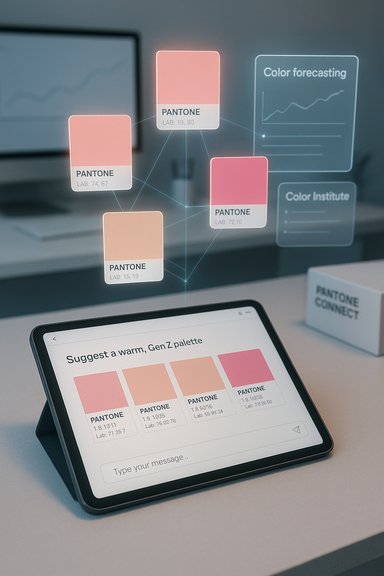
The core user experience is a chat interface where designers describe intent in everyday language—examples range from “a warm, optimistic palette for Gen Z” to “five colors for a spring 2026 womenswear capsule.” The assistant then returns Pantone‑indexed palettes, accompanied by the forecasting snippets and Color Institute rationale that informed the suggestions. Generated palettes can be added directly to Pantone Connect libraries, analyzed, downloaded and shared for collaborative workflows. The initial rollout supports Pantone’s Fashion, Home & Interiors library with plans to expand to the full Pantone catalog.Key capabilities at launch
- Instant palette generation from natural‑language prompts, drawing from thousands of Pantone colors.
- Retrieval‑augmented outputs that attach forecasting or Color Institute snippets as provenance for designer storytelling.
- Seamless import/export with Pantone Connect, including the ability to analyze and download swatches for downstream use.
- Open beta availability for both free (basic) and paid Pantone Connect users, intended to democratize access during rollout.
Technical stack in brief
The Palette Generator is built on Microsoft technologies: Azure OpenAI provides the conversational model layer; Azure AI Search indexes Pantone’s trend content for semantic retrieval; Azure Cosmos DB stores structured palette metadata and assets; and Azure AI Foundry orchestrates model deployments and agentic workflows. The architecture is explicitly described as using Retrieval‑Augmented Generation (RAG) plus agent orchestration to ground outputs in Pantone’s proprietary materials rather than unconstrained web data.Technical deep dive: RAG, agentic orchestration and the “explainable” palette
Why Retrieval‑Augmented Generation matters here
RAG combines a semantic search layer with an LLM: the system first retrieves relevant passages from a curated index, then uses those passages as grounded context for generation. For domain‑specific outputs—where traceability and provenance matter—RAG is the appropriate design choice because it reduces the risk of unsupported statements and provides the potential to attach evidence to outputs. Pantone and Microsoft say the Palette Generator uses RAG to surface Color Institute forecasting snippets alongside palette suggestions.Agentic components: orchestrating discrete capabilities
Beyond RAG, the release references “agentic technology,” which in practice suggests a multi‑agent pipeline: search agents query indexed trend content, retrieval agents fetch and rank snippet candidates, color agents compute Pantone matches and complementary relationships, and packaging agents assemble final palette assets for export. An agentic design adds structure and traceability compared with a monolithic LLM, but it also introduces operational complexity—routing decisions, timeouts and state management become new failure modes that Pantone and its customers will need to monitor.Azure components and enterprise tradeoffs
Using Azure OpenAI, Azure AI Search, Azure Cosmos DB and Azure AI Foundry gives Pantone an enterprise environment with scalability, observability and native compliance tooling. For enterprise customers, this is attractive: elastic compute, managed deployments and existing Azure security controls reduce friction for adoption. The counterpoint is a tighter operational coupling to Microsoft’s cloud and policy models—organizations with strict data sovereignty or on‑premise requirements will want clarity on telemetry, retention and contractual non‑use clauses.Practical benefits for designers and creative teams
Faster ideation and stronger storytelling
The Palette Generator’s value proposition is immediate: what used to take hours of research, mood‑boarding and manual color picking can now be accomplished in minutes or seconds. Because each palette is accompanied by the trend rationale and Color Institute snippets, designers gain a defensible narrative to present to stakeholders—useful for pitches, merchandising decks and marketing materials.Workflow integration reduces friction
Because the Generator lives inside Pantone Connect and allows direct import of generated palettes into libraries, teams can avoid error‑prone copy/paste steps and speed handoffs to design tools and production. Pantone has already improved Adobe extensions and other integrations; coupling generation with analysis and export closes the loop between inspiration and implementation.Democratization of trend insight
Opening the beta to free Pantone Connect users lowers the barrier for students, freelancers and small studios to experiment with Pantone‑level forecasting insights—broadening access while giving Pantone a large feedback pool for product tuning.Risks, limitations and governance considerations
The Palette Generator is a pragmatic and promising tool, but design teams and procurement leaders should be aware of important caveats and operational risks.1. Color fidelity and the material gap
Pantone’s reputation is built on consistent color reproduction across substrates and processes. A palette that looks coherent on a monitor or within a chat UI does not automatically guarantee faithful translation to textile dyes, ceramic glazes, metallic coatings, or specialized printing processes. Pantone has signalled achievability visualization as a roadmap item, but those capabilities are not present in the initial beta—designers must validate generated palettes with LAB conversions, CMYK builds and vendor proofs before production. Overreliance on screen‑only validation risks costly manufacturing surprises.2. Hallucinations, provenance and editorial hygiene
RAG reduces hallucination risk but does not eliminate it. A generative assistant can still produce plausible‑sounding rationales, misattribute trend sources, or omit edge‑case caveats. The announcement emphasizes that the Palette Generator surfaces retrieved forecasting snippets, but the promotional material does not publish detailed retrieval ranking algorithms, confidence thresholds, or fallback behaviors. Until Pantone exposes precise provenance exports and audit metadata, teams should treat AI explanations as helpful guidance—not contractual specifications—and preserve an audit trail.3. Licensing, IP and commercialization ambiguity
Pantone’s color libraries are proprietary and have historically driven licensing friction with major design tools. The announcement frames outputs as “Pantone‑informed,” but it does not fully define downstream licensing for commercialization of AI‑generated palettes. Legal clarity is essential: teams using generated palettes in product IP or exclusive brand color systems should confirm whether existing licensing covers AI‑derived palettes and update supplier and client contracts accordingly.4. Data governance, telemetry and confidentiality
The public notices do not disclose detailed retention policies for prompts or generated palettes, nor do they specify whether user inputs could be used to fine‑tune models (even in aggregated form) absent contractual restrictions. For unreleased collections or sensitive briefs, treat interactions with the open beta as non‑confidential and consider enterprise deployment options or private instances where prompt non‑retention and contractual non‑use can be guaranteed.5. Vendor lock‑in and exportability
Embedding generation and provenance inside Pantone Connect is convenient, but it tightens dependence on a single vendor and cloud stack. Teams should confirm export fidelity (LAB values, CMYK builds, substrate profiles) and maintain independent, versioned repositories of generated palettes as a hedge against subscription changes or integration constraints.How to adopt the Palette Generator safely — an operational checklist
- Start with a pilot on non‑sensitive projects to validate quality and achievability.
- Require provenance exports: save the retrieval snippets and forecasting rationale attached to each palette.
- Validate physically: convert suggested palettes to LAB/CMYK and proof with vendor samples before committing to manufacture.
- Archive exports: maintain a secure, versioned local repository of generated palettes independent of Pantone Connect.
- Update contracts and licensing language to clarify ownership and commercialization rights for AI‑assisted palettes.
- Train your team on prompt best practices: include usage context (digital vs. print vs. textile), substrate constraints and accessibility rules in prompts.
- Define escalation and approval rules for moving AI‑generated palettes into production and for resolving provenance ambiguities.
Prompting best practices and sample prompts
Well‑scoped prompts dramatically improve output quality. Always include the intended use, audience, technical constraints and required export formats.- Optimal prompt structure:
- Objective (e.g., “create a five‑color palette for a spring 2026 womenswear capsule”)
- Audience (e.g., “targeting Gen Z in North America”)
- Constraints (e.g., “must include a washable textile‑friendly neutral and meet AA contrast for text”)
- Output format (e.g., “return Pantone names and LAB values and list the forecast snippet used”)
- Example prompt for designers:
“Create a six‑color palette for a sustainable packaging line for beauty products, evocative of coastal minimalism, optimized for coated paper stock. Include Pantone names, LAB values, and the Color Institute forecast snippets that informed each color choice.”
Enterprise and IT leader considerations
For IT, procurement and brand protection teams, the partnership raises several operational questions beyond the design benefits:- Telemetry and retention: what prompts and outputs are logged, for how long, and are they available to Pantone or Microsoft for model improvement?
- Contractual non‑use clauses: can enterprise customers negotiate prompt non‑retention and explicit guarantees that their data will not be used to train models?
- Data residency and sovereignty: does Azure deployment support in‑country processing or private tenant options for sensitive customers?
- Export formats and integration: do generated palettes include machine‑readable LAB/ICC profiles or vendor‑specific builds to ensure reliable downstream reproduction?
Industry implications — why this matters beyond Pantone Connect
Pantone’s move signals a broader shift: domain authorities and standards bodies are embedding curated expertise into generative AI workflows. That has three major implications:- New creative workflows: designers can iterate conceptually at scale, with domain‑backed reasoning attached to each idea—reshaping early‑stage briefs and mood‑boarding cycles.
- Demand for achievability and material simulation: the next major differentiator will be substrate‑aware color tools that predict how a Pantone selection appears on textiles, metal, ceramics or coated papers using spectral data rather than heuristic conversion. Pantone’s roadmap hints at this direction.
- Marketplace and standards pressure: other vendors—paint manufacturers, textile mills, design platforms—will likely build competing, domain‑specific assistants. Industry standards for provenance metadata, interchange formats (machine‑readable LAB/ICC), and AI licensing will become crucial to avoid fragmentation.
Where the announcement is explicit — and where it remains opaque
What’s explicit:- The Palette Generator launched in open beta and is embedded in Pantone Connect, initially supporting the Fashion, Home & Interiors (FHI) library.
- The solution uses Azure OpenAI, Azure AI Search, Azure AI Foundry and Azure Cosmos DB and relies on RAG + agentic orchestration.
- Beta availability includes free (basic) Pantone Connect users to encourage broad experimentation.
- Exact telemetry, retention policies and whether prompt data might be used to further train or fine‑tune models under any terms. Teams should treat the beta as non‑confidential until contractual protections exist.
- Detailed retrieval ranking algorithms, confidence thresholds, or the granularity of provenance exports—areas that determine real‑world trustworthiness.
- Clear licensing rules for commercializing AI‑generated palettes in products or exclusive brand systems; legal clarification is necessary before relying on generated palettes for proprietary product lines.
Final assessment: pragmatic optimism
The Pantone Palette Generator is a well‑targeted application of generative AI to a real, longstanding pain point in creative workflows: the time and friction it takes to move from trend research and mood boarding to producible color systems. By combining Pantone’s Color Institute expertise with Microsoft’s Azure AI capabilities—RAG, agentic orchestration and managed cloud services—the tool offers a plausible productivity multiplier for designers and a new distribution model for Pantone’s trend insights.That upside comes with disciplined caveats. The tool should be treated as a powerful ideation and storytelling assistant—not a turnkey replacement for color science validation, production workflows or legal clarity around licensing. Until Pantone exposes detailed provenance exports, achievability visualizers and enterprise governance options (data residency, prompt non‑retention, contractual non‑use), serious production teams should adopt the Palette Generator in pilots, validate everything physically, and negotiate contractual protections where needed.
If Pantone follows through on its roadmap—adding substrate‑aware rendering, full library coverage and explicit enterprise controls—the Palette Generator could become a standard part of the modern designer’s toolkit: a fast, evidence‑backed way to explore color while preserving the rigorous validation steps that production and brand integrity demand. For now, the sensible posture is pragmatic optimism: embrace the creative acceleration, but keep the color standards and legal guardrails firmly in place.
Source: Beauty Packaging Pantone Partners with Microsoft Azure OpenAI
