

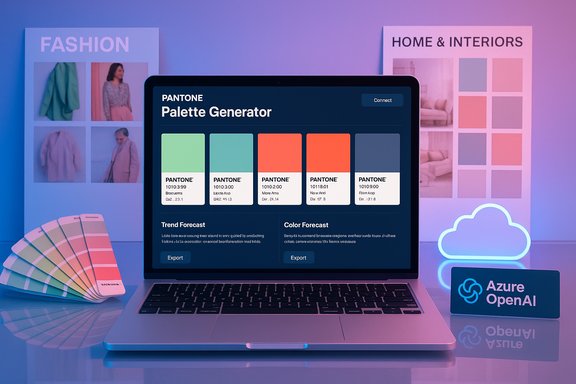
Pantone and Microsoft have launched a new collaboration that embeds a chat‑driven, AI‑powered Palette Generator into Pantone Connect — a move that joins Pantone’s six decades of color expertise with Microsoft’s Azure OpenAI stack to accelerate color research, palette ideation and designer workflows.
Pantone’s Color Institute is the industry reference for color standards, trend forecasting and color psychology across fashion, interiors, packaging and product design. Microsoft has been pushing Azure as an enterprise AI platform capable of hosting Retrieval‑Augmented Generation (RAG) and agentic workflows at scale. The new Pantone Palette Generator brings those two strengths together inside Pantone Connect, offering designers instant, Pantone‑indexed palettes and the forecasting rationale that informed those suggestions. The partnership was announced on November 5, 2025, and the Palette Generator is currently available in open beta to Pantone Connect users — including free (basic) accounts — with initial coverage limited to the Fashion, Home & Interiors library and plans to expand to Pantone’s full catalog. The product documentation and press materials explicitly name Azure OpenAI, Azure AI Search, Azure AI Foundry and Azure Cosmos DB as core components of the technical stack.
The partnership is nonetheless a notable milestone: a standards authority embracing generative AI, and a cloud vendor demonstrating a path for domain‑specific, evidence‑backed AI features in professional SaaS products. The coming months of beta feedback, achievability tooling and contractual clarifications will reveal whether the Palette Generator becomes a new industry staple or a valuable, but bounded, creative accelerator.
Source: Finviz https://finviz.com/news/230689/micr...nable-ai-use-in-creative-and-design-industry/
 Background / Overview
Pantone’s Color Institute is the industry reference for color standards, trend forecasting and color psychology across fashion, interiors, packaging and product design. Microsoft has been pushing Azure as an enterprise AI platform capable of hosting Retrieval‑Augmented Generation (RAG) and agentic workflows at scale. The new Pantone Palette Generator brings those two strengths together inside Pantone Connect, offering designers instant, Pantone‑indexed palettes and the forecasting rationale that informed those suggestions. The partnership was announced on November 5, 2025, and the Palette Generator is currently available in open beta to Pantone Connect users — including free (basic) accounts — with initial coverage limited to the Fashion, Home & Interiors library and plans to expand to Pantone’s full catalog. The product documentation and press materials explicitly name Azure OpenAI, Azure AI Search, Azure AI Foundry and Azure Cosmos DB as core components of the technical stack. What the Pantone Palette Generator actually does
Core features
- A chat‑first interface inside Pantone Connect that accepts natural‑language prompts (for example: “Create a five‑color palette for a spring 2026 womenswear capsule targeting Gen Z”).
- Palette generation that maps suggestions to Pantone‑indexed colors and returns palette assets that can be added to Pantone Connect libraries, analyzed, downloaded and shared.
- Grounding of outputs by Retrieval‑Augmented Generation (RAG) that semantically searches Pantone’s Color Institute and Color Insider forecasting content and surfaces the snippets that informed the palette.
- Use of an agentic orchestration pattern (multi‑agent pipeline) to handle discrete steps such as search, retrieval ranking, color matching and asset packaging, according to the announcement materials and partner briefings.
Immediate user benefits
- Speed: Designers can generate dozens of concept palettes in seconds rather than hours of manual swatch work.
- Provenance: Each suggested palette is accompanied by the Pantone forecasting rationale that informed it, enabling evidence‑backed storytelling for pitches and merchandising decks.
- Workflow integration: Generated palettes import directly into Pantone Connect and can be transferred into downstream design tools and exports, reducing manual copy/paste and transcription errors.
Technical architecture and verification of claims
Pantone and Microsoft describe the Palette Generator as an implementation that blends three architectural pillars:- Retrieval‑Augmented Generation (RAG) — a semantic search index that supplies curated Pantone content as context to the generative model to reduce hallucinations and attach explicit evidence to outputs.
- Agentic orchestration — modular agents that perform search, rank retrievals, compute color matches and produce exportable assets. The partners frame this as a way to improve explainability and traceability.
- Microsoft Azure services — Azure OpenAI for the conversational model layer; Azure AI Search for semantic indexing; Azure Cosmos DB for structured metadata and asset storage; and Azure AI Foundry for orchestrating agent pipelines and managed model deployments.
What is explicitly verifiable
- The product name (Pantone Palette Generator), the launch date (Nov 5, 2025) and open‑beta availability are confirmed in Pantone and Microsoft press materials.
- The initial library coverage (Fashion, Home & Interiors) and intent to expand the catalog are stated in public announcements.
What remains opaque or unverifiable
- The precise model family, training data lineage, and whether any model fine‑tuning on Pantone‑owned datasets occurred are not disclosed in the announcements. That makes the exact provenance and potential model drift behavior difficult to independently audit at this stage. Treat claims about “grounded outputs” as a design objective rather than a technical guarantee until Pantone or Microsoft publishes detailed retrieval and ranking telemetry.
- Telemetry, prompt retention policies, and contractual guarantees around non‑use of enterprise prompts for future model training are not public. Organizations with IP‑sensitive workflows should require those contractual assurances before treating the tool as a production service.
Strengths: where the partnership can add real value
- Domain authority meets scale: Pantone’s Color Institute is widely trusted; integrating its curated forecasting content into a fast, searchable assistant delivers an immediate credibility advantage over generic color pickers.
- Faster ideation and richer storytelling: Designers gain the ability to produce forecast‑backed palettes that can be cited in client decks, hastening decision cycles in marketing, merchandising and product development.
- Enterprise‑grade infrastructure: Building on Azure provides scalability, multilingual reach and enterprise controls that many smaller creative tools can’t match immediately — an important consideration for global studios and brands.
- Democratization during beta: Opening the beta to free users lets students, freelancers and small studios experiment with high‑quality trend insight, broadening feedback and potential adoption.
Risks and critical caveats designers and procurement teams must weigh
Color fidelity and achievability
AI‑generated palettes are digital suggestions; they are not a substitute for physical proofing. Transferring a Pantone number from a digital palette to a printed textile, coated packaging or painted surface requires substrate‑specific color management (LAB/CMYK conversions, spectral data and device profiles). The announcement hints at future achievability tools, but those capabilities are not in the initial beta and must be validated before relying on auto‑generated palettes for production.Dependency and vendor lock‑in
Relying on Pantone Connect + Azure as an integrated solution creates tighter operational coupling between creative workflows and Microsoft cloud policies. Enterprises that require on‑premise or sovereign deployments should seek contractual options and explicit data‑residency guarantees.Intellectual property and prompt data governance
The public materials do not fully disclose whether user prompts or generated palettes are retained, used for retraining, or subject to telemetry. Without explicit non‑use contractual clauses, companies may expose confidential product concepts or seasonal palettes to auditing and retention policies they did not intend. Procurement must demand clear terms for IP protection, prompt retention, and data non‑use in model training.Bias, cultural nuance and trend subjectivity
Trend forecasting encodes human judgment and cultural reading. An assistant trained or grounded primarily in Pantone’s forecasting will amplify Pantone’s worldview and methodology. Designers should complement AI suggestions with local cultural research and inclusive design practice to avoid unintentionally excluding communities or reinforcing stereotyped color associations.Operational complexity and failure modes
Agentic orchestration improves modularity but adds new reliability vectors: search ranking failures, agent timeouts, and incorrect retrieval‑to‑generation handoffs can produce misleading provenance or incomplete justifications. Teams should test edge cases and monitor for inconsistent outputs during beta.Practical guidance: how creative teams should adopt the Palette Generator
Use the Palette Generator as an ideation and storytelling tool, not a final production certifier. Follow these practical steps to minimize risk:- Start small: use the Generator for mood boards and early concepting rather than approved production color specs.
- Request provenance: always ask the assistant to show the forecast snippets or Color Institute sources used for a palette and retain those snippets in your project record.
- Export and test: immediately export candidate palettes and validate colors on target substrates with LAB values and printed proofs before locking into production.
- Contractual checks: for enterprise or IP‑sensitive work, require explicit contractual guarantees covering telemetry, prompt retention, data residency and non‑use clauses for model training.
- Prompt discipline: make prompts concrete (audience, substrate, accessibility/contrast constraints, final use case) to improve the relevance of generated palettes.
- Objective: “Create a five‑color palette for a spring 2026 womenswear capsule.”
- Audience: “Targeting Gen Z in North America.”
- Constraints: “Include a washable‑fabric neutral and meet WCAG AA contrast for body text.”
- Output format: “Return Pantone names, hex and LAB values, and list the forecast snippet used.”
Business and market implications
- For Pantone, the Palette Generator is a strategic productization of its Color Institute research: it moves forecasting from static reports and consultancy into an interactive product, potentially driving higher Pantone Connect adoption and subscription upgrades.
- For Microsoft, the collaboration is a high‑visibility showcase for Azure OpenAI and agentic pipelines in an industry‑specific SaaS context. It demonstrates how Azure can host retrieval‑backed LLM workflows that prioritize provenance and enterprise controls.
- For the design ecosystem, the move signals that legacy standards bodies are actively embedding generative AI into core workflows — a trend that will accelerate integration of AI into creative tooling and platform consolidation around major cloud providers.
- Market writeups and investor summaries have framed the announcement as a positive signal for Microsoft’s Azure AI momentum and ecosystem partnerships; analysts often highlight industry partnerships as incremental evidence of platform strength, although direct revenue impact from a single creative tool will be modest relative to Azure’s overall scale.
Roadmap signals and what to watch next
Key execution items that will determine whether the Palette Generator becomes indispensable or remains a useful prototype:- Expansion to the full Pantone library and improved export fidelity (LAB, CMYK, vendor‑specific builds).
- Achievability visualizers and substrate‑aware renderers that predict how colors will look on different materials using spectral data rather than heuristic approximations. That capability would materially raise the tool’s production readiness.
- Transparent governance: published telemetry policies, contractual non‑use clauses for prompt data, and enterprise controls for data residency and access auditing.
- Wider integrations with major design tools (Adobe Creative Cloud, CAD and textile printing pipelines) to reduce friction and ensure color fidelity across the supply chain.
Final assessment
The Pantone–Microsoft collaboration is a logical, high‑value application of generative AI for creative workflows: it pairs domain credibility with cloud AI scale to address a genuine pain point in color research and early‑stage design. The Palette Generator’s combination of chat‑driven prompts, Pantone‑sourced forecasting and Azure‑backed RAG architecture promises to speed ideation and strengthen the storytelling designers need for stakeholder buy‑in. That optimism comes with clear caveats: color achievability across substrates, commercial licensing and IP governance, operational transparency around telemetry and prompt retention, and the long tail of failures introduced by agentic orchestration are unresolved issues that will determine how quickly studios adopt the tool for production work. Until Pantone publishes more detailed technical and contractual artifacts, design teams should treat the Palette Generator as a powerful ideation ally — not an automated production certifier.The partnership is nonetheless a notable milestone: a standards authority embracing generative AI, and a cloud vendor demonstrating a path for domain‑specific, evidence‑backed AI features in professional SaaS products. The coming months of beta feedback, achievability tooling and contractual clarifications will reveal whether the Palette Generator becomes a new industry staple or a valuable, but bounded, creative accelerator.
Source: Finviz https://finviz.com/news/230689/micr...nable-ai-use-in-creative-and-design-industry/
