

Overview
Panzura’s announcement matters because most enterprise AI strategies still collide with a basic reality: business-critical knowledge is rarely stored neatly in one modern cloud repository. It is spread across file shares, hybrid cloud storage, departmental folders, project repositories, archived documents, and regional systems built over many years. Microsoft 365 Copilot can reason over Microsoft 365 content, but enterprises often hold their most valuable operational history in file systems that were never designed for large language models.
That gap has created a new market around AI-ready data infrastructure. Vendors are racing to connect enterprise content to copilots, agents, semantic indexes, and retrieval systems while maintaining security, compliance, and performance. The hard part is not merely indexing documents; it is preserving the messy reality of enterprise permissions, data residency rules, audit trails, file ownership, and rapidly changing access rights.
Panzura enters this race with a distinctive advantage: it already sells CloudFS, a hybrid cloud global file system designed for distributed organizations with large, shared datasets. Its customer base includes sectors where file data is central to daily work, including architecture, engineering, construction, manufacturing, healthcare, financial services, and media production. These environments generate enormous volumes of documents that are rich in institutional memory but difficult for AI tools to interpret safely.
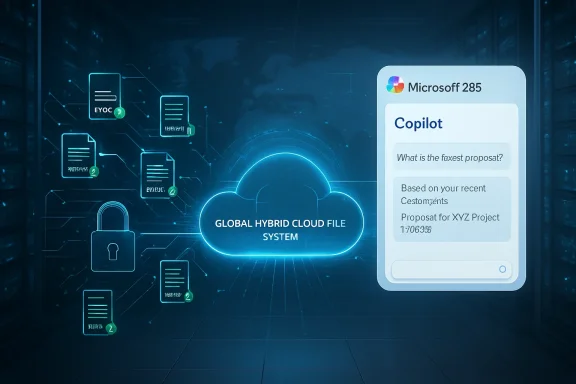
Nexus builds on that foundation by linking selected file data into the Microsoft Copilot experience. Rather than asking customers to move content into a new repository, Panzura is trying to make existing file knowledge available through natural language. That is a subtle but important distinction because enterprise IT teams are far more likely to adopt AI when it can respect the systems, controls, and workflows they already rely on.
Why Enterprise File Data Is the Missing AI Layer
The unstructured-data problem
The modern enterprise is not short of data; it is short of usable context. Emails, Teams chats, SharePoint pages, and Office documents are only one layer of organizational knowledge. A large share of work still happens in unstructured files such as PDFs, CAD documents, spreadsheets, scans, specifications, legal drafts, proposals, design packages, and exported reports.
These files often contain the answer to questions employees ask every day. Which past proposal won the client? Which supplier failed a risk review? Which design assumptions changed between project phases? Which maintenance documents reference a recurring fault pattern? Traditional search can locate filenames or keywords, but it usually cannot synthesize patterns across many files.
That is where retrieval-augmented generation becomes attractive. RAG systems retrieve relevant source material and use it to ground AI responses, reducing the risk that a model invents answers from general training data. In the enterprise, however, RAG only works if retrieval respects permissions, freshness, and document provenance.
- File systems hold high-value operational memory that often predates Microsoft 365 adoption.
- Traditional search struggles with synthesis, especially across large document collections.
- AI assistants need governed retrieval, not uncontrolled bulk access.
- Permission drift can turn AI discovery into a security incident if not handled carefully.
- Freshness matters because stale indexes can produce misleading or unauthorized results.
The significance of Nexus is that it treats the file system as a first-class knowledge source for Copilot. That changes the conversation from “Can Copilot summarize my inbox?” to “Can Copilot reason across the institutional memory of the business?” For many organizations, the second question is where the real return on AI investment begins.
What Panzura Nexus Adds to Microsoft 365 Copilot
A bridge from CloudFS to Copilot
Nexus is designed to integrate with Panzura CloudFS, exposing enterprise file data through Microsoft 365 Copilot’s conversational interface. The product does not appear to be a generic chatbot bolted onto storage. Instead, it is framed as a governed connector layer that maps file content, metadata, and access policies into an AI-readable structure.
That approach aligns with Microsoft’s broader push to extend Copilot beyond native Microsoft 365 content. Microsoft Graph connectors and Copilot connectors already aim to bring external line-of-business data into Microsoft’s knowledge layer. Panzura’s bet is that global file systems need a purpose-built, file-aware path into that ecosystem.
The key differentiator is the emphasis on near-real-time synchronization. Panzura says Nexus relies on event streams from file-system activity rather than periodic full crawls. If a file changes, a permission is updated, or an administrator modifies a policy, Nexus is intended to reflect that change quickly in the knowledge available to Copilot.
That matters because AI answers are only as trustworthy as the retrieval layer beneath them. If a user loses access to finance data at 10:00 a.m. but an AI index still exposes chunks of that data at 10:30 a.m., the system has failed a basic governance test. In regulated industries, that delay can be more than an inconvenience; it can become a compliance issue.
How the experience changes
For end users, the practical effect is a more powerful Copilot prompt surface. Instead of hunting through folders, users could ask questions that span authorized files. The value is not simply faster search, but the ability to compare, summarize, extract, and identify patterns across documents.
Typical scenarios could include:
- “Find successful proposals for similar projects and summarize the common themes.”
- “Compare supplier risk assessments from the last three years.”
- “Identify lessons learned from previous regional deployments.”
- “Summarize design changes across the latest project document set.”
- “List unresolved issues mentioned in meeting notes and technical reports.”
This turns the file system into a queryable knowledge base without forcing employees to leave the productivity environment where many already work. That is important because AI adoption often fails when tools require users to jump between portals, learn new search syntax, or manually upload documents. Nexus makes the more ambitious claim that the knowledge can come to the user through Copilot.
Security and Permissions Are the Real Product
Why access control is central
Panzura is emphasizing that Nexus preserves existing permissions, and that is not merely a checkbox feature. In enterprise AI, authorization-aware retrieval is the product. Without it, connecting file systems to an AI assistant risks exposing sensitive data that users were never meant to see.
Microsoft 365 Copilot itself is designed around existing identity, permissions, and compliance boundaries. But extending Copilot to external file systems introduces another layer of complexity. File permissions may come from Active Directory groups, local ACLs, nested group memberships, project-specific rules, regional policies, and custom administrative practices that evolved over years.
Nexus tries to address this by mapping file-system permissions into the Copilot environment. Panzura’s executives have described a model in which inaccessible chunks are excluded from the conversation altogether. That is stronger than simply filtering the final answer after retrieval because it reduces the chance that restricted material influences the model’s response.
- Permissions must be enforced before retrieval, not merely after generation.
- Access-control changes need fast propagation to prevent stale authorization.
- Security metadata should travel with content chunks during indexing.
- Administrators need policy-based selection over which data enters the AI layer.
- Auditability becomes essential when AI interactions touch regulated content.
The phrase “Copilot respects permissions” is reassuring only if those permissions are accurate. Many enterprises have long-standing oversharing problems in collaboration platforms and file systems. AI does not create those problems, but it makes them easier to discover and harder to ignore.
The oversharing dilemma
The biggest practical risk is not that Copilot suddenly breaks into restricted folders. It is that employees already have excessive access through legacy group memberships, old project folders, broad departmental shares, or abandoned collaboration sites. Once AI makes that content easy to ask about, dormant permission mistakes become operational exposure.
Panzura’s event-driven approach could help by keeping permissions current, but it cannot decide whether every permission is appropriate. That remains a governance task for customers. Before connecting large file estates to AI, organizations should review access models, classify sensitive data, and identify folders where inherited permissions have become too broad.
A sensible rollout would follow a staged process:
- Inventory high-value file repositories and identify candidate datasets for Copilot access.
- Review permissions and group memberships before enabling AI retrieval.
- Apply data classification and sensitivity labels where possible.
- Pilot with limited user groups and carefully selected document collections.
- Monitor prompts, retrieval patterns, and access changes after deployment.
This is where Nexus may succeed or fail in the field. The technology can preserve permissions, but customers still need disciplined information governance. AI readiness is not a connector setting; it is a data hygiene program.
Event-Driven Indexing Versus Periodic Crawling
Freshness as a governance issue
Many enterprise search and AI systems rely on scheduled crawls. That model works acceptably when content changes slowly or when search freshness is not mission-critical. But in live enterprise file systems, documents and access rights change constantly, and a stale index can produce wrong or unsafe results.
Panzura says Nexus avoids full scans by using audit event streams generated by enterprise file systems. Each file change or access-control update can trigger synchronization into the underlying knowledge graph. In theory, that creates a tighter loop between source-of-truth storage and the AI retrieval layer.
The technical significance is bigger than speed. Event-driven architecture reduces the mismatch between what the file system knows and what Copilot can safely retrieve. That reduces both hallucination risk and security risk because the AI layer is less likely to reason from outdated documents or obsolete access rules.
There are performance implications as well. Full rescans of large file estates can be expensive, slow, and disruptive, especially when organizations store millions or billions of files. Event-based updates are more efficient if the underlying event stream is reliable, complete, and properly ordered.
Why the knowledge graph matters
Panzura has described Nexus as updating a graph structure that represents content and policies. That is an important design choice because enterprise knowledge is relational. A proposal relates to a customer, a region, a project team, a contract, a supplier, a template, and a set of outcomes.
A graph can help Copilot retrieve context that keyword search might miss. It can connect documents through metadata, permissions, project relationships, and semantic similarity. The better that graph becomes, the more likely Copilot is to answer with relevant institutional context rather than isolated snippets.
Important architectural questions remain:
- How granular are content chunks, and how are they updated after edits?
- How quickly do permission changes propagate under heavy file activity?
- How are deleted files, renamed folders, and moved content handled?
- What audit trails exist for AI retrieval decisions?
- How does the system manage conflicting metadata from complex file histories?
These are not academic questions for Windows admins and enterprise architects. They determine whether the system can support real workloads rather than polished demos. In distributed file environments, edge cases are the norm.
RAG at Enterprise Scale
Beyond simple document summaries
Panzura is framing Nexus as a platform for RAG at scale, and that phrase deserves scrutiny. Basic RAG is relatively easy to demonstrate with a small document set. Enterprise RAG is much harder because it must handle volume, permissions, freshness, relevance, cost, latency, and auditability at the same time.
The most interesting use cases are not one-off summaries. They involve comparison across many files, pattern detection across years of project history, and synthesis across document types. That is why sectors such as architecture, engineering, and construction are natural early targets.
In AEC environments, teams often manage drawings, specifications, BIM-related exports, proposals, inspection records, contracts, schedules, and field reports. Much of that content is too specialized for a general-purpose model to know. But if Copilot can retrieve and reason over authorized project files, it can become a practical assistant for proposal teams, project managers, and technical reviewers.
- Proposal generation can draw from past wins, client language, and relevant technical qualifications.
- Supplier risk analysis can compare historical reports, incidents, and contractual obligations.
- Workforce planning can surface skills and project experience from internal records.
- Project review can identify repeated delays, design assumptions, or unresolved risks.
- Knowledge transfer can help new employees understand past decisions faster.
The productivity impact could be substantial if users trust the output. A proposal team that spends hours searching for relevant past material may compress that work into minutes. A project manager could ask for a cross-document summary before a client meeting instead of relying on manual folder archaeology.
Trust is the limiting factor
Yet RAG systems can also produce confident mistakes when retrieval is incomplete or context is ambiguous. Nexus may reduce the likelihood of stale or unauthorized retrieval, but it does not eliminate the need for human verification. Users still need citations, source previews, version awareness, and a clear path back to original documents.
This is especially important in regulated or high-liability sectors. An AI-generated summary of a construction proposal, clinical document set, or financial file cannot become a final authority without review. The best role for Nexus is to accelerate discovery and synthesis, not replace professional judgment.
The opportunity is therefore practical rather than magical. Nexus could help employees locate and compare the right knowledge faster. That is valuable precisely because it stays close to the work people already do.
Competitive Implications for File and Storage Vendors
Panzura’s timing
Panzura is moving at a moment when the storage market is being redefined by AI. For years, file infrastructure vendors competed on performance, cost reduction, disaster recovery, global locking, ransomware resilience, and cloud tiering. Those capabilities still matter, but customers are now asking a new question: Can this platform make our data useful to AI without making it unsafe?
That question changes the competitive landscape. Nasuni, CTERA, Egnyte, Box, NetApp, Dell, Pure Storage, and cloud-native file services all have incentives to present their platforms as AI-ready. The winners will not be those that merely attach a chatbot to storage, but those that can govern data movement, indexing, permissions, and retrieval with enterprise rigor.
Panzura’s strength is that CloudFS already targets complex distributed file environments. Its global namespace, file locking, edge caching, and ransomware-resilience story give it a base in organizations where file workflows are mission-critical. Nexus adds an AI layer to that infrastructure narrative.
For Microsoft, partner products like Nexus are also strategically useful. Microsoft wants Copilot to become the enterprise AI interface, but Copilot’s value depends on access to relevant data. The more external systems that connect securely into the Copilot ecosystem, the harder it becomes for rivals to displace Microsoft’s AI front end.
The broader market battle
The market is shifting from storage as capacity to storage as intelligence infrastructure. That does not mean every storage vendor becomes an AI company overnight. It means file platforms must expose metadata, events, security context, and content in ways that AI systems can consume.
Competitive pressure will likely grow around several areas:
- Connector depth, especially for Microsoft 365 Copilot and agent frameworks.
- Permission fidelity, including nested groups and external identities.
- Data freshness, particularly for high-change repositories.
- RAG performance, including latency and relevance at scale.
- Governance tooling, especially for compliance-heavy customers.
Rivals may respond by deepening their own Microsoft integrations or by supporting multiple AI ecosystems. Panzura’s current focus on Microsoft makes sense because Microsoft 365 is deeply embedded in enterprise work. But customers increasingly want optionality across Copilot, private models, cloud AI platforms, and specialized agents.
That means Nexus is both a product launch and a positioning move. Panzura is saying its global file system is not just storage plumbing; it is a controlled knowledge layer for enterprise AI. If customers agree, the company gains a stronger seat in AI infrastructure conversations.
Enterprise Impact: IT, Security, and Knowledge Work
What changes for IT teams
For IT leaders, Nexus introduces a new integration point between storage operations and AI governance. That is powerful but also organizationally complicated. Storage teams, Microsoft 365 administrators, security teams, compliance officers, and business-unit leaders will all have a stake in how the platform is deployed.
The immediate IT benefit is architectural continuity. Organizations do not have to migrate every valuable file into SharePoint or Dataverse to make it available to Copilot. That can reduce disruption, especially in environments where large files, specialized applications, or regional latency requirements make wholesale migration impractical.
But IT teams will need new operating practices. They must treat file permissions as AI-facing controls, not just access-management settings. They must monitor event flows, index health, policy scope, and retrieval outcomes with the same seriousness they apply to backup status or endpoint security.
- Storage administrators will need visibility into which file sets feed AI systems.
- Microsoft 365 admins will need to manage Copilot connector behavior and user experience.
- Security teams will need audits of AI-accessible content and sensitive data exposure.
- Compliance teams will need evidence that policies survive the indexing process.
- Business owners will need responsibility for selecting useful, appropriate datasets.
The most successful deployments will not start with the entire file system. They will start with well-governed, high-value repositories where the productivity payoff is clear. That could mean proposal libraries, project closeout documents, engineering standards, policy repositories, or supplier documentation.
What changes for employees
For employees, the value proposition is less about infrastructure and more about reducing friction. Many knowledge workers spend a surprising amount of time searching for prior work, verifying document versions, or asking colleagues where something lives. Copilot access to governed file knowledge could reduce that invisible tax.
The impact will vary by role. A business-development team might use Nexus to find winning proposal language. A project manager might compare lessons learned across jobs. A finance analyst might query authorized budget narratives. A legal reviewer might identify related contract clauses across approved repositories.
That said, user education is essential. Employees must understand when Copilot is drawing from file data, how to inspect sources, and when to escalate uncertain answers. AI fluency is becoming a workplace skill, and connector-enabled Copilot makes that skill more important.
Consumer Impact and the Windows Ecosystem
Why this is not a consumer Copilot story
For Windows enthusiasts, it is worth separating this announcement from the consumer-facing Copilot experience in Windows 11. Nexus is not about asking the Windows desktop assistant to find vacation ideas or summarize a web page. It is an enterprise data integration story tied to Microsoft 365 Copilot and governed organizational content.
That distinction matters because Microsoft’s Copilot branding now spans many products. There is Copilot in Windows, Copilot in Edge, Microsoft 365 Copilot, GitHub Copilot, Security Copilot, Copilot Studio, and multiple role-based copilots. Panzura’s Nexus belongs squarely in the enterprise Microsoft 365 category.
The indirect consumer relevance is still real. Technologies that begin in enterprise governance often shape broader expectations for personal and small-business AI. Users are learning to expect AI tools that can reason across their files, emails, calendars, and application data while respecting boundaries.
For WindowsForum readers, the deeper implication is that the Windows file era is not ending. Instead, file systems are being pulled into AI workflows. SMB shares, enterprise file namespaces, and hybrid storage platforms remain central because so much work still lives in files.
Why admins should pay attention
Windows administrators should watch Nexus because it reflects a broader trend: AI assistants are becoming another client of enterprise file infrastructure. That means file permissions, group policies, identity hygiene, audit logs, and information architecture now affect AI outcomes. Old shortcuts in file-share governance can surface in new ways.
This also raises practical questions for hybrid environments:
- How should legacy SMB shares be prepared for AI indexing?
- Which file types should be excluded from Copilot retrieval?
- How should administrators handle archived but sensitive project data?
- What monitoring should exist for AI-driven access patterns?
- How should endpoint, identity, and storage policies align?
Nexus may be a Panzura product, but the operational questions it raises apply far beyond Panzura customers. Any organization connecting file data to Copilot must answer them. The Windows ecosystem will increasingly treat file governance as part of AI governance.
Agentic AI and the Next Step Beyond Search
From answers to actions
Panzura is also pointing toward agent-based automation built on enterprise data. That is the logical next step. Once Copilot can retrieve governed file knowledge, agents can potentially perform workflows that depend on that knowledge.
The near-term use cases will likely remain human-supervised. An agent might draft a proposal outline based on prior wins, prepare a supplier-risk briefing, assemble a project handover packet, or flag missing compliance documents. These tasks still require review, but they can eliminate tedious first-pass work.
The more ambitious future involves agents that monitor file events and trigger business processes. For example, a new project folder could initiate a checklist, classify documents, suggest templates, notify stakeholders, and prepare a Copilot-accessible knowledge map. That would turn the file system from a passive repository into an active workflow participant.
But agentic AI raises the stakes. If an AI system is only answering questions, the risk is bad information exposure or poor advice. If an AI agent starts taking action, the risk includes unauthorized changes, incorrect workflows, and automated propagation of mistakes.
Guardrails before autonomy
The path from RAG to agents requires strong controls. Organizations need approval workflows, action logs, role-based agent permissions, and clear boundaries around what an AI system can modify. Retrieval governance is only the first layer.
A mature agent strategy should include:
- Read-only pilots before write-capable automation.
- Human approval gates for high-impact actions.
- Version-aware document handling to avoid acting on stale files.
- Full audit logs for prompts, retrieved sources, and agent actions.
- Rollback plans for automated changes or generated artifacts.
Panzura’s event-driven architecture could be useful here because agents need timely context. However, timeliness alone is not enough. The industry must prove that AI agents can operate safely inside complex enterprise permission models.
Strengths and Opportunities
Panzura Nexus arrives at a moment when enterprises want practical AI value from data they already own. Its strongest opportunity is to make Microsoft 365 Copilot more useful by connecting it to governed file knowledge without forcing disruptive migrations.
- Deep enterprise relevance: Nexus targets unstructured file data that often contains the richest operational knowledge.
- Microsoft ecosystem alignment: Integration with Microsoft 365 Copilot places the product where many enterprise users already work.
- Permission-aware design: Mapping access controls into retrieval workflows addresses a core AI governance requirement.
- Event-driven freshness: Near-real-time synchronization could reduce stale-index problems common in crawler-based systems.
- Strong vertical fit: AEC, manufacturing, healthcare, finance, and project-heavy industries have obvious use cases.
- RAG-to-agent pathway: Nexus could become a foundation for more advanced automated workflows.
- Storage modernization narrative: The product strengthens Panzura’s argument that global file systems are AI infrastructure, not just storage.
Risks and Concerns
The risks are just as real as the opportunity because connecting file systems to AI magnifies every weakness in data governance. Nexus may preserve permissions, but it cannot magically fix years of oversharing, inconsistent classification, or poorly maintained folder structures.
- Legacy permission sprawl: Existing overbroad access may become more visible through Copilot prompts.
- Trust and accuracy: Users may over-rely on generated answers without checking source documents.
- Operational complexity: IT teams must coordinate storage, Microsoft 365, identity, compliance, and security policies.
- Index integrity: Event-driven systems depend on complete, reliable event capture and synchronization.
- Cost uncertainty: Large-scale indexing, storage, licensing, and governance work may create unexpected expenses.
- Vendor concentration: A tight Microsoft focus may concern customers pursuing multi-model or multi-cloud AI strategies.
- Compliance exposure: Regulated industries will need clear auditability before expanding AI access broadly.
What to Watch Next
The first thing to watch is customer evidence. Panzura’s story is compelling, but enterprise AI buyers are becoming more demanding. They will want proof that Nexus can handle large file estates, complex permissions, rapid change rates, and real Copilot workloads without performance or governance surprises.
The second thing to watch is how broad the platform becomes. Panzura is starting with Microsoft because Copilot has enterprise momentum, but customers increasingly ask for AI optionality. Support for additional model ecosystems, agent frameworks, or retrieval APIs could determine whether Nexus becomes a Microsoft-specific enhancement or a broader AI data plane.
The third thing to watch is whether Nexus changes how customers evaluate storage vendors. If AI access becomes a standard procurement requirement, file platforms will need to demonstrate more than capacity and resilience. They will need to show how content, metadata, events, and permissions can safely power intelligent applications.
- Real-world deployment stories from large, distributed customers.
- Performance benchmarks for high-volume file estates and permission updates.
- Expanded AI platform support beyond the initial Microsoft integration.
- Administrative tooling for audits, policy simulation, and sensitive-data discovery.
- Agent workflow controls that move safely beyond read-only retrieval.
Panzura’s Nexus launch reflects a broader turning point in enterprise AI: the value of copilots will increasingly depend on the quality, freshness, and governance of the data beneath them. Microsoft has built a powerful interface for AI-assisted work, but the interface only becomes transformative when it can reach the knowledge that actually runs the business. By opening its global file system to Copilot users, Panzura is betting that the next phase of AI adoption will be won not by the flashiest chatbot, but by the platforms that can safely activate the forgotten knowledge already sitting in enterprise files.