

Pasco County Schools is moving from prohibition to scaffolding: district leaders have drafted a 19‑page AI guidebook and will begin a phased, managed rollout that gives high‑school students aged 13 and older limited access to Microsoft Copilot on December 1 while teachers retain classroom control and the district keeps policy under continuous review.
Generative AI tools are already part of student life, and school systems are finally catching up. Pasco’s approach follows a growing trend among U.S. K–12 districts that are shifting from blanket bans toward managed adoption — deploying vendor‑backed assistants inside institutional tenancy, pairing technical controls with pedagogical guardrails, and treating policy as a living document that must adapt to rapid product changes.
Superintendent John Legg has framed the work as pragmatic and iterative: rather than an immediate, districtwide free‑for‑all, Pasco will open access gradually, keep teachers in charge of assignments, and convene a standing work group to update guidelines as capabilities and risks evolve. That posture — “start slow, learn fast, revise constantly” — is the principal story behind the December 1 launch.
The durable strategy recommended across district playbooks is assessment redesign: emphasize process evidence, staged submissions, and in‑person demonstrations where feasible. Practical classroom changes include:
Caution: some procurement claims in public reporting (seat counts, time‑saved figures, or projected cost savings) are often district‑sourced or vendor‑provided and may not be independently verifiable until procurement records are published. Treat such figures as provisional unless accompanied by public contract documentation.
Recommended training elements:
Measure and publish equity metrics early: who is using Copilot, in which classes, and for how long. Combine telemetry with qualitative teacher feedback to identify whether benefits are equitably distributed.
Strengths of Pasco’s plan include teacher control over classroom use, reliance on managed accounts, and an explicit commitment to iterative updates. Potential weaknesses to watch are the durability of contractual data protections (which must be validated in signed agreements), the limits of detection tools for academic integrity, and the district’s capacity to deliver equitable device and connectivity access across the student body. District leaders and the standing work group will need to be especially attentive to vendor contract language, administrative configuration, and transparent reporting of outcomes.
Caveat: some claims in public conversations about early savings, seat counts, or projected costs are often preliminary and vendor‑or district‑sourced; those numbers should be treated cautiously until confirmed by public procurement documents or independent audits.
Pasco’s approach is a test case: if the district measures outcomes rigorously, protects student data contractually, invests in teacher skill, and redesigns assessments to prioritize process, the initiative could become a pragmatic model for other districts. If it skips any of those elements, the same technology that promises to accelerate learning could instead amplify inequality, undermine assessment integrity, or create privacy surprises. The next two semesters will tell whether Pasco’s measured, teacher‑centered path succeeds in turning a disruptive technology into a durable classroom ally.
Source: Spectrum Bay News 9 Pasco school leaders drafting AI guidebook for students, teachers
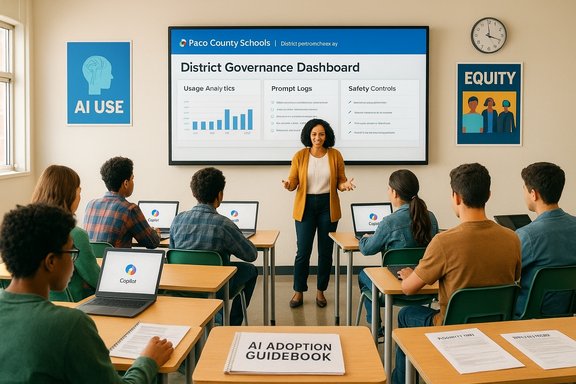 Background
Generative AI tools are already part of student life, and school systems are finally catching up. Pasco’s approach follows a growing trend among U.S. K–12 districts that are shifting from blanket bans toward managed adoption — deploying vendor‑backed assistants inside institutional tenancy, pairing technical controls with pedagogical guardrails, and treating policy as a living document that must adapt to rapid product changes.Superintendent John Legg has framed the work as pragmatic and iterative: rather than an immediate, districtwide free‑for‑all, Pasco will open access gradually, keep teachers in charge of assignments, and convene a standing work group to update guidelines as capabilities and risks evolve. That posture — “start slow, learn fast, revise constantly” — is the principal story behind the December 1 launch.
What Pasco’s draft guidebook says: core features and rules
The district’s draft guidelines are explicitly instructional, not punitive: they are presented as best practices for teachers and students rather than a single, rigid policy. The document encourages using AI for idea generation, formative practice, and revision help — but insists that AI must support learning, not replace student work. Key elements in the draft include:- A recommendation that students use AI to “brainstorm ideas, research topics, practice writing or giving feedback,” while avoiding submission of AI‑produced final products as original work.
- Age gating and account management: student access will be tied to managed district accounts (13+ for Copilot features), with administrative controls layered at the tenant level to limit capabilities and log activity.
- Teacher authority over classroom use: instructors decide whether AI may be used for formative tasks, how attribution is handled, and when outputs must be accompanied by process artifacts (draft logs, prompt histories, reflective statements).
- Tools for detection and documentation: teachers will be provided with AI‑use detection utilities and told to document instances of misuse for integrity and learning‑support purposes.
Why Microsoft Copilot? Vendor alignment, manageability, and control
Pasco’s choice of Copilot reflects practical procurement logic common in large IT environments: districts that already rely on Microsoft 365 for identity, file storage, and LMS integrations favor solutions that can be tenant‑grounded and administered through existing controls. That makes it easier to:- Enforce institutional accounts rather than consumer subscriptions;
- Apply Data Loss Prevention (DLP) and retention policies via Purview or equivalent tools;
- Export logs and monitor usage through tenant analytics; and
- Negotiate contract language that limits model training on district data — at least in principle.
The clock: December 1 rollout and what to expect
Pasco’s operational plan is straightforward:- Continue teacher and staff pilots that have already been evaluating Copilot for lesson planning and administrative tasks.
- On December 1, enable limited Copilot access for high‑school students aged 13 and older through managed, district‑controlled accounts.
- Keep classroom use teacher‑led, require documentation for AI usage contributing to grades, and monitor integrity incidents.
- Convene a standing district work group to review vendor changes, audit telemetry, and revise guidelines on a scheduled cadence.
Pedagogy and assessments: why policy must redesign how we grade
A central educational risk is assessment drift. Generative models can produce polished essays, code, or lab reports with little visible process, and that challenges traditional product‑oriented grading.The durable strategy recommended across district playbooks is assessment redesign: emphasize process evidence, staged submissions, and in‑person demonstrations where feasible. Practical classroom changes include:
- Requiring students to submit prompt-and-output logs plus a short reflection explaining how the AI was used.
- Using oral defenses, viva voce, or classroom presentations for summative tasks where authenticity matters.
- Designing rubrics that reward reasoning, source verification, and revision history rather than surface polish alone.
Data privacy and procurement: the contract is the guardrail
Vendor marketing claims about “non‑training” or “not using customer data to train models” are meaningful only if reflected in signed contracts and specific SKUs. Practical procurement demands include:- Explicit non‑training clauses for student prompts and uploaded files, and clear definitions of which accounts are covered.
- Retention schedules and deletion procedures for conversation logs and generated artifacts.
- Audit and export rights so the district can verify compliance and investigate incidents.
- Data Loss Prevention (DLP) controls, sensitivity labels, and administrative logging configured before broad rollout.
Caution: some procurement claims in public reporting (seat counts, time‑saved figures, or projected cost savings) are often district‑sourced or vendor‑provided and may not be independently verifiable until procurement records are published. Treat such figures as provisional unless accompanied by public contract documentation.
Classroom use cases that make sense — and those that don’t
Promising, low‑risk uses to prioritize early in pilots:- Teacher productivity: draft lesson frameworks, differentiated reading levels, and rubric scaffolds that teachers edit before classroom use.
- Low‑stakes student practice: generate formative quizzes, flashcards, and study guides that students use for revision while teachers verify quality.
- Accessibility and differentiation: create simplified language versions, translations, or alternative representations for English learners and students with special needs.
- Allowing AI to produce graded summative assignments without process evidence.
- Using outputs verbatim for assessments or college‑prep essays that require original work.
- Relying on detection tools as the sole remedy for academic dishonesty — detection is imperfect and can be gamed. Instead, redesign assessment to reduce incentives for misuse.
Teacher training and professional development: the linchpin
Teacher comfort and prompt literacy are the single most important determinants of success. Districts that report the best early outcomes pair rapid technical modules (how to prompt, how to verify outputs, admin controls) with pedagogical sessions focused on assessment redesign and student reflection practices. Pasco’s draft calls for short PD modules and teacher champions to model best practices inside schools.Recommended training elements:
- Prompt design and output verification — how to craft prompts that produce useful scaffolds and how to check for hallucinations.
- Assessment redesign workshops — rewrite rubrics, plan staged submissions, and simulate misuse scenarios.
- Equity and access planning — ensure devices, labs or alternative options for students who opt out or lack home broadband.
Equity concerns: access and unintended gaps
AI can amplify both opportunity and inequality. If Copilot’s benefits are primarily accessible at home or on premium devices, the district risks widening achievement gaps. Pasco’s guidelines therefore recommend monitoring equity indicators (device parity, home connectivity, opt‑out pathways) and scheduling in‑school lab time so students without home access receive equivalent supports.Measure and publish equity metrics early: who is using Copilot, in which classes, and for how long. Combine telemetry with qualitative teacher feedback to identify whether benefits are equitably distributed.
Academic integrity: detection, documentation, and redesign
Pasco plans to equip teachers with AI‑detection tools and instruct them to document misuse. That’s useful operationally, but detection technology has limits — false positives and false negatives are real. The strategic response is twofold:- Tactical: use detection tools to spot recurring patterns and document incidents for remediation.
- Structural: redesign assessments so that reliance on detection is minimized — require process logs, in‑class defenses, and staged submissions to make outsourcing unattractive.
Legal and parental communications
Transparent communication with parents and guardians is essential. Districts should publish:- Plain‑language descriptions of how AI will be used in classrooms and how student data is handled.
- Opt‑out procedures and alternatives for families who decline AI participation.
- A summary of contractual protections the district negotiated (non‑training clauses, retention rules) — or at least a pledge to share contract highlights on request where legally permitted.
Risk register: what to watch in the first semester
The district’s draft and accompanying analysis name several near‑term risks to monitor:- Contractual ambiguity over data use and training. Treat vendor claims as provisional until contracts are signed and reviewed.
- Feature volatility and preview timelines: product roadmaps change quickly; guidelines must be updated on a fixed cadence.
- Assessment integrity levers: detection tools are imperfect; rely on assessment redesign.
- Equity gaps caused by uneven device and broadband access. Measure and remediate promptly.
Practical recommendations for Pasco stakeholders
For district leaders:- Publish the guidebook as a living operational document with a published review schedule and metrics to be reported each semester.
- Make procurement conditional on explicit non‑training, retention and audit clauses, and require vendor transparency on data flows.
- Fund short PD modules and teacher‑champions to model classroom prompt craft and verification workflows.
- Treat Copilot outputs as drafts; require students to submit prompt logs and reflections when AI contributes to credited work.
- Start with low‑stakes uses (study guides, scaffolded practice) and redesign summative tasks to require process evidence.
- Ask whether school accounts are institutional (managed) or consumer accounts; request clarity about retention and deletion policies.
- Encourage students to use AI outputs critically and to document where they relied on AI assistance.
How Pasco can measure success
Short‑cycle evaluation metrics will be the deciding factor for broader scale. Useful measures include:- Usage analytics: who used Copilot, where, and for how long (by course and demographic group).
- Instructional outcomes: changes in formative completion rates, time saved on lesson preparation, and teacher‑reported impact on differentiation.
- Integrity incidents: counts, remediation steps taken, and outcomes.
- Equity indicators: device parity, home connectivity, and access to lab alternatives.
Final analysis: pragmatic adoption with eyes open
Pasco County Schools’ draft guidebook and December 1 Copilot activation reflect pragmatic optimism: the district recognizes both the instructional potential of managed AI assistants and the governance, privacy, and assessment risks they bring. The phased approach — teacher pilots, limited student access, rigorous procurement checks, and observable metrics — mirrors emerging best practices in K–12 AI adoption.Strengths of Pasco’s plan include teacher control over classroom use, reliance on managed accounts, and an explicit commitment to iterative updates. Potential weaknesses to watch are the durability of contractual data protections (which must be validated in signed agreements), the limits of detection tools for academic integrity, and the district’s capacity to deliver equitable device and connectivity access across the student body. District leaders and the standing work group will need to be especially attentive to vendor contract language, administrative configuration, and transparent reporting of outcomes.
Caveat: some claims in public conversations about early savings, seat counts, or projected costs are often preliminary and vendor‑or district‑sourced; those numbers should be treated cautiously until confirmed by public procurement documents or independent audits.
Pasco’s approach is a test case: if the district measures outcomes rigorously, protects student data contractually, invests in teacher skill, and redesigns assessments to prioritize process, the initiative could become a pragmatic model for other districts. If it skips any of those elements, the same technology that promises to accelerate learning could instead amplify inequality, undermine assessment integrity, or create privacy surprises. The next two semesters will tell whether Pasco’s measured, teacher‑centered path succeeds in turning a disruptive technology into a durable classroom ally.
Source: Spectrum Bay News 9 Pasco school leaders drafting AI guidebook for students, teachers
