

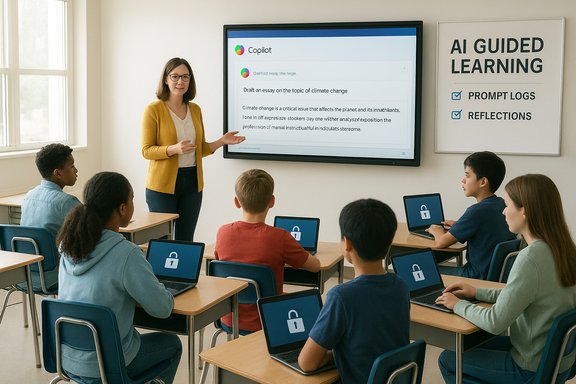
Pasco County Schools will begin a cautious, teacher-led rollout of Microsoft Copilot for high school students on December 1, opening a controlled window for AI-assisted learning while explicitly keeping classroom authority, age gating, and evolving guidelines at the center of its approach.
Background
Pasco County’s shift reflects a broader trend across K–12 districts: move away from blanket bans on generative AI and toward managed, tenant‑grounded deployments that combine technical controls with pedagogical guardrails. District leaders say teachers have already been using Copilot for lesson planning and administrative tasks, and the next step is to let older students use a limited set of Copilot features under teacher direction. Key local reporting notes that access will be limited to students aged 13 and older and that teachers will decide which assignments allow AI assistance. Pasco’s superintendent framed the decision as pragmatic and iterative: rather than pretending AI isn’t part of modern devices, the district aims to provide rules of use so students learn to employ the tool responsibly instead of using it unsupervised. The district’s draft guidance emphasizes that “AI should help you learn — not do the work for you,” and asks students to label or document where AI assisted their work.What Pasco is actually unlocking: the operational picture
Who, when and how
- Who: High school students (district statements and local reporting indicate access is targeted at students aged 13+).
- When: The district has announced a planned activation date of December 1 for student access, following teacher pilots.
- How: Access will be on managed district accounts (not unmanaged consumer logins), with teachers retaining final authority over whether AI may be used on a particular assignment. The district intends to require students to document AI-assisted elements of their submissions.
The age gating mechanism explained
Microsoft’s own education guidance requires administrators to set an age-related attribute in Entra ID (the former Azure AD) so Copilot Chat and certain student-facing Copilot features are only enabled for accounts the tenant marks as 13 or older. That means districts can technically restrict Copilot to older teens, but it requires correct identity provisioning and admin configuration. This is how districts like Pasco can operationalize a 13+ rule at the tenant level.Why Pasco’s approach is sensible — strengths and immediate benefits
Teacher productivity and differentiated instruction
Copilot and similar copilots are engineered to accelerate repetitive, low‑value tasks that absorb teacher time: drafting lesson scaffolds, generating multiple reading‑level versions of materials, creating formative quizzes, and converting materials into alternate formats for accessibility. When used as a drafting and editing aid — with teacher review — these tools can free time for direct instruction and small‑group support. Early pilots and other districts’ reports show measurable time savings when teachers use Copilot for prep work.Scaffolded practice for students
When configured conservatively, student-facing features (such as study agents that generate flashcards, practice quizzes, or step‑by‑step explanations) can provide immediate, personalized retrieval practice—one of the most effective study techniques. The district’s guidance explicitly highlights brainstorming, organization, spelling/grammar checks and practice work as lower-risk uses that can be allowed under teacher oversight.Workforce relevance and digital literacy
Introducing supervised AI in high school teaches students how to interact with generative systems: prompt craft, verification strategies, and critical editing. These are practical competencies in postsecondary education and the workplace. A managed, classroom‑first rollout gives teachers the chance to convert tool use into teachable skills rather than leave students to learn ad hoc on the internet.Critical risks and governance gaps Pasco must manage
1) Privacy and legal constraints (COPPA / FERPA realities)
There are real statutory guardrails that shape K–12 AI adoption:- COPPA (the federal law that governs online collection from children under 13) limits third‑party collection of personal information about children without parental consent. Districts must ensure accounts for children under 13 are handled with specific consent and vendor protections.
- FERPA governs educational records and how schools may share or disclose student information; tools that record, retain, or repurpose student work and prompts can implicate FERPA if those artifacts are treated as education records by the district or by third parties.
2) Academic integrity and hallucinations
Generative models can produce confident but incorrect outputs (“hallucinations”) and can generate polished submissions that obscure a student’s reasoning. Detection tools are imperfect; the durable solution is assessment redesign, not a cat‑and‑mouse game of detection. Pasco’s plan to require process artifacts (prompt logs, reflective statements, draft histories) is good practice — but enforcement and teacher workload must be anticipated.3) Contractual ambiguity about model training and data retention
Vendors often state that institutional inputs will not be used to train public models — but the exact boundaries depend on SKU, region, and signed contract language. Without explicit non‑training clauses and definable retention policies, school districts risk having student prompts or files retained in ways they did not intend. Procurement negotiables should include data use, deletion, export rights, and audit mechanisms.4) Equity and access
AI benefits depend on device parity and internet access. If Copilot access is available only on school devices or via in‑class time, disadvantaged students may still be left behind. Districts must measure access and plan lab time, loaner devices, or tailored alternatives for opt‑outs. Otherwise, the tool risks widening existing achievement gaps.Technical and administrative controls Pasco will need (practical checklist)
- Configure Entra/Azure attributes correctly (ageGroup settings) to gate Copilot Chat for students 13+.
- Ensure all student access uses managed district accounts (no consumer Microsoft accounts). Map account types and verify licensing SKUs.
- Negotiate procurement clauses that explicitly prohibit vendor use of student prompts or uploaded files for training (non‑training clause), define retention windows, and provide audit/export rights.
- Activate Data Loss Prevention (DLP), sensitivity labels, and retention policies in Microsoft Purview or equivalent tools; log and export telemetry for audits.
- Deploy teacher PD on prompt literacy, identifying hallucinations, and practical rubric redesign. Fund short, hands‑on modules and instructional champions.
Pedagogy: redesigning assessment to make AI a learning aid, not a shortcut
Short-term classroom rules that should be standard
- Require students to submit prompt logs and a 2–3 sentence reflection describing how AI was used for any work where Copilot contributed to a grade.
- Reserve Copilot for formative tasks (practice quizzes, brainstorming, drafting) unless process evidence is clearly shown.
- For summative assessments, favor in‑class exams, oral defenses, or staged portfolio submissions that include in‑class drafts.
Long-term curriculum changes
- Integrate an AI literacy strand across grades: prompt design, source verification, bias awareness, and ethical use.
- Rework rubrics to evaluate reasoning and process as much as final product—score editing and verification work explicitly.
- Build teacher‑led modules that convert common assignments into AI-aware tasks (e.g., ask students to critique Copilot output as part of the assignment).
Recommendations by stakeholder
For district leaders
- Publish the guidance as a living operational document with a scheduled review cadence and measurable success criteria. Include an opt‑out process for families who decline AI participation.
- Insist procurement include non‑training guarantees, retention limits, and audit rights before broad activation.
- Fund immediate PD and designate teacher champions to model use and assessment redesign.
For IT and procurement teams
- Map which MS 365 SKUs are purchased and confirm whether the academic Copilot protections you expect are included in the license and contract. Configure Entra ageGroup attributes and test them in a small pilot tenant before district‑wide changes.
For teachers
- Start small: use Copilot for lesson scaffolds and low‑stakes formative practice. Require evidence of student interaction and reflection when Copilot contributes to grades. Expect to update rubrics and workflows.
For parents and guardians
- Ask whether the school account provided to students is a managed institutional account, what data is retained, whether parental consent is required for under‑13 students, and how the district will handle opt‑outs. Demand clear, plain‑language explanations.
How Pasco should measure success: short‑cycle metrics to publish after rollout
- Usage analytics: counts of unique users by grade, class, and demographic group; what features were used and how long sessions lasted.
- Instructional outcomes: teacher‑reported time saved on lesson prep, student completion rates on formative practice, and qualitative feedback on learning usefulness.
- Integrity incidents: number and nature of violations, remediation steps, and outcomes.
- Equity indicators: device parity, home connectivity rates, and counts of students who opt out or require alternative assignments.
Areas that remain uncertain — flagged for caution
- Any specific numeric claims (for example, precise time‑saved estimates or seat counts tied to Copilot licenses) should be treated as provisional until procurement documents are published. Several reporting threads caution that vendor or district-provided figures are often not independently verifiable.
- Vendor statements that institutional prompts and files are not used to train models are powerful but must be confirmed in signed contracts (and may vary by SKU and region). Treat marketing claims as the starting point for negotiation, not the final guarantee.
Final analysis — a pragmatic path with real responsibilities
Pasco County’s decision to open limited Copilot access to high school students is a pragmatic recognition that AI is already embedded in everyday technology and student workflows. By emphasizing managed accounts, teacher control, age gating, and guidance that frames AI as scaffolding not substitution, the district is following an evidence‑aligned playbook favored by many ed‑tech analysts: pilot, measure, redesign assessment, and scale deliberately. That pragmatic posture is the right starting point — but it comes with hard responsibilities. Pasco must turn marketing assurances into contractual commitments, invest in focused teacher PD, redesign assessments to privilege process evidence, and publish short‑cycle evaluation metrics that demonstrate the rollout’s educational value and fairness. If those governance pieces are missing, the rollout risks privacy complications, integrity problems, and widening equity gaps that would overshadow any productivity gains. Done well, Pasco’s pilot could become a replicable model: controlled, teacher‑centric, and transparent. Done poorly, it could be an example of how rapid tech adoption outpaces procurement and pedagogy, producing confusion and mistrust. The next months — administration configuration, contract review, classroom PD, and the district’s first public evaluation — will determine which outcome Pasco delivers.Source: WFLA Pasco County schools embrace AI in student work
