

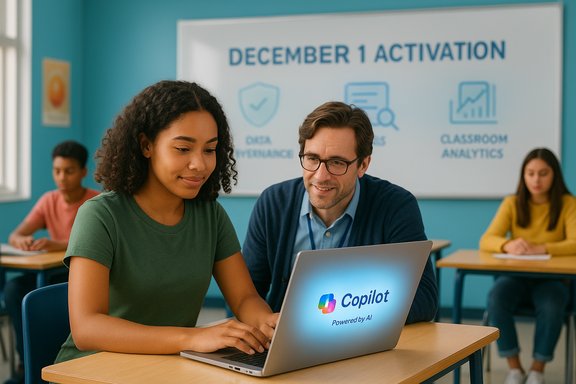
Pasco County Schools will allow limited student access to Microsoft Copilot beginning December 1, a cautiously staged move that formalizes months of teacher pilots and places the district among a growing number of Florida systems shifting from blanket bans to managed adoption of generative AI in K–12 classrooms.
Pasco’s decision follows a national momentum: school districts that previously prohibited student use of consumer chatbots are now experimenting with vendor‑backed, tenant‑grounded assistants that can be administered through existing identity and policy frameworks. District leaders say the rollout is pragmatic and iterative — teacher pilots first, phased student access for older learners, and a standing review process to update guidance as product capabilities and contracts change. The product being offered to Pasco students is Microsoft Copilot, the AI assistant embedded across Microsoft 365 applications. In practice, Copilot can draft and summarize text, generate practice quizzes, scaffold lesson content, and assist with accessibility tasks such as translation and reading‑level adaptation. District staff have already used Copilot for lesson planning and admin work, and the December activation will extend a limited student‑facing capability to high school accounts administered by the district. Pasco’s superintendent, Dr. John Legg, has framed the policy work as a living document: the district expects to revise guidelines frequently as vendor terms, features, and legal questions evolve. “The day we publish this is the day it is obsolete,” he told the school board, a line the district has repeated to underscore how quickly the AI landscape can change.
However, several fault lines remain:
If those governance steps are incomplete or deferred, the program risks the well‑documented pitfalls of premature scale: assessment erosion, privacy ambiguities, and unequal distribution of benefits. The coming semester’s telemetry and evaluation will be decisive. Pasco’s stated posture — pragmatic experimentation with teacher control and public accountability — is the right starting point; execution, transparency, and sustained investment will determine whether Copilot becomes a durable classroom ally or a contentious band‑aid for deeper pedagogical challenges.
Source: WFLA https://www.wfla.com/news/pasco-county/pasco-county-schools-embrace-ai-in-student-work/
 Background and overview
Pasco’s decision follows a national momentum: school districts that previously prohibited student use of consumer chatbots are now experimenting with vendor‑backed, tenant‑grounded assistants that can be administered through existing identity and policy frameworks. District leaders say the rollout is pragmatic and iterative — teacher pilots first, phased student access for older learners, and a standing review process to update guidance as product capabilities and contracts change. The product being offered to Pasco students is Microsoft Copilot, the AI assistant embedded across Microsoft 365 applications. In practice, Copilot can draft and summarize text, generate practice quizzes, scaffold lesson content, and assist with accessibility tasks such as translation and reading‑level adaptation. District staff have already used Copilot for lesson planning and admin work, and the December activation will extend a limited student‑facing capability to high school accounts administered by the district. Pasco’s superintendent, Dr. John Legg, has framed the policy work as a living document: the district expects to revise guidelines frequently as vendor terms, features, and legal questions evolve. “The day we publish this is the day it is obsolete,” he told the school board, a line the district has repeated to underscore how quickly the AI landscape can change. Why Pasco chose a managed Copilot approach
Practical IT and procurement reasons
Districts that already operate under Microsoft 365 tenancy tend to prefer Copilot because it can be provisioned inside the district’s tenant, enabling:- Institutional account control instead of unmanaged consumer sign‑ups.
- Application of Data Loss Prevention (DLP), retention, and sensitivity labeling through Microsoft Purview or equivalent tools.
- Administrative logging and telemetry export for auditing purposes.
- Negotiated contract terms that — in some SKUs — include non‑training assurances for institutional data.
Pedagogical reasoning
Pasco’s guidebook — a draft described publicly as a multi‑page operational handbook for teachers — frames AI as a scaffolding tool, not a substitute for learning. The recommended use cases in teacher pilots have been deliberately low‑risk:- Teacher productivity: drafting rubrics, lesson scaffolds, translation, and multi‑reading‑level adaptations.
- Low‑stakes student practice: generating practice quizzes, flashcards, and stepwise explanations.
- Accessibility support: simplified texts, translations for English learners, and alternate formats for students with special needs.
What the rollout will look like (operational details)
Who, when, and how
- Target group: high school students (district communications have cited age gating consistent with 13+ education SKUs).
- Activation date: December 1 (district officials and multiple local outlets have reported this activation date).
- Access controls: managed district accounts, admin‑enforced settings that limit some features and log usage, and teacher discretion about classroom‑level use.
Teacher professional development and support
Pasco’s plan includes short PD modules and instructional “champions” to model prompt craft, verification workflows, and assessment redesign. Teacher comfort with the tools — prompt literacy, detection of hallucinations, and appropriate assignment design — will be the single most important determinant of success. Early pilots indicate teacher PD should combine hands‑on prompt practice with concrete rubric rewrites and staged submission workflows.Strengths: what Pasco stands to gain
- Teacher time savings. Early pilots across districts report measurable reductions in time spent on lesson scaffolding and administrative drafting, freeing teachers for direct instruction and small‑group interventions.
- Personalized practice at scale. When configured conservatively, Copilot can generate retrieval practice items, flashcards, and short formative checks tailored to class materials, supporting remediation and mastery learning.
- Workforce‑relevant literacy. Introducing supervised AI use helps students learn to evaluate, edit, and verify machine outputs — a practical skillset increasingly valued in higher education and the job market.
- Administrative alignment. Selecting a vendor‑integrated assistant reduces the operational friction of identity, billing, and auditing because it leverages existing district systems rather than creating new, unmanaged touchpoints.
Risks and open governance questions
Contractual ambiguity and data governance
Vendor assurances about not using institutional prompts or files to train public models are significant — but they are contractual, not automatic. Districts must ensure procurement agreements explicitly:- Define which account types are covered (education tenant vs. consumer accounts).
- Include non‑training clauses for student prompts and uploaded files where possible.
- Specify retention windows, deletion procedures, and audit/export rights.
Assessment integrity and hallucinations
Generative models can produce polished outputs that obscure student reasoning or contain confident but incorrect facts (“hallucinations”). Detection tools exist but are imperfect. The durable strategy is assessment redesign that emphasizes process evidence:- Staged submissions with iterative drafts.
- Prompt-and-output logs plus reflective statements.
- Oral defenses, in‑class demonstrations, and portfolio assessments for high‑stakes evaluation.
Equity and access
AI advantages can amplify existing gaps if richer students access the technology more often or from better devices at home. District measures should include:- Device parity programs and scheduled lab time for students without home access.
- Opt‑out pathways with alternative assignments.
- Monitoring and reporting of usage by demographic cohorts to detect uneven benefits.
Feature volatility and vendor risk
Copilot’s capabilities, administrative features, and contractual terms can change rapidly. A vendor may alter retention defaults, entitlement checks, or data handling in ways that affect a school deployment. Pasco’s approach to convene a standing review group and treat policy as “living” is a necessary mitigation, but governance demands constant attention.Practical implementation checklist for districts (recommended)
- Confirm account provisioning: verify every student is assigned a managed, education‑tenant account before enabling Copilot.
- Lock down admin settings: disable unwanted features (for example, web browsing or code generation for particular classes) and turn on audit logging.
- Negotiate explicit contract language: non‑training, retention schedules, audit/export rights, and vendor transparency clauses. Treat vendor marketing as insufficient.
- Start with low‑stakes student pilots: formative practice, study guides, and scaffolded revision tasks rather than graded summative work.
- Require process artifacts for graded work: prompt logs, revision histories, and short reflections about how AI outputs were used.
- Run short PD sprints: prompt design, hallucination spotting, rubric redesign, and remediation workflows for misuse.
- Publish transparent communications: plain‑language guidance for parents, opt‑out processes, and a public schedule for policy review and evaluation metrics.
Measuring success: recommended metrics and cadence
To judge whether the December launch is meeting educational goals, Pasco should publish short‑cycle evaluations each semester that include:- Usage analytics: who used Copilot, in which classes, and for how long.
- Instructional outcomes: changes in completion rates for formative work, teacher‑reported time saved on prep, and qualitative teacher feedback.
- Integrity incidents: counts of misuse, remediation steps taken, and subsequent outcomes.
- Equity indicators: device parity, home broadband access, and whether benefits are equitably distributed.
Legal, parental, and community communications
Transparent communication is essential to reduce misinformation and parental concern. District messaging should include:- A clear description of permitted uses and the difference between formative vs. summative allowance.
- Explicit opt‑out options and alternative assignments for families who decline AI participation.
- Summaries of the contractual protections negotiated for student data (non‑training, retention windows), or at least a pledge to share contract highlights where legally permitted.
Comparison to neighboring districts and the broader Florida context
Pasco’s step is part of a patchwork of district responses in the Tampa Bay region and statewide. Neighboring Hillsborough County has produced a detailed AI manual that explicitly approves some tools but excludes consumer chatbots such as ChatGPT from approved lists, while other counties have moved more slowly or relied on general conduct rules. There are no statewide directives in Florida that mandate a single approach; districts are largely making independent choices. Pasco officials say they have studied neighboring plans as they craft their guidebook.Critical analysis: balanced perspective
Pasco’s staged, teacher‑centered model is aligned with emerging best practice: it privileges teacher judgment, leverages tenant‑grounded vendor offerings, and treats policy as a living document. These choices mitigate many operational risks and create a practical path to pilot AI in classrooms.However, several fault lines remain:
- Contractual clarity is not yet visible publicly; until procurement records or contract highlights are published, claims about non‑training and retention must be treated cautiously. This is a material risk that could change how student data is handled.
- Assessment redesign is difficult at scale. Altering grading practices to reward process over polish requires time, training, and buy‑in; it cannot be solved purely by technical controls or detection tools. Districts that move too fast without robust pedagogical change risk increasing academic dishonesty or deskilling.
- Equity remains unresolved. If benefits accrue primarily to students with better devices and home connectivity, the rollout could widen gaps unless the district pairs Copilot availability with device parity and scheduled in‑school lab time.
- Feature and contract volatility means that the operational picture may change after launch. The district’s commitment to continuous review is necessary but will require resources and governance capacity.
Recommendations for Pasco stakeholders (concise)
- For district leaders: publish the guidebook as an operational, living document; require explicit non‑training and retention clauses in procurement; fund ongoing PD and a standing review team; and commit to semesterly public evaluations.
- For teachers: treat Copilot outputs as drafts; require process logs and reflections for graded work; start with low‑stakes uses and redesign summative assessments to value process and reasoning.
- For parents: confirm whether accounts assigned to students are managed institutional accounts; ask for clarity on retention and deletion policies; and request opt‑out procedures if uncomfortable.
What remains uncertain or needs verification
- Exact contractual provisions for Pasco’s Copilot purchase (SKU, non‑training assurances, retention policies) were not posted in public procurement records at the time of reporting; these are decisive details that must be verified in signed contracts. Treat any vendor or district claims about data not being used to train models as provisional until the contract is published or summarized by the district.
- Precise admin settings that will be enabled at launch (which features will be disabled, retention windows, and logging export procedures) should be published by the district IT team prior to December 1 to allow community review.
Conclusion
Pasco County Schools’ decision to unlock Microsoft Copilot for high school students on December 1 is a consequential, pragmatic experiment in modern schooling. By phasing access through teacher pilots, managed district accounts, and a commitment to iterative policy updates, the district is following a cautious roadmap that many ed‑tech analysts and nearby districts recommend. If Pasco secures contractual guarantees for student data, invests in ongoing teacher training, redesigns assessments to value process evidence, and reports short‑cycle evaluation metrics publicly, the rollout could become a model for responsible K–12 AI adoption.If those governance steps are incomplete or deferred, the program risks the well‑documented pitfalls of premature scale: assessment erosion, privacy ambiguities, and unequal distribution of benefits. The coming semester’s telemetry and evaluation will be decisive. Pasco’s stated posture — pragmatic experimentation with teacher control and public accountability — is the right starting point; execution, transparency, and sustained investment will determine whether Copilot becomes a durable classroom ally or a contentious band‑aid for deeper pedagogical challenges.
Source: WFLA https://www.wfla.com/news/pasco-county/pasco-county-schools-embrace-ai-in-student-work/
