

The Microsoft AZ-900 certification still matters in 2026, but the best way to pass it is not by chasing shortcuts or memorizing question banks. It is by understanding how Microsoft now frames the exam: as a foundation in cloud concepts, Azure architecture, management, and governance, with the current skills outline updated for January 14, 2026. Microsoft’s own study guide makes clear that AZ-900 is aimed at candidates who want foundational cloud knowledge and a common starting point in an Azure career, not just a quick badge.
AZ-900: Microsoft Azure Fundamentals remains the entry point many learners use to break into cloud computing, and that role has only become more important as Azure expands across infrastructure, identity, security, data, and AI-adjacent services. Microsoft positions the exam as a fundamentals credential for people who want to demonstrate broad understanding rather than deep engineering specialization. That distinction matters because it shapes how you should study, how employers interpret the credential, and how you should use it as a stepping stone.
The exam blueprint has also become more structured. Microsoft’s current guide groups the content into three major areas: cloud concepts, Azure architecture and services, and Azure management and governance. Those areas are weighted in a way that tells you exactly where to focus your time: cloud concepts account for 25–30%, Azure architecture and services for 35–40%, and management and governance for 30–35%. In other words, this is not a pure definitions test. It rewards candidates who understand how Azure is organized and how Microsoft expects people to control it in production.
That shift reflects how cloud hiring has evolved. Entry-level cloud credentials used to be treated as optional nice-to-haves. Now they often serve as an employer-friendly signal that a candidate can speak the language of cloud platforms, understand basic cost and security tradeoffs, and navigate the most common Azure services. The credential is especially useful for beginners, career changers, students, and IT generalists who need a clean, recognized starting point.
At the same time, the market has become less forgiving of shallow preparation. A certificate alone is no longer enough to impress a hiring manager if it is not backed by at least some hands-on familiarity. That is why the strongest AZ-900 candidates use the exam as a structured introduction to Azure rather than a one-off test. They build a study plan, use Microsoft Learn, and practice with the concepts until they can explain them in plain English.
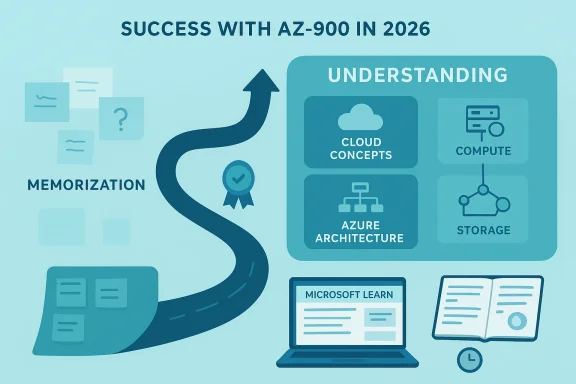
The most important shift for candidates is to stop thinking of the exam as “Azure trivia.” Instead, it is a test of whether you understand the why behind Azure services. For example, you are expected to know why cloud models differ, when high availability matters, and why organizations use governance tools to control spend and compliance. That is a very different mindset from memorizing product names.
Microsoft also highlights concepts that are easy to overlook if you only skim a prep course. These include the shared responsibility model, public/private/hybrid cloud models, consumption-based pricing, and serverless computing. Those topics are foundational because they shape how organizations choose, deploy, and secure cloud services. If you understand them, the rest of Azure becomes much easier to interpret.
A smart candidate treats those domains as separate study blocks, not as one giant pile of notes. That approach helps prevent the common mistake of overstudying one area while neglecting another. AZ-900 rewards balance more than obsession.
For beginners, the certification is valuable because it lowers the intimidation factor around cloud. Azure can feel vast, especially when you are new to IT. AZ-900 breaks the platform into understandable pieces and gives learners a framework for future specialization. That makes it a useful first rung on the ladder, not the ladder itself.
It is also one of the most employer-readable cloud credentials. A recruiter may not know the details of every Azure service, but they know what AZ-900 signals: foundational cloud knowledge and familiarity with Microsoft’s cloud ecosystem. In a crowded entry-level market, that signal can still help candidates stand out.
That dual role is what keeps it relevant. It is both an onboarding tool and a career signal. The more cloud-centric the job market becomes, the more useful that kind of credential remains.
This matters because many learners make the mistake of overvaluing service memorization. They spend too much time on individual service names and too little on the principles that tie those services together. Azure is best learned as a system, and the exam is built to test that system-level understanding.
A realistic prep strategy should therefore move from abstract to concrete. Learn cloud models first. Then learn how Azure delivers compute, storage, and networking. Finally, move into governance, pricing, and support options. That sequence mirrors how Microsoft itself presents the material.
Hands-on practice is more useful than many candidates expect. Even though AZ-900 is not a configuration-heavy exam, using Azure’s free tier or sandbox-style environments helps turn abstract concepts into real understanding. When you see a resource group, a storage account, or a virtual machine in context, the exam questions become easier to reason through.
Practice tests can help, but only if you use them intelligently. They should diagnose weak spots, not replace real learning. If you miss a question, the goal is not to memorize the right answer; it is to understand why the other options were wrong. That habit creates durable knowledge instead of fragile recall.
The reason this works is simple: AZ-900 is broad, not deep. You need familiarity with many ideas and enough confidence to recognize them under pressure. That is easier to build with spaced repetition than with last-minute memorization.
Hands-on work helps because cloud services are easier to remember when you have seen them in action. A storage account is more than a definition when you have created one, looked at access settings, or seen how it fits into a workload. The same is true for networking, governance, and identity basics.
There is also a psychological benefit. Beginners often feel overwhelmed by cloud terminology. A small amount of practical work cuts through that anxiety and makes the platform feel less abstract. That confidence boost can be as important as the technical knowledge itself.
If you can explain what a service does after using it, you are far more likely to retain the knowledge for exam day and beyond. The exam rewards this kind of understanding because many of the questions are scenario-oriented rather than purely definitional.
This is where many candidates get burned. They rely on old videos, outdated blog posts, or surface-level exam dumps that may no longer reflect current exam objectives. That approach can create false confidence and poor exam performance. It may also leave gaps that are obvious once the questions shift from recall to reasoning.
A better approach is to use Microsoft Learn as the canonical source and then supplement it with reputable practice tools. The right mix is official study material, clear explanations, and timed self-testing. That is enough for most candidates if they stay disciplined.
Exam-focused platforms can be helpful if they are treated as practice, not prophecy. The goal is to build skill, not to chase shortcuts. That distinction matters more than many first-time test takers realize.
Another common mistake is focusing too heavily on one domain. Some candidates obsess over compute services and neglect governance or pricing. Others do the reverse and memorize cloud concepts without learning Azure’s actual service structure. Balanced preparation matters because the exam itself is balanced.
A third mistake is relying on passive study resources without self-testing. If you never answer questions under time pressure, you may discover too late that you can recognize a concept in a video but cannot retrieve it from memory in an exam setting. That gap is one of the most common reasons beginners miss the pass mark.
The cure is boring but effective: official outline, steady practice, review of mistakes, and a calm test-day mindset. That combination is simple, but it works.
That progression matters because cloud careers are rarely built on one badge alone. Employers want to see curiosity, follow-through, and skill growth. AZ-900 can establish the vocabulary, but later credentials prove depth. The strongest candidates use fundamentals to get started and then build toward more specialized roles.
This is also where job relevance comes into play. A support technician, junior administrator, or student can use AZ-900 to show that they understand cloud at a business and operational level. That may not sound dramatic, but it often helps in interviews and internal promotions because it demonstrates readiness to learn and adapt.
The important lesson is that AZ-900 should not be a dead end. It should be the start of a sequence that matches your career direction. When used that way, it becomes far more valuable than a standalone badge.
Time management matters too. Do not get trapped by a single hard question early in the exam. Mark it, move on, and return later if needed. That approach preserves momentum and reduces the chance of spiraling into panic.
Confidence is helpful, but overconfidence can be dangerous. Many candidates lose points by assuming they understand a concept when they only know part of it. A careful second read often reveals the difference between the obviously correct answer and the merely familiar one.
That discipline helps protect the work you already did during preparation. In fundamentals exams, calm execution often matters as much as raw knowledge.
The biggest long-term change is not the exam itself but the expectation around how you use it. Employers increasingly want candidates who can combine foundational knowledge with practical judgment and a willingness to keep learning. That means AZ-900 should be treated as the start of a portfolio, not the end of one.
Source: tycoonstory.com Ultimate Guide to Passing Microsoft AZ-900 Certification with Confidence
 Background
AZ-900: Microsoft Azure Fundamentals remains the entry point many learners use to break into cloud computing, and that role has only become more important as Azure expands across infrastructure, identity, security, data, and AI-adjacent services. Microsoft positions the exam as a fundamentals credential for people who want to demonstrate broad understanding rather than deep engineering specialization. That distinction matters because it shapes how you should study, how employers interpret the credential, and how you should use it as a stepping stone.The exam blueprint has also become more structured. Microsoft’s current guide groups the content into three major areas: cloud concepts, Azure architecture and services, and Azure management and governance. Those areas are weighted in a way that tells you exactly where to focus your time: cloud concepts account for 25–30%, Azure architecture and services for 35–40%, and management and governance for 30–35%. In other words, this is not a pure definitions test. It rewards candidates who understand how Azure is organized and how Microsoft expects people to control it in production.
That shift reflects how cloud hiring has evolved. Entry-level cloud credentials used to be treated as optional nice-to-haves. Now they often serve as an employer-friendly signal that a candidate can speak the language of cloud platforms, understand basic cost and security tradeoffs, and navigate the most common Azure services. The credential is especially useful for beginners, career changers, students, and IT generalists who need a clean, recognized starting point.
At the same time, the market has become less forgiving of shallow preparation. A certificate alone is no longer enough to impress a hiring manager if it is not backed by at least some hands-on familiarity. That is why the strongest AZ-900 candidates use the exam as a structured introduction to Azure rather than a one-off test. They build a study plan, use Microsoft Learn, and practice with the concepts until they can explain them in plain English.
What AZ-900 Actually Measures
AZ-900 is not an advanced technical exam, but that does not make it easy. It measures whether you understand the core cloud vocabulary and the essential building blocks of Microsoft Azure. Microsoft says candidates should be able to describe Azure architectural components and services such as compute, networking, and storage, along with the tools used to secure, govern, and administer Azure environments.The most important shift for candidates is to stop thinking of the exam as “Azure trivia.” Instead, it is a test of whether you understand the why behind Azure services. For example, you are expected to know why cloud models differ, when high availability matters, and why organizations use governance tools to control spend and compliance. That is a very different mindset from memorizing product names.
Microsoft also highlights concepts that are easy to overlook if you only skim a prep course. These include the shared responsibility model, public/private/hybrid cloud models, consumption-based pricing, and serverless computing. Those topics are foundational because they shape how organizations choose, deploy, and secure cloud services. If you understand them, the rest of Azure becomes much easier to interpret.
The three skill domains
The study guide’s structure gives you a practical map for preparation. First, you need cloud concepts: what cloud computing is, what cloud models exist, and what benefits cloud services provide. Second, you need architectural literacy: compute, networking, storage, and core services. Third, you need operational awareness: management, governance, identity, pricing, and support.A smart candidate treats those domains as separate study blocks, not as one giant pile of notes. That approach helps prevent the common mistake of overstudying one area while neglecting another. AZ-900 rewards balance more than obsession.
- Understand cloud basics before touching service names.
- Learn the purpose of each major Azure service family.
- Study pricing and governance as seriously as compute and storage.
- Review the exam outline directly from Microsoft Learn.
- Use scenario-based questions to test understanding, not recall.
Why AZ-900 Still Matters
The exam continues to matter because it creates a shared baseline. Employers do not expect an AZ-900 holder to design a global enterprise landing zone, but they do expect the person to understand what Azure is, how cloud pricing works, and why certain governance controls exist. That baseline reduces onboarding friction and makes collaboration easier across teams.For beginners, the certification is valuable because it lowers the intimidation factor around cloud. Azure can feel vast, especially when you are new to IT. AZ-900 breaks the platform into understandable pieces and gives learners a framework for future specialization. That makes it a useful first rung on the ladder, not the ladder itself.
It is also one of the most employer-readable cloud credentials. A recruiter may not know the details of every Azure service, but they know what AZ-900 signals: foundational cloud knowledge and familiarity with Microsoft’s cloud ecosystem. In a crowded entry-level market, that signal can still help candidates stand out.
Enterprise value versus personal value
In enterprise settings, AZ-900 is useful because it supports hiring, internal mobility, and cross-functional collaboration. In personal career development, it is valuable because it gives you a guided introduction to cloud vocabulary and concepts that will recur in more advanced certifications. The credential is small, but its framing is strategic.That dual role is what keeps it relevant. It is both an onboarding tool and a career signal. The more cloud-centric the job market becomes, the more useful that kind of credential remains.
- It helps beginners build cloud confidence.
- It gives employers a standardized baseline.
- It supports later certifications such as AZ-104 or AZ-305.
- It clarifies Azure’s architecture before deeper specialization.
- It can improve interview performance by strengthening vocabulary.
How the Exam Is Structured
Microsoft’s current study guide shows that the exam is organized around a predictable skill hierarchy. The largest portion focuses on Azure architecture and services, which tells you that Microsoft wants candidates to understand the platform’s practical building blocks. Cloud concepts and management/governance remain substantial enough that they can easily determine the difference between passing and failing.This matters because many learners make the mistake of overvaluing service memorization. They spend too much time on individual service names and too little on the principles that tie those services together. Azure is best learned as a system, and the exam is built to test that system-level understanding.
A realistic prep strategy should therefore move from abstract to concrete. Learn cloud models first. Then learn how Azure delivers compute, storage, and networking. Finally, move into governance, pricing, and support options. That sequence mirrors how Microsoft itself presents the material.
A practical preparation sequence
- Read the current AZ-900 skills guide on Microsoft Learn.
- Break the guide into the three skill domains.
- Study cloud concepts until you can explain them simply.
- Learn the major Azure service categories and what they do.
- Finish with governance, pricing, and support topics.
- Take practice tests and review every incorrect answer carefully.
- Start with definitions and models.
- Move to service families and use cases.
- End with pricing, governance, and support.
- Use repetition instead of last-minute cramming.
- Test yourself in short timed sessions.
Best Study Strategy for Beginners
The best AZ-900 prep strategy is structured, repeated, and practical. Microsoft Learn should be your anchor because it reflects the official exam language and current skills outline. From there, build a study schedule that moves in short sessions rather than marathon reading blocks. Consistency beats intensity for an entry-level fundamentals exam.Hands-on practice is more useful than many candidates expect. Even though AZ-900 is not a configuration-heavy exam, using Azure’s free tier or sandbox-style environments helps turn abstract concepts into real understanding. When you see a resource group, a storage account, or a virtual machine in context, the exam questions become easier to reason through.
Practice tests can help, but only if you use them intelligently. They should diagnose weak spots, not replace real learning. If you miss a question, the goal is not to memorize the right answer; it is to understand why the other options were wrong. That habit creates durable knowledge instead of fragile recall.
What a good weekly plan looks like
A good plan usually mixes reading, video, and quiz work. One week can cover cloud concepts, another can cover compute and storage, and a third can cover governance and pricing. The final week should be mostly review and timed practice. Short daily sessions are usually better than a single long weekend cram.The reason this works is simple: AZ-900 is broad, not deep. You need familiarity with many ideas and enough confidence to recognize them under pressure. That is easier to build with spaced repetition than with last-minute memorization.
- Study in 30- to 60-minute blocks.
- Review previous topics before starting new ones.
- Keep a running list of weak areas.
- Revisit cloud concepts multiple times.
- Use the final days for light review, not new material.
The Role of Hands-On Experience
Although AZ-900 is entry-level, it still benefits from practical exposure. You do not need to be a cloud engineer to understand the exam, but you do need enough familiarity with Azure to make the concepts feel real. That is especially true for learners coming from non-technical backgrounds.Hands-on work helps because cloud services are easier to remember when you have seen them in action. A storage account is more than a definition when you have created one, looked at access settings, or seen how it fits into a workload. The same is true for networking, governance, and identity basics.
There is also a psychological benefit. Beginners often feel overwhelmed by cloud terminology. A small amount of practical work cuts through that anxiety and makes the platform feel less abstract. That confidence boost can be as important as the technical knowledge itself.
Why labs beat passive reading
Passive reading creates the illusion of readiness. Labs and guided exercises reveal whether you actually understand how Azure behaves. That is why the most successful candidates blend theory with practical exploration, even at the fundamentals level.If you can explain what a service does after using it, you are far more likely to retain the knowledge for exam day and beyond. The exam rewards this kind of understanding because many of the questions are scenario-oriented rather than purely definitional.
- Use the Azure free tier when possible.
- Create a few basic resources just to see how they relate.
- Read the portal labels and service categories carefully.
- Tie each lab action to a concept from the study guide.
- Keep notes in your own words, not copied definitions.
Choosing Study Resources Wisely
Not every AZ-900 prep resource is equal. The best ones align with Microsoft’s current exam guide and do not overpromise easy results. A resource that is years out of date can teach the wrong emphasis, especially when Microsoft revises skill weightings or renames topics. The 2026 study guide is a reminder that certification prep should always be checked against the latest official outline.This is where many candidates get burned. They rely on old videos, outdated blog posts, or surface-level exam dumps that may no longer reflect current exam objectives. That approach can create false confidence and poor exam performance. It may also leave gaps that are obvious once the questions shift from recall to reasoning.
A better approach is to use Microsoft Learn as the canonical source and then supplement it with reputable practice tools. The right mix is official study material, clear explanations, and timed self-testing. That is enough for most candidates if they stay disciplined.
What to look for in a prep platform
Good prep resources share a few traits. They are current, exam-aligned, and explanatory rather than purely rote. They also help you understand not just what the answer is, but why it is the answer.Exam-focused platforms can be helpful if they are treated as practice, not prophecy. The goal is to build skill, not to chase shortcuts. That distinction matters more than many first-time test takers realize.
- Current exam alignment.
- Clear explanations for each answer.
- Coverage of all three AZ-900 skill domains.
- Timed practice mode.
- Progress tracking.
- Explanations that go beyond memorization.
Common Mistakes Candidates Make
The biggest mistake is underestimating the exam because it is labeled “Fundamentals.” That label can be misleading. The exam is entry-level, but it still covers a broad body of knowledge, and broad exams punish vague preparation.Another common mistake is focusing too heavily on one domain. Some candidates obsess over compute services and neglect governance or pricing. Others do the reverse and memorize cloud concepts without learning Azure’s actual service structure. Balanced preparation matters because the exam itself is balanced.
A third mistake is relying on passive study resources without self-testing. If you never answer questions under time pressure, you may discover too late that you can recognize a concept in a video but cannot retrieve it from memory in an exam setting. That gap is one of the most common reasons beginners miss the pass mark.
Mistakes that cost easy points
Many failed attempts come down to avoidable habits, not lack of intelligence. Candidates often rush, skip official materials, or ignore the explanations behind practice questions. Those habits make the exam feel harder than it needs to be.The cure is boring but effective: official outline, steady practice, review of mistakes, and a calm test-day mindset. That combination is simple, but it works.
- Studying only from outdated material.
- Treating fundamentals as if they require no preparation.
- Ignoring pricing and governance topics.
- Skipping practice exams.
- Not reviewing wrong answers.
- Cramming the night before.
How AZ-900 Fits Into a Career Path
AZ-900 is most valuable when it is treated as the beginning of a sequence. Microsoft’s certification ecosystem is designed so that fundamentals can lead into more job-specific credentials. A learner who starts with AZ-900 can later move toward administration, architecture, security, data, or AI-focused paths depending on career goals.That progression matters because cloud careers are rarely built on one badge alone. Employers want to see curiosity, follow-through, and skill growth. AZ-900 can establish the vocabulary, but later credentials prove depth. The strongest candidates use fundamentals to get started and then build toward more specialized roles.
This is also where job relevance comes into play. A support technician, junior administrator, or student can use AZ-900 to show that they understand cloud at a business and operational level. That may not sound dramatic, but it often helps in interviews and internal promotions because it demonstrates readiness to learn and adapt.
Good next steps after AZ-900
What comes next depends on the role you want. If you want to administer Azure environments, AZ-104 is the logical next step. If you want to design solutions, AZ-305 becomes relevant. If your interests lean into security, data, or AI, Microsoft’s other role-based fundamentals and associate tracks can build from the same base.The important lesson is that AZ-900 should not be a dead end. It should be the start of a sequence that matches your career direction. When used that way, it becomes far more valuable than a standalone badge.
- Use AZ-900 as a launch point, not a finish line.
- Pick a second certification that matches your job goals.
- Build hands-on experience alongside the credential.
- Connect the exam to a real role or project.
- Keep learning after the pass.
Exam Day Tactics That Actually Help
Exam day is less about learning and more about execution. You should already know the material; the job is to stay calm and avoid careless mistakes. Reading each question slowly is one of the simplest ways to improve your score because Azure exams often rely on subtle wording.Time management matters too. Do not get trapped by a single hard question early in the exam. Mark it, move on, and return later if needed. That approach preserves momentum and reduces the chance of spiraling into panic.
Confidence is helpful, but overconfidence can be dangerous. Many candidates lose points by assuming they understand a concept when they only know part of it. A careful second read often reveals the difference between the obviously correct answer and the merely familiar one.
A simple test-day checklist
The best approach on exam day is routine, not improvisation. Get enough sleep, arrive early, and avoid cramming right before the test. If possible, spend the final hour doing light review of your weakest areas rather than opening new topics.That discipline helps protect the work you already did during preparation. In fundamentals exams, calm execution often matters as much as raw knowledge.
- Sleep well the night before.
- Read every question carefully.
- Eliminate obviously wrong answers first.
- Mark difficult items for review.
- Use the final minutes to double-check your reasoning.
Strengths and Opportunities
AZ-900 remains a strong credential because it is easy to explain to employers, useful for beginners, and tied to a platform that continues to dominate enterprise cloud conversations. It is especially effective when paired with hands-on practice and a clear plan for what comes next. Microsoft’s current guide also makes preparation more transparent than in the past, which is a real advantage for first-time candidates.- Clear entry point into Azure.
- Employer-recognized fundamentals credential.
- Good fit for students and career changers.
- Useful foundation for later role-based certs.
- Strong Microsoft Learn support.
- Helpful for cloud vocabulary and interviews.
- Broad coverage across cloud, services, and governance.
Risks and Concerns
The main risk is assuming that “fundamentals” means “easy enough to wing.” That assumption leads to under-preparation, shallow understanding, and disappointment on test day. Another risk is relying too heavily on outdated or low-quality prep material, especially if it overfocuses on shortcuts rather than concepts.- Overconfidence because it is an entry-level exam.
- Outdated study guides or practice material.
- Too much memorization, too little understanding.
- Insufficient practice under timed conditions.
- Treating the badge as a substitute for experience.
- Ignoring governance, pricing, and support topics.
- Failing to connect the exam to a real career path.
Looking Ahead
AZ-900 will likely remain important because it sits at the exact intersection where cloud curiosity becomes cloud fluency. Microsoft’s 2026 skills guide confirms that the exam is still being actively maintained, which is a good sign for candidates who want a current and credible entry point into Azure. The more Microsoft expands its cloud and governance footprint, the more useful this fundamentals layer becomes.The biggest long-term change is not the exam itself but the expectation around how you use it. Employers increasingly want candidates who can combine foundational knowledge with practical judgment and a willingness to keep learning. That means AZ-900 should be treated as the start of a portfolio, not the end of one.
- Follow the current Microsoft Learn study guide.
- Pair theory with small Azure labs.
- Plan a next-step certification early.
- Build job-relevant projects while studying.
- Keep your prep aligned with the latest exam outline.
Source: tycoonstory.com Ultimate Guide to Passing Microsoft AZ-900 Certification with Confidence
