

The discovery of CVE-2022-47673 exposes a subtle but consequential memory-safety problem inside GNU Binutils’ addr2line utility: the function parse_module performs unchecked reads that can step outside buffer bounds in versions before 2.39.3, creating an out‑of‑bounds read that can crash addr2line or otherwise produce unspecified impacts. The flaw has been given a High base severity by NVD (CVSS v3.1 base score 7.8) and vendors and distributions have shipped patches or updates to address the defect; operators who rely on addr2line in automated workflows, CI/CD, crash-analysis pipelines, or developer toolchains should treat this as a production‑impact risk and update immediately.
addr2line is a core diagnostic tool in the GNU Binutils suite. Given an executable and one or more instruction addresses, addr2line maps addresses to the corresponding source filename and line number using embedded debug information; it’s commonly used in crash analysis, symbolication of stack traces, and automated tooling that translates addresses into human‑readable locations. Because addr2line is simple to call and easy to script, it frequently appears inside build pipelines, CI systems, error aggregation services, and forensic utilities.
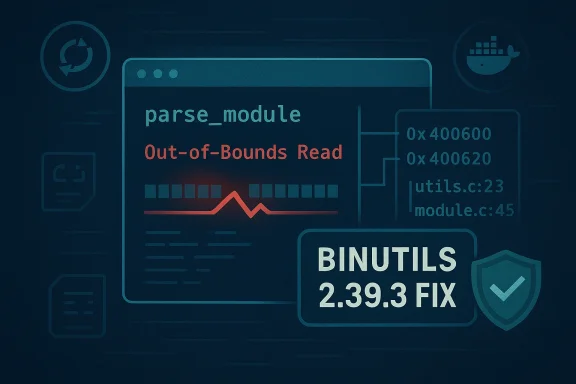
The vulnerability tracked as CVE‑2022‑47673 was published on August 22, 2023 and concerns addr2line implementations in Binutils prior to 2.39.3. The root cause is multiple out‑of‑bounds reads within the parse_module function (reported in the upstream tracking entry referenced by the NVD). Upstream and downstream advisories characterize the direct impact as a denial‑of‑service (program crash) and caution that other unspecified impacts are possible, depending on input conditions and deployment context.
It bears repeating that upstream bug-tracking (Sourceware/Bugzilla) is the canonical tracking location for this issue; NVD and other databases reference Bugzilla entry 29876 as the primary report. Direct access to the Sourceware bug page may be blocked in some environments, but the NVD and multiple distro security trackers reproduce the essential technical summary and the fix boundary (<= 2.39.3).
Caveat: while multiple reputable trackers and vendor advisories converge on the same technical summary and remediation path, some of the deeper code‑level artifacts (for instance, the upstream Bugzilla page and certain diffs) may be restricted or blocked in particular networks. Where primary upstream data is not accessible, rely on the NVD and your distribution’s security tracker for actionable remediation, and treat any claims about exploitation beyond crash behavior as unconfirmed unless a proof‑of‑concept or vendor reproduction is published.
In short: patch Binutils now if addr2line is in your environment, rebuild affected CI images, and treat any automated processing of external debug artifacts as untrusted until you can verify isolation and coverage.
Source: MSRC Security Update Guide - Microsoft Security Response Center
 Background / Overview
addr2line is a core diagnostic tool in the GNU Binutils suite. Given an executable and one or more instruction addresses, addr2line maps addresses to the corresponding source filename and line number using embedded debug information; it’s commonly used in crash analysis, symbolication of stack traces, and automated tooling that translates addresses into human‑readable locations. Because addr2line is simple to call and easy to script, it frequently appears inside build pipelines, CI systems, error aggregation services, and forensic utilities.The vulnerability tracked as CVE‑2022‑47673 was published on August 22, 2023 and concerns addr2line implementations in Binutils prior to 2.39.3. The root cause is multiple out‑of‑bounds reads within the parse_module function (reported in the upstream tracking entry referenced by the NVD). Upstream and downstream advisories characterize the direct impact as a denial‑of‑service (program crash) and caution that other unspecified impacts are possible, depending on input conditions and deployment context.
How the bug fits into real toolchains
Why addr2line matters far beyond a developer laptop
While addr2line is a small utility, its role amplifies risk because it is often called automatically and sometimes on data that’s not strictly trusted:- Crash-reporting servers and aggregation tools run addr2line to symbolicate backtraces produced by clients, CI jobs, or automated fuzzers.
- Build systems and packaging pipelines call Binutils utilities, including addr2line, to process debug info, generate symbol maps, or validate artifacts.
- Security analysts and automated scanners may run addr2line against uploaded artifacts or third‑party binaries to extract location information.
Attack scope and preconditions
The public records classify the attack vector as Local and the user interaction as Required: addr2line processes input files and addresses supplied either interactively or by script, so exploitation normally demands that the attacker can cause the vulnerable utility to parse a crafted file or feed it a crafted address string. The NVD vector string is CVSS:3.1/AV:L/AC:L/PR:N/UI:R/S:U/C:H/I:H/A:H, which reflects local access with low complexity but some required user interaction. In short, the vulnerability is not a remote network worm — its risk is highest in contexts where addr2line runs automatically on data from untrusted sources.Technical analysis
What the public reports say about the code path
Public vulnerability summaries and enrichment records indicate the out‑of‑bounds reads occur in the parse_module routine; some vendor writeups and vulnerability analysts point specifically at vms-alpha.c’s parsing logic (where the code parses certain debug or module records). The crux is insufficient bounds verification before indexing into a parsed record, allowing reads past the allocated buffer when the record length fields are malformed or maliciously constructed. Multiple independent vulnerability databases and advisories list the same root cause (CWE‑125 — out‑of‑bounds read).It bears repeating that upstream bug-tracking (Sourceware/Bugzilla) is the canonical tracking location for this issue; NVD and other databases reference Bugzilla entry 29876 as the primary report. Direct access to the Sourceware bug page may be blocked in some environments, but the NVD and multiple distro security trackers reproduce the essential technical summary and the fix boundary (<= 2.39.3).
What’s not confirmed
- There is no authoritative public evidence that this specific bug enables arbitrary remote code execution. Public advisories consistently describe denial of service (crash) and “other unspecified impacts,” but they stop short of confirming RCE or information disclosure in practice.
- Whether exploitation can reliably leak secrets from surrounding process memory depends on the platform, compiler/build options, and how addr2line is invoked; those properties vary widely between environments, and the vendors do not assert data extraction as a confirmed effect. Where vendors do report confidentiality and integrity impacts in CVSS (NVD’s vector marks high impact), that is an upstream scoring assessment rather than proof of an observed exploit chain. Treat any claim of data disclosure as unverified unless backed by a proof‑of‑concept or vendor reproduction.
Severity, exploitability and evidence
- NVD assigns a CVSS v3.1 base score of 7.8 (High) for CVE‑2022‑47673 and indicates the potential for confidentiality, integrity, and availability impacts. The vector string (AV:L/AC:L/PR:N/UI:R/S:U/C:H/I:H/A:H) is worth quoting to understand the tradeoffs: local attacker, low complexity, no privileges required but user interaction necessary.
- Vendor/distro scoring diverges: Amazon Linux’s advisory classifies the issue as Medium with a lower CVSS representation (CVSS 5.5 in the Amazon listing), reflecting differences in product exposure models and mitigation posture. This divergence is common: one vulnerability can be scored differently depending on perceived deployment context and whether the vendor views confidentiality disclosure as credible. Operators should prioritize the NVD and their own distro advisories for concrete remediation steps.
- Predicted exploitation is low at the time of disclosure and in later EPSS measures. Several aggregators show low EPSS percentiles (for example, Snyk and other trackers record very low short‑term exploit probability), indicating that automated or widespread weaponization has not been observed or is impractical in common environments. That said, low EPSS is not a reason to delay patching — it simply means attackers have not prioritized this vector.
Fixes and vendor responses
Upstream and package fixes
The upstream fix boundary is Binutils 2.39.3. The fix was introduced in the Binutils maintenance track and vendors have either upgraded packages or backported patches depending on distribution policy. Multiple downstream advisories confirm fixed packages are available for major distributions; Debian, Ubuntu, openSUSE/SUSE, Amazon Linux and other distributions published security tracker entries and updated packages to deliver the fix or workaround. Operators should consult their distro’s security tracker and package lists to confirm their installed binutils version and apply vendor updates.What to update
- Where you manage systems directly, update the binutils package to a version >= 2.39.3 (or the vendor’s fixed package version). Some distributions use different package version strings or backport the fix into an earlier numbering scheme; always prefer your distro’s security advisory and version numbers. For example, Debian’s security tracker shows the fixed package lines for Debian releases; SUSE lists its patched package versions.
- On build hosts and containers, rebuild CI images and base images that include Binutils; ephemeral build runners are a common place to miss updates. If you use pinned images in CI, rotate those images and rebuild all reproducible artifacts that depend on Binutils so that your pipelines no longer call the vulnerable addr2line. Several downstream advisories explicitly call out build infrastructure as a place to remediate.
Practical remediation checklist (quick action plan)
- Inventory
- Check whether Binutils is installed and confirm the version: run
addr2line --versionor check the package manager (e.g.,dpkg -l binutilsorrpm -q binutils) to find if the installed version is older than 2.39.3. - Patch
- Apply your vendor’s binutils security update immediately. If your distro backported the fix into a different package version, install the vendor-supplied update listed in the security advisory.
- Rebuild tool images
- Rebuild CI/CD images, containers, and developer toolkits that bundle binutils so that automated processes stop invoking the vulnerable binary.
- Hardening (compensating controls)
- Avoid parsing untrusted debug info with host tooling. Where addr2line runs on inputs from external sources, run it in constrained contexts (unprivileged containers, chroot, seccomp, or dedicated analysis hosts) to limit impact of crashes or memory issues.
- Monitor
- Look for crashes or unusual exits from addr2line in logs on build servers, crash-aggregation workers, and other tooling that might process symbol data; treat unexpected segfaults and core dumps as indicators of attempted exploitation or malformed input sources.
- Validate vendor guidance
- Confirm the patch status for each distribution from its security tracker and follow any additional vendor‑specific recommendations.
Hardening recommendations beyond patching
Even after deploying the update, consider longer‑term hardening that reduces operational attack surface:- Treat all file inputs as untrusted. Symbol files, core dumps, and uploaded binaries should be validated in an isolated environment before they are fed into centralized tooling.
- Run diagnostic utilities used in pipelines under least privilege and within container sandboxes. A crash of an analysis helper should not bring down orchestration masters or CI runners.
- Use process-level containment for tools that parse externally sourced binary artifacts: CPU and memory cgroups, ephemeral containers, and timeouts reduce the risk that repeated malformed inputs produce persistent denial‑of‑service conditions.
- Where possible, prefer language-level symbolication libraries that provide safer parsing or come with memory-safety benefits (for example, tooling written in memory-safe languages) for front‑line processing, relegating native addr2line calls to trusted offline steps.
- Add automated assertions and sanitizers in developer testing environments; fuzzing and sanitizer runs on toolchains can surface similar parsing errors before they reach production.
Operational impact scenarios — what to watch for
- Crash loops on symbolication servers: If a central crash aggregation node receives crafted artifacts, it may repeatedly invoke addr2line and crash, causing backlog and sustained denial of service for new crash reports.
- CI pipeline failures: Package build jobs that call addr2line for debug-info processing may fail or block, delaying releases or automatic tests.
- Supply‑chain visibility: Third‑party binaries and debug info included in supply‑chain artifacts (packaging feeds, shared storage) could carry malformed records; unvetted automation that processes those files is a particularly exposed vector.
- Forensic tool interference: Security monitoring and forensics systems that symbolicate or analyze user-supplied artifacts may be forced offline or produce incomplete results if addr2line is subverted into crashing frequently.
Evidence and cross‑checking: what the records say
I cross‑checked the public tracking and vendor records when preparing this feature:- The NVD entry for CVE‑2022‑47673 provides the canonical vulnerability description, the CVSS vector and score, and points to the upstream bugzilla record (Bugzilla 29876) as the root tracker. This is the principal authoritative record used by downstream consumers.
- Multiple distribution security trackers reproduce the NVD description and list fixed package versions: Debian’s security tracker and SUSE’s security advisory list fixed packages or backports. Those downstream advisories are the practical source of package updates for operators.
- Security aggregators (Snyk, Aqua, Rapid7, and similar) repeat the technical summary and add EPSS or distribution‑specific remediation guidance; these sources show consensus on the root cause (out‑of‑bounds read in parse_module) and reiterate the fix boundary at 2.39.3. The EPSS evidence indicates a low probability of mass exploitation to date.
- Several vulnerability databases and analyst writeups specify vms-alpha.c and the DST_K record parsers as the affected code paths; however, the original upstream bugzilla page is the authoritative code-level tracker (which some networks may block). Where the upstream bug details aren’t directly accessible, vendors still reference the same Bugzilla ID and NVD entry so the public consensus is well‑anchored. Treat any code-level claim beyond an out‑of‑bounds read as contingent on access to the upstream patch and code diff.*
Risk assessment — who should worry most
- Large organizations that run centralized crash ingestion and symbolication services should prioritize immediate patching and containment. The risk is highest where addr2line is exposed to externally generated debug information or is invoked on files produced by untrusted CI jobs.
- Build and packaging servers that process arbitrary third‑party artifacts are at risk because an attacker who can submit a crafted artifact could trigger repeated crashes and persistent denial of service.
- Desktop developers and isolated developer hosts are lower risk if they only run addr2line interactively on their own code; the exposure increases when those hosts are used as part of automated systems or when they process files from unknown sources.
Final verdict and guidance
CVE‑2022‑47673 is a straightforward memory‑safety bug in a widely used diagnostic tool: the fix exists, the impact is clear enough to merit prompt remediation, and the operational complexity of fully isolating addr2line from untrusted inputs is non‑trivial for many organizations. The pragmatic path is direct:- Confirm whether you run a vulnerable Binutils version (earliest check).
- Apply vendor patches or upgrade Binutils to a fixed package (>= 2.39.3 upstream or vendor-supplied fixed versions).
- Rebuild CI and host images that include Binutils.
- Add sandboxing and input‑validation controls to any automation that runs addr2line on external artifacts.
Appendix — quick facts (at a glance)
- Vulnerability: CVE‑2022‑47673 — out‑of‑bounds read in addr2line’s parse_module function.
- Affected upstream versions: Binutils before 2.39.3 (upstream fix in 2.39.3).
- Primary impact: Denial of Service (crash); other unspecified impacts possible.
- CVSS (NVD): 7.8 (High), vector CVSS:3.1/AV:L/AC:L/PR:N/UI:R/S:U/C:H/I:H/A:H.
- Practical mitigation: update binutils via your distribution’s package manager and isolate addr2line in automation.
Caveat: while multiple reputable trackers and vendor advisories converge on the same technical summary and remediation path, some of the deeper code‑level artifacts (for instance, the upstream Bugzilla page and certain diffs) may be restricted or blocked in particular networks. Where primary upstream data is not accessible, rely on the NVD and your distribution’s security tracker for actionable remediation, and treat any claims about exploitation beyond crash behavior as unconfirmed unless a proof‑of‑concept or vendor reproduction is published.
In short: patch Binutils now if addr2line is in your environment, rebuild affected CI images, and treat any automated processing of external debug artifacts as untrusted until you can verify isolation and coverage.
Source: MSRC Security Update Guide - Microsoft Security Response Center
