

Payhawk released its Summer ’26 Edition on June 11, 2026, adding more than 30 finance-platform updates led by a native SAP S/4HANA Cloud, Public Edition integration for synchronising expenses, payments, and master data. The announcement is not just another SaaS release-note bundle; it is a bet that spend management vendors win enterprise accounts by disappearing into the systems finance teams already trust. For WindowsForum readers, the interesting part is not Payhawk’s branding, but the familiar enterprise pattern underneath it: integration gravity, identity-aware controls, Teams-native workflows, and the continuing push to make back-office software feel less like back-office software.
Spend management software has spent years trying to escape the corporate-card niche. The early pitch was simple enough: give employees cards, capture receipts, enforce policy, and stop drowning finance teams in expense reports. But the enterprise market has a way of punishing simplicity once a product starts touching tax, audit trails, multi-entity accounting, procurement, cross-border payments, and month-end close.
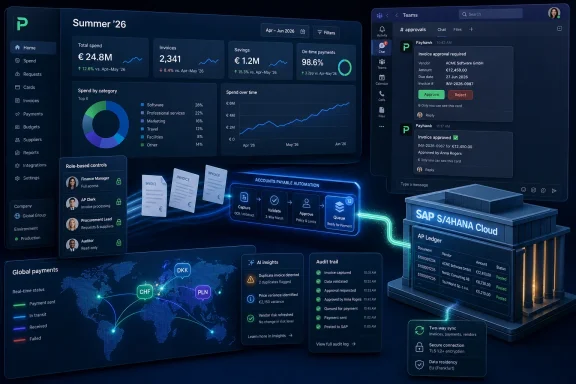
That is why Payhawk’s SAP S/4HANA integration matters more than the sheer number of updates in the Summer ’26 Edition. A native connector to SAP’s public-cloud ERP puts Payhawk closer to the ledger of record, where finance leaders make software decisions less on user delight and more on whether the numbers survive audit, consolidation, and close. The vendor’s promise is that expenses, payments, and master data move directly between Payhawk and SAP without the ritual of CSV exports, batch uploads, and reconciliations that tend to accumulate around financial SaaS.
The company is also careful to frame the move as enterprise readiness without enterprise unpleasantness. That is a familiar line in software marketing, but it speaks to a real procurement tension. Finance teams want controls; employees want not to become unpaid data-entry clerks; IT wants fewer fragile integrations; auditors want consistency; and the CFO wants all of it without adding headcount to police the seams.
Payhawk’s release therefore lands in a market where the most important feature is often not a feature at all. It is the ability to sit cleanly between employee spending behavior and the ERP system that must eventually account for it.
Expense systems that look efficient during the month can still leave accounting teams cleaning up mismatched categories, missing receipts, delayed card settlements, FX fees, bank charges, and duplicate records. If approved spend is not reflected in the ERP until someone runs an export or fixes a failed import, the system has merely moved the work rather than removed it. Payhawk’s pitch is that posting spend as the process unfolds reduces the backlog that finance teams typically discover when the books need to close.
That does not mean the integration eliminates complexity. SAP environments are rarely pristine, and S/4HANA Cloud, Public Edition customers still operate with configured business processes, authorization models, master data dependencies, and local compliance demands. Any third-party connector must respect those boundaries, and the setup process still requires administrator access, communication arrangements, SAP permissions, and the usual care around technical users and data mapping.
But the direction of travel is clear. Spend-management vendors are no longer competing only on card controls or receipt OCR. They are competing on how much accounting friction they can remove before a transaction reaches the general ledger.
That is why “native” carries so much weight in this release. It is a word vendors overuse, but in enterprise finance it points to something concrete: fewer intermediary systems, fewer transformation layers, and fewer places where ownership becomes ambiguous. If Payhawk truly owns and maintains the SAP connection itself, customers have a simpler support chain than they would with an integration assembled from generic connectors and consulting glue.
The competitive backdrop is obvious. SAP, Oracle, Microsoft Dynamics, and NetSuite remain the gravitational bodies around which finance operations orbit. A spend platform that cannot live comfortably with those systems risks staying departmental, useful for employee expenses but not strategic enough for broader finance transformation.
Payhawk’s Summer ’26 Edition also expands expense-report export capabilities and automated ERP master data synchronization for NetSuite and Microsoft Dynamics. That matters because few enterprises standardize globally on one clean architecture. Mergers, regional subsidiaries, and phased ERP migrations often leave finance teams managing a mixed estate, where the winning tool is the one that can support reality rather than the architecture diagram.
Role-based visibility lets finance teams determine what individual users can view or edit. That can support segregation of duties, reduce accidental miscoding, and limit unnecessary exposure of sensitive financial information. For larger organizations, the ability to hide or restrict particular values may be just as important as the approval workflow itself.
This is where spend management begins to overlap with the concerns Windows administrators know well from identity and endpoint management. The old model assumed that controls lived mostly in back-office systems and were enforced after the fact. The newer model pushes controls into the workflow, closer to the moment an employee books travel, submits an invoice, or codes an expense.
That shift is not automatically good or bad. Poorly designed controls frustrate users and drive them into workarounds. Well-designed controls reduce cognitive load by showing people only the options that apply to them. The difference is not the existence of policy, but whether the policy is expressed as a usable system rather than a PDF nobody reads.
Invoice automation has become a battleground because it combines several stubborn problems. Supplier behavior is inconsistent, invoice formats vary, approval chains are political, tax treatment depends on jurisdiction, and the cost of error can be material. Even companies that have digitized the front door often find that people still spend hours matching invoices, chasing approvers, and correcting coding.
The e-invoicing component is especially timely in Europe, where governments and tax authorities have been pushing businesses toward more standardized digital invoice exchange. Mandatory e-invoicing regimes are not merely a compliance detail; they change the operating model of AP by making structured invoice data more central and reducing tolerance for ad hoc document handling. Vendors that can absorb those changes into existing workflows become more attractive to finance teams that do not want a separate compliance project for every market.
There is a catch, though. AI-assisted retrieval from supplier portals sounds useful, but it also expands the operational surface area. Finance and IT teams will need to understand how credentials are handled, how portal changes affect retrieval reliability, and what happens when the AI fetches the wrong document or misses a supplier-side update. Automation reduces labor only when its exceptions are visible, manageable, and auditable.
This is a meaningful expansion because payments are where spend-management platforms stop being workflow tools and start resembling financial infrastructure. Cards, reimbursements, supplier payments, currency conversion, and bank charges all create accounting consequences. If they sit in separate systems, finance teams inherit a reconciliation problem that no amount of friendly UI can fully hide.
Local-currency support matters for the same reason. Paying suppliers or employees through awkward currency routes creates FX exposure, fees, and records that must be explained later. A platform that can handle more of that natively gives finance teams a better shot at managing cost and control in one place.
Still, global payments is not a feature category enterprises should treat casually. Banking partners, safeguarding arrangements, jurisdiction-specific rules, sanctions screening, payment cut-off times, and support procedures all matter. Payhawk’s release strengthens its claim to be a global operating layer for spend, but buyers should interrogate the rails underneath the experience.
Business travel has always exposed the trade-off between central control and employee convenience. If the process is too restrictive, employees complain and exceptions multiply. If it is too loose, finance gets surprise costs, missing documentation, and policy debates after the trip has already happened.
The more interesting strategic point is that travel is becoming less of a standalone workflow. In a unified spend platform, a hotel booking, a per diem, a card transaction, a reimbursement, and a supplier invoice can all be governed by related policy logic and exported into the same finance systems. That is attractive to CFOs because it reduces fragmentation; it is attractive to employees only if the experience does not feel like an ERP screen in disguise.
Payhawk’s challenge is the same one faced by other vendors trying to consolidate finance workflows. Breadth wins executive attention, but execution wins daily usage. Travel is one of the places where employees will quickly notice whether the platform’s enterprise ambitions have made the product heavier.
There is a reason this keeps happening. Many employees will not log into another SaaS application just to approve a routine request, especially if that approval is one of dozens of small tasks scattered across finance, HR, procurement, and IT systems. Bringing approvals into Teams can reduce latency because the user is already there.
But Teams-based workflow also creates governance questions. Notifications can become noise. Approvals can become too casual. Sensitive financial context may appear in channels, chats, or adaptive cards that were not originally designed as the system of record. IT administrators need to understand what data is exposed, how permissions are inherited, and whether audit trails remain complete when decisions happen inside a collaboration interface.
The upside is real. The risk is not that Teams becomes part of finance workflow; that is already happening across the Microsoft 365 ecosystem. The risk is that organizations treat Teams integration as a convenience feature rather than another endpoint for business-critical process.
The right way to evaluate these features is not to ask whether they are AI. It is to ask where they sit in the control chain. Are they retrieving documents, suggesting coding, enforcing policy, flagging exceptions, or approving outcomes? Each step has a different risk profile, and the tolerance for error falls sharply as the system gets closer to posting into the ledger or releasing payment.
AI Fetch, for example, is conceptually different from an AI controller agent. Fetching invoices from portals can be framed as document acquisition, where the key questions are completeness, accuracy, credential handling, and exception management. A controller agent implies a more judgment-oriented role, where finance teams will want explainability, audit logs, and clear human approval boundaries.
This is where finance SaaS vendors must resist the temptation to let AI branding outrun operational detail. CFOs do not buy magic; they buy reduced variance, faster close, better compliance, and fewer unpleasant surprises. If AI helps achieve those goals with traceable controls, it will become mundane infrastructure. If it behaves like an opaque assistant in a regulated workflow, it will meet justified resistance.
Dynamics environments often live inside a broader Microsoft estate where identity, collaboration, endpoint management, security monitoring, and productivity tools are already tied together. A finance application that exports cleanly into Dynamics and surfaces workflows in Teams can fit more naturally into that administrative world than one that behaves like a disconnected island. For IT teams, that can simplify adoption if identity, permissions, and audit requirements are handled properly.
The flip side is that Microsoft-centric organizations are already surrounded by vendors claiming to integrate with Teams, Dynamics, Entra ID, Power Platform, and Microsoft 365. The word “integration” can mean anything from a deep data model alignment to a glorified notification bot. Buyers should press for specifics: what synchronizes, how often, in which direction, under which permissions, and with what failure handling.
Payhawk’s broader move suggests that spend management is being pulled into the same enterprise fabric as CRM, ERP, HR, and collaboration. That is a sensible evolution, but it raises the bar. Once a tool is embedded in finance operations, downtime, permission drift, and bad data mappings become business problems, not minor SaaS annoyances.
That inversion is visible across the release. Employees can capture expenses with SAP master data available in Payhawk. Approvers can act from Teams. Travelers can modify bookings. AP teams can ingest invoices from multiple channels. Administrators can restrict field visibility by role. The common theme is not a single product area, but the relocation of finance controls into the places where work actually happens.
This is the same consumerization story enterprise software has been telling for more than a decade, but finance has been one of the slower domains to change because mistakes have hard consequences. Nobody wants a beautiful expense app that produces dirty books. The breakthrough, if Payhawk can deliver it consistently, is not prettier software; it is software that makes the correct financial action the easiest one.
That is difficult engineering and difficult product design. The more rules a platform absorbs, the more it risks becoming the complexity it set out to replace. The strongest version of Payhawk’s argument is that integration and role-aware design can hide complexity from most users while preserving it for finance teams that need it.
A wider platform means a larger blast radius if permissions are misconfigured, integrations fail, or business rules are poorly designed. It also means vendor dependency becomes more significant. A company that uses Payhawk only for employee expenses can switch with pain; a company that routes payments, invoice ingestion, travel, approvals, and ERP posting through it has made a deeper operational commitment.
That does not argue against adoption. It argues for treating implementation as a finance-IT-security program rather than a departmental rollout. The SAP and Dynamics connectors should be tested with real-world edge cases, not demo data. Teams approvals should be reviewed for auditability. AI-assisted workflows should have explicit human checkpoints. Payment capabilities should be assessed with treasury, legal, and compliance at the table.
The most successful deployments will likely be the boring ones. They will define ownership, map master data carefully, pilot with a limited set of entities, document exception handling, and resist the urge to automate unclear processes before fixing them.
That convergence says a lot about the category’s future.
That is the ideal. The practical reality will depend on how well Payhawk handles edge cases: multi-entity structures, failed postings, blocked master data, payment exceptions, supplier portal changes, travel policy conflicts, and the inevitable mismatch between how processes are designed and how employees behave. Enterprise software is judged less by the happy path than by how calmly it handles the mess.
For WindowsForum’s audience of IT pros and administrators, the lesson is broader than Payhawk. The next wave of business software will increasingly sit across ERP, identity, collaboration, payments, and AI-assisted workflow. That makes these platforms more useful, but also more consequential. Payhawk’s SAP S/4HANA integration is therefore not just a finance feature; it is another sign that the back office is being rebuilt around connected systems where the boundaries between app, workflow, ledger, and collaboration tool are getting harder to see.
 Payhawk Is Chasing the ERP Center of Gravity
Spend management software has spent years trying to escape the corporate-card niche. The early pitch was simple enough: give employees cards, capture receipts, enforce policy, and stop drowning finance teams in expense reports. But the enterprise market has a way of punishing simplicity once a product starts touching tax, audit trails, multi-entity accounting, procurement, cross-border payments, and month-end close.That is why Payhawk’s SAP S/4HANA integration matters more than the sheer number of updates in the Summer ’26 Edition. A native connector to SAP’s public-cloud ERP puts Payhawk closer to the ledger of record, where finance leaders make software decisions less on user delight and more on whether the numbers survive audit, consolidation, and close. The vendor’s promise is that expenses, payments, and master data move directly between Payhawk and SAP without the ritual of CSV exports, batch uploads, and reconciliations that tend to accumulate around financial SaaS.
The company is also careful to frame the move as enterprise readiness without enterprise unpleasantness. That is a familiar line in software marketing, but it speaks to a real procurement tension. Finance teams want controls; employees want not to become unpaid data-entry clerks; IT wants fewer fragile integrations; auditors want consistency; and the CFO wants all of it without adding headcount to police the seams.
Payhawk’s release therefore lands in a market where the most important feature is often not a feature at all. It is the ability to sit cleanly between employee spending behavior and the ERP system that must eventually account for it.
The SAP Connector Is Really a Month-End Close Story
The headline integration with SAP S/4HANA Cloud, Public Edition is positioned as a native, in-house connection rather than a middleware-dependent bridge. In practical terms, Payhawk says the connector can sync master data, export approved expenses, and post payments in a way that keeps SAP aligned with the spend-management layer. That is the language of finance operations, but the pain point is easy to understand: month-end close is where every lazy integration comes due.Expense systems that look efficient during the month can still leave accounting teams cleaning up mismatched categories, missing receipts, delayed card settlements, FX fees, bank charges, and duplicate records. If approved spend is not reflected in the ERP until someone runs an export or fixes a failed import, the system has merely moved the work rather than removed it. Payhawk’s pitch is that posting spend as the process unfolds reduces the backlog that finance teams typically discover when the books need to close.
That does not mean the integration eliminates complexity. SAP environments are rarely pristine, and S/4HANA Cloud, Public Edition customers still operate with configured business processes, authorization models, master data dependencies, and local compliance demands. Any third-party connector must respect those boundaries, and the setup process still requires administrator access, communication arrangements, SAP permissions, and the usual care around technical users and data mapping.
But the direction of travel is clear. Spend-management vendors are no longer competing only on card controls or receipt OCR. They are competing on how much accounting friction they can remove before a transaction reaches the general ledger.
Native Integration Is the New Enterprise Table Stakes
For a smaller company, a manual export may be acceptable. For a multinational with multiple entities, local currencies, employee populations, auditors, and procurement workflows, it becomes a liability disguised as flexibility. Every spreadsheet hop introduces timing differences, formatting errors, and quiet policy exceptions that only become visible when reconciliation turns ugly.That is why “native” carries so much weight in this release. It is a word vendors overuse, but in enterprise finance it points to something concrete: fewer intermediary systems, fewer transformation layers, and fewer places where ownership becomes ambiguous. If Payhawk truly owns and maintains the SAP connection itself, customers have a simpler support chain than they would with an integration assembled from generic connectors and consulting glue.
The competitive backdrop is obvious. SAP, Oracle, Microsoft Dynamics, and NetSuite remain the gravitational bodies around which finance operations orbit. A spend platform that cannot live comfortably with those systems risks staying departmental, useful for employee expenses but not strategic enough for broader finance transformation.
Payhawk’s Summer ’26 Edition also expands expense-report export capabilities and automated ERP master data synchronization for NetSuite and Microsoft Dynamics. That matters because few enterprises standardize globally on one clean architecture. Mergers, regional subsidiaries, and phased ERP migrations often leave finance teams managing a mixed estate, where the winning tool is the one that can support reality rather than the architecture diagram.
Controls Are Moving Closer to the User Interface
The other enterprise-flavored addition is role-based visibility for fields and values. On paper, this sounds like an administration feature. In practice, it is part of the long effort to make financial controls more granular without turning every employee interaction into a policy lecture.Role-based visibility lets finance teams determine what individual users can view or edit. That can support segregation of duties, reduce accidental miscoding, and limit unnecessary exposure of sensitive financial information. For larger organizations, the ability to hide or restrict particular values may be just as important as the approval workflow itself.
This is where spend management begins to overlap with the concerns Windows administrators know well from identity and endpoint management. The old model assumed that controls lived mostly in back-office systems and were enforced after the fact. The newer model pushes controls into the workflow, closer to the moment an employee books travel, submits an invoice, or codes an expense.
That shift is not automatically good or bad. Poorly designed controls frustrate users and drive them into workarounds. Well-designed controls reduce cognitive load by showing people only the options that apply to them. The difference is not the existence of policy, but whether the policy is expressed as a usable system rather than a PDF nobody reads.
Accounts Payable Becomes the Automation Battlefield
Payhawk’s Summer ’26 Edition devotes substantial attention to accounts payable, and that is where the release feels most aligned with the broader direction of finance software. The platform can ingest invoices through electronic invoices, emailed PDFs, and documents retrieved from supplier portals using the company’s AI Fetch tool, then route those invoices to the correct entity. The point is not simply to capture documents; it is to reduce the manual sorting that still defines too many AP departments.Invoice automation has become a battleground because it combines several stubborn problems. Supplier behavior is inconsistent, invoice formats vary, approval chains are political, tax treatment depends on jurisdiction, and the cost of error can be material. Even companies that have digitized the front door often find that people still spend hours matching invoices, chasing approvers, and correcting coding.
The e-invoicing component is especially timely in Europe, where governments and tax authorities have been pushing businesses toward more standardized digital invoice exchange. Mandatory e-invoicing regimes are not merely a compliance detail; they change the operating model of AP by making structured invoice data more central and reducing tolerance for ad hoc document handling. Vendors that can absorb those changes into existing workflows become more attractive to finance teams that do not want a separate compliance project for every market.
There is a catch, though. AI-assisted retrieval from supplier portals sounds useful, but it also expands the operational surface area. Finance and IT teams will need to understand how credentials are handled, how portal changes affect retrieval reliability, and what happens when the AI fetches the wrong document or misses a supplier-side update. Automation reduces labor only when its exceptions are visible, manageable, and auditable.
Payments Expansion Turns Spend Software Into Infrastructure
Payhawk is also expanding its global payments offering, including support for Swiss francs, Danish krone, and Polish złoty. The company says finance teams can open local accounts, receive funds, issue cards, and pay suppliers in local currency without establishing a separate banking relationship in every market. Payhawk now claims support for payments in more than 115 currencies across more than 150 countries.This is a meaningful expansion because payments are where spend-management platforms stop being workflow tools and start resembling financial infrastructure. Cards, reimbursements, supplier payments, currency conversion, and bank charges all create accounting consequences. If they sit in separate systems, finance teams inherit a reconciliation problem that no amount of friendly UI can fully hide.
Local-currency support matters for the same reason. Paying suppliers or employees through awkward currency routes creates FX exposure, fees, and records that must be explained later. A platform that can handle more of that natively gives finance teams a better shot at managing cost and control in one place.
Still, global payments is not a feature category enterprises should treat casually. Banking partners, safeguarding arrangements, jurisdiction-specific rules, sanctions screening, payment cut-off times, and support procedures all matter. Payhawk’s release strengthens its claim to be a global operating layer for spend, but buyers should interrogate the rails underneath the experience.
Travel Management Gets Pulled Into the Same Control Plane
Travel updates in the release show how broad the spend-management category has become. Payhawk says users can change their own bookings, book on behalf of colleagues, apply policy-based allowances, and use negotiated hotel rates inside the system. That places travel alongside cards, invoices, procurement, and payments as another category of employee-initiated spend that finance wants to govern without smothering.Business travel has always exposed the trade-off between central control and employee convenience. If the process is too restrictive, employees complain and exceptions multiply. If it is too loose, finance gets surprise costs, missing documentation, and policy debates after the trip has already happened.
The more interesting strategic point is that travel is becoming less of a standalone workflow. In a unified spend platform, a hotel booking, a per diem, a card transaction, a reimbursement, and a supplier invoice can all be governed by related policy logic and exported into the same finance systems. That is attractive to CFOs because it reduces fragmentation; it is attractive to employees only if the experience does not feel like an ERP screen in disguise.
Payhawk’s challenge is the same one faced by other vendors trying to consolidate finance workflows. Breadth wins executive attention, but execution wins daily usage. Travel is one of the places where employees will quickly notice whether the platform’s enterprise ambitions have made the product heavier.
Microsoft Teams Is Becoming the Enterprise Approval Layer
For WindowsForum readers, the Microsoft Teams integration may be the most familiar part of the update. Payhawk has added workflow features that let finance staff handle approvals and alerts inside Teams, and it frames the work as part of its AI-native workflow direction. That fits a larger enterprise pattern: vendors increasingly treat Teams not just as chat software, but as a surface for business process.There is a reason this keeps happening. Many employees will not log into another SaaS application just to approve a routine request, especially if that approval is one of dozens of small tasks scattered across finance, HR, procurement, and IT systems. Bringing approvals into Teams can reduce latency because the user is already there.
But Teams-based workflow also creates governance questions. Notifications can become noise. Approvals can become too casual. Sensitive financial context may appear in channels, chats, or adaptive cards that were not originally designed as the system of record. IT administrators need to understand what data is exposed, how permissions are inherited, and whether audit trails remain complete when decisions happen inside a collaboration interface.
The upside is real. The risk is not that Teams becomes part of finance workflow; that is already happening across the Microsoft 365 ecosystem. The risk is that organizations treat Teams integration as a convenience feature rather than another endpoint for business-critical process.
The “AI-Native” Label Needs Operational Proof
Payhawk describes parts of the release in AI-native terms, including Financial Controller Agent functions and AI Fetch for supplier invoices. That language is now unavoidable in enterprise SaaS, but finance is not a forgiving domain for vague intelligence. An AI feature that saves five minutes is useful; an AI feature that creates an untraceable accounting mistake is a problem.The right way to evaluate these features is not to ask whether they are AI. It is to ask where they sit in the control chain. Are they retrieving documents, suggesting coding, enforcing policy, flagging exceptions, or approving outcomes? Each step has a different risk profile, and the tolerance for error falls sharply as the system gets closer to posting into the ledger or releasing payment.
AI Fetch, for example, is conceptually different from an AI controller agent. Fetching invoices from portals can be framed as document acquisition, where the key questions are completeness, accuracy, credential handling, and exception management. A controller agent implies a more judgment-oriented role, where finance teams will want explainability, audit logs, and clear human approval boundaries.
This is where finance SaaS vendors must resist the temptation to let AI branding outrun operational detail. CFOs do not buy magic; they buy reduced variance, faster close, better compliance, and fewer unpleasant surprises. If AI helps achieve those goals with traceable controls, it will become mundane infrastructure. If it behaves like an opaque assistant in a regulated workflow, it will meet justified resistance.
The Dynamics Angle Should Not Be Missed
Although SAP leads the announcement, the Microsoft Dynamics improvements are important in a WindowsForum context. Payhawk says expanded expense report export functions and automated ERP master data synchronization for Microsoft Dynamics are part of the release. That means the company is not treating ERP integration as a single-vendor checkbox.Dynamics environments often live inside a broader Microsoft estate where identity, collaboration, endpoint management, security monitoring, and productivity tools are already tied together. A finance application that exports cleanly into Dynamics and surfaces workflows in Teams can fit more naturally into that administrative world than one that behaves like a disconnected island. For IT teams, that can simplify adoption if identity, permissions, and audit requirements are handled properly.
The flip side is that Microsoft-centric organizations are already surrounded by vendors claiming to integrate with Teams, Dynamics, Entra ID, Power Platform, and Microsoft 365. The word “integration” can mean anything from a deep data model alignment to a glorified notification bot. Buyers should press for specifics: what synchronizes, how often, in which direction, under which permissions, and with what failure handling.
Payhawk’s broader move suggests that spend management is being pulled into the same enterprise fabric as CRM, ERP, HR, and collaboration. That is a sensible evolution, but it raises the bar. Once a tool is embedded in finance operations, downtime, permission drift, and bad data mappings become business problems, not minor SaaS annoyances.
The Usability Argument Is Really a Power Argument
Hristo Borisov, Payhawk’s CEO and co-founder, framed the release around the idea that enterprise finance teams should not have to sacrifice usability to gain operational depth. It is a tidy quote, but the deeper point is about power inside enterprise software. For years, employees were expected to adapt to finance systems; now finance systems are under pressure to adapt to employee behavior without losing control.That inversion is visible across the release. Employees can capture expenses with SAP master data available in Payhawk. Approvers can act from Teams. Travelers can modify bookings. AP teams can ingest invoices from multiple channels. Administrators can restrict field visibility by role. The common theme is not a single product area, but the relocation of finance controls into the places where work actually happens.
This is the same consumerization story enterprise software has been telling for more than a decade, but finance has been one of the slower domains to change because mistakes have hard consequences. Nobody wants a beautiful expense app that produces dirty books. The breakthrough, if Payhawk can deliver it consistently, is not prettier software; it is software that makes the correct financial action the easiest one.
That is difficult engineering and difficult product design. The more rules a platform absorbs, the more it risks becoming the complexity it set out to replace. The strongest version of Payhawk’s argument is that integration and role-aware design can hide complexity from most users while preserving it for finance teams that need it.
Enterprise Buyers Should Read the Release Notes Like a Risk Register
The Summer ’26 Edition is broad enough that finance leaders may see it as a consolidation opportunity. Cards, AP, procurement, payments, travel, ERP sync, Teams workflows, and AI assistance all in one platform is an attractive story for organizations tired of stitching together point solutions. But consolidation does not remove risk; it concentrates it.A wider platform means a larger blast radius if permissions are misconfigured, integrations fail, or business rules are poorly designed. It also means vendor dependency becomes more significant. A company that uses Payhawk only for employee expenses can switch with pain; a company that routes payments, invoice ingestion, travel, approvals, and ERP posting through it has made a deeper operational commitment.
That does not argue against adoption. It argues for treating implementation as a finance-IT-security program rather than a departmental rollout. The SAP and Dynamics connectors should be tested with real-world edge cases, not demo data. Teams approvals should be reviewed for auditability. AI-assisted workflows should have explicit human checkpoints. Payment capabilities should be assessed with treasury, legal, and compliance at the table.
The most successful deployments will likely be the boring ones. They will define ownership, map master data carefully, pilot with a limited set of entities, document exception handling, and resist the urge to automate unclear processes before fixing them.
The Summer Release Reveals Where Spend Management Is Headed
Payhawk’s announcement is not revolutionary in isolation. SAP integration, AP automation, global payments, travel controls, and Teams approvals all exist somewhere in the enterprise software landscape already. What matters is their convergence inside a single spend-management platform aimed at complex finance operations.That convergence says a lot about the category’s future.
- Spend management platforms are moving closer to ERP systems because enterprise customers want spend data reflected in the ledger quickly, accurately, and with less reconciliation work.
- Native integrations with SAP, NetSuite, and Microsoft Dynamics are becoming competitive necessities rather than premium add-ons.
- Role-based visibility and workflow controls are increasingly important because finance teams need segregation of duties without forcing every employee through the same interface.
- E-invoicing and invoice ingestion are becoming strategic AP capabilities as compliance regimes push businesses toward structured digital invoice processing.
- Teams-based approvals can reduce workflow friction, but administrators still need to treat collaboration surfaces as part of the control environment.
- AI features in finance will earn trust only when they are auditable, bounded, and attached to clear exception-handling processes.
Payhawk’s Bet Is That Finance Software Can Vanish Into the Work
The strongest reading of Payhawk’s Summer ’26 Edition is that the company wants to make spend management less of a destination and more of an operating layer. Employees should not need to understand SAP to submit a compliant expense. Finance should not need to chase every receipt to close the books. Administrators should not need to maintain brittle exports. Approvers should not need another inbox.That is the ideal. The practical reality will depend on how well Payhawk handles edge cases: multi-entity structures, failed postings, blocked master data, payment exceptions, supplier portal changes, travel policy conflicts, and the inevitable mismatch between how processes are designed and how employees behave. Enterprise software is judged less by the happy path than by how calmly it handles the mess.
For WindowsForum’s audience of IT pros and administrators, the lesson is broader than Payhawk. The next wave of business software will increasingly sit across ERP, identity, collaboration, payments, and AI-assisted workflow. That makes these platforms more useful, but also more consequential. Payhawk’s SAP S/4HANA integration is therefore not just a finance feature; it is another sign that the back office is being rebuilt around connected systems where the boundaries between app, workflow, ledger, and collaboration tool are getting harder to see.
References
- Primary source: CFOtech Australia
Published: 2026-06-15T07:42:08.141627
Loading…
cfotech.com.au - Related coverage: payhawk.com

Ready for the most complex finance setups - Summer ’26 | Payhawk
Native SAP S/4HANA® integration, role-based field and value visibility controls, expanded global payment currencies and capabilities, and 30+ improvements.payhawk.com - Related coverage: globenewswire.com
Payhawk’s Summer ’26 Edition delivers enterprise-grade
Native integration with SAP S/4HANA®, role-based field and value visibility, expanded global payment, new currencies, procurement workflows, enhanced...www.globenewswire.com - Related coverage: learning.scmgurus.com