

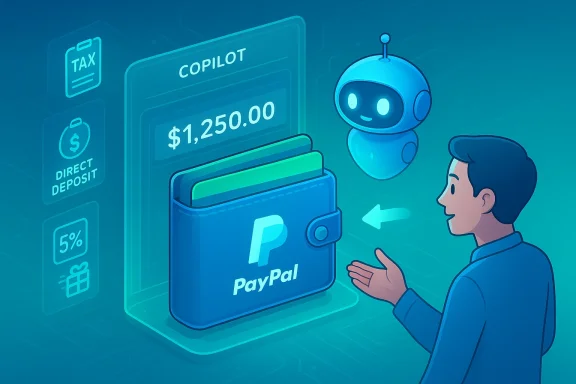
PayPal’s latest flurry of partnerships — powering Microsoft’s new Copilot Checkout, adding free DIY tax filing via April, expanding digital gift‑card cashback with Blackhawk Network, and plugging PayPal Direct Deposit into Paychex’s Flex Perks — is an unmistakable push to turn the wallet from a single-purpose checkout tool into a sticky, daily financial hub for consumers and employees alike.
PayPal’s story for investors in 2025–2026 is no longer just about processing transactions; it is about recapturing relevance in a world where AI agents, big‑tech ecosystems, banks and fintechs are all vying for the same “first‑touch” with consumers. The company entered 2026 with roughly 438 million active accounts, modest user growth but steady total payment volume (TPV) footing, and a profitability narrative that management leaned on in recent quarters to justify continued reinvestment. Total payment volume in mid‑2025 was on the order of the low‑hundreds of billions annually, and PayPal was raising guidance off stronger‑than‑expected margins and Venmo growth.
Those legacy strengths — a large account base, merchant integrations, a consumer wallet, and recognizable checkout branding — are now being leveraged to pursue two connected objectives: (1) make PayPal the payment layer inside AI shopping agents and (2) turn the wallet into the natural home for “everyday finance” features that keep money in the PayPal balance or attached products (debit cards, savings, credit) longer. The Jan 2026 announcements are explicit deployments toward both objectives.
That said, the cost side matters. Agentic commerce and embedded finance demand engineering, compliance, and marketing investment. PayPal has signaled continued reinvestment (product development, partnerships, promotional subsidies) which has been a point of concern among some holders. The balance for investors is clear: accept near‑term pressure on free cash flow for optionality on longer‑term monetization.
Additionally, AI agents surface more consumer data. How PayPal uses, stores, and monetizes that data — and whether consumers or regulators push back — is a material risk to the thesis.
Key economic dynamics to watch:
That said, the move from promise to durable profit requires several moving parts to succeed simultaneously: merchant willingness to let agents mediate discovery and checkout, consumer comfort placing pay and refunds into PayPal, and disciplined promotional economics that build habits instead of draining margins. The January announcements broaden the possible upside of the PayPal story, but they do not eliminate the execution, competitive, and regulatory risks that already shape the company’s valuation debate.
For patient investors willing to give PayPal time to convert integrations into measurable revenue and margin improvements, these developments offer credible optionality — particularly if PayPal can demonstrate sustainable increases in branded checkout TPV, wallet balances, and transactions per account. For shorter‑term or risk‑averse investors, the new initiatives are interesting strategic signals but not yet concrete proof the company will materially re‑rate.
In short: the Copilot Checkout and everyday finance integrations reshape PayPal’s narrative from a payments interstitial to a potential hub of AI‑enabled commerce and embedded finance — but the payoff depends on execution, competitive dynamics, and regulatory navigation.
Source: simplywall.st Should PayPal’s AI Shopping and Everyday Finance Integrations Reshape the Core Story for PayPal (PYPL) Investors? - Simply Wall St News
 Background
PayPal’s story for investors in 2025–2026 is no longer just about processing transactions; it is about recapturing relevance in a world where AI agents, big‑tech ecosystems, banks and fintechs are all vying for the same “first‑touch” with consumers. The company entered 2026 with roughly 438 million active accounts, modest user growth but steady total payment volume (TPV) footing, and a profitability narrative that management leaned on in recent quarters to justify continued reinvestment. Total payment volume in mid‑2025 was on the order of the low‑hundreds of billions annually, and PayPal was raising guidance off stronger‑than‑expected margins and Venmo growth.Those legacy strengths — a large account base, merchant integrations, a consumer wallet, and recognizable checkout branding — are now being leveraged to pursue two connected objectives: (1) make PayPal the payment layer inside AI shopping agents and (2) turn the wallet into the natural home for “everyday finance” features that keep money in the PayPal balance or attached products (debit cards, savings, credit) longer. The Jan 2026 announcements are explicit deployments toward both objectives.
What PayPal announced (January 2026): the short list
Copilot Checkout with Microsoft (Jan 8, 2026)
- PayPal will support Microsoft’s new Copilot Checkout, enabling discovery, comparison and purchase inside Copilot without redirecting users to merchant sites.
- PayPal’s role includes surfacing merchant inventory, powering branded checkout flows, enabling guest checkout and facilitating card payments — starting with Copilot.com and with plans to extend to other Copilot surfaces.
- Early rollout merchants include large consumer brands and marketplaces; Microsoft’s data cited early conversion lifts for Copilot journeys (figures published by the companies show significant short‑term conversion improvements, though those are company‑provided metrics).
Free DIY tax filing with april (Jan 20, 2026)
- PayPal added an embedded tax‑filing service for U.S. PayPal Debit Mastercard holders using april’s tax engine.
- The service includes document upload, AI‑assisted chat help, and a guaranteed maximum refund claim from the tax vendor; PayPal highlights potential time savings and refunds arriving into PayPal balances, with options to route returns to PayPal Savings.
Blackhawk Network / Giftcards.com expansion (Jan 20, 2026)
- Blackhawk’s Giftcards.com began offering PayPal wallet payments with an opt‑in 5% cashback promotion for digital gift‑card purchases through PayPal.
- The collaboration underscores wallet discovery as a channel for category‑specific offers and drives incremental revenue and engagement through promotional economics.
Paychex Flex Perks integration (Jan 8, 2026)
- Paychex added PayPal Direct Deposit as a benefit in its employee perks marketplace, enabling employees of Paychex customers to route payroll into PayPal and, in many cases, receive pay up to two days early.
- This is explicitly aimed at unbanked or underbanked workers and expands PayPal’s distribution points for payroll funding — a classic "bring more pay into the wallet" play.
Why these moves matter strategically
From checkout button to daily financial hub
For years PayPal’s core public narrative oscillated between “checkout partner” and “consumer finance app.” The new announcements make that pivot explicit and coordinated. Rather than rely solely on merchants to embed a PayPal button at checkout, PayPal is now:- Embedding itself in AI agents that are becoming the new starting point for product discovery.
- Offering financial utilities (taxes, payroll, savings) that increase balance activity and product cross‑sell opportunities.
- Using promotional economics (cashback on gift cards) to reinforce habit formation.
The AI angle: why Copilot Checkout is significant
AI agents are emerging as high‑intent shopping touchpoints. When a user asks an agent to find, compare, and buy a product, the agent becomes a one‑stop buying funnel. If PayPal can be the default payment layer inside those agents, it can capture:- Higher conversion rates from intent‑led interactions.
- First‑party signals about consumer purchase intent and preferences.
- Incremental TPV that might not otherwise route through traditional web checkouts.
Financial implications for investors
Near term: modest revenue lift, higher reinvestment
These partnerships are not likely to move line‑item revenue materially in the immediate quarters. Integrations require onboarding, merchant activations, and adoption cycles. Expect incremental TPV and processing revenue over time rather than a one‑quarter windfall.That said, the cost side matters. Agentic commerce and embedded finance demand engineering, compliance, and marketing investment. PayPal has signaled continued reinvestment (product development, partnerships, promotional subsidies) which has been a point of concern among some holders. The balance for investors is clear: accept near‑term pressure on free cash flow for optionality on longer‑term monetization.
Medium to long term: monetization levers
PayPal’s potential pathways to monetize these integrations include:- Increasing branded checkout take rates on agentic purchases, where PayPal can earn a higher margin per transaction than unbranded processing alternatives.
- Driving PayPal Balance and card funding to increase interest income, interchange, and cross‑sell into savings and credit products.
- Offering merchant services (store sync, agentic commerce tools) that command subscription or integration fees.
- Selling promotions/offer placements (e.g., gift‑card cashback) and taking a cut of promotional economics.
Competition and counterweights
Big‑tech and payments rivals
PayPal is not alone in this fight. Microsoft, OpenAI, Google and others are building agentic shopping experiences and will offer multiple payments partners. Stripe, Shopify, and incumbents like Visa/Mastercard also have deep merchant relationships and are competinging to be the preferred payment method inside AI agents. The differences will come down to:- Merchant and platform integrations (ease of onboarding).
- Flexibility on funds flows and merchant economics.
- Trust and fraud mitigation capabilities.
Regulatory and privacy risk
Pushing into payroll, tax filing, and deposit alternatives increases regulatory scrutiny. Embedded tax services and direct deposit products engage banks and federal/state tax rules. PayPal must maintain compliance across money‑transmission laws, consumer finance regulations, and tax filing oversight. Any misstep could cause reputational and financial costs.Additionally, AI agents surface more consumer data. How PayPal uses, stores, and monetizes that data — and whether consumers or regulators push back — is a material risk to the thesis.
Economics of promotions
Offers like 5% cashback on gift cards are effective short‑term drivers of wallet usage but are expensive. Sustaining promotional economics without degrading margin requires careful calibration; long‑term value depends on whether customers retain balances and continue to transact beyond promotional windows.Assessing the claims: what is verified and what requires caution
- PayPal’s role powering Microsoft’s Copilot Checkout rollout and the timing (January 8, 2026) is a confirmed corporate announcement. The integration covers inventory surfacing, branded checkout and payment facilitation inside Copilot’s shopping experience.
- PayPal’s april tax filing partnership (announced Jan 20, 2026) is live for PayPal Debit Mastercard users in the U.S., offering free DIY federal and state filing in certain circumstances and the possibility to receive refunds into PayPal balances.
- Blackhawk Network’s Giftcards.com promotion offering 5% cashback when purchasing with PayPal is an announced collaboration occurring in mid‑January 2026.
- Paychex’s inclusion of PayPal Direct Deposit in Paychex Flex Perks was announced in early January 2026 and includes the ability for employees to receive pay up to two days early via PayPal balances.
A closer look at the “agentic commerce” economics
Agentic commerce — AI agents sourcing products, negotiating prices and executing purchases on behalf of users — changes where value accrues. Historically, the value chain looked like: discovery → merchant site → checkout → payment processor. AI agents collapse discovery and checkout into a single interaction. That compresses friction and increases the opportunity for payment providers that are embedded in the agent to capture wallet share.Key economic dynamics to watch:
- Conversion uplift: Agents can increase short‑term conversion, particularly for long‑tail searches and complex purchases. If PayPal is the default payment, it gets incremental TPV.
- Customer lifetime value (LTV): If agents deposit refunds or payroll into PayPal and users keep balances, PayPal can earn interest, interchange and cross‑sell.
- Merchant economics: Merchants will evaluate whether agentic channels cannibalize existing channels or open net new demand. Their willingness to pay for agentic integrations (or accept PayPal branding inside the agent) will determine rates and take fees.
- Platform openness: Agentic ecosystems that are open and allow multiple payment rails favor interoperability; closed ecosystems favor platform owners. PayPal’s strategy to support multiple agentic protocols intent on openness can help scale usage.
What the moves mean for PayPal’s investment narrative
For bullish investors
- The January integrations are evidence PayPal is pivoting from a transactional checkout play to an embedded financial platform with more daily relevance.
- Being first or early in agentic commerce (Copilot, ChatGPT, others) could give PayPal durable payment share inside high‑intent flows.
- Payroll and tax features broaden distribution and create natural balance holdings that can be monetized.
For cautious investors
- Execution risk is material: merchant uptake, retention of deposit inflows, and the economics of offers must prove out.
- Reinvestment is real; capital will be spent on partnerships and product development before revenue accrues commensurately.
- Competitive fragmentation (multiple payment partners inside agents) could cap take rates and compress margins.
Signals investors should watch next (operational KPIs)
Investors should track product‑level and financial KPIs to assess whether these integrations reshape growth sustainably:- Branded checkout take rate and TPV through Copilot and other AI agents (month‑over‑month adoption).
- Incremental active accounts and transactions per active account attributable to payroll, tax filing and gift‑card promotions.
- Net new balance inflows and average PayPal balance per active account (do refunds and paychecks stay in wallet?.
- Merchant sign‑ups for agentic commerce tools and store sync adoption rates.
- Marketing/promotional spend as a percent of gross margin and the durability of cashback users after promotions expire.
- Regulatory or compliance actions tied to tax or payroll integrations.
- Gross margin and transaction margin dollars, which historically have been better indicators of PayPal’s value capture than raw revenue.
Scenario analysis: conservative, base, aggressive
- Conservative
- Slow merchant adoption inside AI agents; branded checkout share remains modest.
- Promotional economics attract short‑term engagement but low retention.
- Result: flat TPV growth, modest margin pressure from reinvestment, neutral to modest share price performance.
- Base
- Steady merchant onboarding, PayPal wins prominent placement inside multiple AI agents.
- Payroll and tax integrations increase balance inflow modestly; average balances rise and interchange income grows.
- Result: mid‑single digit revenue uplift over 2–3 years, improved monetization, stock re‑rating as execution becomes visible.
- Aggressive
- Rapid, broad adoption of agentic commerce with PayPal as a dominant payments provider in multiple major AI agents.
- Payroll and tax integrations convert into sticky balance holdings and cross‑sell into savings & credit at scale.
- Result: materially higher TPV and revenue take, substantial margin expansion — this is the upside scenario that justifies the longer valuation range some bulls envision.
Risks that could derail the thesis
- Merchant pushback against agentic intermediaries who might erode brand control; merchants could favor payments partners that provide better economics or data access.
- Regulatory scrutiny on payroll and tax products, particularly as embedded finance grows into areas requiring banking licenses or consumer protection oversight.
- Data and privacy backlash if consumers perceive AI shopping experiences as invasive or if data sharing causes reputational harm.
- Competitive contracting: If big cloud or commerce platforms favor other payment processors, PayPal could be sidelined in key agentic ecosystems.
- Pricing pressure: A commoditized payments layer inside AI agents could compress take rates and reduce gross margins.
Tactical investor checklist
- Watch the cadence of merchant onboarding in Copilot and other agents (which merchants, how many, which verticals).
- Monitor PayPal’s quarterly disclosures for product‑level growth: branded checkout TPV, PayPal Balance growth, debit/card metrics, and guidance on reinvestment.
- Track user retention to promotional events (e.g., gift‑card cashback) and whether those users increase long‑term transactions per account.
- Evaluate regulatory headlines tied to payroll and tax services — early regulatory pushback can slow rollouts.
- Reassess valuation expectations based on realized margin impact and transaction margin dollars rather than headline user counts.
Conclusion
PayPal’s January 2026 integration wave is strategically coherent: it stitches payments into AI‑led discovery, folds routine financial tasks into the wallet, and uses promotional mechanics to accelerate engagement. For investors, these are not flimsy marketing stunts — they are targeted attempts to expand both the frequency and economic value of PayPal relationships.That said, the move from promise to durable profit requires several moving parts to succeed simultaneously: merchant willingness to let agents mediate discovery and checkout, consumer comfort placing pay and refunds into PayPal, and disciplined promotional economics that build habits instead of draining margins. The January announcements broaden the possible upside of the PayPal story, but they do not eliminate the execution, competitive, and regulatory risks that already shape the company’s valuation debate.
For patient investors willing to give PayPal time to convert integrations into measurable revenue and margin improvements, these developments offer credible optionality — particularly if PayPal can demonstrate sustainable increases in branded checkout TPV, wallet balances, and transactions per account. For shorter‑term or risk‑averse investors, the new initiatives are interesting strategic signals but not yet concrete proof the company will materially re‑rate.
In short: the Copilot Checkout and everyday finance integrations reshape PayPal’s narrative from a payments interstitial to a potential hub of AI‑enabled commerce and embedded finance — but the payoff depends on execution, competitive dynamics, and regulatory navigation.
Source: simplywall.st Should PayPal’s AI Shopping and Everyday Finance Integrations Reshape the Core Story for PayPal (PYPL) Investors? - Simply Wall St News
