

PayPal’s new tie-up with Microsoft to power Copilot Checkout marks a decisive pivot: the payments giant is doubling down on agentic AI as the lever to revive branded checkout usage and reclaim growth momentum across digital and in‑store commerce.
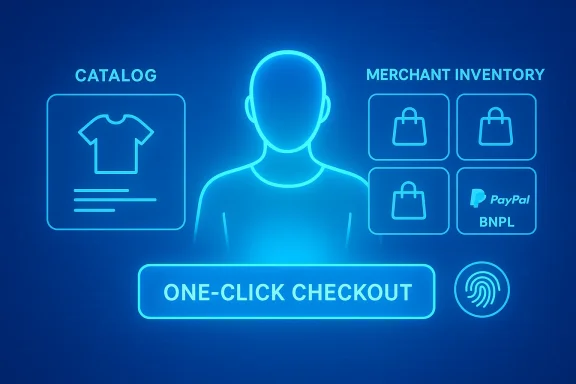
PayPal and Microsoft announced a collaboration in early January that integrates PayPal’s payment stack and PayPal’s Agentic Commerce Services with Microsoft’s Copilot Checkout, allowing shoppers to discover, compare and complete purchases without leaving the Copilot environment. The partnership covers surfacing merchant inventory, branded checkout flows, guest checkout and credit‑card payments to start with Copilot.com. The companies framed the work as creating a streamlined, end‑to‑end shopping journey supported by PayPal’s wallet and funding methods.
This move comes amid intense investor focus on PayPal’s branded checkout metric — the share of total payment volume that uses PayPal’s branded flows and experiences. Industry reporting and analyst notes point to branded experiences contributing roughly 29% of PayPal’s overall payment volume, a figure management and market watchers view as central to margin expansion and customer engagement goals. PayPal’s management has repeatedly called branded checkout its top priority as the company shifts toward higher‑quality, higher‑margin flows.
At stake is more than convenience: agentic experiences — digital agents that can research, select and buy on behalf of a consumer with minimal friction — are projected to meaningfully reshape online spend. One industry study estimated agentic AI agents could drive over $261 billion of U.S. online shopping in coming years, based on consumer willingness to delegate discovery and purchase tasks. That stat, and the broader market signal, explains why payments firms and card networks are racing to be first‑class participants in agentic commerce.
Practical adoption barriers include:
However, the partnership is not a guaranteed growth engine. Real value depends on merchant adoption, clear economics, consumer trust and PayPal’s ability to convert agentic engagements into branded payment volume at scale. Investors and industry observers should look for tangible, quantifiable signals — branded checkout growth, merchant metrics, conversion lifts and disclosure of economics — before recalibrating expectations. Until those data points appear, Copilot Checkout is an important strategic positioning play that reduces strategic risk but does not yet eliminate execution risk.
PayPal’s move into agentic commerce shows the payment industry’s recognition that the next wave of checkout is not just faster forms or cleaner UX — it’s about being the payment partner inside AI agents that shop, decide and pay for consumers. Success will require not just technology, but an ecosystem of merchant onboarding, regulatory alignment and consumer trust. The coming quarters will reveal whether PayPal’s agentic gambit converts product positioning into measurable branded checkout recovery.
Source: American Banker PayPal turns to AI to boost branded checkout
 Background
PayPal and Microsoft announced a collaboration in early January that integrates PayPal’s payment stack and PayPal’s Agentic Commerce Services with Microsoft’s Copilot Checkout, allowing shoppers to discover, compare and complete purchases without leaving the Copilot environment. The partnership covers surfacing merchant inventory, branded checkout flows, guest checkout and credit‑card payments to start with Copilot.com. The companies framed the work as creating a streamlined, end‑to‑end shopping journey supported by PayPal’s wallet and funding methods. This move comes amid intense investor focus on PayPal’s branded checkout metric — the share of total payment volume that uses PayPal’s branded flows and experiences. Industry reporting and analyst notes point to branded experiences contributing roughly 29% of PayPal’s overall payment volume, a figure management and market watchers view as central to margin expansion and customer engagement goals. PayPal’s management has repeatedly called branded checkout its top priority as the company shifts toward higher‑quality, higher‑margin flows.
At stake is more than convenience: agentic experiences — digital agents that can research, select and buy on behalf of a consumer with minimal friction — are projected to meaningfully reshape online spend. One industry study estimated agentic AI agents could drive over $261 billion of U.S. online shopping in coming years, based on consumer willingness to delegate discovery and purchase tasks. That stat, and the broader market signal, explains why payments firms and card networks are racing to be first‑class participants in agentic commerce.
What “agentic commerce” means for payments
Defining the concept
Agentic commerce is an evolution of conversational and recommendation AI: instead of merely helping, an AI agent proactively completes multi‑step tasks for a consumer — from finding products that match preferences to arranging delivery and executing the payment. These agents operate across discovery, product matching, fulfillment and payments with little or no human prompting. Mastercard, Visa, Google and others have publicly described similar initiatives to create standards and tooling for agentic interactions.Why payments matter in the agentic stack
Payments are the final mile of any commerce flow. For an AI agent to act on a consumer’s behalf, it needs:- A trusted payment credential and wallet integration
- A low‑friction, authenticated checkout that minimizes interruptions
- Funding‑method flexibility (cards, bank rails, BNPL, wallets)
- Protection services (fraud detection, dispute handling, seller/buyer trust)
The PayPal–Microsoft deal: practical mechanics and claims
PayPal’s press materials and partner statements describe several concrete features:- PayPal will "power" the checkout experience in Copilot, including surfacing merchant inventory and enabling purchases without leaving Copilot.
- Copilot’s discovery and intent signals are intended to increase conversion by keeping shoppers in one context; PayPal will make its wallet and funding methods available to those flows. Microsoft’s internal Copilot data cited in the PayPal release claimed that Copilot journeys see materially higher conversion and faster purchase times.
- PayPal positions this work as an extension of its Agentic Commerce Services, a suite that bundles payment support, order management, store sync (product catalog ingestion), fulfillment hooks and AI‑first checkout experiences for merchants.
Why PayPal needs agentic partnerships now
PayPal’s strategic pivot to prioritize branded checkout and agentic commerce is driven by several pressures:- Branded checkout growth has decelerated from prior trends, a point flagged by analysts and in company commentary. Branded experiences remain an essential profit lever because they embed PayPal into merchant flows where PayPal can capture higher take rates, ancillary services and customer lifetime value.
- Competitive intensity is rising: card networks (Visa, Mastercard), processors (Stripe), and big tech (Apple, Google) are each pushing several vectors that threaten PayPal’s button prominence across channels. Corporations are also creating agentic protocols and tooling that could make it easier for merchants to default to different payment providers inside AI‑driven shopping.
- Market sentiment is sensitive to execution on branded checkout growth. Reporting noted PayPal’s stock had been under pressure; American Banker flagged a roughly 40% decline over a 12‑month window as a metric of investor impatience, and market watchers expect the company’s upcoming earnings call to be interpreted as a referendum on these initiatives. Whether these AI partnerships can move the needle on branded volume is therefore existential to investor confidence.
What PayPal gains — and what merchants see
From PayPal’s perspective, embedding into Copilot and similar AI surfaces potentially delivers:- Increased discovery‑to‑purchase conversion when shoppers remain inside a single AI context.
- Extended reach to high‑intention customers who rely on AI assistants for product selection.
- An opportunity to expand branded transaction share beyond web checkout to voice, chat and in‑app agentic flows.
- A way to monetize PayPal’s wallet and services (BNPL, Venmo, crypto rails where enabled) across new channels.
Competitive landscape: payments, cards, retailers and Big Tech
Agentic commerce is not a single‑player game. The following competitive dynamics matter:- Card networks and processors are already framing agentic commerce rules and tooling; Mastercard and Visa are actively positioning themselves as foundational infrastructure for secure agentic checkout. That means PayPal faces rival propositions that emphasize network reach and issuer relationships.
- Stripe and other fintech payment providers are adapting their stacks to support AI agents by exposing richer APIs, headless checkout capabilities and automated reconciliation for agentic flows. Merchants can choose where to settle payments; PayPal must offer either better economics or stickiness to win.
- Big tech platforms — notably Microsoft through Copilot, Google via its AI shopping tools, and Apple within device ecosystems — will be arbiters of agentic experiences. A payments provider that is not “first class” inside a major AI platform risks being bypassed when agents transact at scale. PayPal’s partnership with Microsoft is therefore strategic: securing a plug‑in role inside a dominant AI interface is a clear defensive and offensive play.
Technical, privacy and fraud considerations
Agentic commerce introduces new technical challenges that intersect heavily with payments:- Authentication and consent: Agents must reliably validate that the human authorized a purchase and the terms used are within that consent. That requires robust, persistent authentication (passkeys, biometrics) and clear UX to capture intent. PayPal and Microsoft both cited efforts to streamline authentication; real‑world deployment will test how frictionless and auditable these flows are.
- Data minimization and privacy: AI agents rely on context and personal preferences to act. Merchants and payment providers must avoid over‑sharing sensitive payment or identity information while still enabling frictionless purchases. The regulatory landscape in the U.S., EU and APAC — where PayPal operates — contains different thresholds for consent, profiling and cross‑border data transfer.
- Fraud and liability: The expanded attack surface of agentic shopping (voice prompts, cross‑device agents, third‑party plug‑ins) creates novel fraud vectors. Payment providers and platforms need to agree on fraud detection responsibility, chargeback policies and seller protections for AI‑initiated purchases. PayPal’s long history of buyer/seller protections is a credibility asset, but those programs will be stress‑tested by autonomous agents.
Consumer adoption: appetite and limitations
Consumer surveys suggest meaningful interest in delegating discovery to AI, but the payment step remains more conservative. Worldpay’s international survey of 8,000 consumers found that Americans were among the most receptive: 44% overall said they would let an AI assistant browse on their behalf and 59% of 18–34‑year‑olds expressed comfort with such delegation. The study extrapolated a sizable future spend through AI agents — the oft‑cited $261 billion figure — but emphasized adoption will depend on trust, transparency and clear value.Practical adoption barriers include:
- Consumer comfort with an AI making purchase decisions without explicit step‑by‑step human confirmation.
- Fear of incorrect purchases, returns friction, and disputes when an agent acts for a consumer.
- The need for clear agent behavior — how it prioritizes brands, discounts, or affiliate relationships — which affects perceived impartiality and trust.
Financial and investor implications
The Microsoft tie‑up is a product and distribution story, but investors will treat it as an execution variable on the branded checkout thesis.- Short term: The deal alone is unlikely to produce immediate, material topline lift. PayPal’s press release and partner statements highlighted product readiness and merchant benefits but did not disclose incremental revenue forecasts or settlement economics. Management has previously warned that investments in omnichannel and AI could produce near‑term headwinds even as they set up future upside.
- Near term signals to watch (and investors will monitor):
- Branded checkout growth rates on the next earnings report and guidance revisions. Analysts had flagged the risk that branded TPV growth could slow further, creating a tough optics environment for the stock.
- Merchant adoption metrics: number of merchants onboarded to agentic commerce services and early conversion lift statistics from pilot partners.
- Purported conversion win‑rates inside Copilot and early revenue attribution (what portion of Copilot purchases settle via PayPal vs alternative methods).
Regulatory and policy risk
Agentic commerce sits at the intersection of payments regulation, consumer protection, and AI policy. Several regulatory issues are likely to surface:- Transparent agent behavior: Regulators could require disclosures when an AI agent prioritizes merchants due to commercial relationships, creating disclosure obligations analogous to current advertising and affiliate rules.
- Liability and redress: Determining who is responsible for erroneous or fraudulent purchases initiated by an agent — the platform, the payment provider, or the merchant — will require contractual clarity and possibly regulatory mandates.
- Cross‑border data flows and KYC: Autonomous agents that transact internationally will trigger KYC/AML checks that typically require human oversight; automation of these checks may face legal scrutiny.
Risks and open questions
While the partnership is strategically logical, several risks could blunt its impact:- Economics and split: If Copilot Checkout routes traffic but PayPal’s effective take for agentic purchases is low (e.g., merchants prefer other providers or negotiation yields slimmer economics), the partnership may boost volume without improving margins.
- Merchant adoption speed: The benefit to PayPal hinges on merchants enabling store sync and product catalog ingestion. Friction in merchant onboarding or slow plug‑in adoption will delay measurable branded volume gains.
- Consumer trust and intent mismatch: Consumers comfortable with AI discovery may still prefer explicit, human‑driven payment confirmation. Until agents earn trust at scale, payments inside agentic flows could lag discovery adoption, creating a temporal disconnect between usage and monetization.
- Competitive displacement: Apple, Google and card networks can exert their own influence over agentic commerce standards and may favor rival payment solutions. PayPal’s role will depend on whether AI platforms incentivize or default to particular payment rails.
What to watch next: a checklist
- Quarterly branded‑checkout growth and guidance: whether PayPal reports acceleration or further softness in branded TPV on its next earnings call.
- Merchant onboarding cadence for Copilot integrations and early conversion lift case studies PayPal can quantify.
- Product rollout timeline: whether Copilot Checkout expands beyond Copilot.com to other contexts (mobile app, Edge browser, enterprise Copilots).
- Any disclosure of settlement economics or revenue‑share arrangements between Microsoft, PayPal and participating merchants.
- Competitive maneuvers from Apple, Google, Visa and Mastercard on agentic commerce standards or wallet integrations.
Conclusion
PayPal’s integration with Microsoft Copilot Checkout is a strategically sensible bet on the future of commerce: an attempt to embed PayPal’s wallet into next‑generation, AI‑driven shopping flows where discovery and payment converge. The partnership leverages PayPal’s strengths — a widely used digital wallet, multiple funding methods and long‑standing buyer/seller protections — and plugs them into an interface likely to host high‑intent shoppers.However, the partnership is not a guaranteed growth engine. Real value depends on merchant adoption, clear economics, consumer trust and PayPal’s ability to convert agentic engagements into branded payment volume at scale. Investors and industry observers should look for tangible, quantifiable signals — branded checkout growth, merchant metrics, conversion lifts and disclosure of economics — before recalibrating expectations. Until those data points appear, Copilot Checkout is an important strategic positioning play that reduces strategic risk but does not yet eliminate execution risk.
PayPal’s move into agentic commerce shows the payment industry’s recognition that the next wave of checkout is not just faster forms or cleaner UX — it’s about being the payment partner inside AI agents that shop, decide and pay for consumers. Success will require not just technology, but an ecosystem of merchant onboarding, regulatory alignment and consumer trust. The coming quarters will reveal whether PayPal’s agentic gambit converts product positioning into measurable branded checkout recovery.
Source: American Banker PayPal turns to AI to boost branded checkout
