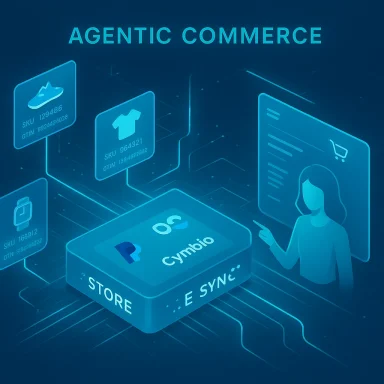
• Thread Author
PayPal’s announced agreement to acquire Tel Aviv‑based Cymbio marks a decisive step in the race to own the operational plumbing of agentic commerce—the emerging set of AI‑driven shopping surfaces where assistants discover, compare and complete purchases on behalf of consumers. The deal, disclosed on January 22, 2026, will fold Cymbio’s multi‑channel orchestration technology and team into PayPal’s Store Sync product as part of the company’s wider agentic commerce push; the transaction is expected to close in the first half of 2026 and financial terms were not disclosed.

Background​

AI assistants are changing how shoppers browse and buy. Rather than visiting a retailer’s storefront or a marketplace, many consumers increasingly rely on conversational and agentic interfaces—search agents, embedded assistants and “brand agents”—that ingest intent and return purchaseable recommendations. For those agents to operate reliably, they need canonical product records, accurate inventory and pricing, fulfillment hooks, and robust order orchestration that prevents oversells and enables dispute resolution.
PayPal’s formal entry into this space began with the public launch of its agentic commerce services in October 2025, which introduced two core primitives: Agent Ready (delegated, tokenized payment primitives and fraud protections for AI assistants) and Store Sync (catalog ingestion and order routing to make merchants discoverable to AI platforms). Those services were presented as an open, one‑to‑many approach that would allow merchants to be discoverable across multiple AI surfaces after a single integration. Cymbio, founded in 2015 and headquartered in Tel Aviv, has spent the last decade building connectors and orchestration logic that automate the painful work of catalog normalization, inventory sync, order routing and billing across marketplaces and retailers. Its capabilities are precisely what a service like Store Sync needs to scale quickly: automated schema mapping, inventory channels, fulfillment handoffs, and reconciliation. PayPal says Cymbio’s technology and people will power Store Sync and accelerate merchant reach into AI platforms.

What the deal actually says (verified facts)​

  • PayPal announced on January 22, 2026 that it has agreed to acquire Cymbio; the transaction is expected to close in the first half of 2026, subject to customary conditions. Financial terms were not disclosed.
  • PayPal describes Cymbio as a multi‑channel orchestration platform that will enable merchants to become discoverable on AI platforms including Microsoft Copilot and Perplexity, with support for OpenAI’s ChatGPT and Google’s Gemini expected in the future.
  • As part of PayPal, Cymbio’s technology will support Store Sync — PayPal’s catalog and order plumbing that publishes normalized product data to AI discovery endpoints and routes orders into merchants’ existing fulfillment systems. PayPal emphasizes merchants will remain merchant of record and keep control of brand and customer relationships.
  • PayPal’s agentic commerce stack and Copilot Checkout collaborations are already live with Microsoft’s Copilot and with Perplexity; PayPal previously signaled that Copilot Checkout and Store Sync pilots are part of an immediate commercialization pathway.
These are the load‑bearing facts that shape the commercial and technical analysis below. Where the company makes future‑oriented claims—such as “enable tens of millions of merchants”—treat them as product projections rather than hard, verifiable outcomes at the moment of announcement.

Why PayPal is buying Cymbio: strategic rationale​

PayPal’s acquisition is a clear “own the stack” play. The logic is straightforward and defensible:
  • Faster merchant enablement: Cymbio’s prebuilt connectors, mapping rules and marketplace expertise shorten the time it takes for merchants to be agent‑ready across multiple AI platforms. That reduces friction for PayPal’s Store Sync rollout and unlocks one‑to‑many merchant reach quickly.
  • Capture upstream discovery: Owning the orchestration layer means PayPal does not have to be merely the checkout button—its payments, fraud systems and buyer protections can be embedded into moments of intent upstream in the customer journey.
  • Operational control for reliability: Agentic checkout depends on canonical product records and reliable fulfillment. Cymbio brings the operational automation (inventory sync, dropship logic, order orchestration) that reduces the risk of stale data, oversells and escalations—problems that would otherwise undermine AI shopping experiences.
  • Network effects and merchant lock‑in: The more merchants PayPal makes discoverable across Copilot, Perplexity, ChatGPT and Gemini, the more transaction volume and first‑party data it can capture—strengthening PayPal’s commercial value to merchants.
These strengths explain why a payments infrastructure company would buy a narrow but critical orchestration capability rather than attempting to build it from scratch.

How the integration is likely to work (technical overview)​

At a high level, PayPal will fold Cymbio’s ingestion, mapping and orchestration layers into Store Sync. The practical flow will look like this:
  1. Merchant connects a PIM/ERP/commerce platform to Store Sync (now augmented with Cymbio connectors).
  2. Cymbio’s ingestion layer normalizes product attributes (SKUs, GTINs, variants, rich attributes, images, shipping windows and return policies).
  3. Normalized records are published to AI discovery endpoints with provenance metadata (merchant‑of‑record, timestamps, fulfillment SLA).
  4. When an AI agent initiates an order, Store Sync routes the order into the merchant’s existing fulfillment or ERP/WMS, preserving original fulfillment logic and merchant relationships.
  5. PayPal’s delegated/tokenized checkout (Agent Ready / Copilot Checkout) completes payment and fraud mitigation without exposing raw card data to the conversational agent surface.
This integration model preserves merchant‑side fulfillment control while letting PayPal capture the transaction and associated payment services.

Who wins and who should worry​

Winners​

  • Mid‑market and enterprise merchants that lack the engineering bandwidth to build their own connectors will benefit from faster time‑to‑market and operational automation.
  • Merchants already using PayPal’s merchant services stand to gain low‑friction access to AI discovery channels through a single integration.
  • PayPal gains a durable position in the upstream funnel of AI commerce and extends its payments moat into agentic surfaces.

Entities that should evaluate their exposure​

  • Third‑party integrators and middleware providers that compete with orchestration platforms may face consolidation pressure as PayPal internalizes Cymbio’s capabilities.
  • AI platform owners (OpenAI, Google, Microsoft, Perplexity) will need to guard against single‑provider lock‑in while balancing partnerships that reduce friction for merchants.
  • Regulators and privacy advocates should scrutinize the concentration of product, inventory and buyer metadata in a small set of intermediaries.

Key strengths and notable positives​

  • Speed to scale: Acquiring a decade‑old orchestration platform accelerates Store Sync onboarding for many merchants, reducing integration costs and engineering cycles.
  • Operational completeness: Cymbio’s existing orchestration capabilities (inventory sync, feeds normalization, order routing, marketplace billing) are the exact operational glue needed for reliable agentic commerce.
  • Trust layer coupling: PayPal’s buyer protection, fraud systems and payments scale combine with orchestration to build a trustable agentic checkout experience—an advantage when consumer confidence matters.
  • One‑to‑many value proposition: Merchants can potentially integrate once and be discoverable across multiple AI agents, making the proposition simple and attractive for resource‑constrained retailers.

Risks, execution challenges and open questions​

The acquisition is strategically sensible but not risk‑free. Major risks include:
  • Vendor lock‑in and pricing opacity. PayPal did not disclose deal terms, and the post‑close pricing model for Store Sync (now powered by Cymbio) is unknown. Merchants must watch for changes to commercial terms—especially fees or restrictive contracts that could erode margins.
  • Data governance and privacy. Agentic commerce involves routing product, inventory and potentially customer signals across multiple platforms. Clear contractual commitments on data usage, retention, portability and provenance are essential. Without them, merchants risk ceding valuable behavioral and product telemetry to intermediaries.
  • Operational integration risk. Consolidating Cymbio into PayPal’s systems is nontrivial: preserving Cymbio’s connectors, minimizing latency, maintaining mapping fidelity across thousands of SKUs and ensuring orders reliably reach merchant ERPs will require months of disciplined engineering and strong SLAs.
  • Fraud and dispute complexity. Agentic flows introduce new edge cases (multi‑channel returns, dropship failures, ambiguous agent‑initiated cancellations) that increase fraud surface and dispute workload. PayPal’s fraud systems will be tested at scale in unfamiliar patterns.
  • Competitive and regulatory pressure. Large platforms (Amazon), payments rivals (Stripe, Adyen), and AI platform owners might respond with competing offers, preferred integrations, or regulatory challenges if the market perceives undue concentration of commerce orchestration and payment control.
All of these risks are manageable, but success will depend on execution speed, transparent commercial terms, strong operational KPIs, and proactive governance.

Practical advice for merchants and IT leaders​

Merchants planning to pilot or adopt Store Sync (with Cymbio under the hood) should follow a disciplined approach to avoid surprises:
  • Start with a pilot: run a limited rollout on a controlled SKU subset to measure conversion lift, fulfillment reliability, return rates and dispute incidence.
  • Prioritize product data hygiene: canonical SKUs, GTINs, complete attribute sets, high‑quality images, and accurate shipping dimensions are the foundation of agentic discoverability.
  • Instrument for AgentOps: implement agent‑specific telemetry and observability (indexing health, latency, mismatch rates, fulfillment handoffs) to detect and resolve issues early.
  • Negotiate contractual protections:
    • Clear SLAs for catalog indexing latency and inventory sync.
    • Data portability and portability clauses to prevent lock‑in.
    • Responsibility matrices for disputes and fraud claims across PayPal, the AI platform and the merchant.
  • Maintain multi‑channel parity: don’t put all eggs in one discovery basket. Keep direct‑to‑consumer experiences and marketplace channels active while experimenting with agentic surfaces.
  • Audit flows for edge cases: returns, BNPL interactions, dropship cancellations and cross‑border tax/settlement implications must be documented and tested.
Numbered checklist for pilots:
  1. Select 100–500 SKUs representative of category, price and fulfillment complexity.
  2. Map PIM fields to PayPal/Cymbio schema; fix missing or ambiguous attributes.
  3. Run an inventory parity test for 30 days and log mismatches.
  4. Enable Store Sync in a staging AI endpoint and simulate agent checkouts.
  5. Measure conversion delta, fulfillment accuracy, return rates and dispute volumes.
  6. Decide on scale‑up after passing SLA and business KPI thresholds.

Regulatory and market oversight implications​

The consolidation of discovery orchestration and payments under one provider raises legitimate policy questions. When a single company controls the pathway from product indexability to payment settlement, several regulatory angles warrant attention:
  • Antitrust and market concentration. If PayPal becomes the de‑facto gateway that routes merchant catalogs into AI platforms, regulators may examine whether that structure disadvantages alternative providers or creates discriminatory distribution.
  • Data protection and cross‑border flows. Catalog and order metadata will likely traverse jurisdictions; merchants and platforms must ensure compliance with regional privacy regimes and contractual limits on reuse or retention.
  • Consumer protection and liability. With AI agents mediating recommendations and checkouts, regulators will want clarity on liability when an AI provides incorrect information that leads to consumer harm or financial loss.
These are not immediate blockers, but they are factors that will influence how quickly and widely agentic commerce scales.

Competitive landscape and likely responses​

PayPal’s move is an accelerant, not an exclusive lock. Expect several market reactions:
  • AI platform owners (OpenAI, Google) could push for more neutral or multi‑vendor orchestration layers to minimize single‑provider dependency.
  • Payments rivals (Stripe, Adyen) may accelerate their own agentic payments capabilities or pursue partnerships with orchestration platforms and commerce middleware.
  • Commerce platforms (Shopify, BigCommerce, Wix) may deepen integrations with multiple orchestration partners to preserve merchant choice and compete on simplicity and economics.
  • Marketplaces (Amazon, eBay) that control demand may double down on their own assistant integrations and seller tools, bypassing third‑party orchestration where possible.
The net effect will be faster feature development, competing commercial models, and a stronger emphasis on open standards for catalog schemas, provenance metadata and agent interoperability.

What to watch next (near‑term milestones)​

  • Completion of the Cymbio acquisition (close window: first half of 2026) and public disclosures about integration timelines and product roadmaps.
  • Post‑acquisition pricing and contract terms for Store Sync: whether PayPal will bundle, tier, or charge per‑catalog SKU or per‑transaction.
  • Measurable operational KPIs: catalog freshness, inventory parity rates, fulfillment latency, dispute incidence after agentic checkouts scale.
  • AI platform expansions: when OpenAI’s ChatGPT and Google’s Gemini integrations go live with Store Sync and whether those platforms require alternate technical approaches.
  • Merchant adoption signals: which categories and merchant segments show durable lift from agentic discovery.

Final analysis: a sensible bet with conditional payoff​

PayPal’s acquisition of Cymbio is a pragmatic and strategically coherent move: it stitches an orchestration engine to PayPal’s payments and trust infrastructure at precisely the point where agentic discovery meets transaction settlement. The combination addresses real operational gaps—catalog normalization, inventory parity, order orchestration—that would otherwise slow merchant participation in AI‑driven shopping surfaces.
The upside is tangible: faster merchant enablement, stronger network effects, and a deeper commercial role inside the moments where purchase intent is formed. The success conditions are operational and contractual rather than conceptual: measurable improvements in catalog accuracy, robust inventory synchronization, low dispute rates, transparent pricing and clear data governance will determine whether merchants and platforms treat Store Sync as a utility or a risky dependency.
This is not a guaranteed win. Execution risk, pricing strategy, data governance, and competitive or regulatory responses will shape outcomes. For merchants, the prudent approach is deliberate experimentation: pilot, instrument, negotiate protections, and preserve multi‑channel parity.
PayPal has placed a clear strategic bet—owning the “plumbing” that makes agentic commerce reliable. If it executes with discipline and transparency, merchants and consumers could gain a more frictionless and trustworthy path to buy on AI platforms; if not, the deal could become an early example of the dangers of concentrating the discovery‑to‑payment stack in the hands of a few intermediaries.
What the market is seeing now is an early blueprint for AI shopping architected with commerce reliability in mind. The next 6–18 months will show whether the blueprint becomes the default pattern across AI platforms—or whether alternative architectures and standards will emerge to preserve choice, interoperability and merchant control.

Source: FintechNewsSG PayPal to Acquire Cymbio in AI Agentic Commerce Push - Fintech Singapore

 

PayPal’sales agreement to acquire Cymbio marks a decisive bet on “agentic commerce” — the fast-emerging market where AI assistants discover, compare and complete purchases on behalf of consumers — and accelerates PayPal’s effort to make millions of merchants discoverable and transactable across AI platforms.

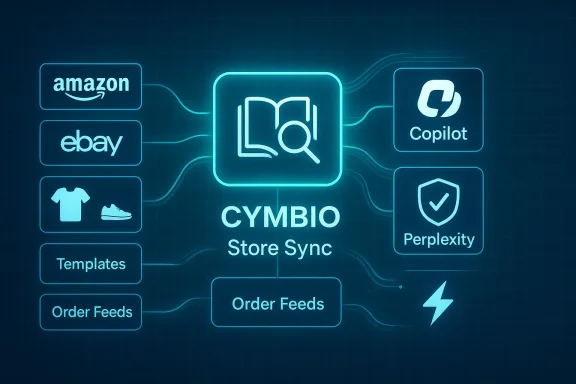
CYMBIO Store Sync diagram linking Amazon, eBay, templates, order feeds with Copilot and Perplexity.Background​

Agentic commerce describes a shift from human-led shopping journeys to interactions where autonomous or semi-autonomous AI agents execute parts of the shopping workflow: discovery, comparison, negotiation and checkout. Analysts and consultancies have framed this as a potentially enormous new channel for retail, with McKinsey estimating the U.S. B2C retail opportunity at up to $900 billion–$1 trillion by 2030 and a global agentic commerce window in the multi-trillion-dollar range. These are projections, not guarantees, but they help explain why payments companies and orchestration platforms are racing to build the technical rails for agent-enabled shopping. PayPal’s own journey into this space began publicly in October 2025 when the company announced its agentic commerce services — a bundle of merchant-facing capabilities including Store Sync (catalog and order sync) and Agent Ready (agent-enabled payment readiness). The platform approach emphasizes one integration that can make a merchant discoverable across many AI surfaces while retaining merchant-of-record status and brand control. PayPal has since partnered with Wix, Logicbroker and others to scale merchant onboarding and applied Store Sync pilots with recognized retailers. Cymbio, founded in 2015 and headquartered in Tel Aviv, is a multi-channel commerce orchestration platform that helps brands connect catalogs and workflows to marketplaces, retailers and, more recently, AI shopping surfaces. PayPal previously invested in Cymbio through PayPal Ventures in 2022, making this acquisition a logical deepening of an existing relationship. The acquisition is expected to close in the first half of 2026; PayPal has not disclosed financial terms.

Deal details and immediate effects​

What PayPal announced​

  • PayPal said it has agreed to acquire Cymbio and will fold Cymbio’s team and technology into PayPal’s agentic commerce stack to power Store Sync and related services. The deal is subject to customary closing conditions and is targeted to close in H1 2026. Financial terms were not disclosed.

What Cymbio brings​

  • Multi-channel orchestration: A decade of experience connecting product catalogs and drop-ship/marketplace workflows to hundreds of retail endpoints and marketplaces.
  • Integration plumbing: Connectors, mapping logic, and operational automation that convert merchant data models into channel-ready feeds and fulfillment workflows.
  • Customer base and references: Cymbio’s platform is used by notable brands and retailers; PayPal highlighted brands already live with Store Sync on AI channels, including Abercrombie & Fitch, Fabletics, Ashley Furniture, Newegg and Adorama.

Immediate product-level impact​

  • Cymbio will be deployed to scale Store Sync — PayPal’s catalog-to-AI pipeline — so more merchants can quickly become discoverable within AI surfaces like Microsoft Copilot and Perplexity today and, later, in ChatGPT and Google’s Gemini. The integration promises to drop orders into existing merchant fulfillment and management systems while preserving merchants’ ownership of customer relationships.

Technical deep dive: how Store Sync and Cymbio fit together​

What Store Sync is trying to solve​

At scale, agentic commerce requires consistent, structured, and trusted product data that AI systems can interpret and present to end users. Store Sync aims to accept merchants’ catalog, inventory, pricing, and fulfillment rules and translate them into formats consumable by LLM-driven discovery and agent interfaces.
Key capabilities:
  • Data normalization and enrichment (attributes, images, descriptions)
  • Inventory and pricing synchronization
  • Order routing into merchant OMS/WMS/ERP systems
  • Identity and fraud protections tied to PayPal’s payments stack
  • Merchant-of-record model to preserve brand and customer ownership
PayPal’s October 28, 2025 product release spelled out these exact priorities — emphasizing one-to-many compatibility so a single integration makes merchants visible across multiple AI shopping surfaces.

Where Cymbio plugs in​

Cymbio’s orchestration engine already performs multi-marketplace normalization and operational automation: mapping product attributes, managing drop-ship relationships, and bridging catalogue feeds to diverse retailers. In PayPal’s architecture, Cymbio accelerates Store Sync onboarding by:
  • Shortening integration time with pre-built connectors and mapping templates
  • Automating catalog transformation between merchant systems and AI channel schemas
  • Handling order orchestration, status updates and returns flows back into merchant systems
  • Scaling onboarding for tens of millions of small and medium merchants without bespoke engineering work on each AI endpoint.

Protocols, APIs and the wider technical stack​

Agentic commerce is not one monolithic standard yet — the ecosystem includes competing and complementary protocols: Agentic Commerce Protocols, Agent Payments Protocols (AP2/UCP), Model Context Protocols (MCP) and agent-to-agent (A2A) coordination layers. Payment networks and platform providers have prototyped agent-aware primitives for authentication, mandate handling, and cryptographic authorization to allow AI agents to act credibly on behalf of a user. PayPal’s integration strategy therefore needs to remain flexible across multiple protocol landscapes, especially as large platform players (Microsoft, Google, OpenAI) evolve their agent APIs and commerce modes.

Strategic rationale: why this deal makes sense for PayPal​

  • Scale merchant discoverability fast
  • Building and maintaining connectors at retail scale is expensive. Cymbio’s existing infrastructure short-circuits that cost and time, enabling PayPal to onboard merchants rapidly into AI channels and to offer a single integration to reach multiple AI surfaces.
  • Protect merchant relationships
  • By focusing on a model where merchants remain the merchant of record and retain control of customer communications, PayPal positions itself as a trusted bridge rather than a middleman that captures customer data and ownership. This is a merchant-friendly stance that could lower resistance to adoption.
  • Differentiate payments and risk services
  • Agentic commerce multiplies the surfaces through which transactions originate; PayPal’s fraud, identity, buyer protection and dispute tools become a competitive asset when integrated with agentic flows. Owning both the catalog orchestration and payments rails can be a powerful moat.
  • Defend and extend ecosystem partnerships
  • PayPal already powers Microsoft’s Copilot Checkout and has integrations with Perplexity and other players. Bringing Cymbio in-house consolidates the technology stack and reduces third-party dependencies for Store Sync’s expansion.

Merchant impact: benefits and practical considerations​

Benefits for merchants​

  • Faster onboarding to AI shopping platforms via turnkey connectors.
  • Broader reach as a single integration exposes catalog across multiple agentic surfaces.
  • Retained merchant-of-record status: merchants keep brand control, customer contact data, and fulfillment operations.
  • Use of PayPal’s payment protections and fraud detection across agent-initiated transactions.

Practical adoption questions​

  • Data hygiene: merchants must standardize SKUs, images, and descriptions to prevent poor AI presentation or mismatches.
  • Pricing and promotions: dynamic pricing logic, promotions and bundles must be translated into agent-friendly rules; edge cases (time-limited offers, flash sales) may behave unpredictably if agent logic isn’t carefully specified.
  • Fulfillment latency: AI agents often optimize for speed; merchants with slow fulfillment or complex shipping rules risk poor conversion metrics or order cancellations.
  • Dispute attribution: when an AI agent initiates a purchase on behalf of a consumer, liability for accidental orders, mis-specified preferences, or fraudulent requests remains legally and operationally fuzzy — merchants and payments providers must clarify who bears what risk. Some of these operational details are being addressed by payments protocols and platform agreements, but merchants should expect to negotiate and test these flows.

Competition and the broader payments landscape​

The race to own agentic commerce is both a platform and payments battle. Major technology platforms (Microsoft, Google, OpenAI) are rapidly wiring buy buttons and agent APIs into their assistants; major payment networks (Visa, Mastercard) have launched agent-aware frameworks; platform-to-platform protocol efforts (ACP, UCP, AP2) are proliferating. PayPal, by acquiring Cymbio, is trying to combine orchestration and payments to stay competitive against:
  • Payment networks and rails building agent-ready primitives (e.g., Mastercard’s Agent Pay, Visa’s Trusted Agent initiatives).
  • Stripe and other processors offering agentic-checkout SDKs and integrations.
  • Cloud and platform incumbents (Microsoft, Google, OpenAI) that can natively embed commerce into their assistant experiences.
  • Marketplaces (Amazon, Walmart) that will seek to keep agent-driven discovery anchored to their own inventories and fulfillment advantages.
This means PayPal must keep its integrations flexible, continue nurturing partnerships with platform owners, and ensure that merchants see tangible conversion and margin benefits from being discoverable on multiple agentic surfaces rather than becoming captive to a single assistant’s marketplace.

Security, privacy and regulatory risks​

Fraud and authorization​

AI agents introduce new attack surfaces: credential misuse, agent impersonation, and mandate abuse. Payments and identity layers need cryptographic proof-of-intent and user-bounded authorizations. PayPal’s agentic payments work aims to add built-in fraud and buyer protection, but the industry is still iterating on standards for automated consent and revocation.

Data privacy and profiling​

Serving accurate product recommendations and completing purchases requires sharing catalog, inventory and, in some cases, customer preference data with AI platforms. Merchants will need clear contractual controls and technical safeguards to prevent downstream profiling, data reuse, or leakage of proprietary catalog intelligence. Retaining merchant-of-record status helps, but it is not a silver bullet for privacy governance.

Consumer protection and liability​

Agentic purchases raise thorny consumer protection questions: how will regulators treat purchases made by an AI on behalf of a consumer when the result doesn’t match intent? Which party is responsible for refunds, return shipping, or mis-sold items? Payment providers, platforms and merchants will need coherent policies and disclosures; regulators may eventually define new accountability frameworks. These remain active policy areas and require careful legal design.

Operational and integration challenges​

For PayPal​

  • Integrating Cymbio’s stack without disrupting merchant-facing functions or existing partner agreements.
  • Harmonizing data models and mapping logic between Cymbio, PayPal’s Store Sync, and third-party AI platform schemas.
  • Scaling onboarding and monitoring to ensure data correctness, availability and latency across many AI surfaces.

For merchants and technology partners​

  • Ensuring inventory fidelity and real-time stock signals to prevent overselling via high-intent AI purchases.
  • Updating internal processes to accept and route agent-originated orders seamlessly into fulfillment and returns workflows.
  • Instrumenting analytics and attribution to measure AI-sourced conversions and lifetime value in order to justify programmatic investments.
These challenges are practical, solvable engineering problems, but they require investment, test-and-learn cycles and clear SLAs between merchants, orchestration platforms and AI surfaces.

What this means for developers, platform operators and WindowsForum readers​

  • Developers building e-commerce platforms, plugins or middleware should prioritize agentic readiness: API-first catalog models, robust inventory endpoints, and event-driven order accept/reject flows will be table stakes.
  • ISVs and platform operators (Wix, BigCommerce, Shopware, etc. should expect more pre-built connectors and partner programs as payment and orchestration companies race to reduce merchant friction.
  • Merchants who prepare now by improving data hygiene, streamlining fulfillment and testing agentic channels on a small scale can capture early-mover advantages, especially in categories where personalization and speed matter (fashion, electronics, home goods).
  • Security teams need to plan for agent-driven authorization flows and to incorporate cryptographic mandates or tokenized delegation models where possible.
For readers who manage Windows-hosted e-commerce stacks or operate Windows-based desktop tooling tied to back-office systems, the practical takeaway is that system integrations will become more API-driven and less human-UI bound. Ensuring your Windows-based tools can emit and consume standardized APIs and webhooks will be essential.

Risks and unanswered questions​

  • Deal economics: PayPal has not disclosed purchase price or terms; the valuation and strategic concessions remain private. That lack of transparency makes it harder to judge the long-term financial impact.
  • Protocol fragmentation: Multiple competing agentic protocols and payment frameworks increase integration complexity. If the ecosystem fragments into incompatible stacks, merchants may face vendor lock-in or duplicated integration work.
  • Regulatory uncertainty: Consumer protection, liability for autonomous purchases, and cross-border obligations are nascent regulatory domains. Future rulemaking could change the economics or compliance burden for agentic commerce.
  • Merchant appetite: Not all merchants will want to participate. Those prioritizing brand control and high-touch customer service may be wary of handing discovery to third-party assistants, even if merchants remain the merchant of record. Real-world uptake will follow proven conversion and margin lift, not vendor roadmaps alone.
Where clear verification isn’t possible — for example, the ultimate size of near-term merchant adoption or exact deal economics — these points are flagged as speculative and depend on future disclosures and market behavior.

Bottom line​

PayPal’s acquisition of Cymbio is an acquisition of operational capability: connectors, orchestration logic, and a merchant network that can accelerate Store Sync adoption across the expanding universe of AI shopping surfaces. It positions PayPal as a combined orchestration-and-payments play in the agentic commerce era, leaning into a future where AI agents — not browser search — increasingly act as consumers’ primary discovery layer.
This move strengthens PayPal’s technical and commercial positioning, but it also increases exposure to an ecosystem that is still standardizing — from protocols to regulatory guardrails — and to operational complexities that will determine whether agentic commerce becomes a durable replacement of, or a complement to, existing channels. Merchants, platforms and payments providers will need to iterate fast, prioritize data and fulfillment quality, and demand clear protections for consumers and businesses alike.
PayPal’s acquisition of Cymbio accelerates a clear market trend: the commercial internet is shifting from destination-driven shopping to intent-driven agentic discovery. For merchants prepared to adapt, that shift promises new reach and demand; for the industry, it promises a decade of technical and contractual negotiation about who controls the customer, who bears risk, and which rails will settle the trillions in expected agentic commerce flows.
Source: FinAi News PayPal to acquire Cymbio to expand agentic commerce
 

PayPal’s agreement to acquire Tel Aviv–based Cymbio marks a clear escalation in the company’s effort to own the operational plumbing of agentic commerce—the emerging architecture in which AI assistants discover, recommend and complete purchases on behalf of consumers—and will fold Cymbio’s marketplace and drop‑ship orchestration into PayPal’s Store Sync and broader agentic commerce stack.

A futuristic command center displays STORE SYNC with data dashboards and protection panels.Background​

Agentic commerce describes a shift from human‑led browsing and checkout to experiences where autonomous or semi‑autonomous AI agents perform discovery, comparison, selection and payment on behalf of end users. This model places a premium on canonical, machine‑readable product data, real‑time availability, fulfillment connectivity and auditable order provenance—capabilities that are operational rather than purely transactional. PayPal framed this move publicly when it launched its suite of agentic commerce services on October 28, 2025, introducing two headline products: Agent Ready (tokenized, delegated payment primitives and fraud protections) and Store Sync (catalog ingestion and order routing to make merchants discoverable to AI platforms). Cymbio, founded in 2015 and headquartered in Tel Aviv, built a decade of experience automating catalog syndication, marketplace listings, inventory synchronization, dropship orchestration and returns management—precisely the operational plumbing merchant‑facing AI agents require to show accurate, purchaseable options. PayPal’s January 22, 2026 announcement states it has agreed to acquire Cymbio, with the action expected to close in the first half of 2026 and financial terms undisclosed. The deal expands on a partnership that began when PayPal announced its agentic commerce initiative and had already included Cymbio as an integration partner.

What Cymbio actually does: a technical profile​

Cymbio’s platform is built to remove the manual effort of connecting brands to retailers and marketplaces at scale. Its core technical capabilities include:
  • Catalog ingestion and schema mapping: converting diverse merchant product models into standardized, channel‑ready records.
  • Real‑time inventory and price synchronization: maintaining accuracy across dozens or hundreds of downstream endpoints to avoid oversells.
  • Order orchestration and dropship support: routing accepted orders into merchant ERPs, warehouse management systems (WMS), or third‑party logistics (3PL) partners and automating the return flows.
  • Marketplace and retailer connectors: prebuilt integrations to hundreds of marketplaces and retail endpoints to accelerate channel rollouts.
  • Operational automation for pricing, promotions and reconciliation across distributed commerce partners.
Cymbio reports integration retailers and marketplaces and the capability to connect to 800+ endpoints—an operational footprint that shortens merchant time‑to‑market for new channels. The company’s customer roster includes well‑known brands and retailers in apparel, footwear and lifestyle categories. These are the precise capabilities PayPal needs to scale Store Sync from pilot to mass adoption.

Funding and corporate background​

Cymbio’s most‑reported external financing includes a $20 million Series B announced in November 2021 and a subsequent strategic investment from PayPal Ventures in March 2022. Public reporting places cumulative funding in the tens of millions—multiple outlets reference figures between $27M and $35M raised to date—while private databases show some variation in totals depending on secondary rounds and valuation updates. PayPal’s prior venture investment helps explain the relatively smooth shift from partner to acquisition target.

How Cymbio plugs into PayPal’s Agentic Stack​

At the product level, the acquisition is explicitly designed to make PayPal’s Store Sync scale. The practical flow after integration is expected to look like this:
  • Merchant connects PIM/ERP or commerce platform to PayPal’s Store Sync (augmented by Cymbio connectors).
  • Cymbio ingests merchant feeds, normalizes attributes (SKU, GTIN, titles, images, dimensions), and enriches records for agent consumption.
  • Normalized catalog entries and availability are exposed to AI discovery endpoints (for example, Microsoft Copilot, Perplexity, and soon ChatGPT/Gemini).
  • When an agent‑initiated purchase is confirmed, PayPal handles delegated tokenized payment authorization (Agent Ready), while Cymbio generates routable orders and drops them into merchant fulfillment workflows—maintaining merchand customer relationships.
  • PayPal’s payment protections, fraud detection and dispute mechanisms provide consumer assurances while Cymbio’s operational metadata preserves order provenance and returnability.
This combined stack addresses the two largest failure modes of early agentic commerce pilots: hallucinated or stale product information and breakdowns in fulfillment or returns that damage buyer trust. PayPal’s promise to keep merchant record—that is, the party responsible for fulfillment and direct customer service—is central to the commercial pitch and to merchant willingness to adopt AI channels.

Strategic rationale: Why PayPal bought Cymbio​

The logic behind the acquisition is straightforward and defensible on multiple fronts:
  • Faster merchant enablement at scale. Building and maintaining hundreds of marketplace connectors and data mapping templates is expensive. Cymbio short‑circuits that cost, allowing PayPal to offer merchants a single integration with one‑to‑many exposure across AI platforms.
  • Control of upstream discovery. Owning the orchestration layer helps PayPal move beyond being “the checkout discovery funnel where agents recommend and select products. That positioning increases PayPal’s opportunity to capture transaction flow, buyer data and post‑purchase signals.
  • Operational reliability. Agentic commerce is fragile without tight inventory and order synchronization. Cymbio’s operational automations reduce the odds of oversells, delayed shipments and contested disputes—factors that could otherwise erode trust in agent‑initiated checkouts.
  • Network effects. The more merchants PayPal can make discoverable across Copilot, Perplexity, ChatGPT and Gemini, the stronger its position to monetize transactions and ancillary services, such as data products, advertising or marketplace services.
These factors combined explain why a payments infrastructure company with global scale would invest in an orchestration engine rather than attempt to rebuild it internally from scratch.

Strengths: What PayPal gains immediately​

  • Prebuilt integrations: Cymbio’s connectors and mapping logic reduce onboarding time dramatically, enabling a faster rollout of Store Sync.
  • Proven enterprise references: Cymbio’s customer base—brands that already operate complex marketplace provides credibility when selling Store Sync to mid‑market and enterprise merchants.
  • Operational IP: Ownership of dropship rules, marketplace reconciliation, and fulfillment orchestration gives PayPal leverage over the end‑to‑end experience inside AI checkouts.
  • Payment + Orchestration bundling: Combining PayPal’s fraud controls, buyer protection and delegated payment capabilities with credible orchestration reduces friction and risk for both merchants and AI platform partners.
Together these strengths make PayPal’s agentic commerce offering materially more complete than a payments‑only integration, increasing the probability of merchant adoption at commercial scale.

Risks, execution challenges and open questions​

The acquisition does not eliminate several real and immediate risks:
  • Integration complexity. Folding Cymbio’s systems, data models and connector catalog into PayPal’s Store Sync will demand careful engineering and operational harmonization. Differences in SLAs, telemetry and error handling could create transitional failures that harm merchant trust.
  • Merchant economics and pricing. Cymbio’s services historically solved complex operational problems that can be expensive to run. How PayPal packages pricing—subscription, take‑rate, or hybrid—will affect merchant willingness to adopt and the economics of the arrangement.
  • Data governance and privacy. Exposing product metadata and inventory to AI platforms raises questions about who controls customer and behavioral data, how personalization signals are shared, and whether merchants retain exclusive access to their first‑party relationships.
  • Platform dependency and standards fragmentation. Agentic commerce is still evolving and lacks a single standard. PayPal must remain agile across competing protocols (for example, the Agentic Commerce Protocol and other emerging agent‑to‑platform primitives) to avoid lock‑in to a platform that loses momentum.
  • Competitive response. Other payments and commerce providers—including large cloud and platform players—are actively building agentic primitives and marketplace orchestration capabilities. PayPal’s head start may be short if rivals match orchestration and payments bundles quickly.
Additionally, public reporting shows the deal’s financial terms were not disclosed, while some local coverage speculates the price could be in the hundreds of millions—an estimate that should be treated as rumor until formal disclosures (SEC filings or company releases) confirm structure and price.

What merchants should do now: a practical checklist​

Merchants that intend to participate in agentic channels should begin practical preparedness now. Recommended steps:
  • Inventory and canonicalization: Audit product data (SKUs, GTINs, images, dimensions, return policy) and implement a canonical PIM or master catalog.
  • Real‑time stock telemetry: Ensure inventory systems are producing near real‑time availability feeds; agentic surfaces penalize stale stock more quickly than traditional listings.
  • Order routing and fulfillment readiness: Validate that order management systems (OMS/WMS/ERP) caiginated orders and can return consistent status updates.
  • Instrumentation and telemetry: Add observability to monitor conversion, chargebacks, shipping SLAs and agent‑origin metadata to analyze performance and support disputes.
  • Legal and data governance review: Update agreements and privacy notices to cover transactions initiated by third‑party agents and to define who owns customer communications and data.
  • Pilot and measure: Start with a tightly scoped pilot (limited SKUs, controlled dropship partners) and measure conversion lift, dispute rates and operational overhead before wider rollout.
These steps reduce operational surprises and make it easier to accept orders routed from AI assistants with confidence.

Competitive and market landscape​

PayPal is not the only company racing to secure a position in the agentic commerce stack. Large platform vendors and commerce infrastructure players are establishing their own agentic primitives and checkout rails. Notable dynamics include:
  • Platform partnerships: PayPal’s agentic commerce rollout already includes integrations with Microsoft Copilot and Perplexity, and PayPal has signaled plans to support ChatGPT and Google Gemini in the future. These relationships are central to the commercial pathway for Store Sync adoption.
  • Protocol proliferation: Multiple protocol proposals and vendor‑specific implementations exist for agent authorization, delegated payments and order provenance. This fragmentation creates both opportunities (for flexible integrators) and risks (if standards consolidate around competing players).
  • Vertical specialization: Some orchestration providers will continue to specialize in particular verticals (fashion, furniture, electronics) where unique attributes and returns logic matter. PayPal’s breadth gives it an advantage in cross‑vertical reach but may leave gaps in highly specialized flows.
In short, the market will reward speed of execution, operational robustness and clear governance models that preserve merchant control while enabling discovery on new AI surfaces.

Privacy, security and regulatory considerations​

Agent‑initiated commerce introduces nuanced privacy and security challenges beyond traditional e‑commerce:
  • Delegated payment tokens must be cryptographically bound to the agent‑merchant interaction to prevent replay or fraud. PayPal’s Agent Ready tokenized primitives aim to address this, but implementation details and cross‑platform compatibility are critical.
  • Provenance and audit trails: Regulators and platforms will demand auditable records that show what product information the agent presented at the time of purchase and what consent or preferences were in effect. Cymbio’s record linking capability is essential for dispute resolution and compliance.
  • Data minimization and retention: Merchants and platforms must define how long agent interaction metadata is stored, who may access it, and how it may be used for personalization or analytics.
  • Consumer protections: Buyers expect dispute resolution, returns and refunds to be straightforward regardless of whether a human or an agent initiated the purchase. Maintaining merchant‑of‑record status while delivering consistent protections is operationally delicate.
These are active policy and engineering problems; PayPal’s existing buyer protection and fraud stack gives it a head start, but success depends on transparent practices and robust SLAs that merchants can rely on.

Financial and strategic implications for PayPal​

Owning orchestration can move PayPal’s revenue mix beyond pure payment take‑rates. Possible monetization levers include:
  • Subscription or platform fees for Store Sync/Orchestration services.
  • Transactional fee layering for agentic checkouts.
  • Data and advertising products that monetize product discovery signals aggregated across agent platforms.
  • Increase in core payment volumes as more agent‑initiated purchases flow through PayPal rails.
Market reactions to PayPal’s broader AI commerce partnerships (for example, OpenAI and Perplexity integrations) have been measured positively in financial press coverage, reflecting investor appetite for growth tied to AI‑driven commerce channels. However, the acquisition will be judged by post‑close KPIs such as onboarding speed, fulfillment reliability, chargeback/dispute rates and conversion lift. Those metrics will determine whether this is a transformational tuck‑in or an expensiv

What to watch next​

  • Integration milestones: public roadmaps from PayPal about when Cymbio’s connectors and features will appear inside Store Sync and in which markets.
  • Pricing and SLAs: how PayPal chooses to charge merchants for orchestration and the service levels it commits to for inventory freshness and fulfillment reliability.
  • Platform breadth: which additional AI platforms and agent standards Store Sync supports beyond Copilot and Perplexity.
  • Regulatory filings: any SEC disclosure or 8‑K that clarifies purchase price, structure or contingent liabilities.
  • Early merchant metrics: conversion lift, dispute rates and operational overhead reported by pilot participants.
These signals will show whether the acquisition accelerates merchant adoption of AI channels or becomes another integration layer that creates complexity without commensurate value.

Conclusion​

PayPal’s acquisition of Cymbio is a logical and strategically coherent move to secure the operational backbone of agentic commerce. By combining PayPal’s payment, fraud and buyer‑protection capabilities with Cymbio’s catalog normalization, marketplace connectors and order orchestration, PayPal dramatically shortens the path for merchants to appear and transact within AI assistants and agentic surfaces. That technical fit is strong—and the ability to preserve merchant‑of‑record status while enabling discovery is a commercially persuasive proposition.
Execution risk remains the central question. Integrating two complex technology stacks, pricing a historically operationally expensive service, navigating protocol fragmentation, and ensuring transparent data governance will determine whether this acquisition becomes a foundational advantage or another costly integration project. For merchants, the practical path forward is clear: fortify product data, instrument operations, and run controlled pilots now. For PayPal, the next milestones to watch are integration timelines, merchant adoption metrics and the company’s public disclosures on price and SLAs—tangible evidence that the promise of agentic commerce can be turned into reliable, auditable, and profitable reality.
Source: Finovate PayPal Acquires Cymbio for Agentic Commerce Capabilities - Finovate
 

PayPal’s agreement to acquire Tel Aviv‑based Cymbio marks a decisive escalation in the race to own the operational “plumbing” of agentic commerce — the AI‑driven shopping layer where assistants discover, compare and complete purchases on behalf of consumers.

Blue neon scene of people using devices around a glowing PayPal logo with circuits.Background​

Agentic commerce describes a shift away from destination‑based shopping toward experiences where intelligent agents take on discovery, comparison and, increasingly, purchase execution for users. These agentic surfaces — embedded chat assistants, conversational search agents, and platform‑integrated copilots — require reliable, canonical product data, real‑time inventory, accurate pricing and seamless order orchestration to operate without introducing friction or consumer harm. PayPal publicly launched a suite of agentic commerce services in late 2025 centered on two primitives: Agent Ready (tokenized, delegated payment primitives with fraud protections) and Store Sync (catalog ingestion and order routing so merchants become discoverable to AI platforms).
Cymbio, founded in 2015 and headquartered in Tel Aviv, builds precisely this operational layer: catalog normalization, multi‑channel feed management, inventory parity, dropship orchestration, order routing and reconciliation. PayPal says the acquisition will fold Cymbio’s technology and team into PayPal’s Store Sync product to accelerate merchant reach into agentic surfaces such as Microsoft Copilot and Perplexity today, with OpennAI’s ChatGPT and Google Gemini integrations expected to follow. Financial terms were not disclosed and the transaction is expected to close in the first half of 2026, subject to customary closing conditions.

What PayPal bought — the pragmatic case for Cymbio​

Deep multichannel orchestration​

Cymbio is not a discovery engine or a payments processor; it is an orchestration engine. Its technical strengths include:
  • Catalog ingestion and schema mapping that convert diverse merchant product models into normalized, channel‑ready records.
  • Real‑time inventory and price synchronization to prevent oversells across downstream endpoints.
  • Order orchestration and fulfillment handoffs that drop orders into merchant ERPs, WMS, or 3PL partners.
  • Prebuilt connectors and mapping templates to many marketplaces, retailers and channels, reducing merchant onboarding time.
Those are precisely the operational gaps PayPal needed to close to scale Store Sync: without canonical product records and dependable inventory flows, agentic assistants can surface incorrect options, create failed order attempts or produce a bad buyer experience. The Cymbio acquisition therefore reads as a rational, product‑fit tuck‑in to accelerate merchant enablement for AI‑driven shopping.

Existing traction and real customers​

PayPal highlighted that Store Sync is already used by brands and merchants including Abercrombie & Fitch, Fabletics, Ashley Furniture, Newegg and Adorama — concrete proof points that underwrite PayPal’s claim of commercial readiness and the need to scale onboarding. Cymbio brings an existing merchant roster and hundreds of channel integrations that shorten time‑to‑market.

Strategic continuity: PayPal Ventures to acquisition​

This deal follows a prior strategic relationship: PayPal Ventures invested in Cymbio in 2022, and the companies collaborated on early agentic commerce pilots in 2025. That background makes this acquisition a logical deepening of a partnership rather than an entirely speculative bet.

The technical fit: how Cymbio plugs into Store Sync​

Data normalization and canonicalization​

Agentic assistants require structured, machine‑readable product metadata (attributes, GTINs, variants, dimensions, images and rich text descriptions) to perform ranking, filtering and purchase recommendation reliably. Cymbio’s normalization layer can ingest disparate merchant formats and output standardized channel schemas that AI platforms can consume — reducing the likelihood of hallucinated or incomplete product results.

Inventory parity and live availability​

Real‑time inventory is a non‑negotiable for agentic commerce. When an AI agent recommends a product and submits an order, the merchant must be confident the item is fulfillable. Cymbio’s inventory channels and real‑time sync reduce oversells and the operational churn that would otherwise erode trust in AI checkouts.

Order orchestration into merchant systems​

Store Sync must not only make products discoverable — it must also ensure orders triggered by AI agents are routed into merchants’ existing fulfillment systems intact. Cymbio’s order routing and dropship support are built to translate AI‑originated orders into formats merchants already accept, preserving merchant‑of‑record status and existing fulfillment flows.

Commercial and competitive rationale​

PayPal’s playbook with this acquisition is to become the trusted conduit between merchants and major AI platforms. The rationale includes:
  • Faster merchant enablement via Cymbio’s connectors, enabling PayPal to scale Store Sync without bespoke build work for each merchant-channel combination.
  • Capture upstream discovery and payments flows, moving beyond “checkout button” to become the interoperable payments and orchestration layer for agentic commerce.
  • Strengthen PayPal’s network effects: more merchants discoverable via PayPal increases the utility of PayPal’s agentic checkout offerings to AI platforms and vice versa.
Taken together, the acquisition is a defensible, product‑led consolidation: PayPal buys an operational capability it already depended on, shortens merchant onboarding cycles, and isolates a failure surface (catalog / fulfillment mismatch) that would otherwise limit agentic adoption.

What the announcement actually confirms — and what remains uncertain​

PayPal announced the agreement on January 22, 2026 and said the transaction is expected to close in H1 2026; financial terms and detailed closing conditions were not disclosed. The company framed the purchase as a way to accelerate Store Sync and to make merchant catalogs discoverable on AI surfaces, with immediate support for Microsoft Copilot and Perplexity and planned support for ChatGPT and Google Gemini. Those are the load‑bearing, verifiable facts; any projection about “tens of millions of merchants” or market size remains a company projection, not a realized metric.
Unanswered or partially answered items merchants and analysts should watch for include:
  • Concrete integration timelines and migration milestones for Cymbio into PayPal’s Store Sync.
  • Pricing and contract changes post‑close (per‑SKU, per‑catalog, per‑transaction or bundled tiers).
  • Service‑level agreements (SLAs) for catalog freshness, inventory parity and dispute rates.
  • Whether the acquisition triggers regulatory scrutiny in jurisdictions where PayPal and Cymbio operate, particularly around data transfers and platform competition.
Where claims cannot yet be independently verified (e.g., exact pricing, internal integration timelines or closed financials), those should be treated as forward‑looking or speculative until PayPal files formal regulatory disclosures or publishes detailed integration roadmaps.

Risks and downsides — operational, commercial and regulatory​

Concentration of discovery-to-payment rails​

One of the clearest risks is concentration: when a single commercial entity controls both the discovery plumbing and the payment rails across multiple AI platforms, merchants face potential lock‑in, and markets may lose interoperability. PayPal’s value proposition is trust and payments expertise, but consolidation raises questions about competitive access and whether alternative orchestration architectures will be disadvantaged. This is not a hypothetical — platform governance and antitrust scrutiny historically focus on dominant intermediaries when they straddle critical ecosystem layers.

Operational fragility at scale​

Agentic commerce won’t be judged on announcements — it will be judged on operational KPIs. If catalog freshness slips, inventory parity breaks or fulfillment latency rises after mass onboarding, AI agents will surface bad options, and users will lose trust. Metrics to watch post‑close include:
  • Catalog accuracy rates (attribute parity, image and description completeness).
  • Inventory parity (percentage of AI‑initiated orders that successfully fulfill).
  • Dispute, chargeback and return rates for agentic checkout flows.

Data governance and privacy​

Agentic commerce centralizes product, inventory and order signals that are commercially sensitive. Merchants will need clarity on how product data, customer data and transaction telemetry are stored, shared with AI platforms, and protected across jurisdictions — especially with cross‑border fulfillment and data residency complexities. PayPal’s global footprint and Cymbio’s Tel Aviv base complicate data transfer and compliance obligations. Clear contractual commitments and transparent privacy practices will be required.

Fraud, liability and consumer protections​

Agentic checkouts introduce novel liability questions: when an AI agent negotiates constraints, recommends substitutions, or auto‑accepts offers, who is liable for incorrect or unauthorized purchases? Payments firms and merchants must clarify liability, fraud protections and dispute resolution pathways. PayPal’s Agent Ready primitives aim to address delegated tokens and fraud protection, but the legal frameworks around autonomous purchasing decisions remain immature and may invite regulator attention.

What merchants should do now — a practical checklist​

The rise of agentic commerce is an operational problem as much as a strategic one. Merchants preparing for AI‑driven discovery and checkout should prioritize these actions:
  • Normalize product data and metadata now: ensure GTINs, variants, attributes and images are complete and machine‑readable.
  • Instrument telemetry for agentic channels: track conversion lift, fulfillment success, dispute incidence and average time‑to‑fulfill for AI‑originated orders.
  • Negotiate explicit SLAs and data governance terms with any agentic commerce provider, including rollback and remedy clauses.
  • Maintain multichannel parity: avoid exclusive dependency on a single discovery‑to‑payment provider during early pilots.
  • Pilot with clear KPIs: run small, measurable pilots, compare against web and marketplace baselines, and keep control over merchandising and pricing rules.
  • Prepare legal playbooks: define liability, substitution policies and return flows for AI‑originated transactions.

The competitive landscape and standards questions​

PayPal’s Cymbio deal is one of several recent moves by financial services and commerce players to participate in agentic commerce rails. Other firms are forming partnerships with AI platform providers and card networks to build alternative flows. The next 12–18 months will likely be shaped by:
  • Rival orchestration providers and commerce platforms that push open standards for catalog schemas, provenance metadata and agent interoperability.
  • Platform owners (AI and search companies) setting technical requirements for discoverability and payments integration that could favor one architecture or another.
  • Market pressure for transparent pricing and non‑discriminatory access to AI surfaces to prevent preferential routing.
Interoperability standards — or the absence of them — will determine whether agentic commerce converges around a small number of integrated rails controlled by large incumbents, or whether a federated, standards‑based approach enables broad merchant choice and competition.

Policy and regulatory horizon​

Agentic commerce intersects with consumer protection, data privacy and platform competition policy. Regulators will likely focus on:
  • Consumer protection: ensuring that agentic purchases are authorized, transparent and reversible where appropriate.
  • Data protection and cross‑border transfers: clarifying obligations when product, transaction and personal data flow between vendors, orchestration providers and AI platforms.
  • Competition and antitrust: examining whether integrated orchestration + payments models create barriers to entry for alternative providers or lead to discriminatory routing.
PayPal and other incumbents will need to demonstrate transparent governance, clear remedy pathways and fair access terms if they are to scale agentic commerce without inviting regulatory constraints.

Independent validation and what we can confirm​

Multiple independent outlets and aggregation services reported PayPal’s agreement to acquire Cymbio on January 22, 2026, repeatedly citing the same deal parameters: an H1 2026 close target and undisclosed financial terms. PayPal’s agentic commerce products — Agent Ready and Store Sync — predate the acquisition and have been publicly referenced in product communications from October 2025; Cymbio’s technical profile as a multi‑channel orchestration provider with marketplace connectors and order orchestration capabilities is well established in industry reporting. These converging accounts provide a consistent picture of the strategic logic behind the transaction, even as granular deal economics remain private.
Where claims are forward‑looking — such as the pace of merchant onboarding, projected conversion lifts or the scale of agentic transaction volume — they should be treated as product projections until PayPal publishes post‑close integration metrics or independent adopters publish verified results.

Bottom line​

PayPal’s acquisition of Cymbio is a pragmatic, product‑level move to own a critical operational gap in the burgeoning agentic commerce stack. By combining Cymbio’s catalog and orchestration expertise with PayPal’s payments, risk and buyer‑protection assets, the company positions itself as a one‑to‑many bridge between merchants and AI platforms — an attractive value proposition for merchants that want rapid access to agentic discovery without heavy engineering lift.
That upside is real, but conditional. Execution risk, data governance, competitive responses and regulatory scrutiny will determine whether this becomes a durable advantage or a concentrated choke point. Merchants and platform architects should prepare now: clean product data, instrument AgentOps telemetry, insist on clear SLAs, and preserve alternative channels during the early rollout. The next 6–18 months — closing and integration milestones, early post‑close KPI reporting, and AI platform adoption patterns — will determine whether PayPal’s bet becomes the default blueprint for AI‑enabled shopping or simply the opening chapter in a broader standards and competition debate.

In an era where AI assistants increasingly shape buyer intent, the race is no longer just about payments — it’s about who can reliably translate intent into fulfilled orders. PayPal’s Cymbio acquisition is the clearest evidence yet that the winner will be the organization that marries trust‑grade payments with operationally robust, standards‑aware commerce plumbing.

Source: FStech PayPal acquires agentic commerce start-up
 

PayPal’s move to acquire Tel Aviv‑based orchestration specialist Cymbio is a deliberate aand consequential pivot: the company is adding a decade‑old catalog and order‑orchestration engine to its fledgling Agentic Commerce stack as PayPal races to become the default plumbing for AI‑driven shopping experiences. The deal, announced January 22, 2026 and expected to close in the first half of 2026, folds Cymbio into PayPal’s Store Sync product with the explicit aim of making millions of merchants discoverable and shoppable inside AI assistants such as Microsoft Copilot and Perplexity today, with ChatGPT and Google Gemini listed as near‑term expansion targets.

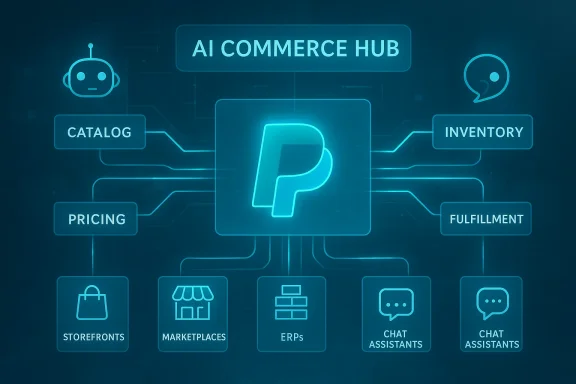
Neon blue AI commerce hub diagram linking catalog, pricing, inventory, and fulfillment.Background: why agentic commerce matters now​

Agentic commerce describes a shift from destination‑based retail (visit a store or marketplace) to intent‑driven shopping where AI agents—conversational assistants or autonomous agents—discover, evaluate and, increasingly, complete purchases on behalf of consumers. This is not incremental: it rewrites discovery, relevance and checkout, and creates a new chokepoint where payments, catalog accuracy and fulfillment orchestration must interoperate seamlessly for agents to recommend and transact reliably. McKinsey’s research frames the scale: by 2030 U.S. B2C agentic commerce alone could represent up to about $1 trillion in orchestrated revenue, with global opportunity estimates ranging into the low‑trillions.
PayPal itself introduced the commercial vocabulary and primitive building blocks late in 2025 with the public launch of its agentic commerce services—two of which are central here: Agent Ready (delegated, tokenized payments and fraud protections tailored to agent checkouts) and Store Sync (catalog ingestion and order routing that makes merchants discoverable across multiple AI surfaces after one integration). Those product announcements signaled that PayPal aims to own not just the checkout button but the entire agentic commerce flow from discovery to settlement.

What Cymbio actually brings to PayPal​

Cymbio is a multi‑channel commerce orchestration platform built to automate the tedious but mission‑critical plumbing brands need to syndicate SKUs across marketplaces, retailers and retail platforms. Its capabilities map closely to the operational problems that make agentic commerce hard to scale:
  • Catalog ingestion and normalization — mapping a merchant’s product model (SKUs, GTINs, variants, attributes) into canonical records suitable for multiple downstream endpoints.
  • Real‑time inventory and pricing synchronization — preventing oversells and ensuring the agent surface displays purchaseable options.
  • Order orchestration and dropship support — routing orders into merchant ERPs, warehouse management systems (WMS) or 3PL partners and managing returns and reconciliations.
  • Prebuilt connectors to hundreds of marketplaces and retail endpoints — accelerating merchant onboarding and reducing bespoke integration work.
Operationally, those functions are the “hard yards” that turn a product suggestion into a reliably fulfilled purchase. Cymbio’s existing customer supported integrations (the company cites hundreds of endpoints and a roster including recognizable brands) give PayPal immediate commerce‑grade capabilities it lacked at scale. PayPal’s investor announcement describes Cymbio’s fit with Store Sync and notes prior partnership activity and a prior PayPal Ventures investment, underscoring that this acquisition formalizes an existing strategic relationship.

The strategic logic: own the agentic commerce plumbing​

PayPal’s acquisition of Cymbio is best read as an “own the stack” play with four interlocking strategic rationales:
  • Faster merchant enablement: nd automation shorten the time it takes merchants to become “agent‑ready” across multiple AI platforms using PayPal’s single integration model. This accelerates Store Sync adoption and compresses PayPal’s go‑to‑market timeline.
  • Operational control and reliability: Owning an orchestration engine improves PayPal’s ability to guarantee the catalog freshness, inve provenance that AI agents require to avoid hallucinations, oversells and disputes—three failure modes that would quickly erode consumer and merchant trust.
  • Monetization and network effects: Agentic commerce opens adjacent monetization paths beyond pure interchange—premium orchestration tiers, catalogue optimization services, discovery ps. The more merchants funnel orders through PayPal‑enabled agentic surfaces, the stronger PayPal’s feedback loops for fraud, risk and conversion optimization.
  • Defensive positioning: As AI platforms build in‑chat checkout and buy buttons, payments providers must either be embedded into those flows or risk commoditization. Owning orchestration reduces PayPal’s dependence on third‑party integrators and positions it to be the integrated payments and orchestration partner for leading AI platforms.
These are convincing commercial dynamics: discovery becomes the upstream prize, and whoever controls reliable discovery‑to‑fulfillment rails will capture persistent transaction share and derivative revenue streams. Industry coverage and PayPal’s own materials make this case explicitly.

Technical mechanics: how Cymbio will power Store Sync​

At a technical level, the integration path is straightforward in concept but complex in execution. The two systems must coordinate control flows:
  • Catalog canonicalization: Cymbio transforms merchant product feeds into structured, agent‑friendly records—SKU, GTIN, dimensions, rich media, shipping windows and return policies—that Store Sync can publish to AI discovery endpoints. This canonicalization is essential to reduce hallucinations and ensure agents surface verifiable options.
  • Inventory and price parity: Cymbio’s real‑time sync prevents agents from recommending items that are out of stock or priced incorrectly. That parity is critical to avoid failed agentic purchases and chargebacks.
  • Delegated/tokenized checkout: Agentic checkouts typed payment sessions and delegated authorization so conversational surfaces never hold raw card data. PayPal’s Agent Ready primitives pair with Cymbio’s order routing to convert an accepted agent order into the merchant’s fulfillment workflow and settlement.
  • Provenance and dispute traceability: Cymbio’s record linking plus PayPal’s payment metadata create auditable trails that help assign liability, trace agent recommendations, and support disputes and chargebacks—an operational necessity for regulators and merchants.
The hard part is discipline: PayPal must deliver SLA guarantees around catalog freshness, fulfillment latency and dispute windows. Early pilots with recognized brands such as Abercrombie & Fitch, Fabletics and Ashley Furniture are cited as proof points, but enterprise‑grade SLAs depend on rigorous post‑close integration work.

Market and regulatory context: opportunities and headwinds​

The macro picture for agentic commerce is large but contested. Beyond McKinsey’s $900B–$1T U.S. B2C projection and global multi‑trillion estimates, multiple financial institutions and consultancies predict substantial but varied outcomes: More analysts put a meaningful near‑term upside on agentic shoppers in specific verticals (groceries, consumables), and IBM and others highlight rapid adoption signals alongside major integration and governance challenges. These independent perspectives converge on two themes: market is enormous, and the principal barriers are operational reliability, consumer trust and regulatory clarity.
Key regulatory and policy risks to monitor:
  • Consumer protection and liability for autonomous purchases: As agents act on behalf of consumers, rules around informed consent, refunds and liability attribution are nascent and likely to evolve quickly. Payments firms embedded in agentic flows could cause burdens.
  • Data privacy and data governance: Agentic discovery increases cross‑party data flows among merchants, orchestration layers, payments providers and AI platforms. Clear contractual limits and transparent governance will be needed to manage privacy and antitrust exposure.
  • Platform governance and standards: If dominant AI platforms impose preferential routing, proprietary schemas or closed protocols, PayPal’s orchestration advantage could be blunted unless it participates in standards efforts and secures platform partnerships.
  • Merchant backlash and lock‑in concerns: Merchants that value brand presentation or direct‑to‑consumer experiences may resist giving discovery control to AI intermediaries, particularly if orchestration becomes monetized aggressively. PayPal must demonstrate conversion lift and preserve merchant control to avoid resistance.

Financial and market reaction: valuation, sentiment and a note of caution​

News coverage places PayPal’s transaction value in an estimated range—industry commentary suggested low hundreds of millions—but PayPal has not disclosed terms, and that figure should be treated as an unverified market estimate pending regulatory filings or an SEC Form 8‑K disclosure. Independent reporting confirms the lack of disclosed financial terms. Any price estimate is therefore speculative.
PayPal’s stock narrative matters to this deal. The company had shown a mixed-but‑improving fundamental picture through late 2025: Q3 FY2025 results posted revenue growth and an EPS beat (Zacks reported an earnings surprise of roughly +12.6%), which PayPal used to underscore product progress. Market participants remain split on forward momentum: some see value—Investing.com referenced a forward P/E in the low‑teens—while a plura maintained cautious ratings, reflecting skepticism about PayPal’s ability to materially reaccelerate growth. These valuation and sentiment datapoints help explain why PayPal is pursuing inorganic engineering to reignite merchant distribution and new structural revenue lines.
It’s important to flag unverifiable or variable claims here: specific analyst tallies (for example, the AD HOC piece noting 24 Hold vs 12 Buy) reflect snapshots from distinct datange quickly; these figures should be treated as indicative but not definitive unless you reference a specific analyst consensus tracker at the moment of interest. Similarly, any single‑day share price or moving‑average position is ephemeral; investors should consult live market data for curr.

Execution risks: what could go wrong​

PayPal’s strategic rationale is solid, but execution risk is high. The acquisition reduces a technical gap, yet the real test is operational excellence at scale. Key hazards include:
  • Integration complexity and brittle synchronizations: Real‑time inventory and price sync across thousands of merchants and hundreds of endpointsle. Even brief mismatches create customer friction and chargebacks that damage trust. PayPal must invest heavily in monitoring, fallback routing and reconciliation automation.
  • Monetization vs. adoption tradeoffs: Monetizing Store Sync through aggressive pricing or pay‑for‑placement models risks merchanl need to demonstrate clear ROI—conversion lift, lower dispute costs or higher margins—to justify charges beyond basic payment processing.
  • Concentration risk and platform dependency: Owning orchestration may create favorable network effects, but it also makes PayPal a critical dependency. Platform governance or regulatory action that mandates open protocols or non‑preferential routing could erode that advantage. Active participation in staninteroperability commitments will be essential.
  • Data governance and privacy liability: The multiplication of data flows among merchants, PayPal/Cymbio and AI platforms raises privacy and compliance complexity—especially in cross‑border contlity in agent‑initiated purchases could create regulatory exposure and merchant disputes.

Merchant playbook: how brands should respond now​

For merchants considering Store Sync and agentic channels, the practical advice is conserv- Fortify product data: Clean, canonical product records (complete GTINs, accurate dimensions, consistent variant handling) are baseline requirements for agentic discoverability. PayPal/Cymbio can accelerate syndication, but the must be owned by the merchant.
  • Run controlled pilots: Start with narrow SKUs and categories to measure conversion lift, fulfillment latency impacts and dispute incidence before broad rollout. Instrument every step of the flow to capture telemetry for economic decisions.
  • Negotiate protective SLAs and data terms: Ensure contracts preserve merchant‑of‑record status, define data governance, and limit surprise liability for agent‑initiated behaviors. Consider exit and migration costs in the agreement.
  • Preserve multi‑channel parity: Avoid scenarios where agentic channel pricing or inventory diverges meaningfully from other channels unless intentional. Agentic conversions should complement—not cannibalize—existing channels.

Competitive implications and industry responses​

PayPal’s orchestration tuck‑in will likely trigger follow‑on moves by peers and partners. Expect:
  • Payments competitors to seek partnerships or acquisitions of orchestration vendors to avoid being relegated to commoditized2. AI platforms to continue opening commerce primitives—buy buttons, tokenized payments and standardized agent protocols—creating both opportunities and competition for orchestration players.
  • Standardization efforts (schemas, provenance metadata, Agent Payments Protocols) to accelerate as stakeholders negotiate liability and interoperability.
If PayPal executes reliably and sets merchant‑friendly commercial terms, the combined payments‑orchestration offering could become a default pattern. If not, alternative architectures—open proace‑driven orchestration, or merchant‑owned integrations—could preserve merchant choice and blunt PayPal’s leverage.

Verdict: a sensible, conditional bet with measurable deliverables​

PayPal’s acquisition of Cymbio is strategically coherent and product‑level sensible: it stitches a mature orchestration engine to PayPal’s payments, trust and fraud infrastructure at the precise intersection where agentic discovery becomes pay‑to‑deliver commerce. That archiwers a clear, immediate need—canonical product records, inventory parity, and order orchestration—that would otherwise impede merchant participation in agentic surfaces.
The payoff will be operational, contractual and empirical, not conceptual. The market should therefore judge the deal by measurable post‑close metrics: merchant onboarding speed, catalog freshness rates, fulfillment reliability, chargeback incidence and demonstrable conversion lift for pilot merchants. These tangible KPIs will determine whether Cymbio is a durable competitive advantage or an expensive integration that adds complexity without proportionate value.
  • Strengths: tight product fit, prior partnership and strategic investment, immediate presence on Copilot and Perplexity, and a clear roadmap to pair orchestration with PayPal’s Agent Ready payments primitives. ([investor.pypl.com](PayPal to Acquire Cymbio, Accelerating Agentic Commerce Capabilities: integration complexity, potential merchant resistance to monetization, privacy/regulatory uncertainties, and the possibility of platform governance changes that reduce preferential routing.
In short, PayPal’s Cymbio acquisition is not a moonshot; it is a pragmatic bet on owning an operational choke‑point in a potentially massive new commerce channel. The strategy is smart, but the outcome depends on execution discipline, transparent governance and credible SLAs that will persuade merchants to adopt a new mode of discovery and to trust AI agents with purchase execution. Those elements will reveal themselves over the next 6–18 months as the deal closes, integrations roll out, and live merchant telemetry becomes public.

Conclusion​

The PayPal–Cymbio deal is a clear articulation of how payments companies view their role in the AI era: transition from pure settlement rails to integrated commerce infrastructure that controls discovery, checkout, and post‑purchase reconciliation inside agentic experiences. That repositioning is precisely what the arrival of Copilot, Perplexity and other AI platforms has made possible—and in many ways inevitable. Whether the acquisition becomes a decades‑lasting competitive moat or a temporary tactical advantage will hinge on the unglamorous but decisive work of catalog management, inventory parity, SLAs and dispute management. For merchants, the path forward is practical and tactical: prepare product data, instrument experiments, and insist on contractual protections. For PayPal, the clock now runs to convert strategic intent into operational reality.

Source: AD HOC NEWS PayPal’s Strategic Bet: Acquiring AI Commerce Capabilities to Fuel Growth
 

PayPal’s agreement to acquire Tel Aviv–based Cymbio marks a decisive move to own the operational plumbing of “agentic commerce” — the emerging sand of AI-driven shopping surfaces where assistants discover, compare and complete purchases on behalf of consumers. The deal, announced January 22, 2026, will fold Cymbio’s multi‑channel orchestration technology and team into PayPal’s Store Sync product as PayPal pushes to make merchant catalogs discoverable across AI platforms; terms were not disclosed and the transaction is expected to close in the first half of 2026.

Futuristic holographic storefront for agentic commerce featuring the Cymbio module.Background​

Agentic commerce describes shopping experiences where conversational AIs and autonomous agents take on discovery, selection and purchase execution for users. Instead of browsing storefronts or marmarketplaces directly, many consumers now rely on assistants embedded in search, chat, or platform copilots to match intent, propose options and, increasingly, complete transactions. For those agents to operate reliably they need canonical, machine‑readable product records, accurate inventory, fulfillment cobble order provenance — capabilities that sit squarely in the operational layer PayPal has targeted.
PayPal publicly laid the groundwork for this strategy with its October 28, 2025 launch of agentic commerce services, including two core primitives: Agent Ready (delegated, tokenized payment primitives plus fraud protections for AI assistants) and Store Sync (a one‑to‑many catalog ingestion and order routing service). These components were designed to make merchants discoverable across AI surfaces without forcing them to rearchitect their fulfillment or payment flows.
Cymbio — founded in 2015 and headquartered in Tel Aviv — is a multichannel orchestration platform that automates the tedious work of catalog normalization, inventory sync, order routing and billing across retailers, marketplaces and social channels. The company’s platform has long specialized in converting diverse merchandise channel‑ready records and maintaining inventory parity across hundreds of endpoints, capabilities PayPal needs to scale Store Sync quickly. Public reporting places Cymbio’s footprint at hundreds of retailer and marketplace integrations (Cymbio has stated support for a global network of outlets, commonly referenced at 600–800+ retail endpoints).

What PayPal bought — the pragmatic case for Cymbio​

Core capabilities that matter​

Cymbio brings four practical capabilities that solve the immediate engineering problem for agentic commerce:
  • Catalog ingestion & schema mapping: converts merchant feeds (PIMs, ERPs, CSVs) into standardized schemas consumable by AI discovery endpoints.
  • Real‑time inventory & price sync: reduces oversell risk by keeping availability and pricing current across downstream surfaces.
  • Order orchestration & fulfillment handoffs: routes accepted orders to merchant ERPs, WMS or 3PLs while automating dropship and return workflows.
  • Prebuilt connectors & low‑code onboarding: a library ketplaces, retailers and commerce platforms that dramatically shortens time‑to‑market.
Those exact capabilities are the operational gaps that would otherwise slow PayPal’s Store Sync roll‑out. By acquiring a company whose raison d’être is automation for multi‑channel commerce, PayPal buys not just software but the tacit integration expertise — mapping rules, reconciliation logic and channel‑specific compliance — that is costly to replicate at scale.

Strategic continuity and prior ties​

PayPal’s relationship with Cymbio predates the acquisition: PayPal Ventures previously invested in Cymbio and the two companies collaborated on early agentic commerce pilots. That existing partnership smoothed the path from integrator to acquisition target, and reduces immediate integration risk because teams already know how the respective products interoperate.

How the integration likely works (technical overview)​

At a system level, expect PayPal to fold Cymbio’s ingestion, normalization and channel orchestration into Store Sync. A practical flow will look like this:
  • Merchant connects their product data source (PIM/ERP/commerce platform) to Store Sync/Cymbio.
  • Cymbio’s ingestion pipeline normalizes attributes (SKUs, GTINs, varg windows, return policies).
  • Normalized records are published to AI discovery endpoints with provenance metadata (merchant‑of‑record, timestamps, SLA).
  • When a user orders through an AI agent, Store Sync/Cymbio routes the order into the merchant’s fulfillment stack.
  • PayPal’s Agent Ready / delegated checkout tokens complete payment, fraud mitigation and settlement; PayPal retains buyer/seller protections and dispute mechanics.
This design preserves merchant control over fulfillment and returns while enabling PayPal to capture the payments and associated data flow. It’s an integration-first model: discovery and conversion are decoupled from merchant operational control, but they remain linked through robust orchestration and record tracing.

Immediate commercial and merchant implications​

Who benefits​

  • Mid‑market and enterprise merchants that lack in‑house engineering to build and maintain dozens of channel integrations will gain a faster path to AI discovery.
  • Merchants already using PayPal benefit from single‑integration onboarding into urfaces.
  • PayPal strengthens its position as a default checkout mechanism embedded into agentic surfaces and captures more upstream transaction volume and first‑party commerce signals.

Practical merchant considerations​

Merchants should evaluate these practical questions before adopting Store Sync + Cymbio flows:
  • Integration complexity: how Cymbio connectors map to the merchant’s ERP/PIM and whether bespoke mappings or middleware are required.
  • Commercial terms: any orchestration fees, revenue share, or placement charges beyond PayPal’s processing fees must be clarified.
  • Data governance: what product, inventory and order metadata are exposed to AI platforms and how consumer data is shared, retained and used.
  • Brand presentation: control over creative, merchandising rules and how product information is rendered on AI surfaces.
PayPal’s public materials stress that merchants will remain merchant of record and retain customer relationships, but the legal and operational details that matter to merchants — SLAs, dispute escalation paths, chargeback handling and data access — will require careful contractual review. Treat PayPal’s “merchant‑of‑record” statement as a baseline guarantee but expect implementation nuance at scale.

Strengths of the acquisition​

  • Time to scale: Cymbio’s connector library and mapping rules shorten onboarding time for Store Sync, et rollouts across Copilot, Perplexity, ChatGPT and Gemini as those partnerships come online.
  • Operational reliability: owning the orchestration layer reduces the likelihood of oversells, failed orders and data mismatches that trust in AI checkouts.
  • Vertical integration: PayPal now combines payments, fraud, buyer protections and orchestration — a vertically integrated stack that is harder for rivals to replicate quickly.
  • Monetization levers: beyond transaction fees, PayPal gains options for premium merchant services — catalog optimization, analytics, fulfillment financing and curated placement inside AI experiences.

Risks and open questions​

1) Operational complexity and integration risk​

Merging two platforms that must operate in near real time across hundreds of merchant systems is nontrivial. Data normalization, mapping edge cases (multi‑variant SKUs, localized tax rules, subscription products) and cross‑border fulfillment are known failure points. Any misalignment between discovery signals and real availability will quickly erode trust in agentic checkouts.

2) Merchant appetite and channel economics​

Not every merchant will want AI discovery. Brands that prioritise curated storefront experiences, luxury positioning, or tight control over customer service may be reluctant to cede discovery to third‑party agents even if they remain merchant of record. Real adoption will follow measurable conversion uplift and margin proof points, not vendor roadmaps alone.

3) Regulatory and liability exposure​

Agentic commerce raises fresh regulatory questions: who bears liability for autonomous purchases initiated by an AI agent; how consumer consent and transparency are enforced; and cross‑border compliance when agents route orders between jurisdictions. Future rulemaking could increase compliance costs or change the economics of delegated payments. These are nascent domains and a key area to watch.

4) Data concentration and antitrust attention​

Paired with PayPal’s scale — more than 400 million accounts and deep fraud tooling — owning orchestration and checkout deepens PayPal’s influence over the discovery‑to‑checkout funnel. That concentration of commercial and metadata could attract regulatory scrutiny around competition, data portability and fair access to AI platforms for rival payment providers or orchestration vendors. This is a strategic benefit, but also a long‑term regulatory risk.

5) Execution on cross‑platform support promises​

PayPal has stated Store Sync and agentic services are live on Microsoft Copilot and Perplexity and will support ChatGPT and Google Gemini. Those are product ambitions; timing and depth of integrations will determine merchant value. Statements about “enabling tens of millions of merchants” are forward‑looking projections and should be treated as aspirational until demonstrated metrics (merchant onboards, conversion lift, dispute rates) are published.

Competitive landscape​

The battle for agentic commerce plumbing isn’t PayPal’s alone. Big tech platforms (OpenAI, Google, Microsoft) are embe; card networks and payments firms are prototyping delegated payment protocols; and commerce orchestration vendors, marketplaces and PIM providers are jockeying to be the default channel layer.
PayPal’s differentiator is combining trusted payment rails, fraud protections and buyer/seller dispute mechanics with orchestration that links discovery to fulfillment without requiring merchants to lose their own systems. That vertical stack can win merchants who value operational continuity and risk mitigation. However, AI platforms may prefer diversified payment options to preserve competition and consumer choice, making interoperability standards and protocols (such as the Agentic Commerce Protocol referenced in several partnerships) an area to monitor.

What merchants and platform operators should do now​

  • Inventory readiness: audit product data quality, GTINs, high‑resolution images, shipping lead times and return policies — these are the inputs AI agents will use to rank and surface products.
  • Instrument metrics: set up conversion, cancellation, dispute and fulfillment latency metrics to measure the impact of agentic channels.
  • Contract diligence: require clear SLAs for data accuracy, incident response, chargeback handling and data portability in any Store Sync/Cymbio agreement.
  • Data minimization & privacy: insist on contract terms that limit downstream data-sharing and allow for auditability of who accesses product and customer metadata.
  • Pilot conservatively: run controlled pilots with a subset of SKUs and channels to validate uplift before full catalog syndoader implications for consumers and the market
For consumers, agentic commerce promises convenience: compressed discovery‑to‑checkout flows, more personalized results and fewer friction points for intent‑driven purchases. For merchants, the upside is access — instant discoverability across multiple AI surfaces from a single integration. For the market, this acquisition signals migration of value from destination storefronts to agentic intermediaries and the operational layer that supports them.
That said, the shift will force new commercial arrangements — who pays for placement, how returns and disputes are handled when an AI suggested the product, and how brand identity is preserved when product panels are rendered in an assistant’s voice. These legal and economic questions will shape whether agentic commerce complements existing channels or gradually displaces parts of them.

Final assessment​

PayPal’s acquisition of Cymbio is a pragmatic, well‑timed tuck‑in: it acquires the operational IP required to scale Store Sync and accelerates r AI shopping surfaces. The immediate strengths are clear — faster merchant onboarding, tighter operational integration, and broader monetization levers. However, execution risk, regulatory uncertainty and merchant appetite are significant variables that will determine the long‑term value of this bet.
Key load‑bearing facts are verifiable: PayPal announced the acquisition on January 22, 2026; Cymbio will power Store Sync; the transaction is expected to close in the first half of 2026; and financial terms were not disclosed. These points are documented in PayPal’s investor release and corroborating coverage.
For merchants preparing to engage, the recommendation is clear: treat agentic channels as a strategic experiment that requires robust product data, careful contractual protections and measurement discipline. For PayPal, the prize is real but conditional: success depends on seamless operational integration, cross‑platform adoption and regulatory clarity. The acquisition accelerates a market trend — the commercial internet is shifting from destination‑driven shopping to intent‑driven, agentic discovery — but whether PayPal’s move becomes a durable competitive moat or merely a near‑term advantage will hinge on the company’s ability to execute at scale while keeping merchants and regulators aligned.

Concluding note: where public statements project scale or future capability (for example, enabling “tens of millions” of merchants), those should be treated as company projections until independent metrics (merchant migration counts, conversion uplift figures, dispute rates post‑integration) are published. Early post‑close KPIs to watch will include merchant onboarding velocity, order failure/oversell rates, chargeback and dispute trends, and incremental GMV attributable to agentic channels.

Source: crypto.news paypal-cymbio-merchants-sell-products-ai-chatbots
 

Back
Top