

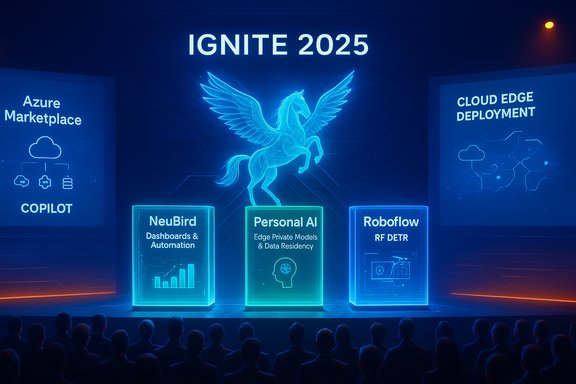
Microsoft’s partner spotlight at Ignite this year places three startups — NeuBird.ai, Personal AI, and Roboflow — center stage as practical examples of the company’s playbook: use Microsoft for Startups’ Pegasus program and marketplace integration to move experimental AI out of pilots and into production-grade enterprise deployments. The announcement frames each vendor as enterprise‑ready—with promises of faster incident resolution, private and efficient small language model (SLM) deployments, and real‑world vision AI at cloud and edge scale—yet the claims behind those promises deserve careful technical verification and commercial scrutiny. The rest of this feature examines what each company says it delivers, what independent evidence confirms, where claims remain vendor‑level assertions, and how IT leaders should validate these solutions before they touch production.
Microsoft Ignite 2025 is being used as a staging ground for a larger narrative: enterprise AI is now an assembly problem—companies will compose trusted platform primitives (Azure, Copilot, Azure AI Foundry, Entra identity, Purview governance) with vetted partner capabilities exposed through a unified Marketplace and co‑sell network. Microsoft for Startups’ Pegasus Program is repeatedly described as a selective track designed to accelerate enterprise readiness for startups by providing technical, go‑to‑market, and co‑sell resources. That positioning is an important context for why NeuBird, Personal AI, and Roboflow are highlighted: inclusion in Pegasus is being used as a proxy for “enterprise readiness,” but it is not a substitute for standard procurement diligence.
Key platform context enterprises should note:
Things to validate in procurement:
Source: The Official Microsoft Blog Turning vision into enterprise impact: Three startups to watch at Microsoft Ignite 2025 | Microsoft Bay Area Blog
 Background / Overview
Microsoft Ignite 2025 is being used as a staging ground for a larger narrative: enterprise AI is now an assembly problem—companies will compose trusted platform primitives (Azure, Copilot, Azure AI Foundry, Entra identity, Purview governance) with vetted partner capabilities exposed through a unified Marketplace and co‑sell network. Microsoft for Startups’ Pegasus Program is repeatedly described as a selective track designed to accelerate enterprise readiness for startups by providing technical, go‑to‑market, and co‑sell resources. That positioning is an important context for why NeuBird, Personal AI, and Roboflow are highlighted: inclusion in Pegasus is being used as a proxy for “enterprise readiness,” but it is not a substitute for standard procurement diligence.Key platform context enterprises should note:
- Microsoft is emphasizing discoverability and procurement via a single Marketplace (consolidating Azure Marketplace/AppSource) and an explicit AI Apps & Agents category.
- The company’s partner mechanics—co‑sell readiness, seller introductions, and technical validations—are intended to shorten buyer procurement lifecycles but require startups to meet non‑trivial security, identity, and observability requirements.
- Ignite sessions and demos will stress measurable outcomes (MTTR, inventory accuracy, edge inference latency), because enterprises now demand KPIs, auditable governance, and predictable cost models before moving to production.
NeuBird.ai — Generative AI SRE for IT operations
What NeuBird says it delivers
NeuBird positions itself as an AI‑driven Site Reliability Engineering (SRE) platform. Its flagship product, Hawkeye, ingests diagnostic telemetry and uses generative reasoning (LLM‑backed workflows) to identify, triage, and in many cases remediate operational incidents automatically, or escalate to human engineers when needed. The Microsoft blog highlights NeuBird’s placement in Pegasus and quotes company leadership on significant MTTR (mean time to resolution) reductions and operational sanity for SRE teams.Public verification and funding context
Independent reporting confirms NeuBird’s investor backing and product claims:- NeuBird announced a seed extension led by Microsoft’s venture fund M12 (reported as a $22.5M round) and coverage by major outlets documented that strategic investment. This reinforces the startup’s close integration with Microsoft channels but does not by itself validate every product metric.
- NeuBird’s corporate site and product press materials describe Hawkeye integrations (Datadog, Azure Marketplace availability) and marketing claims about MTTR reductions up to 90% in certain deployments. These customer‑facing claims are explicit vendor metrics and should be treated as referenceable but needing customer-level validation during procurement.
Technical approach and operational fit
NeuBird’s approach is typical of the new breed of “AI SRE” tools:- Read‑only telemetry ingestion of logs, metrics, traces and alerts; LLM reasoning to correlate multi‑signal incidents; automated playbook execution for known failure modes.
- Integration points mentioned include Datadog and Azure marketplaces, signaling compatibility with common enterprise monitoring stacks and Azure billing models.
- Faster triage for routine incidents by automating repetitive correlation tasks.
- A route to scale SRE coverage when hiring high‑quality engineers is hard and costly—particularly useful where cloud services are already on Azure.
- A potential reduction in noise and quicker escalation to human responders for complex cases.
- The headline MTTR reductions (eg. “up to 90%”) are vendor claims drawn from customer anecdotes or pilots; buyers must require named references and measured before/after KPIs under contract. NeuBird marketing materials state these improvements but do not substitute for a validated SLA or a pilot acceptance plan.
- LLM‑driven automation in operations introduces specific failure modes (hallucinated root causes, unsafe remediation commands). Evaluate whether Hawkeye executes changes directly or only proposes actions; prefer short‑lived credentials, approval gates, and immutable audit trails. NeuBird states read‑only telemetry access and escalation patterns, but verification is necessary.
- Require a two‑week pilot with identical production telemetry and measurable MTTR baselines.
- Insist on identity and credential model documentation (how actions are authorized, short‑lived credentials, role separation).
- Validate auditability and evidence capture (who approved an action, what logs were changed).
- Run a red‑team exercise that simulates edge‑case incidents and verifies safe failure modes.
- Confirm cloud billing model (Azure Marketplace offer, consumption vs. subscription) and FinOps predictability.
Personal AI — Small language model platform
What the Microsoft blog claims
Microsoft’s post highlights Personal AI as a Small Language Model (SLM) infrastructure vendor focused on precise, private, and programmable models for enterprise and networked deployments. The blog cites a $15M seed raise and lists enterprise customers including telcos, Salomon, and Wilson Sports — and positions Personal AI as Pegasus‑backed and ready to scale in production with Microsoft support.Verification and gaps
This is the area where public verification is mixed and must be treated cautiously:- Personal AI’s own corporate blog and press posts confirm enterprise activity, a focus on SLMs, and recent hires that signal enterprise go‑to‑market scale. Company posts note telco partnerships and enterprise case work, which aligns conceptually with Microsoft’s summary.
- However, the specific funding figure cited in Microsoft’s blog—$15 million seed led by Differential Ventures and the named investor list—was not verifiable through independent press coverage at the time of reporting. Public records (company posts and prior reporting) indicate earlier funding rounds and cumulative capital figures but do not clearly corroborate a single $15M seed announcement from an independent outlet. Where Microsoft’s blog repeats a funding figure that cannot be cross‑checked with major news outlets or filings, treat that number as a vendor claim until audited or confirmed by an independent financial disclosure.
Technical and commercial posture
Personal AI focuses on deploying small, private models closer to customers or on edge infrastructure to deliver deterministic, private experiences that do not rely on large public LLMs. That architecture is strategically appealing for regulated enterprises or telco partners that require low latency, data residency, and predictable cost models.Things to validate in procurement:
- Exact model architecture and operational footprint: how large are the SLMs (parameter counts), what hardware do they require, and are they deployable inside the customer VPC or only in a hosted model?
- Data governance and provenance: are training datasets derived from customer data, and what controls prevent leakage or model drift?
- Certification and security posture: SOC2 reports, penetration test results, and integration with enterprise identity (Azure AD) and DLP tools.
- Customer references for the named brands (Salomon, Wilson): ask for direct references and one‑pager outcome metrics tied to production deployments. As with other vendors, claims without named reference verification are insufficient for procurement.
Roboflow — Scaling vision AI for enterprise impact
What Roboflow says it offers
Roboflow’s platform is a full‑stack computer vision developer and enterprise solution that shortens the time from dataset to production model, enabling deployments across cloud and edge targets. The Microsoft blog highlights Roboflow’s RF‑DETR model and live demos showing object tracking use cases across sports broadcasting and freight—calling out examples like the US Open and BNSF Railway inventory monitoring. The pitch centers on moving from months of custom work to days with platform tooling and prebuilt pipelines.Independent confirmation
Roboflow’s own technical blog, open‑source code, and customer case studies substantiate many of the Microsoft blog’s claims:- RF‑DETR, Roboflow’s real‑time detection transformer, is published on Roboflow’s blog and available on GitHub (model checkpoints, training guides). This confirms Roboflow’s active contributions to detection architectures and a public roadmap for RF‑DETR adoption.
- Roboflow hosts a BNSF case study describing how vision AI provides real‑time yard inventory and inspection automation; the case study cites BNSF’s scale (transporting over 4.8 million carloads annually) to contextualize the scale of the deployment. Roboflow’s customer pages and industry materials also document usage in sports broadcasting (player/ball tracking) and media analysis. These customer references provide solid evidence that Roboflow has production deployments across logistics and media customers.
Technical strengths and enterprise fit
Roboflow’s platform is architected around three practical strengths for enterprise adoption:- Rapid dataset curation and augmentation tooling to produce high‑quality training sets quickly.
- Prebuilt deployment pipelines and on‑device runtimes for Windows ML and edge inference, aligning with Microsoft’s device/edge strategy.
- Open source and reproducible model releases (RF‑DETR) that let organizations audit or retrain models in‑house when needed.
- Edge vs. cloud tradeoffs: evaluate inference latency, privacy needs, and cost implications for edge + offline scenarios (e.g., Windows 11 PCs at ports or yard gates).
- Model maintenance: track how Roboflow handles dataset drift, retraining cadence, and model performance thresholds required to keep inspection/monitoring systems within SLA.
- Integration path: confirm integration with existing video management systems, camera fleets, and enterprise monitoring tools; ask for an on‑site proof‑of‑value that demonstrates both accuracy and maintainability.
Cross‑cutting themes: what Microsoft’s Pegasus framing means for buyers
Advantages of the Pegasus + Marketplace route
- Faster procurement discovery: Marketplace listings and Pegasus signaling reduce initial discovery friction for buyers who want Azure‑aligned solutions.
- Operational alignment: Startups accepted into Pegasus are more likely to have gone through technical engagements and to have templates for Azure identity, billing, and deployment patterns—shortening integration timelines.
- Go‑to‑market visibility: Microsoft seller networks and co‑sell mechanics can materially accelerate pipeline generation, which benefits startups and enterprise buyers that prefer suppliers with platform endorsement.
Practical buyer risks to mitigate
- Demo‑to‑production gap: Agentic and model‑based demos can be compelling yet brittle. Demand pilot plans with acceptance criteria and rollback strategies.
- Vendor claims vs. audited evidence: Large percentage improvements, funding claims, and customer lists are useful signals but require verification. Always request primary artifacts: SOC2 reports, named customer references, billed invoices, and Partner Center artifacts if co‑sell is promised.
- Hyperscaler dependency: Deep integration with Azure primitives reduces integration friction but increases long‑term switching costs. Factor this into TCO and contract negotiation.
How enterprise IT teams should evaluate these startups (practical checklist)
- Alignment: confirm the startup’s solution maps to an explicit business outcome (reduced MTTR, inventory accuracy %, inspection throughput) and not just a capability.
- Pilot design: require a fixed‑duration, measurable pilot with production telemetry and agreed KPIs (baseline + target improvements).
- Security & governance:
- Validate SOC2, penetration test reports, and DLP integration.
- Ensure identity binding (Azure AD integration) and short‑lived credentials for automation.
- Auditability:
- Require immutable audit trails and human‑in‑the‑loop approval for any autonomous remediation or write operations.
- FinOps & licensing:
- Obtain a clear cost model (consumption, flat fee, per‑device) and run a 12‑month forecast.
- SLA & exit:
- Negotiate SLAs aligned with business criticality, and ensure data export/portability clauses and model handover mechanics.
Conclusion — Turning vision into verifiable impact
Microsoft’s Ignite messaging makes a serious, practical claim: the next phase of enterprise AI is about assembling vetted platform primitives and partner solutions into production workflows that deliver measurable outcomes. NeuBird, Personal AI, and Roboflow each illustrate different slices of that promise—SRE automation, private SLMs, and vision AI at cloud and edge scale—but buyers should treat marketing narratives as the opening of a procurement conversation, not the contract.- NeuBird’s investor backing and product integrations are well documented; its MTTR claims are compelling but must be validated against measurable pilot data and security audits.
- Personal AI’s SLM approach is strategically sensible for privacy‑sensitive deployments; however, the specific funding figure quoted in the Microsoft blog and some customer name claims were not independently verifiable at the time of review and should be treated as vendor assertions until confirmed with named references and financial disclosures. Flag these in procurement.
- Roboflow’s RF‑DETR model and documented case studies (including BNSF) provide strong supporting evidence for real‑world viability in logistics and media; integration with Windows ML and edge runtimes makes it a practical option for enterprises that require local inference and privacy.
Source: The Official Microsoft Blog Turning vision into enterprise impact: Three startups to watch at Microsoft Ignite 2025 | Microsoft Bay Area Blog
